
Immediately after the U.S. midterm elections, technology stocks led by AI hardware in the global market tumbled, and U.S. stocks evaporated US$3.2 trillion overnight.
At the same time, rumors are spreading in the market. For example, the most frightening piece of so-called news is that the Democrats have submitted a bill that strictly prohibits the development or deployment of super artificial intelligence. Companies that violate regulations will be forcibly disbanded and their assets will be confiscated. Individuals will be sentenced to up to 20 years in prison. This is equivalent to using nuclear weapons-level felonies to deal with AI.
Will the Democratic Party really suppress the AI industry after taking office? This might be the wildest ghost story of the year. In today’s video, let’s clarify at once whether this bill is true or false, and what is the true attitude of the Democratic Party towards AI? How big will the impact be?
First of all, it should be noted that every time this happens, there will always be some exaggerated articles circulating in the market, causing panic to be seriously amplified.
For example, the bill mentioned earlier does exist, but it was submitted to the U.S. Congress in September. At that time, it didn’t even make a splash. Now, more than a month has passed, but it suddenly flooded the Internet. Don’t you think there is something obviously wrong with this?
And there are three flaws in it.
First, the super artificial intelligence defined in the proposal is not the AI we are talking about now. It refers to a super intelligence that completely surpasses humans in most fields and may deprive humans of their dominance. This is something in science fiction, but it scares many people.
Second, one of the people who proposed this bill is a radical without party affiliation, and the other is a fringe member of the Democratic Party. The bill written by such people is not the mainstream consensus of the Democratic Party.
Third, there are so many eye-catching proposals from U.S. congressmen, with tens of thousands proposed every year. Most of them are stillborn and are not even qualified to vote, so they are not worthy of attention at all.
So here comes the key question, how will the Democratic Party treat AI? Will strict restrictive policies be introduced to suppress the development of the AI industry? Let’s analyze it at both macro and micro levels.
Let’s talk about the macro first. The most fundamental support for America’s nearly century-old hegemony is technological superiority. From railways to electrification, to semiconductors, the Internet, and today’s artificial intelligence, the United States has been at the forefront of every technological revolution, allowing them to maintain a strong national power and be able to support so many aircraft carriers and military bases. Over the years, the United States has long formed a path dependence on technological leadership. This is their national foundation.
What’s more, now that the U.S.’s national power is weakening, how can we resolve the 39 trillion U.S. debt? How to solve the hollowing out of manufacturing industry? Inflation, growth, competitiveness, the only thing that is possible to open these dead knots is the explosion of productivity brought about by the take-off of AI. AI is like the last life-saving straw. It has been deeply bound to the national destiny of the United States, so it has to be held on tightly. How can it be possible for oneself to deliberately let go?
There is also a more realistic constraint here, that is, the U.S. financial system is highly related to AI. According to data from the Federal Reserve, the largest asset of U.S. residents is stocks, accounting for 34%, which is higher than real estate and bank deposits. There are also U.S. pension funds and mutual funds, all of which are heavily stocked.
AI is now the engine of the US stock market. If you suppress AI, you will suppress the US stock market, which is equivalent to robbing Americans’ money bags. No matter how bold the Democratic Party is, they will not dare to crash the US stock market.
Therefore, the positions of the two parties are highly consistent in supporting the AI industry. If you think about it, in order to maintain the U.S.’s lead in AI during the Biden era, they blocked Chinese technology and did more ruthlessly than Trump did.
Moreover, the Democratic Party is closer to Wall Street and Silicon Valley than the Republican Party. California, the home base of Silicon Valley, has been a deep blue state for decades. On the contrary, the Republican Party represents the interests of rural areas, small towns and small and medium-sized business owners. Therefore, it is impossible for the Democratic Party to suppress AI for the sake of the sponsors behind it. This is the absurdity of macro logic.
Let’s look at the micro-operation level. After the Democratic Party takes control of both houses of Congress, it is indeed possible to introduce more stringent regulatory policies for AI, but it should be noted that regulation does not mean suppression. This is mainly considered from a security perspective. It may increase the compliance costs of AI companies, but it also reduces the uncertainty risk of the industry. For leading companies, the higher the compliance threshold, the deeper the moat, which is not a bad thing for them.
On this point, the two parties do have differences in their operational thinking, but that is a difference in rhythm and approach, not an opposition in stance.
And don’t forget that although Trump has become a lame president, he has failed more than succeeded. If the Democratic Party wants to introduce a very outrageous bill, he can veto it alone. The president is not a decoration. If the federal level wants to legislate to suppress AI, it will not work at all in terms of procedures.
In fact, the places that really have an impact are the several red states that the Republican Party has lost this time. According to Goldman Sachs’ prediction, about 45% of the new data center construction in the United States will be affected due to this election, of which Texas alone accounts for 26.7%. In addition, there are also states such as Georgia and Michigan, which will also have a relatively large impact.
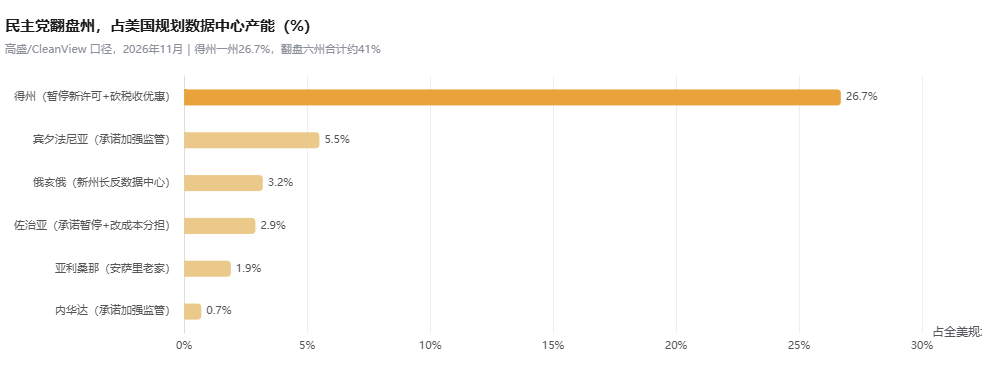
The most ironic thing about this matter is that these states are originally the strongholds of the Republican Party. Trump has spent a lot of effort in the past two years to obtain many data centers for these states. In the end, it was precisely because of these data centers that his opponents stole them.
Why is this happening?
The root cause is a problem with the distribution of benefits. In these states, data centers are being built, and local governments can take away the income from land sales, as well as GDP and long-term stable tax revenue.
However, the data center consumes a lot of electricity, and the cost of transforming the power grid has to be shared among local residents. In addition, there are also problems such as water consumption, noise, and pollution. All these disadvantages are passed on to local residents, so can this public complaint not explode?
But we must note that this kind of problem is not without room for maneuver. For example, letting AI giants bear the cost of power grid transformation and returning part of the tax revenue to the community are all effective means of changing public opinion.
To put it bluntly, this is not the original sin of the data center, but the state government’s past performance was too ugly. The newly elected governor of Texas has softened her tone. She made it clear that all approved data centers will be allowed to complete construction. It is expected that this part of the production capacity will be enough to build until 2028.
And even now, there are still many states willing to provide subsidies and tax incentives to compete for data centers. Google has just announced that it will spend $17 billion in Wyoming.
Therefore, for those computing power giants, there is nothing terrible about moving at the worst possible time. This is only a short-term disturbance to the AI industry, not a reversal of the trend.
Related Reading
- Nvidia live updates: Jensen Huang ousted, CFO Colette Kress to serve as interim CEO2026-11-13
- Are mangoes not afraid of red fruits?2026-11-12
- Original: After Huang Renxun, who is most likely to take over Nvidia?2026-11-12
- Samsung’s roll-screen mobile phone is exposed, creating a new form ahead of Huawei and Apple, and folding screens are expected to be eliminated2026-11-12
- Musk’s favorite car is going to be discontinued.2026-11-12