Produced by Huxiu Technology Group
Author|Huang Tianyuan
Editor|Miao Zhengqing
Header image|Visual China
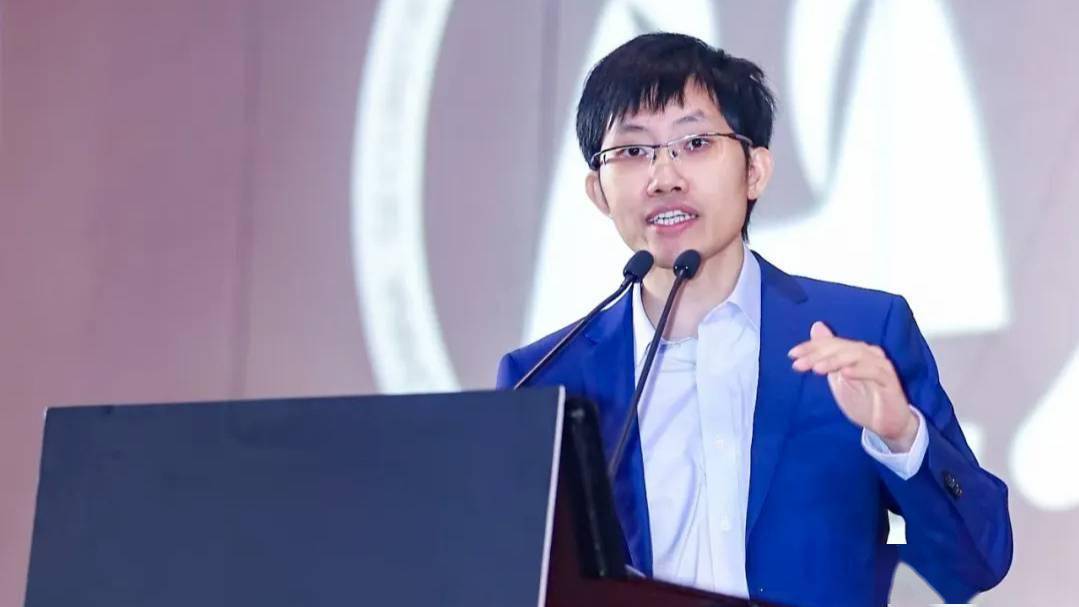
Wenfeng is open source again.
On the evening of October 31, the DeepSeek Harness team disclosed the architectural design of Super-agent and open sourced the research prototype to explore allowing Personal Agents to participate in daily work more autonomously. Currently, the public prototype is mainly for a single GitHub repository, with the option of accessing Feishu, and some designs have not yet been implemented.
What he wants to solve this time is to let the AI discover bugs on its own without anyone @ or giving instructions, and actively try to reproduce, locate and fix them in the background, and then submit a code modification request and wait for human review.
It can continuously pay attention to work group messages, collaborate across platforms, advance multiple complex tasks in parallel, reduce the human coordination burden between multiple sessions, and even run 24 hours a day.
After reading the entire architecture article, there is one thing that needs to be clarified first.
DeepSeek did not propose a new theory or a new technical route this time.Super-agent provides a systematic innovation. It applies classic computer system ideas to the Agent system, such as multi-Agent division of labor, event triggering, asynchronous execution, etc.
What it solves is that when AI can do more and more work, people are forced to switch back and forth between different tasks, becoming more and more like AI project managers, and human attention has become the bottleneck of harness.
Freeing the human brain was now a more important problem, and they wanted to solve it engineeringly.
What is the difference between DeepSeek’s Agent architecture?
For AI to continue to be involved in work, four questions need to be answered.
The first question: How to do multiple things at the same time?
Suppose the team makes three requests at the same time: fix a bug, review another piece of code, and develop a new feature. If it is all handled by the same session, it will have to constantly switch between several tasks, and if several sessions are separated, people will have to remember their own progress.
For this purpose, DeepSeek adopts a two-layer structure that separates scheduling and execution: the upper-layer Router is responsible for receiving messages, understanding the relationship between tasks, and assigning work; the lower-layer Worker is responsible for specific execution.One fixes the bug, and the other reviews the code. Each retains the background and process required to complete the task, reducing the mixing of details from different tasks.
According to DeepSeek’s public execution documentation, the prototype will establish an independent execution session and working directory for each work order. When the task is complex, the Worker can continue to call sub-Agents to help.
After the division of labor, new information must be found to find the AI that is working. For example, a Worker has submitted a PR, that is, a code modification request, and the developer then leaves a message below: “Write this part in a different way.” The system will send the opinion back to the Worker responsible for the task, and let it continue to modify it, without the need for people to reopen a session and explain the causes and consequences again.
This relies on a subscription mechanism: the task is connected to the relevant discussion, and subsequent messages are delivered along this link; requirements beyond the scope of the task are returned to the coordination layer for processing.
Of course, this division of labor is not the first of its kind. In Anthropic’s 2025 Research technical description, it was introduced that the main agent organizes multiple sub-agents to search in parallel. The focus of DeepSeek this time is to organize mechanisms such as division of labor and message follow-up, and continue to promote multiple tasks.
To reduce overhead, the architecture article also discusses merging backlogged messages and retrieving old records when needed. This not only reduces item-by-item judgments, but also avoids stuffing the entire history into the model every time.
The second question: How does the Agent know what to do if no one is dispatched?
DeepSeek introduces an event-driven mechanism so that messages in the work environment can also become the starting point of tasks. For example, if someone in the work group reports a bug, or the code automatic check fails, the system can take it into account.
But a lot of the messages are just chatter. According to GitHub’s authorization document, the prototype first uses a program to check where the message comes from, who sent it, and whether it meets the admission rules, and then lets the model determine whether it needs to start working. For tasks that no one directly requests, the team must write down the rules in advance for what is allowed.
The internal case shown by DeepSeek configures the “silent recurrence and repair” strategy.Someone in the group reports a problem. Even if there is no @AI, it can try to reproduce it in the background, find a way to fix it, confirm the problem and find a simple solution, and then submit the results.
This approach is called speculative execution: spend some computing resources trying it out first, and prepare useful results up front.
Feedback also needs to be given. According to the design principles of GitHub, after receiving a clear request, the Agent will briefly confirm it; try to be quiet during the work, and give feedback when the results are available, need someone to decide, or cannot be completed. This means that the AI can push forward a little more work without the user having to read a bunch of more progress notifications.
The third question: If you multi-task in parallel, can you still listen to people talking?
Suppose the Agent is running a time-consuming test, and you suddenly find that the requirements are wrong and you want it to adjust its direction. If it had to wait until the test ended before processing the message, it would probably continue to do the same thing as the old requirements.
DeepSeek uses asynchronous execution for this: time-consuming operations are placed in the background, and the results are sent back after completion; the session can still process new messages during this period. New requirements are processed after the current inference step ends, without waiting for background tasks to complete. Its specific method is to transfer the command to the background after running for more than 5 seconds, so that the Worker can receive messages in subsequent steps.
The fourth question: How can I continue doing this for a long time?
To continue working, the system must both remember progress and handle failures.
According to DeepSeek’s design, the computing program that drives the Agent’s work, the record that saves task progress, and the computer where the code and tools are located can be separated. For example, computing programs can be run in the cloud, with records kept separately and code remaining on the user’s original computer, with the system connecting to it when needed.
In this way, the running program can be restarted or replaced, and then the task can be restored based on the records; users do not have to move all working environments to the cloud in order to use the cloud agent. If an operation requires the use of a computer that is offline, wait until it reconnects before continuing.
However, the program is still running and may not have made effective progress. DeepSeek therefore designed an independent Watchdog, which can be understood as an additional supervision agent. It regularly checks whether other agents have malfunctioned, whether they have repeatedly tried the same invalid method, whether they have deviated from the mission goal, and try to intervene in recovery.
DeepSeek is completing capabilities beyond the model
Putting Super-agent back into DeepSeek’s recent series of actions, we can see that the company is expanding its financial reserves, replenishing computing power and talents, and pushing its model capabilities to more use scenarios.
The first is capital.
On October 30, Beijing time, The Information disclosed that DeepSeek’s second round of financing was RMB 105.5 billion, with a valuation of RMB 615.5 billion. Tencent and CATL continue to participate as major investors, and companies such as Changxin Memory, SMIC, vivo, and Meituan also appear on the investment list. Participants cover fields such as chips, terminal manufacturing and Internet services.
In addition to funding, computing and engineering capabilities are also expanding.
Bloomberg reported in September that DeepSeek plans to deploy at least 160,000 Huawei AI chips in data centers in Inner Mongolia for model inference, that is, running existing models and processing user requests.
Software adaptation is also progressing. Reuters pointed out that DeepSeek cooperated with Huawei to develop programming infrastructure for the Ascend platform, involving computing and communication libraries, and to promote super node solutions.
Another set of inputs began to extend to the robots.
Disclosure documents related to Yushu Technology’s IPO show that DeepSeek invested approximately 140.8 million yuan to participate in the strategic placement of Yushu Technology’s IPO. The two parties agreed to cooperate in the development of humanoid robot AI models and give priority to each other in terms of model training services, technical solutions and robot procurement. On October 12, DeepSeek plans to lead the seed round of financing for robotic AI startup Winverse AI.
Adjustments in personnel and organization are also supplementing execution capabilities for expansion.
On September 21, Yan Wentao, a former Hillhouse Venture Capital partner, officially joined DeepSeek as CFO.
The engineering team is also expanding. According to a report by The Paper on September 8, DeepSeek’s new round of recruitment plans to provide about 150 places, focusing on server-side development and Agent elastic computing research and development, involving research platforms, Agent frameworks, APIs and online services. Cui Tianyi, the then head of Harness, explained that the growth in data, computing tasks, Agent operating environment and user requests was requiring the team to upgrade or even rewrite the original back-end system.
The product team began to integrate.The Science and Technology Innovation Board Daily reported on October 16 that DeepSeek has integrated the Harness, Web, App and Platform teams into a product department, with Cui Tianyi as the person in charge, and is also recruiting for product design-related positions.
These changes also echo the updates of models and tools.
According to the official update log, the official version of V4 Pro updated in August emphasized Agent capabilities; V4.1 Flash released in September added native visual understanding; when updated again on October 17, the company emphasized reducing task running time and output length, and optimizing for multiple Agent platforms. Model updates began to focus on both task performance and execution overhead.
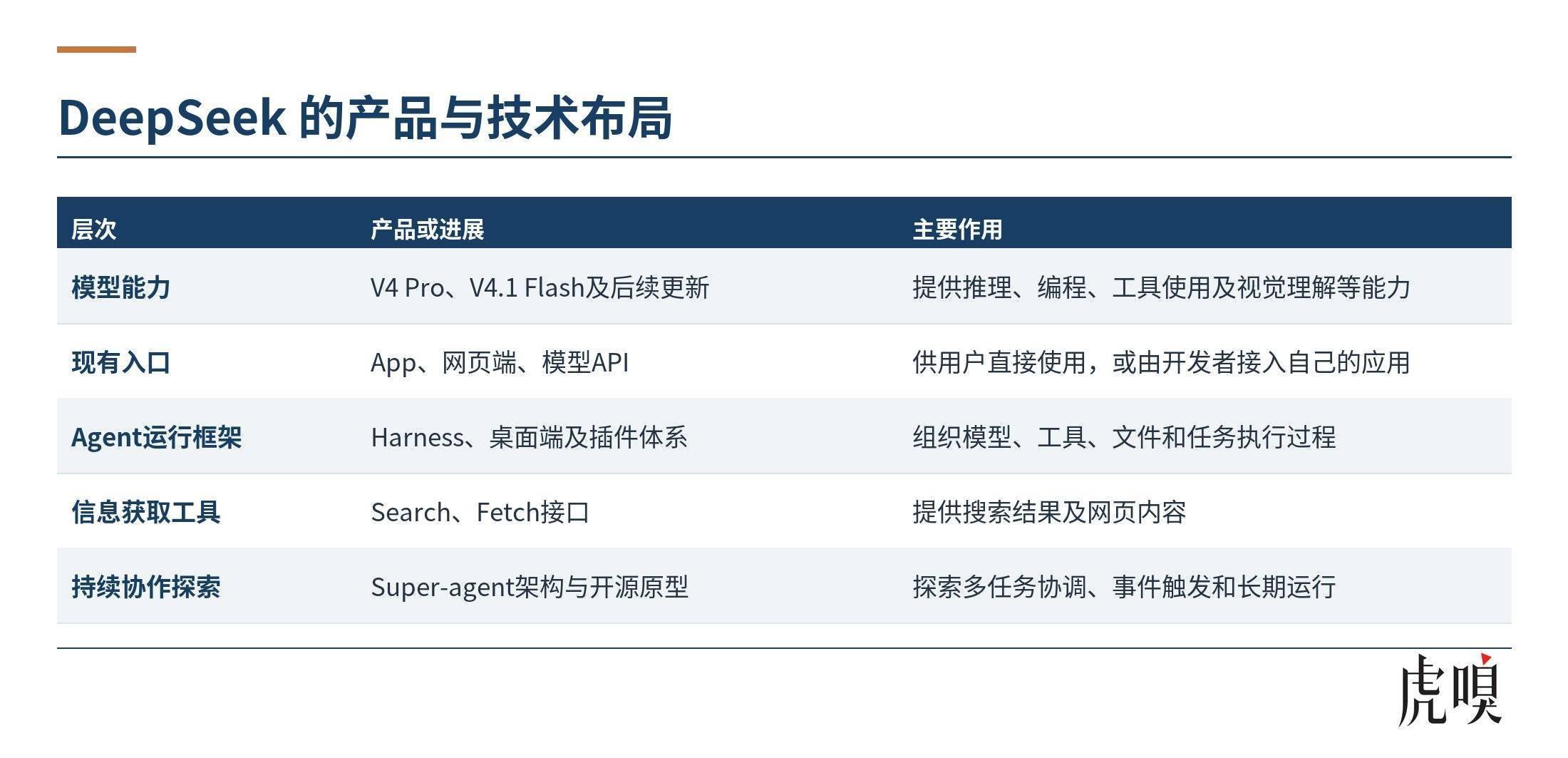
Judging from these continuous actions, DeepSeek is building a R&D and application system around the basic model. Agent is one of the directions that has been clearly promoted, and investment in robots provides opportunities for cooperation to further explore applications in the physical world.
Super-agent demonstrates DeepSeek’s vision for the next step—further efforts to reduce human attention. But this design still needs to be tested in real scenarios: whether it can stably complete the work, control operating costs, and truly save people’s time will determine how far it can go.
Related Reading
- Nvidia live updates: Jensen Huang ousted, CFO Colette Kress to serve as interim CEO2026-11-13
- Are mangoes not afraid of red fruits?2026-11-12
- Original: After Huang Renxun, who is most likely to take over Nvidia?2026-11-12
- Samsung’s roll-screen mobile phone is exposed, creating a new form ahead of Huawei and Apple, and folding screens are expected to be eliminated2026-11-12
- Musk’s favorite car is going to be discontinued.2026-11-12