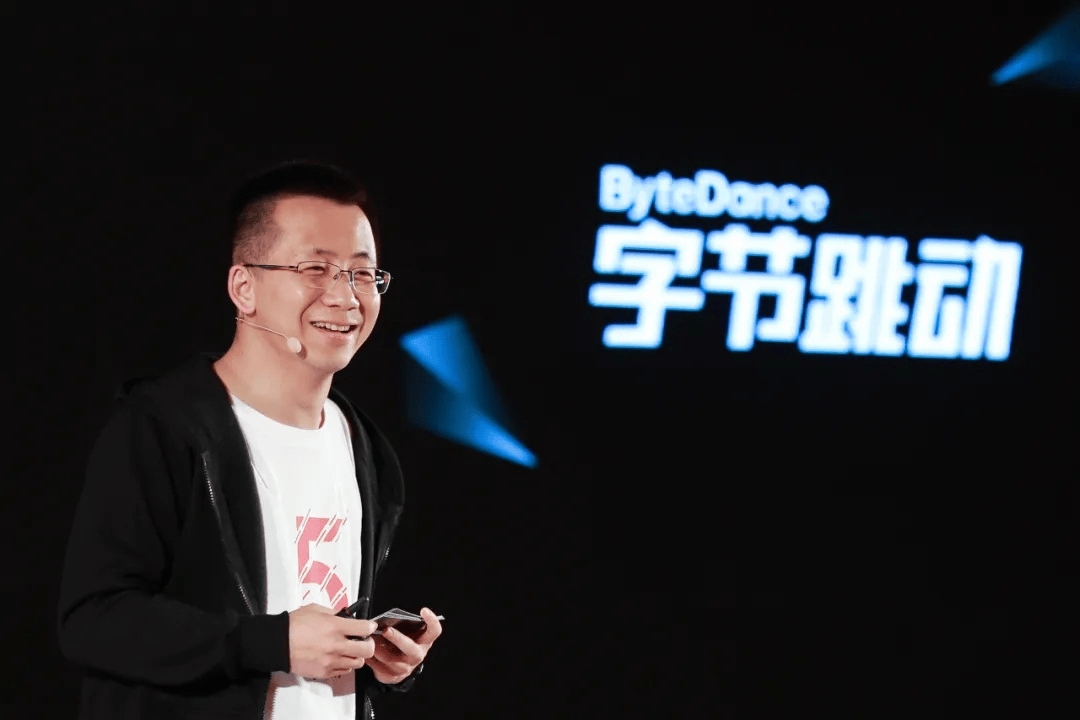
Produced by Radar Finance Written by Zhou Hui Edited by Meng Shuai
Recently, Hurun Research Institute officially released the “2026 Hurun Rich List”. After a year, ByteDance founder Zhang Yiming once again won the title of China’s richest man.
The list shows that Zhang Yiming’s latest personal wealth is as high as 670 billion yuan, an increase of 200 billion yuan from last year, setting a new wealth record for China’s richest man. At the same time, his personal net worth is only one-third short of the trillion mark.
Hurun Group Chairman and Chief Research Officer Hurun said that almost all of Zhang Yiming’s wealth comes from ByteDance. According to The Information, in the first half of this year, ByteDance’s revenue reached US$120 billion, a year-on-year increase of approximately 30%.
Behind the revenue of hundreds of billions of dollars is a huge product matrix built by Byte using algorithms. Nomura Securities quoted QuestMobile data as saying that in July 2026, ByteDance’s five applications collectively accounted for 40.9% of the time share of China’s top 50 mobile Internet applications, far exceeding the 29.1% of Tencent’s camp.
This data change quickly triggered heated discussions on the Internet. Among them, Qin Shuo, a well-known financial media person, published an article saying that China’s Internet may usher in a “byte era.”
However, Li Liang, vice president of Douyin, did not agree with this, calling the characterization “extremely imprecise” and “pure nonsense”, and said that no company has become “the xx time of China’s Internet.” The two sides immediately launched a remote debate on the topic.
Zhang Yiming became China’s richest man for the second time, only 1/3 away from a trillion-dollar fortune
On October 27, Hurun Research Institute released the “Hurun Rich List” for the 28th time. The latest list shows that a total of 1,529 entrepreneurs with personal wealth of more than 5 billion yuan are on the list this year, a year-on-year increase of 6.6%, setting a record high; the total wealth of the entrepreneurs on the list reached 32 trillion yuan, a year-on-year increase of 7%.
Among them, the title of China’s richest man, which has attracted much attention from the outside world, was won by ByteDance founder Zhang Yiming. Data shows that his personal wealth reaches 670 billion yuan, an increase of 200 billion yuan from last year, setting a new wealth record for China’s richest man.
It is worth mentioning that this is the second time that Zhang Yiming has become the richest man in China. In 2024, 41-year-old Zhang Yiming became China’s richest man for the first time with a net worth of 350 billion yuan.
The following year, Nongfu Spring founder Zhong Suisui returned to the top of the list, while Zhang Yiming dropped to second place with a wealth of 470 billion yuan.
Public information shows that Zhang Yiming was born in Longyan, Fujian in 1983. The outside world calls him the “Three Heroes of Longyan” along with Meituan founder Wang Xing and Xueqiu Fang Sanwen.
After graduating from university in 2005, Zhang Yiming formed a team to develop an IAM collaborative office system for enterprises. However, because there was not yet a sufficient market for coworking in China at that time, Zhang Yiming’s first venture failed.
Since then, Zhang Yiming has worked at Kuxun and Microsoft. In 2008, at the second invitation of fellow Wang Xing, Zhang Yiming participated in the Fanfou entrepreneurial project, known as the originator of Chinese Weibo; the following year, he co-founded Jiujiufang with Wang Qiong, an investor in Kuxun.
However, the starting point for Zhang Yiming’s sharp rise in wealth will have to wait until 2012. This year, Zhang Yiming officially founded ByteDance, a “money-attracting behemoth” that will leave many marks on China’s Internet in the future.
In 2016, thanks to the rapid development of Toutiao, Zhang Yiming appeared on the Hurun Rich List for the first time with a wealth of 2 billion yuan.
One year later, Zhang Yiming’s wealth quickly climbed to 29 billion yuan, a surge of 1,350% from the previous year, ranking 83rd on the “Hurun Rich List” that year.
Since then, Zhang Yiming’s wealth has hit new highs. Regarding Zhang Yiming’s bid to become China’s richest man for the second time this year, Hurun Group Chairman and Chief Research Officer Hurun said that almost all of Zhang Yiming’s wealth comes from ByteDance.
Hurun pointed out that with the help of Douyin, TikTok and AI assistant Doubao, the company is already one of the most valuable technology companies in the world; the progress of AI business has allowed the market to re-evaluate the company, and the valuation continues to rise, reaching 3.3 trillion yuan, and he holds more than 20% of the shares.
According to technology media The Information, citing three people familiar with the matter, ByteDance’s revenue reached US$120 billion in the first half of this year, a year-on-year increase of approximately 30%.
Among them, TikTok’s strong growth in international advertising and e-commerce revenue has played a certain role in promoting it. However, affected by increased investment in AI, ByteDance’s net profit dropped to US$20 billion in the first half of the year.
“In the next decade, China will give birth to the first batch of trillion-level entrepreneurs. Zhang Yiming’s wealth is already two-thirds away from the trillion-level threshold.” Hurun predicts that China will have three trillion-level entrepreneurs within five years, and is expected to reach 10 within ten years.
Byte family bucket, “crazy grab” user time
ByteDance’s powerful “money-attracting” ability is inseparable from its huge product matrix built through algorithms.
In the information scene, ByteDance launched Toutiao as early as August 2012. With the help of personalized recommendation engine technology, the number of users of Toutiao has increased rapidly.
By August 2016, the fourth anniversary of Toutiao’s launch, its user base had exceeded 550 million, with daily active users reaching 60 million. For the whole of 2016, Toutiao’s revenue exceeded 6 billion yuan, a year-on-year increase of approximately 5 times.
It is worth mentioning that 2016 was also a “watershed” for the short video industry. At that time, Zhang Yiming’s “All in Short Video” launched three products: Huoshan Short Video, Xigua Video, and Douyin.
Today, Byte has taken the absolute leading position in the field of short videos. QuestMobile data shows that in August 2026, the total number of users of ByteDance’s Douyin deduplication reached 1.028 billion, which is more than twice that of the second-place Kuaishou (approximately 467 million).
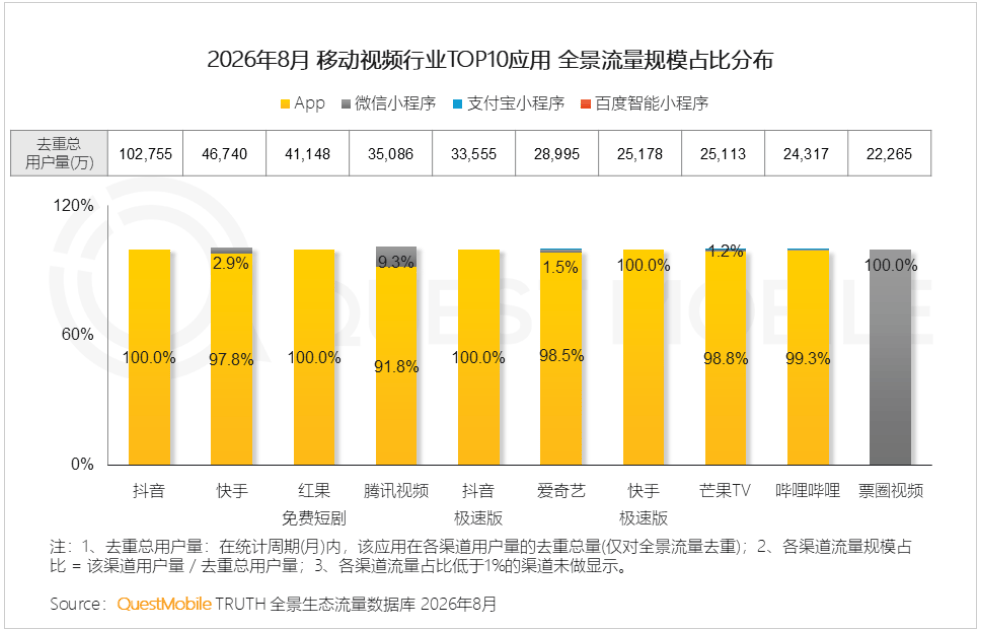
The Hongguo short drama launched by Byte in August 2023 has allowed it to successfully occupy the leading position in the field of short dramas.
The above data shows that in August this year, the total number of users of Hongguo’s free short dramas was approximately 411 million, ranking among the top three TOP10 applications in the mobile video industry, surpassing the long-established long video giants such as Tencent Video, iQiyi, and Mango TV.
In addition to the aforementioned products, Byte also has many applications such as Feishu, Jianying, and soda music. The product matrix has been further expanded to daily office, video editing, music and other scenarios.
In 2023, with the advent of the AI era, Byte has launched a new “king bomb” – AI personal assistant Doubao to compete for C-end users.
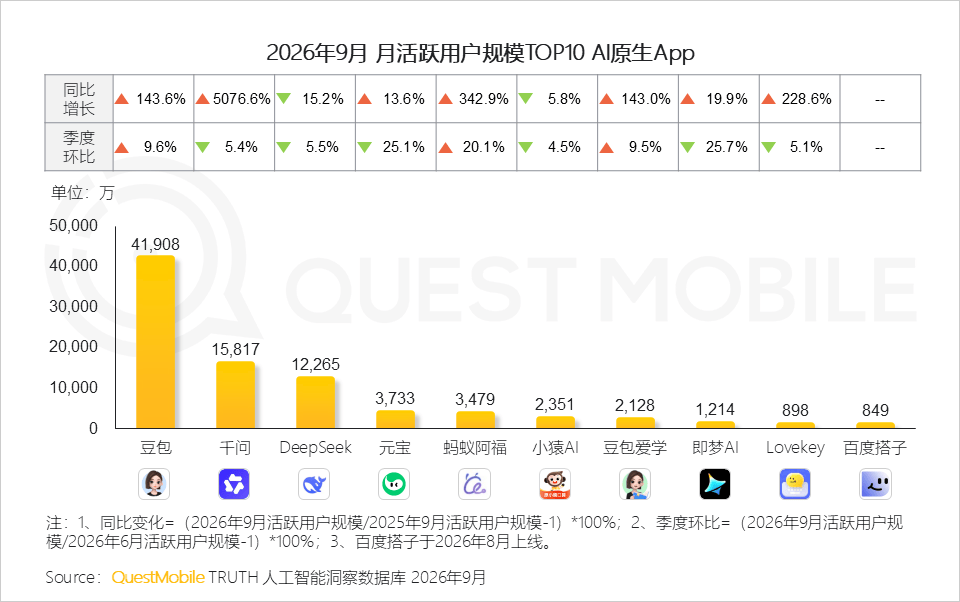
QuestMobile data shows that in September this year, the number of monthly active users of Doubao reached 419 million, a year-on-year increase of 143.6% and a month-on-month increase of 9.6%, ranking first in the TOP10 AI native apps.
Some people believe that ByteDance is effectively “harvesting” users’ fragmented time with its huge product matrix covering many scenarios such as users’ lives, entertainment, and work.
Nomura Securities quoted QuestMobile data as saying that in July 2026, ByteDance’s five applications (Douyin, Douyin Express Edition, Hongguo Shorts, Toutiao and Tomato Free Novel) collectively accounted for 40.9% of the time share of the top 50 applications on China’s mobile Internet, a significant increase from 33.6% in July 2025, far exceeding the 29.1% of the Tencent camp.
Among them, the total monthly usage time of Douyin increased by 29% year-on-year, surpassing Tencent WeChat’s 18.8% for the first time with a time share of 19.4%, becoming the longest-used application in China.
Radar Finance found that the strong appeal of byte-based applications can also be clearly felt in the software rankings of major mobile application malls.
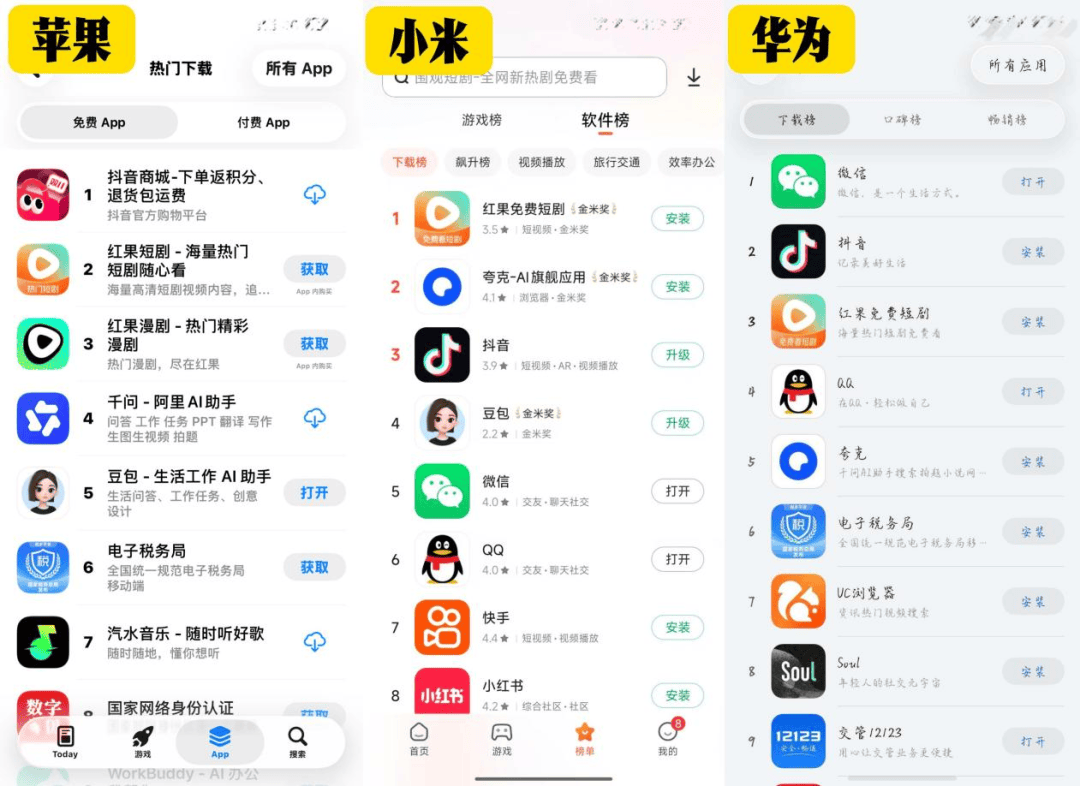
On October 28, among the top five apps in the Apple App Store free list, only Qianwen was a non-byte product; in the Xiaomi App Store software list, Hongguo free short drama, Douyin and Doubao were among the top five; and in the Huawei App Store software download list, Douyin and Hongguo ranked second and third respectively.
Qin Shuo and Vice President of Douyin debated over “Byte Time”
The “dominance” of byte-based applications on the Internet immediately aroused a lot of discussion on the Internet.
On October 26, Qin Shuo, a well-known financial media person, published a post titled “The Terrible Red Fruit and the Byte Time of China’s Internet” on his WeChat public account “Qin Shuo Moments”.
Qin Shuo said, “Although WeChat still has more daily active users (more than 900 million) than Douyin (more than 700 million), in terms of user time, is China’s Internet ushering in a new order – from Tencent time to byte time, from WeChat time to ‘Douyin + Hongguo time’?”
However, Li Liang, Vice President of Douyin, disagreed with the statement that China’s Internet has ushered in “byte time”, calling the characterization “extremely imprecise” and “pure nonsense.” He also said that competition on the Internet is fierce and no company can become “the xx time of China’s Internet.”
Li Liang believes that among Internet products, only instant messaging has a relatively stable market structure because of the relationship chain that serves as a moat. Products such as short dramas and short videos belong to fully competitive industries. The market competition is fierce and the market structure changes rapidly. No company can maintain the number one position in the market.
In order to refute the term “byte time”, Li Liang even did not hesitate to “exaggerate” his competitors – “The real situation is that the growth rate of Tencent’s short dramas and short videos far exceeds that of Douyin and Hongguo, and among Internet applications, instant messaging, games, e-commerce, and music all occupy a very large amount of users’ time.”
Subsequently, the two sides launched a remote debate on this topic. On October 28, Qin Shuo spoke out again and presented a set of data – “According to data from QuestMobile quoted by Nomura Securities, among the top 50 apps in China’s mobile Internet usage time in August 2026, the Byte system accounted for 41.8% and the Tencent system accounted for 28.6%. The gap between the two is about 13.2 percentage points.”
Qin Shuo also mentioned that according to the Anti-Monopoly Law (Article 24), if an operator’s market share in the relevant market reaches one-half, it can be presumed that the operator has a dominant market position.
Qin Shuo believes, “When the Byte family’s share reaches more than 40%, it already has a certain dominant position in the dimension of duration. ‘Byte time’ is a very real fact, not a myth.”
Later, Li Liang issued an article in response, saying that Qin Shuo’s analysis contained several basic common sense errors – the data that the byte system accounted for 41.8% did not meet the aforementioned standards in the Anti-Monopoly Law, and the Nomura statistics were actually the duration of the Top 50 Internet mobile terminals in China.
In the latest Weibo, Li Liang mentioned that according to a recent report released by Nomura (September), WeChat regained the throne of China’s most popular apps, accounting for 19.3% of the time.
It is worth mentioning that apart from the war of words surrounding whether China’s Internet has entered “Byte Time”, Byte is quietly accelerating its layout in the field of embodied intelligence.
According to news from the Science and Technology Innovation Board Daily on October 26, ByteDance’s official website and recruitment website information show that its Seed Model team has updated a number of robot-related positions, involving dozens of directions such as body design, dexterous hands, reducer control, simulation engineers, and data algorithm engineers.
It is reported that since 2023, Byte has successively launched GR-1 and GR-2 robot operation models to explore the transfer of knowledge learned from Internet videos to robot operations.
In 2025, the Byte Seed team further released the GR-3 model and the self-developed dual-arm mobile robot ByteMini, and expanded its capabilities to human-computer interaction, task planning and long-term precision operations through research such as Robix and GR-RL.
On the investment side, Byte invested in projects such as Jiazhi Technology and Future Robots in 2021.
According to Tianyancha, in January this year, ByteDance’s strategic investment department participated in the 1 billion yuan A++ round of financing of Independent Variable Robot; in July, it participated in the 1 billion yuan Pre-A round of financing of Near Future Robot.
According to previous news in the industry, the cumulative output of Byte wheel logistics robots in two and a half years has exceeded 1,000 units, serving customers such as Douyin e-commerce, BYD, and SF Express.
Although it is still controversial whether China’s Internet has entered “Byte Time”, it is an indisputable fact that Byte’s commercial territory continues to expand.
Related Reading
- Nvidia live updates: Jensen Huang ousted, CFO Colette Kress to serve as interim CEO2026-11-13
- Are mangoes not afraid of red fruits?2026-11-12
- Original: After Huang Renxun, who is most likely to take over Nvidia?2026-11-12
- Samsung’s roll-screen mobile phone is exposed, creating a new form ahead of Huawei and Apple, and folding screens are expected to be eliminated2026-11-12
- Musk’s favorite car is going to be discontinued.2026-11-12