During this year’s National Day holiday, many scenic spots across the country, including Taishan, Huashan, and Huangshan, experienced peak passenger flow. In addition to queuing up for mountain climbing, there is also a new sight in the scenic area – tourists wearing exoskeleton robots (hereinafter referred to as “exoskeletons”) to climb mountains. They have lightweight equipment tied around their waists and legs, which is gently lifted up when going uphill and provides cushioning for their knees when going downhill, as if they have a “small electric motor”.
This is not a scene from a science fiction movie, but a real consumption scene taking place during the National Day holiday in 2026. Exoskeletons, which have long been limited to professional fields such as medical rehabilitation and industrial production, are breaking through the consumer market in an unexpected way.
Putting on an exoskeleton does not mean you will be “cheated” immediately
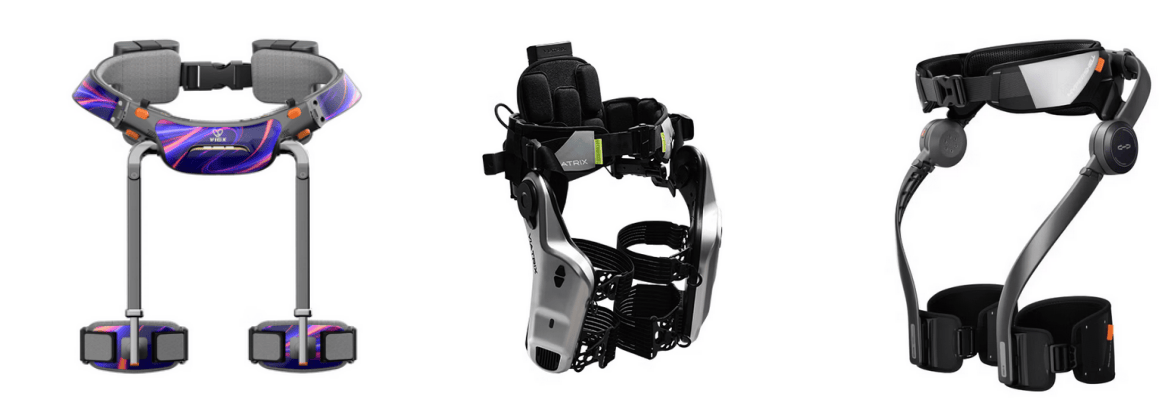
An exoskeleton is a wearable smart device that combines exoskeleton structure and robotic technology. It enhances or restores the human body’s movement capabilities by working collaboratively with the human movement system. It is essentially a human-machine collaboration system that helps users complete more efficient and safer actions while reducing physical burden.
In fact, exoskeletons are nothing new. In the professional field, it has already formed a specific application system. For example, in the field of medical rehabilitation, exoskeletons mainly serve patients with hemiplegia, disabled elderly people, and children with cerebral palsy. The price of a single unit ranges from tens of thousands to millions of yuan; in the industrial field, exoskeletons are mostly used in scenes such as heavy object handling and high-altitude operations, and the price of a single unit usually ranges from 10,000 to hundreds of thousands of yuan.
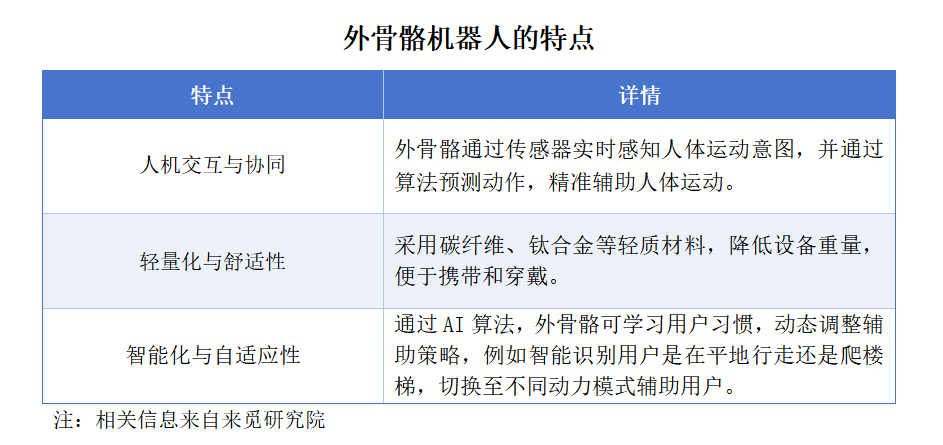
The real turning point comes from technological iteration and scale effect. With the decline in the cost of core components, the popularization of lightweight materials such as carbon fiber and aviation aluminum alloys, and the maturity of AI gait recognition and torque adaptive technologies, exoskeleton robots have begun to evolve from “bulky machinery” to “wearable consumer electronics”, knocking on the door of the consumer market. In terms of intelligence, take the “AsExo-TK1000” launched by Zhiyuan Research Institute as an example. It integrates AI gait prediction and torque adaptive technology, and uses deep learning algorithms to achieve automatic adjustment and accurate prediction, with an accuracy rate of 99.2%. In terms of lightweight, take the “π” launched by Kenxi Technology as an example. Its weight dropped to 1.8kg after iteration.
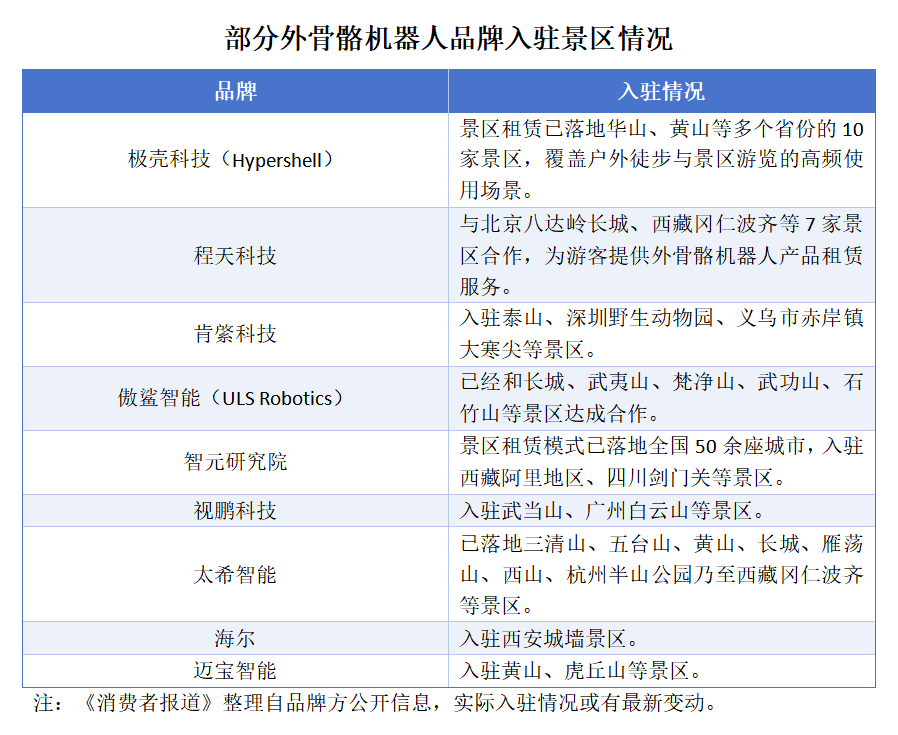
According to incomplete statistics from Consumer Reports, currently, well-known exoskeleton brands such as Jike Technology, Chengtian Technology, Kenqi Technology, Aosha Intelligence, and Taixi Intelligence have settled in many mountaineering and hiking scenic spots across the country to provide exoskeleton rental services. In terms of price, a single rental fee is usually 80-200 yuan, which is equivalent to 20-30 yuan per hour. If you encounter a brand promotion experience activity, the cost of a single experience can be discounted to less than 10 yuan.
“29 yuan for 1 hour, 39 yuan for 2 hours, 59 yuan for 3 hours. (Same price for all working days and holidays) It only takes 3 minutes to wear. It is recommended to wear comfortable sneakers and loose trousers for a better experience.” Planck AI exoskeleton Baiyun Mountain Station inspection staff told Consumer Reports that after using the exoskeleton for assistance, users will feel like they are being carried along, and it is easier to climb the steps. It takes about 1.5 hours to walk from the south gate to the top of Mount Mosing Ridge, and the battery life of the equipment is about 2-3 hours.
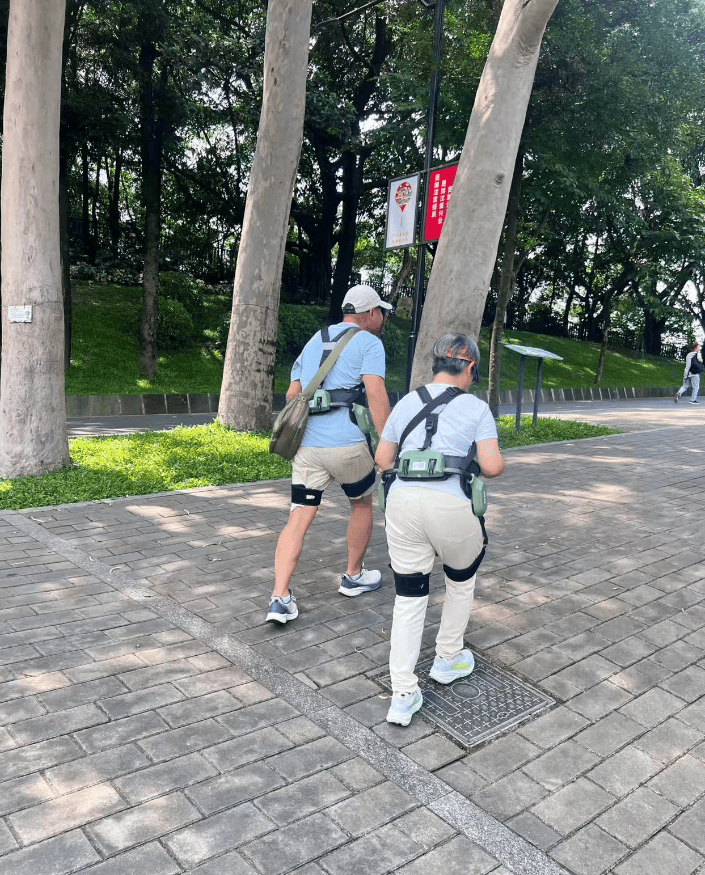
Tourists experience exoskeletons in Guangzhou Baiyun Mountain Scenic Area (Source: Social Platform)
In a sense, the exoskeletons provided in the scenic area are like shared bicycles and shared power banks, appearing during an outdoor journey of several hours. Shared attributes split an exoskeleton equipment worth several thousand yuan into low-cost and fresh experiences sold on a pay-per-view basis.
“Consumer Report” noticed that the exoskeletons rented in scenic spots look similar to knee pads and waistbands, weigh between 1.5 and 3 kilograms (one piece of equipment), and have a battery life of 2 to 8 hours. Passengers can simply scan the QR code to rent and wear them in just a few minutes. Its core technology lies in the built-in sensor and AI intelligent system, which can accurately sense the wearer’s movement intention. When the wearer wants to lift his leg, it can provide an upward thrust, and when the wearer walks downhill, it can provide damping and cushioning.
On the eve of the National Day, Mo Jun (age 25-30 years old, with the habit of climbing mountains regularly) participated in a free trial event organized by a certain brand. He told Consumer Reports that the exoskeleton is not big and makes him feel relaxed when climbing steep slopes. However, he admitted that the battery life of the product is not enough, the device itself has a certain weight, and the crotch will feel like it is falling when the battery is out of power. The overall battery life is about 4 hours, and the entire activity is more than 5 hours. If you don’t bring a replaceable battery or power bank, it will become a heavy walking. “I think it is useful for people who are a little older or who don’t exercise much. I have climbed a lot of mountains before, and the exoskeleton will not be very tiring on the day’s trip. The actual improvement is not big. In addition, the power assist cannot be activated as accurately as uphill when going downhill, so the usefulness is not that obvious.” He believes.
Another user Chen Feng (aged 45-50, who participates in low-intensity sports daily) who experienced exoskeletons at the Beifeng Scenic Area in Hangzhou believes that exoskeletons are very helpful for climbing uphill and walking up stairs. “The legs are assisted when you take a step, and your thighs will not be sore when you continue to walk up the stairs. When going downhill, the assistance will be automatically weakened to protect your knees. The disadvantage is that it takes a while to get used to when you first put it on. It is not suitable for running scenes, and you need to pay attention to the battery.” He told Consumer Reports.
During the National Day, Liu Chang, who likes to travel, experienced the exoskeleton at the Tiger Leaping Gorge Scenic Area in Yunnan. He told Consumer Reports: “It feels like it can save 20%-30% of energy when going up the mountain, but the product has no obvious assistive effect when going down the mountain. There will be a slight delay in the exoskeleton’s follow-up, but it can provide stable power during regular brisk walking.”
On the social platform, some mountain climbing enthusiasts shared: “You don’t immediately ‘hang up’ after putting on the exoskeleton. It takes about 1-2 hours to feel its help. It may be that it takes 2 hours to climb the mountain before slowly exhausting yourself, and the effect is obvious in comparison; it may also be that the device needs time to read the data and adapt to the user’s rhythm of movements.”
Judging from the feedback from experiencers, the exoskeleton in the scenic area has a certain assisting effect on users walking, but the assistance when going downhill is not as significant as going uphill. In addition, the exoskeleton needs to allow time for users to adapt, and there is also room for improvement in battery life.
Exoskeleton leasing drives C-side and industry growth
In the past, if you wanted to save effort when climbing mountains, you needed to use a “cable car.” However, this “simple and crude” way of climbing has many limitations. On the one hand, tourists are too concentrated in some scenic spots, causing the pressure on the scenic spots to increase; on the other hand, tourists taking the cable car will miss a lot of scenery along the way. Exoskeletons that appear in the form of rentals can alleviate these problems to a certain extent, and also provide consumers who want to exercise but have limited physical strength with a leisure mountaineering experience full of technology.
In fact, for scenic spots, this is a business that pays back very quickly. According to estimates in a research report by Orient Securities in September 2025, if all 100 exoskeleton equipment in the Taishan Scenic Spot are operated at full capacity, the daily income can reach 24,000-32,000 yuan; if the scale of the equipment is expanded to 5,000 units, the theoretical annual income potential will reach 300-400 million yuan.
Scenic area exoskeleton equipment brings more than direct rental income. The above research report shows that about 78% of rental users will purchase additional sports data analysis services, and 43% of users are willing to purchase customized mountaineering equipment. After users use exoskeletons, their journey time will be significantly shortened and physical exertion will be reduced. This will be expected to significantly increase secondary consumption in catering, performing arts, entertainment and cultural creativity, thereby increasing the overall unit price.
For exoskeleton manufacturers, scenic spot rental is an excellent “product fitting room”, which can accumulate market awareness and reputation foundation for subsequent C-end sales. The price of consumer-grade exoskeletons ranges from a few thousand yuan to tens of thousands of yuan. The product itself is not a “rigorous need” for consumers, making it difficult for them to purchase it directly. But after splitting it into pay-per-view rental experiences worth tens of dollars, consumers’ decision-making costs are significantly reduced.
This B2B2C model solves the dilemma of promoting new categories: the threshold for first-time use is lowered; on-site experience completes parameter education; the devices worn by passengers become mobile advertisements, bringing topicality and social attributes to new products. According to Ctrip’s public data, in the first quarter of 2025, the sales of scenic spot products marked with robot experience increased by 217% year-on-year, of which young users aged 18-30 accounted for 73%. This set of data reflects that fresh experiences can be used as a marketing highlight to attract young consumer groups.
The popularity of exoskeleton rentals has also boosted overall sales. According to data from the Ministry of Commerce, in the first four months of this year, online retail sales of smart mobility exoskeletons increased by 785.5%.
According to IDC data, China’s total exoskeleton robot shipments in 2025 will be approximately 26,000 units. Although the medical rehabilitation category still contributes most of the revenue, the consumer assistance category has accounted for 72.8% of shipments, nearly 19,000 units. In 2025, the leasing model represented by scenic spots, elderly care institutions and professional service providers will develop rapidly, effectively lowering the user experience threshold through centralized procurement and operation services, and becoming an important channel for rapid growth in the consumer market. JD.com’s retail big data shows that in the first half of 2026, the sales volume of exoskeleton robots exceeded 1,500% year-on-year.
From a longer-term perspective, the popularity of exoskeletons in scenic spots reflects that the entire exoskeleton industry is in a period of rapid growth. Public data from multiple institutions show that this is a golden track with great market potential.
According to data from the Toubao Research Institute, the market size of China’s exoskeleton robot industry has reached 4.2 billion yuan in 2025, of which the size of the elderly care and cultural tourism consumption segment is 730 million yuan, accounting for 17.4%, showing a trend of increasing growth. The institute believes that the elderly care, culture and tourism consumption segment has room for growth of hundreds of billions, and its potential consumer population exceeds 100 million people.
According to research firm ABI Research, the output value of the global exoskeleton robot industry is growing rapidly and is expected to increase from US$392 million in 2020 to US$6.8 billion in 2030, with a compound annual growth rate of approximately 33%.
Liang Linchao, founder and CEO of Taixi Intelligent, publicly stated that pre-sales of the brand’s new products have exceeded expectations. Shipments in the first half of this year have increased several times compared with previous years, and shipments for the whole year are expected to increase by more than 10 times.
These data mean that renting an “exoskeleton robot” to climb mountains in a mountain climbing scenic spot may be just the beginning of the entire business narrative. In the next stage, exoskeletons may not just appear on mountaintops, but will become a natural extension of human capabilities like most smart devices.
Related Reading
- Under the deep ice of Antarctica, waiting for a letter from the universe –2026-10-07
- The sudden emergence of Chinese-language groups has brought countless old games to light again.2026-10-07
- Original Terminator comes true! 1500℃ molten steel, robots line up for “cremation”2026-10-07
- Altman fires! Musk is a “bully”: you have to punch him in the nose occasionally to respect you2026-10-06
- An AI movie without actors won the Dragon Award first2026-10-06