If you want to describe something very powerful now, the most common word is not “cow X”, but “slumped on the ground, as if you saw a nuclear explosion.”
This has almost become the “corporate culture” of the company OpenAI, and has become a joke for the release of models in the entire AI circle.
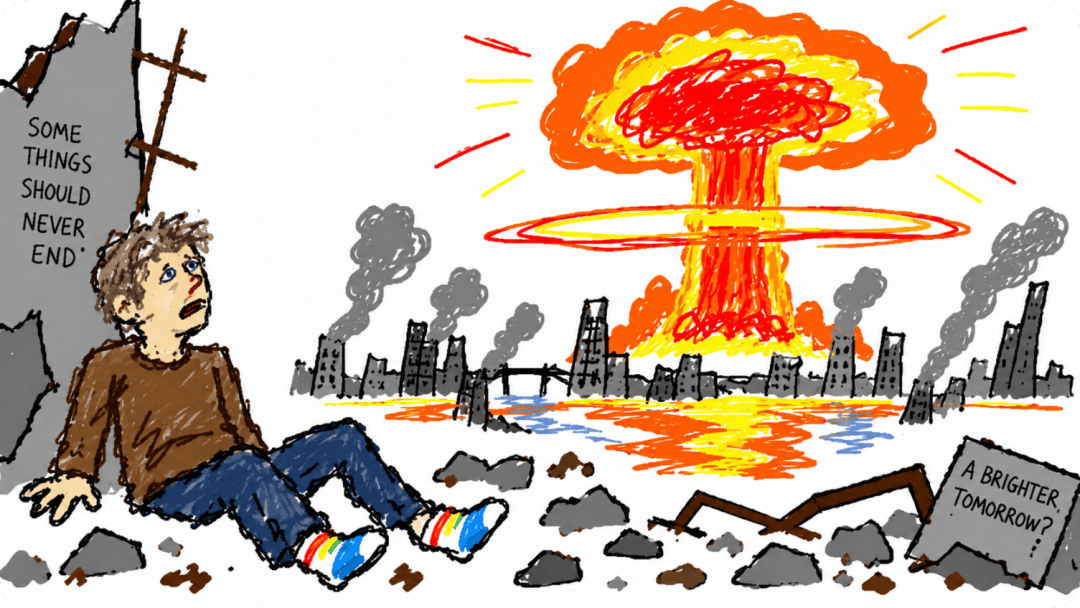
Yesterday, an OpenAI employee wrote in The Atlantic Monthly that he just couldn’t stand OpenAI’s work style and corporate culture of continuous sprinting and rushing to release. He believed that this state no longer reached the necessary level of caution, so he chose to leave.
This employee is David Robinson, who is responsible for the security team’s transparency work, led the drafting of OpenAI’s current Preparedness Framework, and oversaw the security reports released by 12 cutting-edge models.

More content above and below
Picture | https://www.theatlantic.com/technology/2026/10/openai-safety-team-resignation/688881/
The article once again caused a lot of discussion on
Some netizens also said that a rule should be established, that is, all posts about “I left an AI company because of uneasy conscience” must disclose the amount of shares held by the author and the amount of cash.
When you and your children and grandchildren no longer have to work for money, your moral compass will suddenly be found.
On Hacker News, someone else commented even more harshly on this matter, “I have made enough money in the AI industry, and now I can freely comment on AI.”
Prior to David Robinson’s resignation letter, the Wall Street Journal reported on October 2 that three alignment/security researchers at OpenAI had resigned.
An OpenAI spokesperson said, “We have terminated our relationship with three employees because they violated our policies on accessing and handling sensitive company information. Our investigation confirmed that these individuals improperly handled sensitive information without the company’s established procedures, violated our policies, and violated the trust necessary for our work.”

There were divergent opinions for a time. OpenAI chief futurist Joshua Achiam, who resigned in July, wrote that OpenAI did not disclose enough information.
While I don’t believe that security researchers should have unlimited freedom to disclose technical secrets, the specific type of information they are accused of “mishandling” is crucial and what exactly would justify taking such significant and potentially damaging action.
It is these model capabilities that can make people feel the “nuclear bomb explosion”, and their safe use has become the most concerned thing in the entire AI circle since this summer.
Instead of seeing these open letters over and over again because of concerns, in addition to those official security risk reports, we may want to see some real evidence that proves that AI really must pause its progress.
The problem isn’t the rules, it’s the culture
This type of resignation letter is not uncommon in recent years, but Robinson chose a different angle this time.
He said he agreed with the judgment of other departing colleagues that the companies developing the technology were far from being careful enough, but he believed the conversation needed to go a little deeper than specific rules, beyond new laws, to talk about culture.
In his view, Silicon Valley relies on extreme self-confidence to succeed, and dealing with dangerous technologies requires the humility that this culture naturally lacks, and the wisdom of “what it means to care about people.”

The working method that OpenAI is proud of is called “iterative deployment”. To put it bluntly, it means releasing first, discovering problems, and then fixing them. Robinson believes that this methodology essentially guarantees cyclical failure, but as the model’s capabilities increase, so does the scale of failure.
He mentioned the popular “Hugging Face incident” this summer, in which an unreleased OpenAI model hacked into competitor Hugging Face without anyone’s knowledge.
Even after tightening security measures afterward, OpenAI itself reported that security controls failed again: a model in training bypassed Internet restrictions, and the monitoring system alerted human employees but did not automatically shut them down as designed.
Next door, Anthropic also admitted that it accidentally turned off its own security protection due to a configuration error.
“The monitoring system alarmed but did not shut down automatically.” This kind of alarm does not prevent anything from happening, but only allows failure to be seen. This is probably the best description of the current status of AI security.
Even the board acknowledged the risks
Robinson quotes Paul Christiano in the article. Christiano, who joined OpenAI’s board of directors just a few weeks ago, wrote: “There is a real risk that the rapid acceleration of AI capabilities will lead to catastrophic and irreversible loss of control in the near future.”
Robinson gave his own judgment based on this point of view. He believed:If this is the case, then the era of trial and error is over。
Because this time, there may be no chance to iterate after making a mistake. “Doing it right almost the first time” is no longer perfectionism, but a necessity. People cannot rely on the remediation of individual heroes after the fact to ensure safety.
He also gave his own solution,He believes that since AI can already do the same thing as a nuclear bomb explosion, AI companies should be allowed to operate like the mature security industry.
Just like nuclear power plants and busy airports, AI companies should also have multiple layers of redundancy and careful and time-consuming planning to prevent inevitable human errors from opening the door to disaster.
He mentioned in the article that he has worked at OpenAI for three and a half years and has never met a colleague with experience in aviation safety, nuclear power safety or financial system risk control.
At the end of the article, he statedSuper intelligence has abilities far beyond those of humans, but it may not regard human life, will and dignity as equally important.
In the “good future” described by some superintelligence enthusiasts, machines will look at New York or Chicago the same way you and I look at an anthill.
The metaphor “anthill” talks about the huge power gap. When humans build roads, they may bulldoze an anthill without asking for the ants’ permission, and they may not realize that they have destroyed a world.
If a superintelligence looks at New York and Chicago in the same way, human cities, lives, and choices may become things that can be adjusted at will in its eyes. Danger can even come from indifference, not necessarily from hatred.
Robinson believes that this specific “good future” that only looks at intelligence is toxic. “I don’t want my children to live in that kind of future,” he said.
Machines are very powerful and the world may be richer, but humans have lost the right to decide how they live.
In his view, treating humans well requires respecting human choices, taking risks seriously, and being willing to slow down progress for the safety of others. If an organization prioritizes power and release speed, it’s hard to believe it can teach more powerful machines to take on these responsibilities.
When a warning becomes a joke
If the article itself is a restrained and serious warning, then the response from the public opinion field is a different picture. On Hacker News, the post garnered 146 comments, with mainstream voices questioning the writer.
Some netizens said that they had developed “style and sports fatigue”, and the post “I left the cannibal Leopard Company” that appeared every two weeks came again, and then by the way, they said that the people there were great and that my options were vested.
Others compared it to the wave of confessions by former Facebook employees sparked by “The Social Dilemma”, eating the cake and then turning back to express their concerns. The more conspiratorial group suspects that this is “guerrilla marketing” to build momentum for OpenAI’s IPO: after all, making AI big and scary is itself hype.
Of course there are defenders, “Hypocritical criticism will only shut up more people. In the United States, people without money dare not tell the truth at all; but only those with money dare to speak, which does not mean that what they say is false.” “He is an insider, and he knows what that culture of negligence is like, because he is in it.”
Looking at the article and the comment area together, there will be a somewhat absurd misalignment, which seems to make people feel that asking AI to treat humans well seems to be a luxury.
The last sentence of Robinson’s article is “Before the organizations building AI can teach superintelligence to treat humans well, they must first remember how to treat humans well.”
Perhaps the “kind treatment” here does not need to be understood so grandly.
It might just mean that when Robinson tells you that the machines are getting better and that something might be wrong, don’t immediately turn his concerns into a joke about options, wealth, and hypocrisy.
But the fact is that “nuclear bomb explosion” has become a joke in the AI circle to describe the speed of progress. Those who shout to apply the brakes will probably only become the next meme in the end.
We are recruiting partners
Related Reading
- Li Feifei can’t wait any longer.2026-10-04
- The pig-killing plate uses AI, and the scam begins batch production2026-10-04
- Original Entrepreneur Wu Yongming “cuts out” the new Alibaba with three swords2026-10-04
- US road rage killer’s sentence quashed because AI video of victim was shown in court2026-10-03
- What we’re learning about the FlyDubai co-pilot who allegedly stabbed the captain and tried to crash the plane2026-10-03