Author: Wang Jianen
Life in the current Ningde era is not very comfortable.
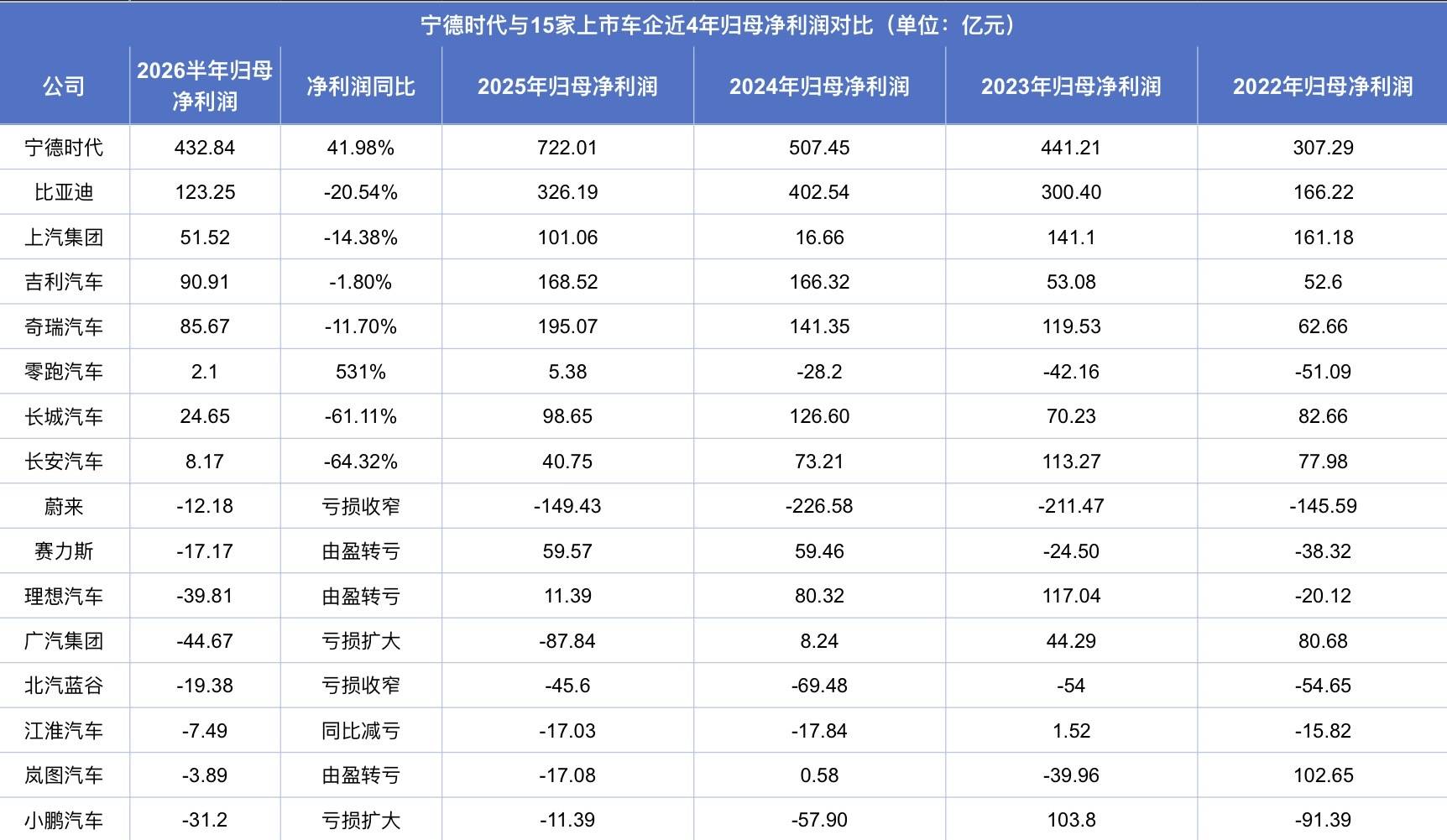
It’s not that the performance is not good, on the contrary, I made a lot of money in the first half of the year. The company’s semi-annual report shows that the net profit attributable to the parent company was 43.284 billion yuan, a year-on-year increase of 42%, and the average daily net profit was nearly 240 million yuan. What is this concept? The total net profit attributable to parent companies in the first half of the year for the 15 mainstream car companies listed on A-shares and Hong Kong stocks was 21.048 billion, less than half of Ningde.
A company that makes batteries makes twice as much as the combined profits of a group of car companies.
But making too much money can sometimes be a trouble.
1. The “little brothers” no longer want to work for “King Ning”
The first one to make a big move is Ideal.
On September 7, Ideal officially announced that its self-developed batteries will be installed on all models. At present, L6, L8, i8 and other models have already used it. When the production capacity ramp is completed, all series will use it.
The wording in the ideal announcement is very particular, “Self-developed chips do not affect NVIDIA’s leading brand, and self-developed batteries do not affect CATL’s leading brand.”
Translated, “You’re a good guy, but I want to go it alone.”
Why do this? More than half a month later, on September 21, Li Auto President Ma Donghui revealed the mystery in an interview. He first denied the idea of cost reduction, “We don’t think that the cost of self-developed batteries is lower than that of external procurement.” If not to save money, what are you trying to do? The picture is of “three connections” – “opening up underlying data, opening up vehicle experience, opening up maintenance standards and after-sales service.”
To put it simply, it means three words: control.
In this regard, CATL did not respond directly, but the words of Ni Jun, CATL’s chief manufacturing officer, made the whole incident full of gunpowder.
On September 17, at an open month event of the company, he first took Musk as an example, “Musk is also very powerful, SpaceX, Neuralink, etc. have all done it.” Then suddenly the topic changed, “You can build cars, but you don’t necessarily know how to build batteries. You still need professional people to do professional things.” He also emphasized that it is not difficult to make a good battery, but it is difficult to make a billion equally good batteries.
It was not named directly, but it was obviously a response to the recent hotly debated “de-Ningdeization” issue.
2. Battery manufacturers “eat meat” and automobile manufacturers “eat soup”
It is not difficult to understand why car companies choose to develop their own batteries. Let’s first look at a set of data.
In the first half of 2026, the total net profit attributable to parent companies of 15 mainstream car companies was 21.048 billion, compared with 35.131 billion in the same period last year, a year-on-year decrease of 14 billion. Nine companies experienced an increase in revenue, while 11 companies experienced a decline in profits or sustained losses. The profit margin of the automobile industry has dropped from 5.71% in 2022 to 3.6% in the first seven months of 2026, a four-year low.
Battery costs account for 30% to 50% of the total vehicle cost. On the one hand, car companies are engaging in price wars with each other, and on the other hand, raw materials are rising in price. Lithium carbonate has risen from 75,000 yuan/ton at the end of 2025 to more than 200,000 yuan in mid-May 2026, an increase of more than 160%. If the cost rises, the selling price will not rise, and the profits will be squeezed out.
More and more cars are sold and less and less money is made, but the battery factory is making crazy money. CATL’s net profit attributable to its parent company in the first half of the year was 43.284 billion, twice that of the 15 car companies.
At the 2026 Power Battery Conference, Liu Jincheng, chairman of Yiwei Lithium Energy, said, “When I met the chairman of the industry recently, their expressions were very bright. Most battery companies have very good half-year results.”
Some people are happy and others are worried.
Yin Tongyue, chairman of Chery, publicly stated, “We agreed to share risks and results, but now the battery factory enjoys the results more.” Lu Fang, chairman of Lantu, pointed out more directly that core components such as batteries and chips have concentrated most of the industry’s profits, squeezing the space for vehicle companies’ R&D iteration, technological innovation and market operations.
This statement is quite rude.
3. Car companies are beginning to take matters into their own hands
Complaining is useless, car companies have begun to find their own way out.
Ideal announced on September 4 that it plans to spend 2.65 billion yuan to increase its capital in Sunwanda Power. After the transaction is completed, its shareholding will rise to 11.17%, making it the second largest shareholder of Sunwanda. The two parties have previously established a joint venture, Shandong Ideal Automotive Battery Co., Ltd., with each holding 50% of the shares.
The route is very clear. The battery cells are self-developed and handed over to Sunwoda and China New Aviation for OEM. PACK is self-developed and manufactured, and the definition rights and data links are in its own hands.
Xiaomi announced at the same time that it was cooperating with China Airlines and Sunwoda, and its battery suppliers expanded from CATL and Fudi to four. Vice President Huang Zhenyu said, “We are determined to participate and invest in the entire chain,” including production details such as cell design and negative electrode secondary rolling.
Geely, Changan, Leapao, and Xiaopeng have also included second-tier manufacturers in their supply scope. NIO and Tesla are developing their own batteries, while BMW and EVE Lithium Energy are jointly developing cylindrical batteries.
The appeal of second-tier manufacturers is plain and cheap. Industry insiders revealed to the media that the price of power batteries from second-tier manufacturers is about 5% cheaper than that of CATL. If a 100-kilowatt-hour battery is calculated at 80,000 yuan, it saves 4,000 yuan for a bicycle, or 40 million yuan for 10,000 vehicles.
There is also a timing coincidence. In 2023, many media reported on CATL’s “lithium mine rebate” plan. Some batteries were settled at a lithium carbonate price of 200,000 yuan/ton, provided that the car company committed about 80% of the battery purchases to it for a three-year period. If implemented according to the deadline disclosed at the time, these commitments will expire exactly this year. The expiration means that the market structure will usher in an opportunity to reshuffle, and automobile companies will have the opportunity to allocate more orders to second-tier manufacturers.
Ideal has repeatedly emphasized that self-research is not necessarily cheaper than external procurement. The goal is not to save money, but to gain control. The motivations of each car company are not exactly the same, but the direction is the same. They can no longer bet all their lives on one company.
4. The “Ningwang” moat is still there
If you say that “Prince Ning” is going to die, you are thinking too much.
In the first seven months of this year, CATL’s domestic power battery installed capacity share was 45.37%, BYD ranked second with 17.52%, China New Aviation and Sunwanda ranked 6.32% and 2.89% respectively. There is still a clear gap between them and the Ningde era.
Ningde Times will invest 22.1 billion in R&D in 2025, and its net profit attributable to the parent company in the first half of this year will be 43.284 billion, a year-on-year increase of 41.98%. Technology, scale, and manufacturing capabilities are still at the top of the industry.
Moreover, despite the loud calls from the outside world to “de-CATL”, car companies have not abandoned the CATL era on a large scale. Geely, Leappo, NIO, and Xiaomi are still important customers of CATL, and the first batch of delivery models of Ideal MEGA and i9 are still equipped with batteries from CATL.
In addition, the fact that car companies are willing to use power batteries from second-tier manufacturers does not mean that consumers will definitely approve. In media interviews, many car owners and online ride-hailing drivers made it clear that they would not buy models equipped with second-tier batteries.
But it is clear that car companies are increasing their supplier selection, investing in second-tier manufacturers, and developing their own batteries, which are gradually changing the supply relationship that “Ning Wang has the final say” in the past. Even if there is no loss of large orders, the signal of “having a spare tire” itself is enough to change the balance of power on the negotiating table.
“Ningwang”‘s past absolute advantage is loosening.
5. “De-Ningdeization”, a slogan that has been overblown
As the voice of “de-Ningdeization” has intensified recently, “China Industry and Information Technology News”, a media in charge of the Ministry of Industry and Information Technology, stood up and spoke out to cool down the situation. The title was “The argument of “de-Ningdeization” is unacceptable.”
The article said that car companies adjust their supply chains, add suppliers, and deploy self-research. This is a normal market behavior, but it is constantly packaged as “de-Ningdeization” and even made into a confrontation between vehicle companies and battery companies. “It has become a farce of public opinion.” What a mature industry wants is not to cut peaks and fill valleys, or “whoever is ahead will weaken whoever is ahead.”
The article also gave an example. Germany has Bosch and Continental, and Japan has Denso and Aisin. Powerful OEMs and powerful parts factories have long coexisted. I have never heard of “de-Bosch” or “de-Denso”.
This statement can be regarded as a fair word for the Ningde era.
In the final analysis, what car companies want is not to drive away CATL, but they just don’t want to have only CATL as an option.
It is still the most capable company in the industry, but the era of “taking orders while lying down” has been shaken.
Disclaimer:This article is based on public reports and information and represents only the author’s personal views and does not constitute any investment advice. The article involves operating data, market share, model supply arrangements and other calibers. Please refer to the latest announcements and official disclosures of listed companies.
References:
1. CATL earns 240 million per day, while the 15 listed car companies combined earn less than half – China Business News
2. Li Auto: Self-developed batteries will be fully installed on all models – Cailianshe
3. The project was established 6 years ago! Li Auto explains in detail its self-developed battery strategy: not to reduce costs, but to connect data and vehicle experience – Everyjing.com
4. Dialogue|Ni Jun, Chief Manufacturing Officer of CATL: Just because a battery can leave the factory does not mean it is qualified – Blue Whale Finance
5. New energy vehicle supply chain continues to adjust: Lixiang i9 is equipped with self-developed batteries, Li Xiang said that he holds the decision-making power of the product in his own hands – The Paper
6. Automobile companies no longer want to be controlled by “Ning Wang” – Jiemian News
Related Reading
- Who is earning the “tuition” of robots?2026-09-24
- The first iPhone 18 Pro victims emerge2026-09-24
- Car companies collectively “create people”2026-09-23
- Buy a Taiyu tree for 99,000, put a logo on it and receive 100 million2026-09-23
- Original Luo Yonghao, who is no longer restricted by height restrictions, has a positive attitude and is a big V with 5.4 million fans2026-09-23