On September 20, Zhang Chaoyang, the founder, chairman and CEO of Sohu and a Ph.D. in physics, once again visited Beijing Normal University, a century-old university. With the theme of “Gradient and Differential of Tensors”, he gave a hard-core offline lecture with both mathematical depth and physical insights. At the beginning of the school year, he explored the scientific charm of general relativity with students. This is the second time that “Zhang Chaoyang’s Physics Class” has appeared on the podium of the Beijing Normal University after a lapse of two years after the 2024 “General Relativity Solution in Stellar Interiors” special session.
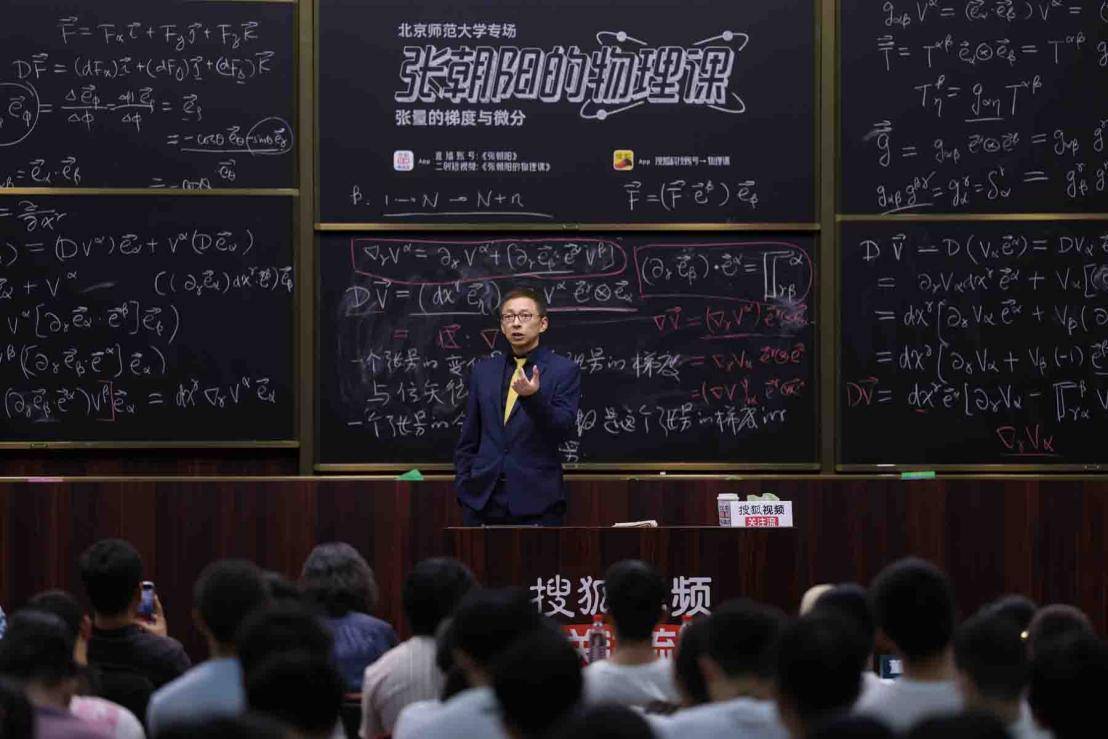
After the course, Zhang Chaoyang accepted an interview with the media and shared his views on topics such as science popularization concepts, scientific learning in the AI era, and the ecology of the Sohu video streaming platform. He said that in the AI era, it is even more important to do calculations in person. “Only by doing calculations can you get it into your head.”
Hard core derivation of the differential rules of curved space-time and a detailed explanation of why charge density is not a scalar quantity
This time he chose to return to Beijing Normal University to teach courses related to general relativity. Zhang Chaoyang explained that Beijing Normal University is an important position in domestic research on general relativity, and senior scholars in the field of relativity such as Liang Canbin have emerged. Two years ago, he lectured on the solution of general relativity inside stars at Beijing Normal University; now, as the fourth volume of “Zhang Chaoyang’s Physics Class” about general relativity is nearing completion, he has recently begun to think more about differential geometry.
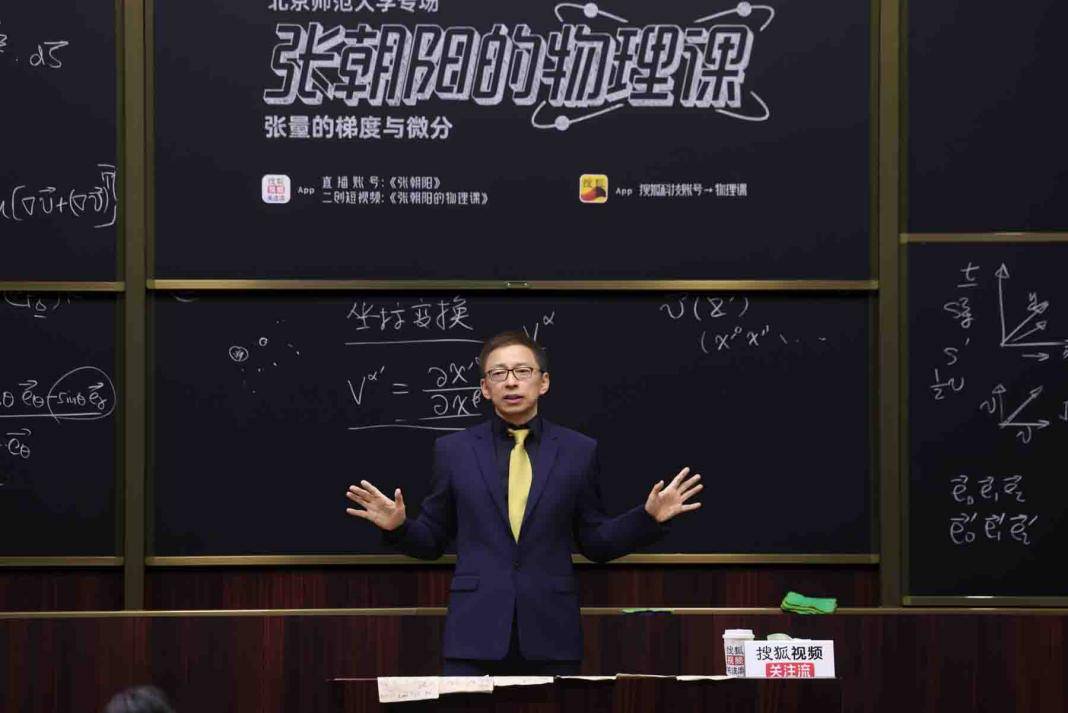
What exactly is a tensor? How to differentiate in curved space-time? At the scene, Zhang Chaoyang started from the basic concepts of tensors, systematically sorted out the dimensions and orders of tensors, and deduced in detail how to define dual basis vectors, metric, and the function of metric on basis vectors and component lifting indicators. The Kreisberg symbol thus defined is compatible with the metric, and its gradient is zero. He emphasized that the zero gradient property of the metric is “remarkable” and is the key to the ease of entry and exit of the lifting operator.
During the interactive session, Zhang Chaoyang and the students on site discussed issues such as the physical meaning of high-dimensional space-time, the application of tensors in the study of black holes and gravitational waves, the difference between partial derivatives and gradients, and the relationship between tensors and linear mapping. When asked what exactly a scalar is, Zhang Chaoyang emphasized that a scalar is not just “a number”. The key is whether the value remains unchanged under the transformation considered.
He took the charge density under the transformation of the reference system as an example. The charge density is seemingly a number, but under the transformation of the reference system, it will change due to the scaling effect, so it is not a scalar quantity. It and the current density in three-dimensional space can be combined into a covariant four-dimensional vector. This perspective can further explain the origin of the Lorentz force in different reference systems. For example, there is a moving electron outside a current-carrying wire, and its speed is the same as the moving speed of the electron in the wire. From the ground reference system, it is the magnetic field generated by the current that exerts magnetic force on the moving electron; but switching to the coordinate system that moves with the electron, the positive charge in the wire moves in the opposite direction and increases in density under the shrinkage effect, presenting an electrostatic force that attracts the test electron. This intensive output of “brainstorming” also benefited netizens on site and in the live broadcast room a lot.
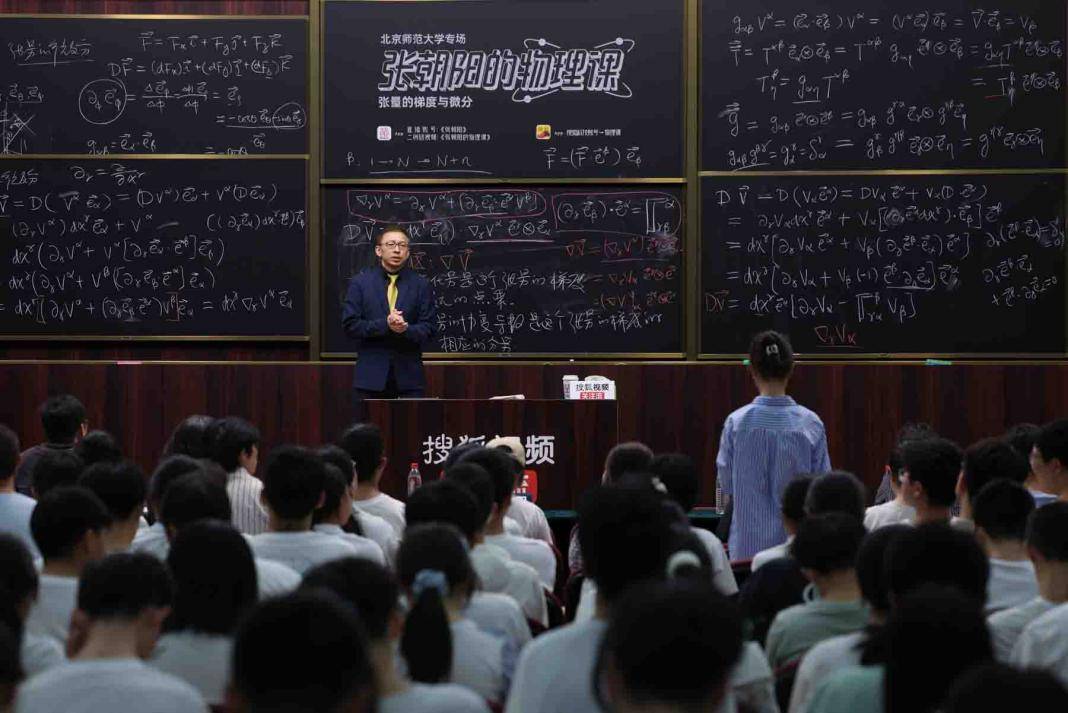
Talking about the history of physics, Zhang Chaoyang said, “The history of physics and the popularization of physics science can be carried out at the same time. Only by doing calculations can you understand what happened at that time.” He took Einstein’s calculation of light deflection as an example. Einstein first studied the inertial system and then the acceleration system. He thought of the equivalence principle while sitting in the elevator, but felt strange because all planetary orbits had nothing to do with mass, and finally moved towards Riemannian geometry. He also particularly emphasized the importance of learning English well. “Everything you need in English about the history of physics is available.” The English-speaking world is extremely rich in academic materials.
An employment ceremony was also held at the course site. Relying on the science popularization education base platform of the Chinese Physical Society, the School of Physics and Astronomy of Beijing Normal University officially hired Zhang Chaoyang as the base’s “special science popularization expert”. Xu Lei, secretary of the party committee of the college, came to the stage to issue a letter of appointment to him. The college expressed its hope that Zhang Chaoyang will continue to spread the true knowledge of physics and lead young students to realize the beauty of physics.
In the AI era, it is even more necessary to do calculations in person. The focus of attention streams is on real-person social networking.
It will be five years since the broadcast of “Zhang Chaoyang’s Physics Class”. Talking about the multi-dimensional value of the course, Zhang Chaoyang said in the interview that personally, picking up physics is to make up for the regrets in his early years and stems from strong interest; on the Sohu platform, the physics class helps knowledge live broadcast and social platform construction; at the social level, it has a public welfare attribute, showing the charm of physics to young people and providing a new way of learning.
It’s the back-to-school season, any advice for teenagers on how to learn math and science well? He advocated that “when learning mathematics and science, we should make good use of bad writing and bad words, shorten the reading time to one-third, and use the other two-thirds of time for deduction and thinking.” In addition, students must change their inherent cognition and not be overly coerced by the pressure of scores and rankings. It is precisely because of the “amateur learning advantages” – no triple pressure of taking exams, publishing papers, and fear of being called “stupid” that he studies physics purely based on interest-driven thinking, and his thinking becomes more active.
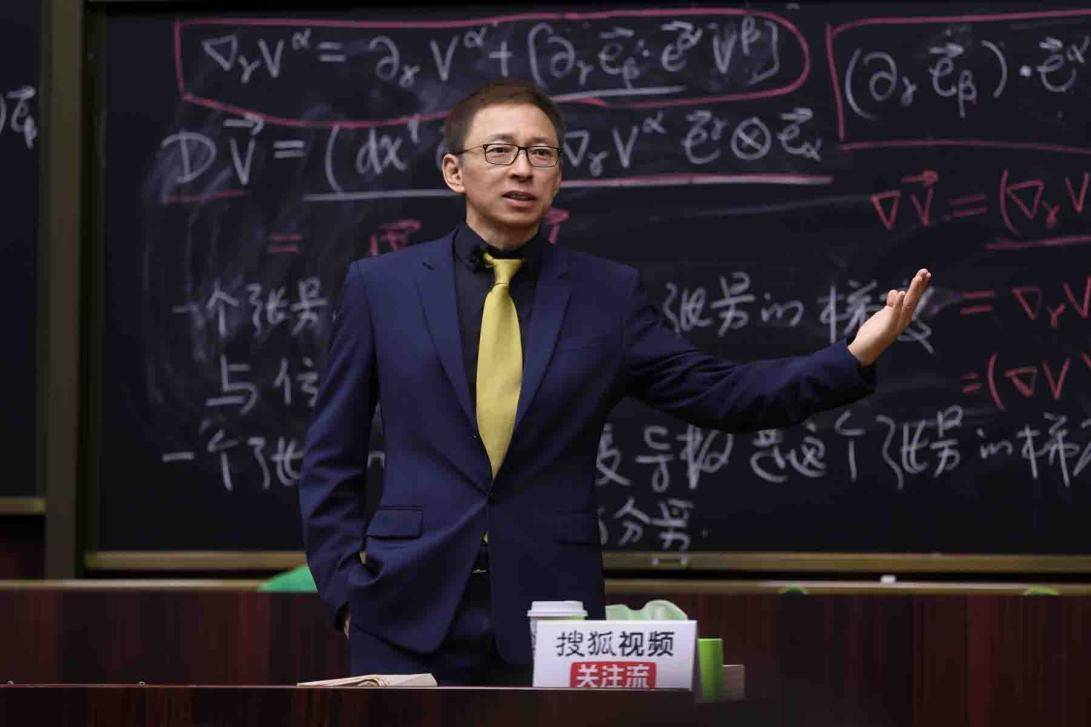
Regarding the confusion about major selection, he believes that the major studied in university does not have to be completely bound to future career development. The logical thinking brought by basic subject learning can be adapted to a wide range of fields, and lifelong learning is the key.
At present, AI tools can instantly output answers to various questions, causing many people to rely on AI and lack the ability to perform independent calculations. Zhang Chaoyang took the orbit of sun-synchronous remote sensing satellites as an example. AI can directly give orbit-related conclusions, but without personal calculations, it is still impossible to understand the underlying principles such as precession and the torque caused by the oblateness of the earth. He emphasized, “In the AI era, it is even more important to do calculations yourself, otherwise people will become stupid if they passively receive information all day long. Only by doing calculations can it be done in the brain.”
In addition, Zhang Chaoyang also shared the business development of Sohu Video’s “Attention Stream”. He introduced that Follow Stream is a comprehensive platform for creators, of which intellectual content is only a part. Circles such as Kpop and Hanfu are growing rapidly. Among them, Kpop competitions have grown into iconic IPs of the platform. This year, there will be 12 sub-station competitions. Next week, he will also go to Hong Kong to participate in sub-station activities.
Zhang Chaoyang believes that the platform should not be simply divided into long and short videos. One-minute short videos and several hours of in-depth live broadcasts can coexist. In Sohu Video, distribution logic and creators are the core of the platform. He stressed, “The focus of attention streaming is real-person social interaction, making friends and getting to know people through content.”
Related Reading
- Huang Renxun: The possibility of AI causing the destruction of the world in 2030 is zero2026-09-21
- Red Sea storm rises again, Middle East energy artery becomes battlefield again2026-09-21
- The Chinese men’s basketball team will return to China today. The team will be disbanded after returning home. The whole team needs to write a summary of the Asian Games campaign.2026-09-21
- ICE officer shoots and seriously wounds food delivery driver in Texas, lawyer says2026-09-21
- White House removes CNN from TV press pool as Trump’s media restrictions expand2026-09-21