A newly formed crater on the moon is giving researchers a chance to learn about the complex geology of our closest celestial body. The crater was formed by an asteroid impact in 2024, with a diameter of about 222 meters. It is the largest crater so far that people have observed the formation process with their own eyes. Relevant research was published in “Science Advances” on September 16.
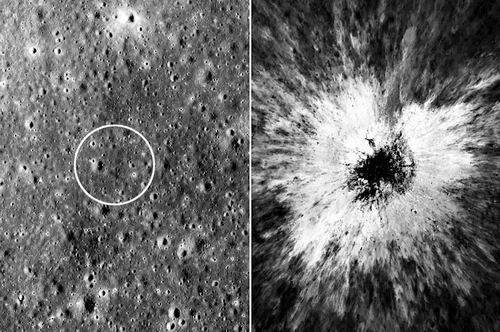
The crater was first discovered last year. At that time, researchers discovered it and named it McGetchin Crater after comparing multiple sets of images taken by NASA’s Lunar Reconnaissance Orbiter (LRO) in 2024 and 2025. According to the lunar impact frequency model, a crater of this size will be formed approximately every 132 years.
While there are many larger craters on the moon, observing the formation and evolution of one is a unique opportunity for scientists to learn about the lunar surface and its geology.
“Impact craters are very common in the solar system, so we spend a lot of time trying to understand how a new crater changes the surface of an object and see how it degrades over time,” said Tyler Powell of Johns Hopkins University in the United States.
Powell and colleagues measured the temperature of the area surrounding McGetchin Crater and found that the impact created a cold spot about 7 kilometers wide that was 8 to 9 Kelvin cooler than the surrounding area during lunar nights. These cold spots form when post-impact lunar dust becomes fluffy and therefore cools faster after sunset.
The team studied all impact craters identified so far that are larger than 20 meters in diameter and found that all impact craters with a diameter of about 30 meters or more produce detectable cold spots. This means that cold spots are a common result after impacts on newer moons. In addition, they found that cold spot temperature anomalies increase with crater size, indicating deeper modification of the lunar soil around larger craters.
Another team, led by Mark Robinson of Intuitive Machines in the US, found that the impact threw dust and rocks more than 120 kilometers away from the crater.
“What we’ve come to realize over the past few years is that this impact not only changes the area where the crater is located, but it changes the area far beyond the size of the crater itself. It’s really shocking,” Powell said.
The researchers pointed out that the crater exposed the moon’s complex geological structure and provided information for the current cratering mechanism model. It will help understand and study the history of the moon and other atmosphereless, cratered celestial bodies in the solar system, and facilitate future deep space exploration.
Related Reading
- Super El Niño is coming. How will global agriculture respond?2026-09-19
- A hardcore lesson for the beginning of the school year! Zhang Chaoyang will return to Beijing Normal University with hard-core physics courses2026-09-19
- Someone has poisoned 28 Lake Tahoe trees. Now there’s a $147,000 reward.2026-09-19
- Why do mosquitoes bite people harder in autumn?2026-09-19
- When knowledge is at your fingertips, how can you win in the AI era?2026-09-19