Last year, there were so many potatoes in Europe that farmers paid money to dispose of them. This summer’s continuous heat wave destroyed millions of tons of potatoes in Europe. An analysis released by the Energy and Climate Intelligence Center (ECIU), a non-profit research organization, on September 17, local time, showed that extreme weather has caused the loss of approximately 3.1 million tons of potatoes in Germany, France, Belgium, and the Netherlands, worth 400 million to 620 million euros. The total potato production in the four countries in 2026 is expected to drop from a record 27.3 million tons in 2025 to 19.5 million to 20.5 million tons.
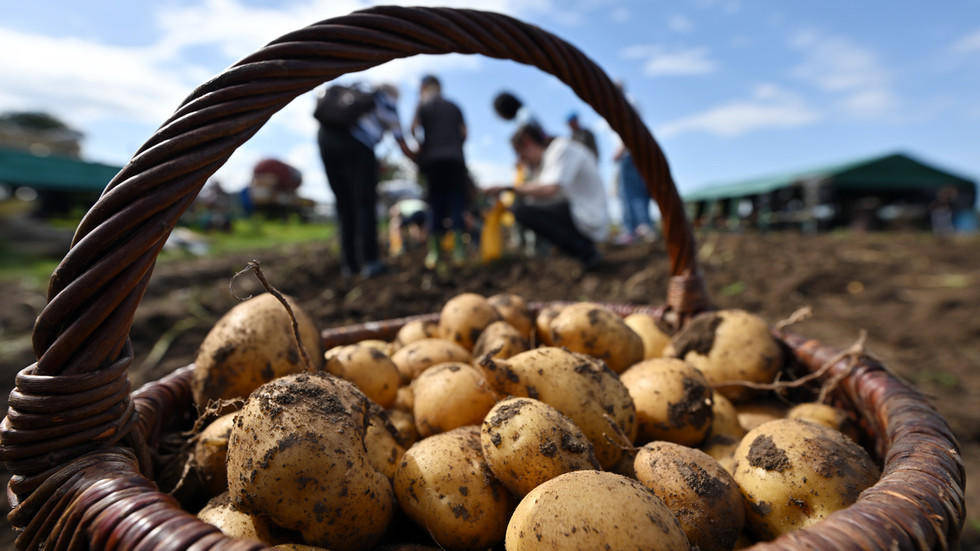
▲On September 7, German farmers placed a basket of potatoes in the field during the potato harvest.
“If these estimates are true, (production) has dropped from an all-time high to an all-time low within a year, which is a ‘potato upheaval,'” said Craig Elliott, Europe, Middle East and Africa market analyst at Expana, a commodity price information service.
Elliott said no one expected five severe heat waves this summer, which would damage potato production and quality.
Last year, there was a potato glut in Europe, which once pushed the Belgian benchmark price to nearly zero. Farmers discard, give away, burn potatoes, or feed them to cattle. The new U.S. tariffs have squeezed the export of frozen French fries, and farmers are simply planting less this year. However, this year, under the influence of the ongoing heat wave, there was no rain in the fields of farmer Jean-Paul Dalena near Arras in northern France from June 10 to August 25. Especially in August, when the temperature remained above 30°C for nearly a week, his potatoes “stopped growing.”
Processors usually require potatoes to be more than 50 millimeters in diameter, and Dalena said many of the potatoes grown this year did not meet this standard. In some of his plots, most potatoes were less than 40 millimeters.
Belgium is the world’s largest exporter of frozen French fries. According to industry information compiled by the ECIU, the yield per hectare of Fontenay potatoes, the main high-yielding variety used for industrial processing of French fries, was about 32 tons per hectare at the end of August, 30% lower than last year, and only about half of the potato pieces exceeded the 50 mm required by processors. Processors have begun to relax specifications. “You’re going to see smaller fries,” Dalena said.
Potato production is going down, and prices are already going up. In some parts of Europe, new-season processed potatoes were sold for up to 250 euros per ton, up from about 30 euros a year ago; French fresh potatoes were quoted at 520 euros per ton on September 3, compared with 310 euros previously. Belgian free market potatoes have risen from zero prices in April to more than 200 euros per ton, and German processed potatoes have risen from a low of 15 euros in June to about 240 euros.
Cedric Porter, editor-in-chief of the “World Potato Market”, a potato market information service, said that the stocks left over from last year’s harvest should be enough to supply the market until December 25; by March next year, the shortage of potato products will begin to reappear on supermarket shelves.
Tom Lancaster, land, food and agriculture analyst at ECIU, said that potatoes are one of the most water-intensive crops in Europe, and the heavy damage to the harvest was expected. Industry yield estimates have begun to reflect this, with some places falling by 20%. “For potato growers on the front lines of climate change, there’s no turning back when it comes to chips.”
He also said that farmers need a stable climate to continue to grow this staple food on European tables and cannot withstand unsustainable losses caused by extreme weather.