Data source: Ministry of Natural Resources Chart: Shen Yiling
The Political Bureau meeting of the CPC Central Committee held on July 30 proposed to continue to promote the transformation and upgrading of traditional industries. From steel blast furnaces to the depths of mines, from logistics parks to textile workshops, traditional industries have developed with the help of technological innovation and transformed into high-end, intelligent and green industries, bursting out with new vitality and injecting strong momentum into high-quality development. This column launches a series of reports starting today, focusing on traditional industries shifting gears to speed up and move towards a broader track.
——Editor
How does a mine harvest more resources from the same ore?
In Chenzhou, Hunan, the Shizhuyuan polymetallic deposit contains 143 kinds of minerals. The resources are abundant, but their use is not easy: different minerals coexist closely, some have small particles, and some have low content, making it difficult to separate and recycle them.
Continuous technical research has made low-grade ores that were difficult to use in the past have mining and utilization value-Shizhuyuan tungsten mineral processing recovery rate has increased from 26.8% to more than 70%, and the fluorspar recovery rate has increased from less than 30% to more than 65%. The cumulative amount of revitalized ore has reached 150 million tons.
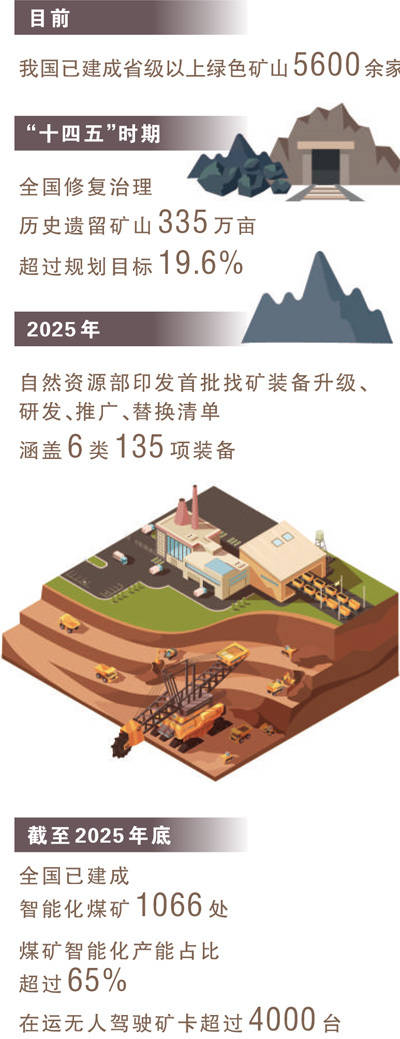
Mining is connected to national energy and resource security on one end and green waters and green mountains on the other. At present, our country has built more than 5,600 green mines at or above the provincial level. A green revolution covering the entire life cycle of exploration, development and restoration is taking place in every mine.
135 items of prospecting equipment in 6 categories are included in the list
Innovative technology supports green exploration
Mines are underground and fields are above ground. How to find resources and protect farmland at the same time?
The Qihe-Yucheng rich iron ore exploration area in Shandong Province has developed a method that runs through before and after construction. Before the drilling rig enters the site, the surface cultivated soil with a thickness of more than 30 centimeters at the working site is peeled off in layers and properly stored. During construction, mud is circulated in special facilities, and mud pools are no longer directly excavated. After the construction is completed, the previously preserved cultivated soil is backfilled in layers, and then deep plowing, fertilization and management and protection are carried out.
Whether the protection is in place needs to be verified with data. Before and after construction, the project carried out soil sampling, testing and comparison; after the temporary land reclamation, we continued to pay attention to the restoration of the land’s agricultural functions.
Information provided by the Ministry of Natural Resources shows that during the “14th Five-Year Plan” period, 142 million tons of rich iron ore resources were added in the exploration area, and the reclamation rate of temporary land for exploration reached 100%. By optimizing point layout and improving drilling technology, the temporary area occupied by a single project has been reduced by more than 10%, and the overall drilling construction time in the entire region has been shortened by more than 20%.
In forested areas, technological change is equally intuitive.
In the past, in order to see the shallow strata clearly and obtain samples, geological team members often had to dig long trenches. The Heilongjiang Provincial Institute of Geological Sciences has developed small-angle drilling technology to replace trenching with drilling sampling. The special base can adjust the drilling direction, and multiple boreholes can be constructed on the same platform, reducing equipment relocation and new land occupation. Since 2019, Heilongjiang has completed more than 50,000 meters of small-angle drilling, involving more than 50 projects, protecting more than 600,000 square meters of forest land, and saving forest land compensation costs of more than 50 million yuan. Not only that, this drilling technology can obtain fresh rock cores from deeper depths, reduce the interference of surface weathering on the judgment of mineralization, and make the prospecting clues clearer.
In 2025, the Ministry of Natural Resources issued the first batch of prospecting equipment upgrade, research and development, promotion, and replacement lists, covering 135 items of equipment in 6 categories. This year, the “New Round of Prospecting Breakthrough Strategic Action “15th Five-Year Plan” Equipment Construction Plan” was released; in April, the green exploration specifications for solid minerals completed the national standard project; in July, the “Green Exploration Budget Standards for Mineral Resources” was issued; in September, the “Green Exploration Specifications for Solid Minerals” was released… From local exploration to industry promotion, equipment, standards and funding guarantees are being promoted in a supporting manner. In the prospecting process, according to different geological conditions and ecological characteristics, the requirements of less disturbance and recovery are implemented throughout every process to promote the implementation of green transformation.
Mining recovery rate, mineral processing recovery rate, and comprehensive utilization rate continue to improve
“Dead mines” become “living mines”, and “small mines” become “big mines”
When you find a mine, you also need to answer how to mine it and how to use it.
The first is the mining link. Take Shizhuyuan Company as an example. With the iteration of mining methods and equipment upgrades, the mining recovery rate has increased from 45% to more than 95%, and the annual mining capacity has increased to 3.5 million tons.
The recovery rate can be understood as the proportion of the ore that can be mined to the corresponding ore reserves; the mineral processing recovery rate reflects how much of the useful components entering the mineral processing process are recovered. One focuses on leaving less resources underground, and the other focuses on reducing the loss of useful components in the mineral processing process. Only by improving efficiency in both links can resource advantages be more fully transformed into supply capabilities.
In order to solve the problem of mineral processing, Shizhuyuan Company cooperates with scientific research institutes to continuously improve mineral processing technology, and then improves the separation effect through process combination and automated control. At present, the number of useful minerals that can be recycled has expanded to 11 types, and the annual recycling volume of fluorspar concentrate alone reaches 350,000 tons.
The waste rock extracted and the tailings left from mineral processing are also being used. Henan Songxian Shanjin Mining Co., Ltd. uses ore dressing tailings and excavation waste rock as filling materials to fill underground goafs to reduce surface accumulation and enhance the stability of the goafs.
Command management and technical transformation continuously improve the efficiency of the production site. At the Huibaoling Iron Mine in Linyi, Shandong, the intelligent control center integrates 15 subsystems. The operation of ventilation, air pressure, lifting and other equipment can be monitored centrally, allowing dispatchers to grasp the production status and detect abnormalities in a more timely manner. By analyzing blasting data and conducting tests, Huibaoling Iron Mine has reduced the proportion of large ore rocks after blasting from 25% to 7%. With the transformation of ore processing automation, the unit production cost of iron concentrate has been reduced by 5.88 yuan.
From “exploiting the rich and abandoning the poor” to “eating and squeezing all”, information provided by the Ministry of Natural Resources shows that mining companies are using the “three-rate” standards of mining recovery rate, mineral processing recovery rate, and comprehensive utilization rate as binding indicators, carrying out re-evaluation of low-grade, co-associated minerals, and promoting advanced and applicable technologies. By carrying out low-grade, co-associated re-evaluation work, a batch of “dead mines” will be turned into “live mines”, and “small mines” will be turned into “big mines”.
Nowadays, “mining without minerals” and “unmanned mining” have become a reality in more and more mines, and the efficiency of resource development and utilization has been significantly improved. In addition to output, efficiency and quality have become more important yardsticks for measuring the effectiveness of mining development.
During the “14th Five-Year Plan” period, 3.35 million acres of mines left over from history will be restored and managed.
“Ecological baggage” becomes “green bank”
To the south of Huangsi Village, Xindu District, Xingtai City, Hebei Province, Desheng Mine Park has become a good place for nearby villagers to relax.
“Five years ago, this was the ‘white stubble mountain’ of abandoned mining areas.” Wan Minghua, general manager of Xingtai Shenghehua Building Materials Co., Ltd., said that the company has incorporated the restoration of abandoned mining areas into its overall planning, and is mining, treating, and restoring at the same time. To make up for the ecological debt, the park is embedded in the mining area, and the living environment of the surrounding people has improved.
Zhao Weijie, deputy director of the Xindu Branch of the Xingtai Municipal Bureau of Natural Resources and Planning, said that there are many mines in Xindu District, and ecological restoration focuses on mountain regreening, water source conservation, and the cultivation of eco-tourism, characteristic forestry and other industries. Surrounding farmers have gained new development opportunities from environmental improvements through aquaculture, tourism services, etc.
While the mining area is being restored to green, the land continues to recover its functions, laying a solid foundation for continued use.
Kunyang Phosphate Mine in Yunnan has faced problems such as land damage due to mining and water and soil erosion. During the restoration, in response to the lack of irrigation facilities and few suitable plants in the goaf, the mine carried out soil-covering vegetation experiments, built high-level pools, laid out irrigation pipe networks, screened drought-tolerant tree species and strengthened management and protection. The mine has invested a total of more than 500 million yuan in ecological restoration funds for continuous management, with the land reclamation rate reaching 77.53% and the vegetation recovery rate reaching 95.32%. On this basis, the mine has also developed flower, vegetable and other planting industries.
During the “14th Five-Year Plan” period, 3.35 million acres of historical mines were restored and managed across the country, exceeding the planned target by 19.6%. The Ministry of Natural Resources and the Ministry of Finance have deployed and implemented 68 ecological restoration demonstration projects of historical mines, using central fiscal funds to drive local governance. Currently, the Ministry of Natural Resources is studying and formulating institutional documents to strengthen the supervision of ecological restoration of production mines, strengthen restoration plans and cost management, consolidate the responsibilities of corporate entities, and promote the implementation of “mining while restoring”.
The construction of green mines is not something that can be done once and for all once the title is obtained. The Ministry of Natural Resources has made it clear that it will strictly manage the dynamic list of green mines, promptly remove mines that do not meet standard requirements, promote the construction and operation of new mines in accordance with standards, and accelerate the green transformation of production mines.
Mine pits are turned into parks, subsidence areas are turned into granaries, and water surface substations… “ecological baggage” is turning into “green banks.”
Related Reading
- As one data center bill stalls, more proposals to protect consumers from rising energy costs are brought forward in Congress2026-09-19
- Middle East opens new front, European energy supply under pressure2026-09-19
- The marching coastline丨Humanity and sea coexist harmoniously. The changes in sea use behind the fishing festival2026-09-19
- an everlasting mark2026-09-19
- 【Youth Chapter2026-09-19