On November 19, South Korea held the college entrance examination. In and outside this year’s examination rooms, an offensive and defensive battle has begun around AI cheating.
On the eve of the college entrance examination, an AI-generated picture sparked a heated discussion on the Internet. The picture depicted Yongsan Electronics Mall in Seoul as a “famous place for further studies” that has produced a large number of students admitted to prestigious schools: a banner hung in front of a camera store that read “Congratulations to 70 people who were admitted to Seoul National University”; a computer store across the street also hung a banner, announcing that “48 people were admitted to Seoul National University, and all subjects achieved first-level results!”
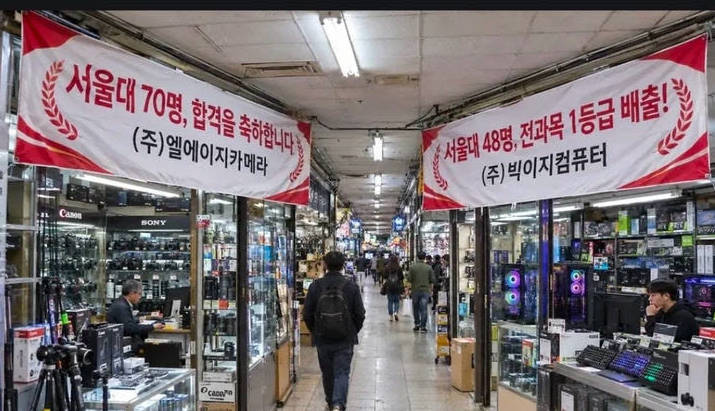
AI-generated pictures circulating on Korean social platforms.
The promotional banner that originally appeared in the cram school district of Daechi-dong, Seoul, has now been “transplanted” to the electronics shopping mall, which is intended to satirize the phenomenon of using micro cameras and AI to achieve excellent results in exams.
In addition, some pictures mocking the government’s response have been circulated online. One image showed a button-down shirt and was captioned, “Wearing this on college entrance exam day will get you taken away.” This is a mockery of the government’s previous announcement that it will prevent candidates from cheating by using micro cameras by “putting labels on clothes buttons.”

Button memes circulating on Korean social platforms.
Behind this dense series of satirical memes on the Internet is the recent ongoing controversy over “AI cheating”. The cause was a candidate who used a miniature camera to cheat on the tax accountant exam and got first place, and then submitted a written confession to the police.
South Korean President Lee Jae-myung held an emergency video conference during his visit to the Philippines on the 17th, emphasizing that “the fairness and credibility of the college entrance examination must not be shaken” and announced that he would reward 100 million won (approximately RMB 500,000) for reporting cheating cases.
Smart glasses cheating incidents occur frequently, and cheating equipment has clearly marked prices
Last week, a man named Han Won-seok appeared on his lawyer’s YouTube channel wearing a mask. He described how he used a tiny camera to take pictures of test papers, and then sent the test image to AI to obtain answers, and then checked the answers on his mobile phone. He said he felt guilty about it.
Han Won-seok achieved nearly perfect scores in the tax accountant exam without being caught cheating. As the case became the focus of the news, the South Korean government announced that it would initiate disciplinary proceedings, invalidating the results of the tax accountant exam cheater and banning him from applying for the exam for five years.
In fact, AI cheating incidents in Korean junior high schools and universities this year have attracted widespread attention. Investigation results released by South Korea’s Ministry of Education on November 9 showed that four cases of cheating using AI smart glasses have been discovered in junior high schools across the country this year, involving one junior high school and three high schools. A high school in Seoul discovered that many students used AI to write their essays during the November essay exam. In November last year, during an exam on an AI course at Yonsei University, dozens of students turned themselves in after using AI to answer questions.
At the same time, the use of cheating devices as profit-making tools has emerged online. According to Yonhap News Agency, the “Examination Cheating Equipment Circulation Investigation Report” released by data intelligence company S2W on November 18 showed that in a Telegram channel where Chinese users gather, there were posts selling pinhole glasses, clothes button cameras, ultra-miniature headphones and other equipment.
The prices listed by the seller are: 4,000 yuan (RMB) for pinhole glasses, 2,000 yuan for a clothes button camera, and 1,000 yuan for ultra-miniature headphones the size of rice grains. Among them, the equipment for taking test questions and the equipment for receiving answers are sold separately. The sales advertisement also introduces the specific cheating method: after the examinee enters the examination room wearing pinhole glasses and ultra-miniature headphones, people outside the venue will transmit the answers to him through a signal transmitter.
In a Telegram group that includes Korean-speaking users, different users posted purchase information on the 16th, such as “If you are selling college entrance examination AI cheating kits, please contact me.”
There are even advertisements for “AI contact lenses” on the Internet, but in fact such a function cannot be realized yet. There are also advertisements that claim “the probability of being discovered is zero,” guaranteeing that cheating will never be detected. Relevant advertisements are taking advantage of candidates’ anxiety when looking for ways to cheat, and carry out false or exaggerated propaganda. The very act of a candidate trying to purchase a cheating device may also serve as a basis for financial extortion.
Only black pencils are allowed. Send “emergency disaster text messages” to troubleshoot mobile phones.
South Korean Prime Minister Han Sung-sook said at a press conference on November 17 that all electronic devices will be prohibited in this year’s examination rooms, and any candidates found to be trying to cheat will be banned from taking the exam again in the next 10 years. She also said that the government will send an additional 8,400 staff to strengthen the invigilation work this year.
For 24 hours starting from 6 pm local time on the 18th, public Wi-Fi within 100 meters of all college entrance examination examination rooms in South Korea will be blocked. However, unlike Wi-Fi operated by telecommunications companies and public institutions, the tethering function of a personally installed router or mobile phone is difficult to forcibly block.
The South Korean government has also decided to send “emergency disaster text messages” from time to time during this year’s college entrance examination. This type of text message cannot be rejected. As long as the mobile phone is turned on, the mobile phone will continue to issue a prompt tone for 10.5 seconds, which can detect candidates who have not turned in their mobile phones.
In order to combat AI cheating, the requirements for candidates to bring supplies have also become stricter. Electronic devices such as smart glasses, mobile phones, and Bluetooth headsets are prohibited from being brought into the examination room. Regardless of whether they are actually used or not, they will be immediately treated as cheating. On November 18, the Korean Ministry of Education temporarily modified the stationery regulations in the examination room. Candidates can only bring their own black pencils. Computer-specific signature pens, correction tapes, erasers, and mechanical pencil refills will be provided by the examination center.
The Korean government recommends that candidates try to avoid wearing buttoned clothes and requires invigilators to strengthen inspections of collars, cuffs, wrists and other parts.
Such strict discipline may also affect candidates’ emotions. Hong Do-hyun, a senior at Yongseok High School, told Korean media News1: “There has been a lot of noise recently about AI cheating. I wear thick-rimmed glasses myself, and I am really worried. However, I believe that the exam management system can be improved, so I will still take the exam normally.”
Two days before the college entrance examination, Li Zaiming held an emergency video conference during his foreign visit, calling the exam “a ladder of opportunity and a symbol of fairness” and urging relevant departments to formulate long-term measures to combat cheating in exams.
Related Reading
- In the early morning, an international flight from Hong Kong made an emergency landing. 146 people were evacuated through emergency slides. Reports said the plane showed signs of fire; the airline responded2026-11-22
- The AI cheating incident in South Korea’s college entrance examination has been brewing, and Education Minister Choi Gyo-jin has resigned. Previously, Lee Jae-myung offered a large reward to investigate and punish those who cheated in the college entrance examination: 100 million won for every cheating case reported2026-11-22
- The spectacle of “Hai Hao” appears in Weihai, and the sea suddenly seems to be “boiled and smoking”2026-11-22
- Iran’s President: The ongoing economic war is “far more difficult” than a military conflict2026-11-22
- Why are T and K classified as high-speed passenger trains? How to choose Z, N and V for normal speed trains? The authoritative answer is here2026-11-22