When she first moved from kindergarten to a nursing home, Wang Youmin felt a little at a loss. She originally thought that taking care of the elderly would be the same as accompanying children. She could “happily” sing, dance, play games and do crafts with them. It was only after actual work that I discovered that the schedule and care methods of kindergartens cannot be directly transferred to the elderly.
Wang Youmin gradually realized the weight of elderly care. In nursing homes, many scenes make people feel powerless. The elderly may become disabled or have dementia, and are at risk of physical weakness at any time. Caregivers need to accept their different physical conditions and make adjustments at any time according to the on-site situation. For Wang Youmin, these are all “tests” after changing careers.
Changing careers was Wang Youmin’s active choice. After working in a kindergarten for 27 years, she felt that she had reached the turning point of the times and had to face the intersection of the two curves of declining birthrate and aging: according to the National Bureau of Statistics, the national birth population dropped from 14.65 million in 2019 to 7.92 million in 2025. In contrast, at the end of 2019, the country’s population aged 60 and above was 253.88 million, and by the end of 2025 it would reach 323.38 million. In the past six years, the elderly population has increased by a net 69.5 million people.
The accompanying change is that the number of kindergartens continues to decrease. In 2023, when Wang Youmin changed careers, according to the “2023 National Education Development Statistical Bulletin” released by the Ministry of Education, there were 274,400 kindergartens in the country, a decrease of 14,808 or 5.12% from the previous year. There were 40.9298 million children in preschool education, a decrease of 5.3457 million or 11.55% from the previous year.
From teacher to kindergarten principal, Wang Youmin has a real sense of change. She remembers that in the early years of kindergarten enrollment, one was selected from three to five children who signed up. By 2020, one was admitted as soon as they came. In 2022, three out of five children who were originally scheduled to register did not come.
In the midst of changes, Wang Youmin made a decision that her mother had strongly opposed and moved to work in an elderly care home. In her 40s, she needed to learn from scratch, take the nursing certificate, and practice helping the elderly turn over, give baths, and prevent pressure ulcers. Different from the life growth she saw in kindergarten, in a nursing home, she faced the death of an elderly person for the first time, and rescued an elderly person who was choking on food for the first time in the corridor.
Now, three years later, she has discovered that the empathy skills learned in kindergarten are “just placed in a different way” in nursing homes. The elderly, like children, have a variety of emotions and needs.
Now, Wang Youmin is the director of a nursing home. She said that switching from early childhood education to elderly care is not a retreat created by the times, but a spiritual practice, the core of which is to see people and keep their dignity.
The following is Wang Youmin’s account.
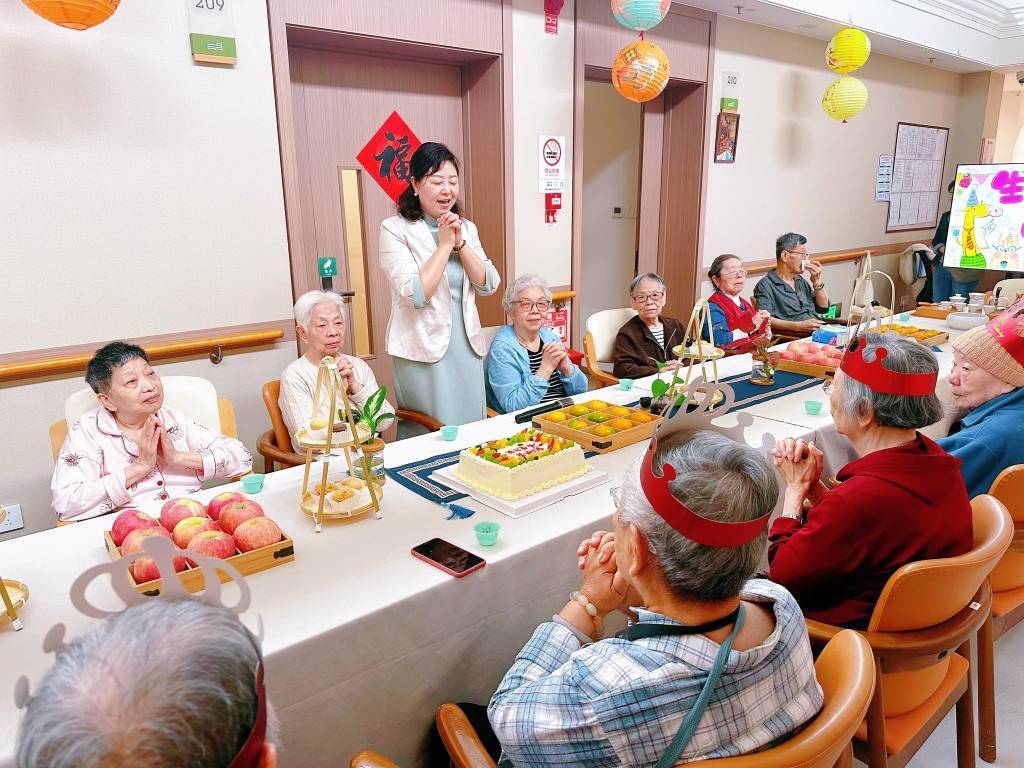
Wang Youmin and the elderly. Respondent graph
The “test” after changing careers
To be honest, before I officially entered the industry, I had an image of a nursing home: the sun was shining brightly, the elderly were happy, and there were dedicated people to cook and take care of their daily lives. Our main job was to sing, dance, do crafts, and play games with them. These were all things I was good at in kindergarten, and I thought it would be easy to transfer to them.
The reality is not like this. When I first went there, I didn’t even know where to start.
Kindergartens can implement unified schedules, such as class time, game time, and rest time, and all children can be synchronized. When I first arrived at the nursing home, I copied this idea and arranged a complete and unified schedule.
It was only when we were about to implement the service that we discovered that only three meals, morning care, and evening care could be fixed at fixed times. The rest of the time could not be unified. It had to be adjusted at any time according to the physical condition of each elderly person, and the caregivers had to adapt according to the on-site conditions.
In addition to the work and rest schedule, the thinking inertia of early childhood education also makes me “step into pitfalls”. There is a saying called “old child”. Many people think that you can talk to the elderly in a coaxing tone. But the old man already has rich life experience, so he would feel disrespected by speaking like this.
When talking to the elderly, be sincere and polite, and respect his autonomy. For example, when eating, I will tell him what nutrients the ingredients in the meal have and how they are good for his body, so he is more likely to accept it. Some elderly people have very rich life experience. They will directly point out that today’s meals are repeated and the combination is unreasonable. I have to listen carefully to all these.
The same goes for feeding. For children in kindergartens and small classes, just chop the food into fine pieces. Every time the elderly eat, their swallowing ability must be checked first.
But from the experience of early childhood education, there are also things that can be brought over: love, patience, and carefulness.
Carefulness is reflected in observation. During a group activity, an old man’s neck kept twisting from side to side, and the caregiver could not find out the reason. When I looked closer, I realized that the clothing label was sticking up and pricking the skin of my neck.
Not long after I arrived at my job, I encountered my first “test”.
On the Double Ninth Festival, I carefully prepared an activity to respect the elderly. My old colleagues from the kindergarten where I used to work were very supportive and organized the children from the top class to participate in the activities. The process was very complete. The day before the event, I greeted the elderly people in the courtyard one by one. Everyone was very happy and said “ok”. Except for a grandmother who is over 80 years old and suffers from dementia. When I called her, she became angry on the spot: “What kind of event? I won’t go! I won’t participate!”
During the activity, many elderly people suffered from physical problems. The nursing home is on the 5th and 6th floors with limited space. Most of the residents are elderly people who are severely disabled or semi-disabled.
Later, the caregivers pushed them back to their rooms to rest. In the end, there were more children present than elderly people participating in the event.
Seeing that scene, I felt quite disappointed.
This incident taught me a great lesson. When organizing activities for children, we will set clear goals and achieve predetermined results; when organizing activities for the elderly, the core is to accept individual differences and everything should be based on the actual physical condition. The old man is allowed to just watch from the side, and he is allowed to withdraw at any time midway. The old man is just in a bad mood, and he does not need to come.
There is also a type of emergency situation where an elderly person suffers an emergency on the spot.
During a group activity, a grandmother in her 80s suddenly turned blue and her lips turned purple. We saw something was wrong and immediately called 120. The rescue was timely and the old man was out of danger.
This is a risk brought about by the decline of physical functions in the elderly. The first version of the activity plan I took the lead in writing did not cover safety, but the second version specifically added safety points for the entire process of recreational activities. After this incident, we put safety protection at the top of all our recreational activities.
If you want to do a good job, you can only summarize things one by one.
Two months into my job, I faced the death of an old man for the first time.
He was a grandfather in his 80s who had underlying diseases and was bedridden for a long time.
On the morning of November 23, 2023, I went to the room to talk to him, asking him how he had eaten for breakfast, what he felt uncomfortable about, what he wanted to eat, and told him to ring the bedside call bell if he needed anything. I developed this habit when I was the principal of a kindergarten. There used to be two hundred children in the kindergarten, and I could call everyone by name and know who would pick them up every day. When I arrived at the nursing home, I remembered every elderly person and took the initiative to say hello. Even if the elderly were bedridden and had poor cognitive status, I would also go up and ask.
About an hour after I left the room, a notice came saying that the grandpa was in critical condition.
I was completely stunned.
I walked to the door of the room, but I didn’t dare to open the door and go in. I was scared, and the image of him that morning was still in my mind. The emergency personnel at 120 were doing first-aid compressions, and the equipment was beeping. The family members also arrived. I stood there, not knowing how to comfort me and unable to say a word.
Confronting changes in demographic structure
I am from Chuzhou, Anhui Province. I was admitted to Chuzhou Normal School in 1993 and graduated in 1996.
At that time, not many people studied as kindergarten teachers. I chose this path because of the influence of my mother, who is a primary school teacher. In that era, it was said that “son inherits father’s career” and “daughter inherits mother’s career”. Many teachers in the school hope that their children will also have a job in education in the future. The reasons are very practical: first, teachers have winter and summer vacations; second, teachers had a high social status at that time, and the elders thought it was a decent job.
In the year of graduation, most of our classmates went to kindergarten teachers, more than half of them went to public kindergartens, and some went to private kindergartens. At that time, there was a gap in public preschool education resources, and private kindergartens were supplemented by private kindergartens, which attracted many graduates.
After working for a while, I came up with my own idea to open a kindergarten in Chuzhou. I have opened two kindergartens in total. At that time, the student population was very good. At the most, the two kindergartens combined had more than 300 children, basically from surrounding communities.
At that time, there was no complete concept of daycare. Many classes were mixed-age classes, where 3-year-old children and 6-year-old children were in the same room, and the older one would take the younger one with him. Parents do not have high expectations for preschool education. Most of them only want to take good care of their children and provide some simple enlightenment.
Later I met my lover, who was working in Shanghai at the time. In 1999, I came to Shanghai and entered a kindergarten in Xuhui District, where I worked as a kindergarten teacher for ten years.
In the past ten years, I have taught small classes, middle classes, and large classes. There are relevant standards for kindergarten class sizes: no more than 25 students in a small class, no more than 30 students in a middle class, and no more than 35 students in a large class. Even if there is an upper limit, the actual number of people is often close to the line, and sometimes even slightly exceeds it because the demand for children to enter the kindergarten is too great. When there are sufficient students, kindergartens will not have to worry about recruiting students.
In 2009, I was transferred from a front-line teacher to another kindergarten as the deputy principal. Two years later, I was transferred back to the previous kindergarten as the principal. This coincided with the years when preschool education was developing the fastest.
When I first returned to work as the principal, there were 5 classes in the kindergarten. Later, there were too many children and the number was expanded to 6 classes. At its peak, there were more than 200 children in six classes.
The industry began to discuss the declining birthrate, probably around 2015. I attended an industry conference where experts talked about population development trends. At that time, there was a common judgment in the industry that private kindergartens were the first to be affected.
In those years when the industry advocated “one park, one course”, they were all thinking about one question: how to attract students in the future. In 2015, we began to offer kindergarten-based special courses, focusing on traditional culture, integrating ancient poetry into children’s painting creations and incorporating them into daily rhythmic exercises. I believe that as long as we teach in a down-to-earth manner and polish the courses well, we can withstand risks.
From 2016 to 2018, the number of students was still very good, and no obvious impact was seen. The turning point came in 2020.
In the early years of enrollment, three to five children who registered could be admitted to the kindergarten. By 2020, only one child who registered would be admitted.
The pressure will be even greater in 2021. We organized all faculty and staff to distribute flyers in places where children gather, such as botanical gardens and children’s play areas in shopping malls. We also went to communities to give course demonstrations and encouraged teachers to recommend students. The tense atmosphere could be felt throughout the park. 2022 will be the most uncomfortable year. Three out of five children who had originally decided to register did not come.
During parent-teacher meetings, I would also ask: If conditions permit, would you like to have another child? Most shook their heads. Look around you, many young girls in the early childhood education industry are still in their 30s and have not yet gotten married. The desire and concept of childbearing are different from the past. Based on the data and the feedback from people around me, I am sure that the decline in students is not a short-term fluctuation, but a change in the demographic structure.
In those years, every Double Ninth Festival, I took my children to surrounding nursing homes and neighborhood committees to do elderly care activities. In nursing homes, it can be clearly felt that the number of elderly people is increasing year by year. When chatting with people in the neighborhood committee, they also lamented that there are more and more elderly people under local management, and the care of the elderly is becoming more and more important.
There is news in 2021 that an old man living alone died at home and was not discovered for a long time. This old man lives in the community where our kindergarten is located. This incident touched me deeply. We have witnessed batch after batch of children grow up, and the kindergarten has also brought out many outstanding early childhood education backbones, but now the elderly group needs more attention.
There is a saying that I always remember: There are old people in every house, and everyone will grow old. My parents are also old, and I will be old myself in the future. From that time on, I began to pay attention to the elderly care industry.
In May 2023, we went to Ningbo, Zhejiang to visit and study. There is a local chairman who runs a kindergarten and is diversifying the industry. What he did impressed me deeply: the main building is a kindergarten, and a new building is built next to it to serve the grandparents who come to pick up and drop off their children every day, and to provide day care for the elderly.
I asked him how to do it. He said that the old man sent his grandchildren to the kindergarten, walked to the building next to him, and had lunch in the community canteen. The building has a calligraphy and painting room, a chess and card room, a Tai Chi class, and a dance room. You can choose whatever you want to do. This model has two levels of value. One is to stabilize the source of kindergarten students, and the other is to serve the elderly who come to pick up and drop off children. The activity space for young children and the activity space for the elderly are independent of each other, but the young and old are actually integrated together.
After returning, as an employee representative of the Xuhui Chengfa Group to which the kindergarten belongs, I visited several sites, including nursing homes, which are key projects promoted by the group. Some of them are nursing homes that were transformed from idle nursery sites. Looking at it, I think the pension industry has good prospects.
It was also at that time that everyone started talking about the fact that the director of a nursing home was about to retire. This position had been recruiting people, but no suitable candidate could be found. After hearing this, my heart moved.
I took the initiative to discuss my ideas with the leaders in charge of the group, and participated in the formal interview for the head care unit.
Passed the interview. I joined an elderly care home in Shanghai Tianlin Community as the deputy director. The registration time is September 1, 2023.
The two kindergartens I used to work in were closed in 2024 and 2026 respectively. As far as I know, most of the teachers took compensation and left, and one teacher also moved to the elderly care industry as a social worker.
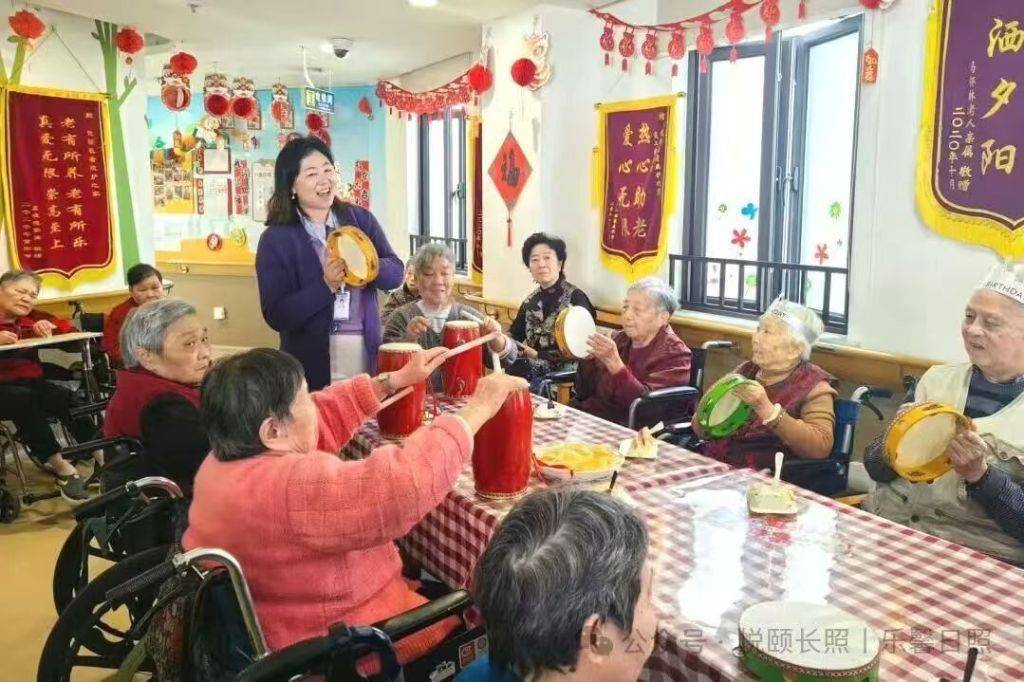
Wang Youmin and the elderly.
回爐重造
Three months after joining the elderly care home, I decided to apply for the job as a primary care worker. The business of this nursing home includes three major areas: 24-hour residential care, home care, and community meal assistance. When I first joined the company, I not only had to learn and understand the management model of each project, but the group also arranged for experts in the industry to conduct quality assessment and guidance. From admission and discharge to catering and nursing, I learned every step along the way.
During the learning process, I found that there was still a gap between the knowledge in books and simulation training on models and the real front-line nursing scenes.
For example, I thought it would not be difficult to move a semi-disabled old man from bed to a wheelchair at first. The test training uses a simulation model. The model follows your strength, which is very labor-saving. The real old man’s body is soft and weak, and may not necessarily follow you.
The first time I did the operation, the person I transferred was a tall old lady who weighed 1,780 pounds. The order is to move the shoulders first, then the hips, and finally the legs. Together, they help the person to sit firmly on the edge of the bed, and then help her put on her shoes. It took the skilled caregiver ten minutes to complete the entire procedure. My movements were unfamiliar and I couldn’t find my strength. It took me more than twenty minutes and I was sweating all over.
Another example is pressure ulcer prevention, which is also a highly professional nursing operation. The process is as follows: the old man lies down first, then turns sideways, and the nursing staff massages the pressure points one by one. After massaging one side, the old man turned over to lie down on his back. He had to arrange the quilt properly to prevent it from being pulled away when he turned over. Then help the old man turn over and massage the other side.
To prevent pressure ulcers, you must first take care of the elderly’s emotions. When turning over, the temperature of the room should be controlled, and the quilt should be lifted to massage to prevent people from catching cold; after the elderly person turns over, use lotion to massage the coccyx, which is prone to pressure. The whole process is interactive with the elderly, not mechanically moving the body.
There is a grandfather who is over 80 years old. He is more than 1.8 meters tall, almost completely bedridden, and weighs nearly 200 kilograms. The caregiver said it was difficult to turn over, so I went up to help. I’m not a small person, but after giving him a rolling massage for the first time, I couldn’t straighten my back when I got home from get off work.
Only then did I understand why many family members give priority to tall caregivers when looking for them. When facing heavy bedridden elderly people, physical strength is the threshold. When I first started practicing, I was so tired that I couldn’t lie down at night, so I had to sleep on my stomach.
You have to practice it over and over again to get it right. If you don’t do it yourself, you won’t understand how difficult it is for caregivers.
In the first half of 2024, I had just obtained my primary care worker certificate and encountered something that I had been afraid of for a long time.
There was an old man who had difficulty moving and could not speak. His family members secretly gave him a piece of cake. That day he was on the aisle, taking out the cake and eating it. I happened to be passing by and saw that he had a strange look on his face and kept pointing his finger at his throat.
I immediately went over and used the Heimlich maneuver to help him expel the things stuck in his trachea and clean up the remaining residue in his mouth. The old man recovered quickly.
A piece of cake may kill a person. The safety management responsibility of nursing homes is too heavy. The elderly may choke, suffer from pressure sores, fall, or become lost. Firefighting and food safety must not cause any problems in any aspect.
When I went home that day, I felt completely empty. In the past, in kindergarten, our curriculum concept was “Growing up in the sun”, and every day was full of vitality; after that time, I felt like a fog had drifted into my heart.
For a while, I didn’t dare pass by the corridor where the incident occurred. I thought over and over again that if I had not happened to pass by and if the rescue had not been successful, I would have been stuck in self-blame for the rest of my life. The scene at that time was replayed in my mind, and I thought about each gesture after gesture, which part of me failed to do the right thing.
Later, I found a way. I used to love folk dance, so I found a teacher to take classes again. I danced to relieve stress and slowly adjusted.
After this incident, I didn’t want to put the old man’s life on the luck of “just being there”, so I began to take the initiative to systematically learn the professional skills of elderly care and apply for the senior nursing job. Because only by understanding the full set of regulations can I train employees more accurately, set prevention and control nodes, revise plans, and prevent fatal risks such as choking in advance instead of waiting for rescue after an accident occurs.
Junior caregivers focus on front-line practical operations, and a large part of the work of senior caregivers is to guide and train junior and intermediate caregivers. Senior caregivers are also involved in palliative care: how to soothe the emotions of the family members of the dying elderly, how to give family members advice on funeral arrangements, and how to provide psychological counseling to family members.
In 2025, I obtained the senior nursing certificate. Now, with every movement of the caregiver, I can tell at a glance whether the gestures are standard or not, and what risks are hidden in the care. There are many details that I would not have noticed before.
For example, when transporting a wheelchair, there should be a fistful of distance between the position where the seat belt is fastened and the chest of the elderly person. When pushing a wheelchair down a slope, do not push forward along the slope. Instead, walk backwards with your back to the slope. At the same time, pay attention to the road conditions behind you, and keep the elderly’s hands away to avoid being pinched when closing the door. When giving a bath to a bedridden elderly person, towels and basins must be prepared in advance according to their use. Room temperature and water temperature must be controlled to prevent wind and keep warm. These are the cognitions I only gained after studying the system.
Care for two generations
I never told my family about my transfer to a nursing home at first. I didn’t tell my mother until the time for joining the company was decided.
She is 73 years old, still in good health, and lives with us in Shanghai. She was cooking in the kitchen, holding onions and ginger in her hand. After I finished speaking, she slapped it on the cutting board. She felt that I didn’t discuss such a big matter with her in advance.
“If you are a good educator, you can help others with their excrement and urine.”
There was a reason why she reacted so violently. She has personally taken care of my ancestors and knows that taking care of the elderly is not the same thing as taking care of children.
My maternal great-grandmother died in our home. She fell down when she was in her 80s and was paralyzed and bedridden for two or three years. My father was a long-distance trucking driver and was rarely home. Most of the care for my great-grandmother fell on my mother, who was still working as a primary school teacher.
Her day at that time was like this: she got up at six in the morning, first went to see the bedridden old man, changed dirty clothes, made breakfast, and fed me one bite at a time; then she settled me in and sent me to kindergarten; and then rushed to school. At that time, students in kindergartens and primary schools had to go home for lunch. She would come back after get off work at noon, cook for the elderly, clean and care for them, help us eat, rest for a while, and then go back to school. At night, after the housework and elderly care are finished, she still has to prepare lessons, often until midnight.
That day, after I told her about the job transfer, we didn’t even have dinner. She sat on the sofa and told me these past events, and she cried while telling me. She said that the educational experience I have accumulated over the years cannot be used in a nursing home, which means that decades of career accumulation have been in vain; I have already become the director of the kindergarten and my career development is very good, so there is no need to take this step.
I also wavered and called the leader in charge of the group to ask if I could withdraw my application for job transfer. The leader said that the entire process has been completed and the new principal who succeeded me has arrived, and there is no way to make any further adjustments.
My mother later said, “Now that you have decided, I can’t change you.” She asked me to buy her a ticket back to her hometown. The next day she took the train back alone. She did not say goodbye to me in person, but only said to my husband: “I have no control over the affairs at home. I can’t see out of sight.”
By 2024, we will have almost no communication for almost half a year. Later, we resumed sporadic contact, but we deliberately avoided the topic of elderly care. Whenever I talked about work, she would become silent and would just walk away.
In the past, when she went home to celebrate the New Year and her relatives were sitting around the table, she would proudly introduce her: My daughter is the principal of a kindergarten in Shanghai. During the Chinese New Year in 2024, my husband and I returned to Anhui, and she deliberately did not mention my current job.
The change occurs in 2025. My younger brother called and told me that my mother had fallen and her hip bone was broken. She had a steel plate implanted in her body. She could not move her right leg and could only lie flat for a long time after the surgery. I immediately rushed back to my hometown hospital and stayed with him for a whole week.
A nurse was hired at night, but the nurse only did the most basic tasks: handling the toilet and wiping the face. It was September, the weather was still hot, and I noticed that the skin on her body that was under pressure began to turn red, indicating a high risk of pressure ulcers. Once an elderly person develops a pressure sore, it will worsen step by step, and in severe cases, it can even rot to the bone.
There was no air bed in the hospital, so I first used soft cushions to prop up the areas where she was under pressure and raise them up. Only one place was not enough. The heels and hip bones were also under pressure and needed to be raised up.
She had just had surgery, and the injured leg could not be moved at will, and it was difficult to turn over. I first used a soft pad to protect the injured leg, then helped her turn over little by little, massaged her back with lotion, gave her a bed scrub, and changed the bed sheets and quilt covers.
These are practical projects in primary nursing courses.
The nurse next to me watched me turn over, change the sheets, and called to the others: “Come over and take a look.”
After this set of care, my mother felt much better. She also began to introduce to others: My daughter is studying nursing care. After seeing it with her own eyes, she knew that this job was professional.
Since then, our mother-daughter relationship has softened.
It has been a full year since she was injured last year. My home is a three-story building with no elevator. She has difficulty with her legs and feet. I plan to make aging-friendly renovations at home: divide the living room on the first floor into a bedroom, install handrails in the bathroom, and replace the furniture with ones suitable for the elderly. I have managed more than 20 home care caregivers and am very familiar with these.
In nursing homes, professional matters are left to professionals. The chefs cook, the caregivers take care of it, and the managers do the operations. There is a clear division of labor. It is very difficult for a home caregiver to take care of everything: cooking, professional care, housekeeping, emotional counseling, and caring for the elderly with dementia.
“See someone well”
In August this year, I joined a nursing home in Shanghai Kangjian Community as the director. Now, more and more young people are entering the elderly care industry, which I think is a general trend and a good thing. Our organization has two interns from technical colleges.
But I have also seen that many young people enter the industry with the goal of moving to management positions in the future and are unwilling to take root on the front line. Therefore, I believe that schools should have in-depth linkage with elderly care institutions, and allow students to go to the front lines of institutions to experience it as early as possible, to experience first-hand what care is like, and to identify in advance whether they are willing to work in this field, instead of just studying theory in books.
Now our elderly care institutions have set new rules: interns specializing in elderly care must start on the front line as caregivers.
Managers and supervisors of the nursing department have concerns about this. Some young people hold senior nursing care certificates, but they are still psychologically repulsed by the scenes of turning the elderly over, changing clothes, and handling excrement. We use the old to lead the new, letting senior nursing staff lead interns to do the work, and provide psychological counseling at the same time.
After working in early childhood education for more than 20 years, and now moving to elderly care, my attitude towards aging and life has changed a lot.
In kindergarten, what I face is growth, cultivating children’s abilities and habits, and laying the foundation for his lifelong development. In a nursing home, I faced aging, physical deterioration, and death. In kindergartens, scientific education methods can be used to guide children to get better little by little; in the elderly care industry, it is different. When faced with disabled or dementia elderly people, many conditions cannot be changed by human power.
As I come into contact with more elderly people, I find that the abilities of empathy, observation, and knowing how to see other people’s hidden emotions taught me by early childhood education have never been invalidated, they have just been placed in a different way.
A good preschool education will use “mood cards” to let children express their emotions at the moment: happy, angry, sad, lost… The elderly also have various emotions, and caregivers must learn to accept them.
There is a 92-year-old grandmother with moderate dementia who used to be a music teacher and loves beauty. Every time I go to see her, she compliments my outfit, but every time she doesn’t recognize who I am and I have to reintroduce myself.
Once, she put away the towel by herself, looked back and forgot where she put it, and insisted that the towel was lost. We did not directly say that she remembered it incorrectly. I first accompanied her for a walk outside, and quietly motioned to the caregiver to take out the towel from the cabinet and hang it back up. When we came back from our walk, I pretended to have just discovered it and told her that I had found the towel. This way there won’t be any conflict with her.
An old man always thought that we had taken her bank card and repeatedly asked us for it, saying that he wanted to withdraw money. In fact, he did not leave it with us. We don’t deny that we found an idle shopping card or transportation card and handed it to her pretending to be a bank card. When she got the card, she felt at ease and calmed down.
There is also an old man with moderate dementia who no longer recognizes his wife. He beats his wife at home and cannot take care of her at home, but he just doesn’t want to come to the nursing home. We changed the story and told him that this is a free nursing home specially opened by the state for those who have made contributions. He agreed.
Preschool education and elderly care, one is towards the morning sun, the other is with the twilight, two completely different life trajectories, and finally end up on the same thing – to see a person well, respect his feelings, and retain his dignity and value as a human being.
Related Reading
- In the early morning, an international flight from Hong Kong made an emergency landing. 146 people were evacuated through emergency slides. Reports said the plane showed signs of fire; the airline responded2026-11-22
- The AI cheating incident in South Korea’s college entrance examination has been brewing, and Education Minister Choi Gyo-jin has resigned. Previously, Lee Jae-myung offered a large reward to investigate and punish those who cheated in the college entrance examination: 100 million won for every cheating case reported2026-11-22
- The spectacle of “Hai Hao” appears in Weihai, and the sea suddenly seems to be “boiled and smoking”2026-11-22
- Iran’s President: The ongoing economic war is “far more difficult” than a military conflict2026-11-22
- Why are T and K classified as high-speed passenger trains? How to choose Z, N and V for normal speed trains? The authoritative answer is here2026-11-22