The “Voyager 1” probe launched by the National Aeronautics and Space Administration (NASA), after nearly half a century of flight, arrived at a position “one light day” from the Earth at about 18:00 on November 18, Beijing time – about 25.9 billion kilometers. This marks that Voyager 1 continues to break the record of man-made objects traveling in the universe and is the farthest man-made object ever flown by humans.
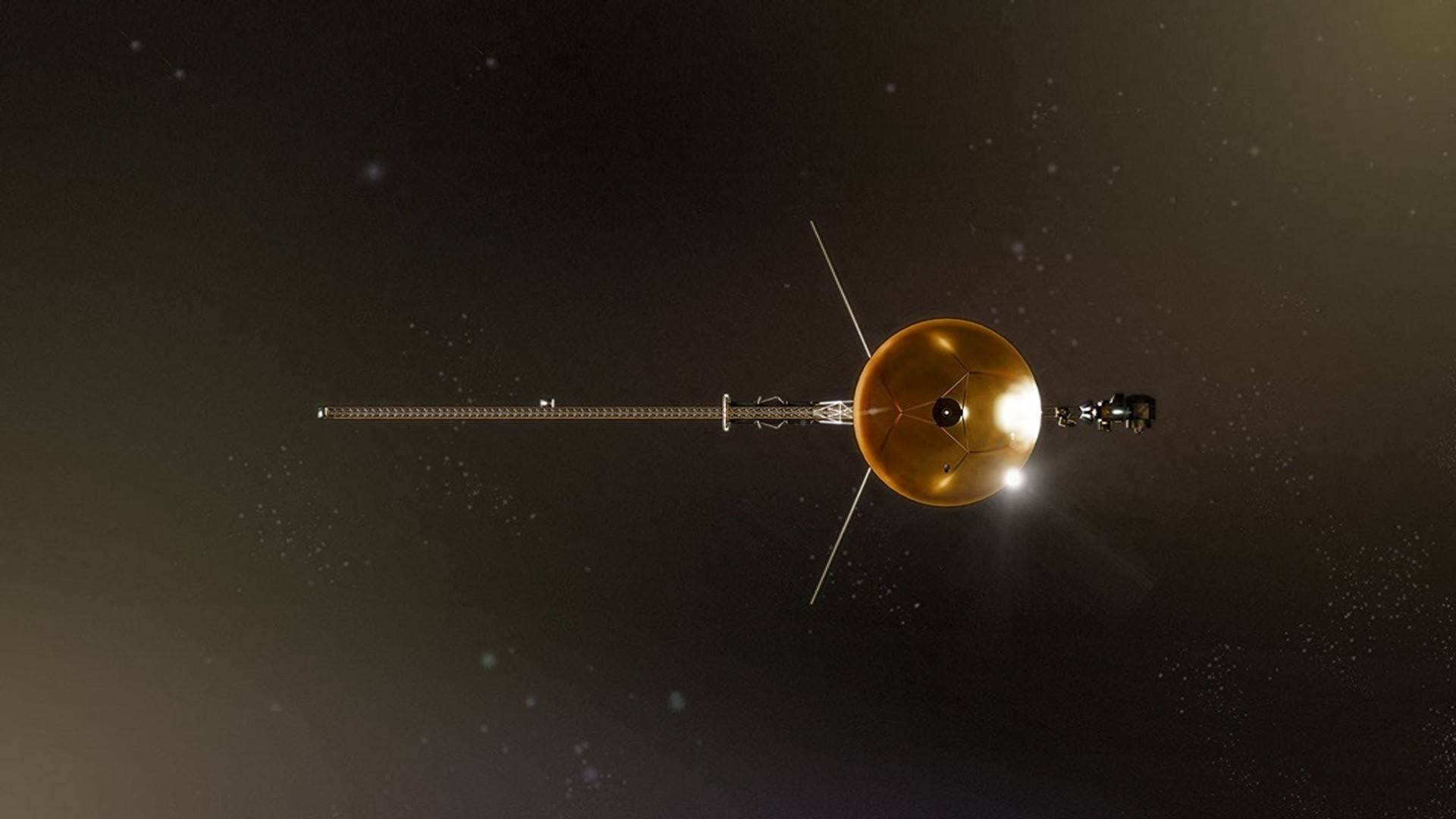
An artist’s concept drawing of the Voyager spacecraft (Source: NASA)
In the vast universe, the scale of metric space is stretched to light years. One light-year is approximately equal to 9.46 trillion kilometers, which is the distance traveled by light traveling at a speed of approximately 300,000 kilometers per second in one year. And 1/365.25 of it corresponds to “one light day”.
A beam of light only needs to travel a day, but Voyager 1 has been flying alone in deep space for nearly half a century. Its original mission was to explore planets outside the solar system. It was launched on September 5, 1977. Since then, it has flown by Jupiter and Saturn, and used the gravitational slingshot effect to gain additional kinetic energy and continue to fly to the outer edges of the solar system. In 2012, it successfully flew into interstellar space; now, it has reached a position “one light-day” away from the Earth.
Now, Voyager 1 continues to send back scientific detection data. However, as its distance from the Earth continues to increase, it becomes increasingly difficult for scientists to contact it. From the time the ground team issued the command to receiving the response from the detector, a single communication took 48 hours. As working hours continue to extend, Voyager 1’s energy supply is gradually decreasing. In addition, the detector also experienced data failures and communication abnormalities. With the efforts of the ground team, the related problems were repaired, further extending its scientific detection time.
During the flight, Voyager 1 also took a famous photo “Dull Blue Dot”. Its shooting angle is about 6.4 billion kilometers away from the Earth. In the light belt formed by sunlight scattering, the Earth’s figure only occupies about 0.12 pixels, making it appear extremely small. In the detector, scientists also specially placed a “golden record” that records information about human civilization. It is like a “cosmic drifting bottle” and looks forward to the opportunity to encounter other civilizations.
Related Reading
- In the early morning, an international flight from Hong Kong made an emergency landing. 146 people were evacuated through emergency slides. Reports said the plane showed signs of fire; the airline responded2026-11-22
- The AI cheating incident in South Korea’s college entrance examination has been brewing, and Education Minister Choi Gyo-jin has resigned. Previously, Lee Jae-myung offered a large reward to investigate and punish those who cheated in the college entrance examination: 100 million won for every cheating case reported2026-11-22
- The spectacle of “Hai Hao” appears in Weihai, and the sea suddenly seems to be “boiled and smoking”2026-11-22
- Iran’s President: The ongoing economic war is “far more difficult” than a military conflict2026-11-22
- Why are T and K classified as high-speed passenger trains? How to choose Z, N and V for normal speed trains? The authoritative answer is here2026-11-22