In October this year, Zhou Hongyi, the founder of 360, released a video on social platforms and publicly told about an accident he experienced.
He mentioned that while bouldering at a climbing gym, he accidentally fell from a rock wall about three meters high. At the moment of landing, because he failed to make a standard buffering action, his left leg supported the ground on one side. The huge impact directly caused a comminuted fracture of his left knee.
This self-narration quickly spread on social platforms, and also brought the emerging sport of indoor rock climbing to the public’s eyes again.
In the comment area and various communities, many rock climbing enthusiasts shared their experiences. Some people showed off the seven steel nails in their ankles, others sent in MRI scans showing signs of a ruptured anterior cruciate ligament, and others told about their experience of being bedridden for half a year after breaking a bone in a bouldering gym. Such falls are not isolated in a sport that continues to see an influx of young people.
According to the statistical analysis of rock climbing accidents in 2025 compiled by the Mountaineering Management Center of the State Sports General Administration, the China Mountaineering Association, and the China University of Geosciences (Beijing), among the rock climbing crowd, young people aged 18 to 35 account for more than 80%, and more than 60% are novices who have been in contact for less than half a year; more than half of the injuries are concentrated in the feet and ankles, and irregular protective actions, improper use of equipment, and insufficient risk assessment are the main causes.
The other side of the frequent accidents is the rapid heating up of this sport in recent years.
According to statistics from the China Mountaineering Association, the market size of China’s rock climbing industry has increased from less than 1 billion yuan in 2020 to approximately 4 billion yuan in 2024; as of December 2025, there are more than a thousand operating rock climbing gyms across the country.
Rock climbing was first born out of outdoor mountain adventures. In the mid-20th century, in order to maintain finger strength and movement memory during the non-climbing season, European mountaineers began to fix wooden blocks on barn and indoor walls to simulate rock wall routes, and modern indoor rock climbing evolved from this. At that time, it was a professional training with strict requirements on rope skills and fall prediction.
But as the sport becomes more popular, unknown risks are also accumulating. Many practitioners said that nowadays, a large number of inexperienced novices are flooding into rock gyms and blindly climbing to high places without mastering basic knowledge and fall protection movements. In the wildly growing rock climbing gym, it is mostly unclear whether the safety briefing before entry is in place, whether the protective measures are up to standard, whether the on-site safety personnel have first aid qualifications, and whether the design of the climbing route is reasonable.
It was not until after falling from the rock wall that many injured rockers discovered that “the most important thing in this sport is not only how to climb to the highest point, but also how to land safely.”
“There are many people injured due to rock climbing.”
Kuang Xiaxia had been climbing for less than a week when she fell from the rock wall.
She chose a fifteen-meter-high speed track. This is a vertical artificial high wall lined with dense red rock points. The climber’s only goal is to go straight to the top as quickly as possible.
In order to save the trouble of manually pulling the rope on the ground, the rock gym hung an automatic protector on the top. A flat nylon webbing hangs down and buckles onto the harness. When a person climbs up, the webbing automatically retracts; when the user lets go and falls off, the centrifugal braking system inside the device senses gravity and decelerates, smoothly returning the person to the ground.
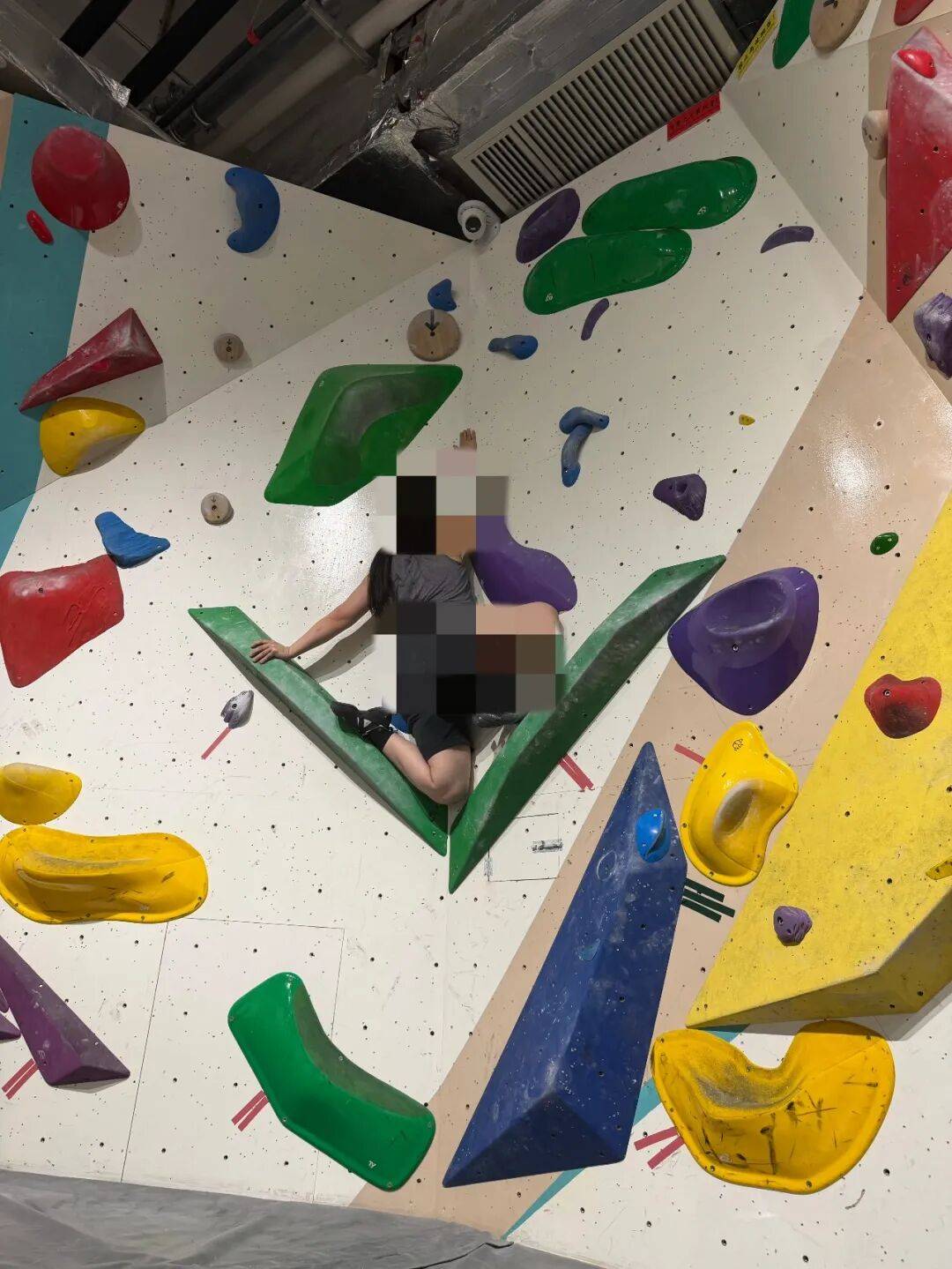
▲Kuang Xiaxia tried rock climbing for the first time. Picture/provided by interviewee
In Kuang Xiaxia’s eyes, this set of equipment provides a foolproof sense of security.
But soon, the visual pressure brought by an altitude of more than ten meters disrupted her rhythm. When she climbed to a high place, Kuang Xiaxia felt that the ground beneath her feet quickly shrunk into a blurry patch of color. The narrow field of vision and the feeling of suspension also made her hands and feet stiff.
She recalled that before entering the venue, the safety officer verbally explained the key points of falling off on the ground – when letting go, you must push off the rock wall with your feet and let your body hang back, so that the webbing can bear vertical force. But under the panic caused by the altitude, Kuang Xiaxia’s mind went blank. The moment her fingers took off the rock point, she pressed against the wall and slid vertically down the rock wall.
After falling about one meter, the protector at the top was locked due to force. This upward pulling force pulled her body into the air, causing a huge swing in an instant. The moment she swung back forward, her left foot hit a large molding board protruding from the wall, causing a fracture of the left three ankles.
Compared with Kuang Xiaxia, 36-year-old Li Wei is considered an experienced enthusiast and has been rock climbing for nearly a year. The area where Li Wei’s accident occurred was in the bouldering area. Bouldering is a type of rock climbing that does not rely on any ropes or machinery. The height of the rock wall is usually controlled within four and a half meters, and the thick sponge mat on the ground is the only means of protection.
In bouldering, the industry usually uses “V difficulty level” to mark the difficulty of the route. The higher the number, the higher the difficulty. For amateurs, V3 is a watershed. This level of rock wall has a camber elevation of more than ten degrees, the rock points become smaller, and the gripping surface is mostly inclined. Climbers must rely on explosive power and core strength to complete the climb while their body is suspended in the air.
It was his fourth attempt of the day. At that time, Li Wei was hanging on an elevation wall more than three meters above the ground. When he jumped up to grab the next rock point, the toe of his right foot accidentally slipped. His whole body was completely suspended in the air, and he was caught off guard and fell.
In the past year of climbing, Li Wei jumped from similar heights countless times, and every time he was firmly caught by the 40-centimetre-thick seamless sponge pad on the ground. This experience gave him an inertial judgment, thinking that “it will be fine if it falls on a thick mat.”
The accident happened unexpectedly.
Li Wei recalled that when he fell, he did not follow the standard action of bending his knees, leaning back, and rolling to release force. Instead, he subconsciously straightened his right leg and tried to land upright on one foot. The moment the sole of his foot hit the ground, the huge impact was transmitted directly from the heel to the joints, and he immediately fell to the mat.
The diagnosis confirmed a comminuted fracture of the talus of the right foot, accompanied by subtalar joint dislocation. The doctor told him that the talus is the load-bearing core bone of the ankle joint and has poor blood supply around it. The comminuted injury caused by this high single-point hard support is not only severely fragmented, but also accompanied by the collapse of the cartilage surface. Even if the surgery is completed, it will be difficult to fully restore the joint mobility in the future.
During the long recovery period, Li Wei posted his experience to several rock climbing WeChat groups he frequented. The feedback in the group was beyond his expectation. The group members were not too surprised, but instead led to a series of similar injury exchanges: ruptured anterior cruciate ligament, meniscus compression tear, internal fixation of clavicle fracture, and spinal contusion caused by falling off a high wall…
Only then did Li Wei realize that “there are many people injured due to rock climbing.”
“A sense of control”
There are different reasons that bring people into climbing gyms.
Kuang Xiaxia, 27, works as an operator at an Internet company. Usually, her work schedule is full, business reports come one after another, and she still receives work news late at night. Anxiety is everywhere.
After accidentally seeing a blogger’s sharing about rock climbing on a social platform, she was attracted by the sense of power shown in the picture and decided to give it a try at the rock gym.
After actually putting on her shoes and standing under the rock wall, rock climbing was not what she expected.
Routes on artificial rock walls are pre-planned by route setters. There are resin rock points of the same color distributed on the same route. From the start to the end, there are fixed trajectories where you hold your hands, where you step on your feet, and how your body’s center of gravity moves. Before climbing, people need to stand under the wall and deduce body movements. In the rock climbing circle, this process is called “line reading.”
Reading the thread for the first time, Kuang Xiaxia felt a rare concentration.
The climb begins. Kuang Xiaxia’s fingers were clasped on the bulge a few centimeters wide, her toes stepped on the narrow fulcrum, and her attention had to be highly concentrated on every exertion and balance of her body. If you are distracted or move unsteadily, you will lose your hands and fall. In those few minutes, all I could think about was the moves in front of me. She felt that this state of high concentration helped her temporarily relieve her mental fatigue.
There are many people attracted by this sense of purity. Under the rock wall, a relatively relaxed social atmosphere has also attracted more young people to stay in this sport.
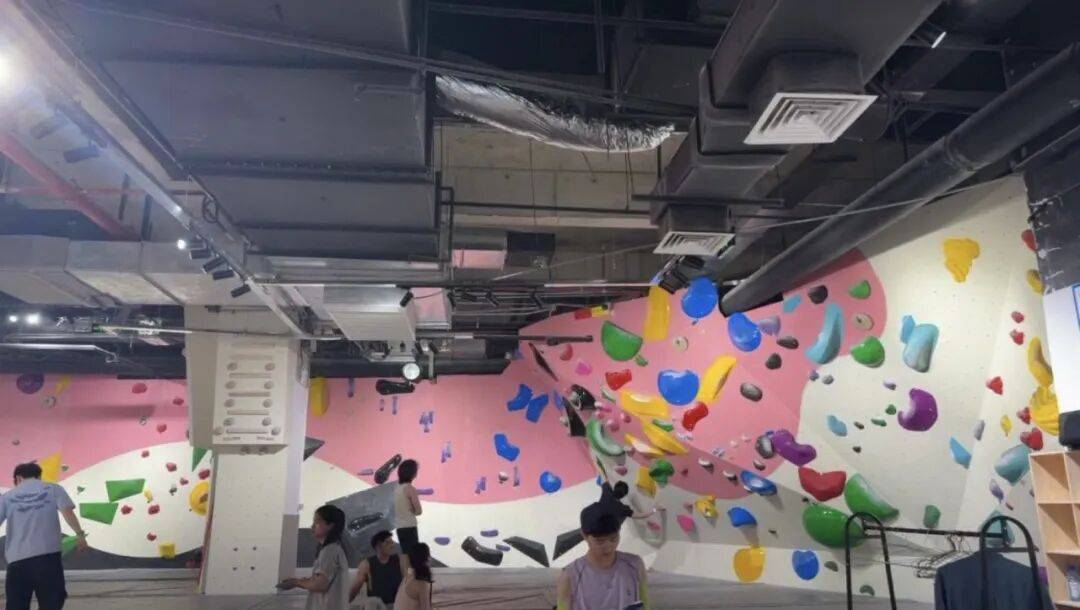
▲In the bouldering area, many enthusiasts are waiting to climb. Picture/provided by interviewee
Zhou Yuan has been running a rock climbing club in Shanghai for nearly seven years. In his observation, the structure of the crowd that has poured into the rock gym has changed greatly in the past two years. In addition to the original outdoor enthusiasts, white-collar workers and college students have become the main force. “Many people come initially to exercise and decompress, but then stay, largely because of the happier atmosphere in the gym.”
Zhou Yuan gave an example. In the bouldering area, everyone was wearing loose sportswear and sitting on the same sponge mat. Communication usually revolves around the route on the wall. For example, when a person is stuck in a certain movement and tries repeatedly, the person next to him will pass a long-handled brush to help clean the magnesium powder on the rock point; when encountering difficulties that cannot be overcome, veterans often come over and point out key movements to help the climber reach the finish line smoothly.
“After completing the action, there were enthusiastic high-fives, and even when I fell down, I laughed it off. This low-burden way of getting along makes it easy for people to feel friendly.” Zhou Yuan said.
This relationship sometimes extends to the outdoors as well.
Li Wei has several local rock climbing groups on his phone. Every Thursday, the group will initiate carpooling to the wild rock field. Wild climbing is different from indoor climbing. Under a natural rock wall tens of meters high, one person climbs up, and the other person must hold the protector on the ground and pull the protective rope. The safety of the climber depends entirely on the concentration and reaction of the climber on the ground. Once the climber steps on the ground, the person below needs to brake and lock the rope as soon as possible. After several trips to the wild, we can often build deep trust between each other.
According to the accounts of rock climbing enthusiasts, once the attempt gradually becomes a habit, the time, money and physical consumption also begin to increase simultaneously.
Li Wei introduced that novices can enter the venue and experience it by spending more than 100 yuan to buy a single ticket and rent a pair of shoes. But if you want to play for a long time, the cost will increase.
In order to adapt to different types of routes, Li Wei successively purchased six pairs of professional rock climbing shoes. The soles of these shoes are usually made of hard rubber and the toe box is bent downward. When wearing shoes, the toes must be curled tightly into the narrow shoe cavity so that the toes can accurately touch the edge of the tiny rock surface.
When he first started wearing them, Li Wei’s toes were often squeezed and painful, and he needed to take off his shoes frequently to relieve the pain. Later, the pain took a backseat to habit. In order to exert his strength more accurately, Li Wei successively spent tens of thousands of yuan on advanced rock shoes, liquid magnesium powder, customized powder bags and high-elastic climbing pants…
The body is also quietly changing.
Long-term gripping makes climbers’ knuckles thicken, and thick calluses develop on their palms and fingertips. When exerting force on the rock wall, the calluses on the hands are sometimes worn away by rough rock points, exposing the reddish flesh underneath. Li Wei said that in the rest area of the rock gym, you can often see people simply rinse their wounds with cold water, wrap the broken knuckles with white sports tape several times, dry their hands, re-apply white magnesium powder and continue climbing.
For many enthusiasts, pain is a daily occurrence. They experience the satisfaction of overcoming difficulties and a sense of control in their upward attempts, and they are unwilling to stop.
Climbing gym regulations
Zhou Yuan, 37 years old, is one of the first people in China to get into rock climbing.
In 2012, while traveling in France, he walked into a local indoor rock gym for the first time and was attracted by this sport. After returning to China, he obtained the rock climbing instructor qualification from the China Mountaineering Association. Starting from the most basic resident coach, he accumulated experience and customers and opened his own rock climbing gym.
Around 2016, Zhou Yuan heard for the first time that an amateur fell and became disabled in a commercial rock gym. In the nearly ten years since then, similar accidents have been reported to him intermittently.
In the past two years, Zhou Yuan has published popular science on rock climbing technology on social platforms, and has received many private messages from readers asking for help. As he combed through the information, he discovered that fractures, Achilles tendon ruptures, and ligament tears caused by falls among amateurs at commercial rock gyms across the country were not the only ones.
He began to publicly appeal: “A high-risk sport with professional thresholds cannot be simply packaged into a risk-free Internet celebrity project.”
Zhou Yuan observed that as the popularity of rock climbing increases, many newly opened rock gyms are located in bustling commercial core areas. Most of them are promoted as “fashionable decompression lifestyle” and “zero-based experience”. On social platforms, content such as “beginner-friendly” and “one-hour indoor rock climbing check-in” appear frequently.
He said that in the bouldering areas of many rock gyms, the first thing many first-timers do before going up the wall is to put the mobile phone holder on the sponge pad and adjust the video angle. During the climb, some people repeatedly froze their poses in mid-air in order to take pictures, and even turned back frequently to confirm the shot. Many people mistakenly believe that they can easily play just by putting on a pair of shoes and stepping on colored rock points, completely ignoring the potential dangers of this sport.
In fact, in my country’s current management system, rock climbing has a clear legal definition. According to the “Announcement on the Catalog of the First Batch of High-Risk Sports Projects” jointly issued by five departments including the State Sports General Administration in 2013 (State Sports General Administration Announcement No. 16, 2013), rock climbing was listed as the first batch of high-risk sports projects together with swimming, diving, and skiing, and its business sites must obtain administrative licenses.
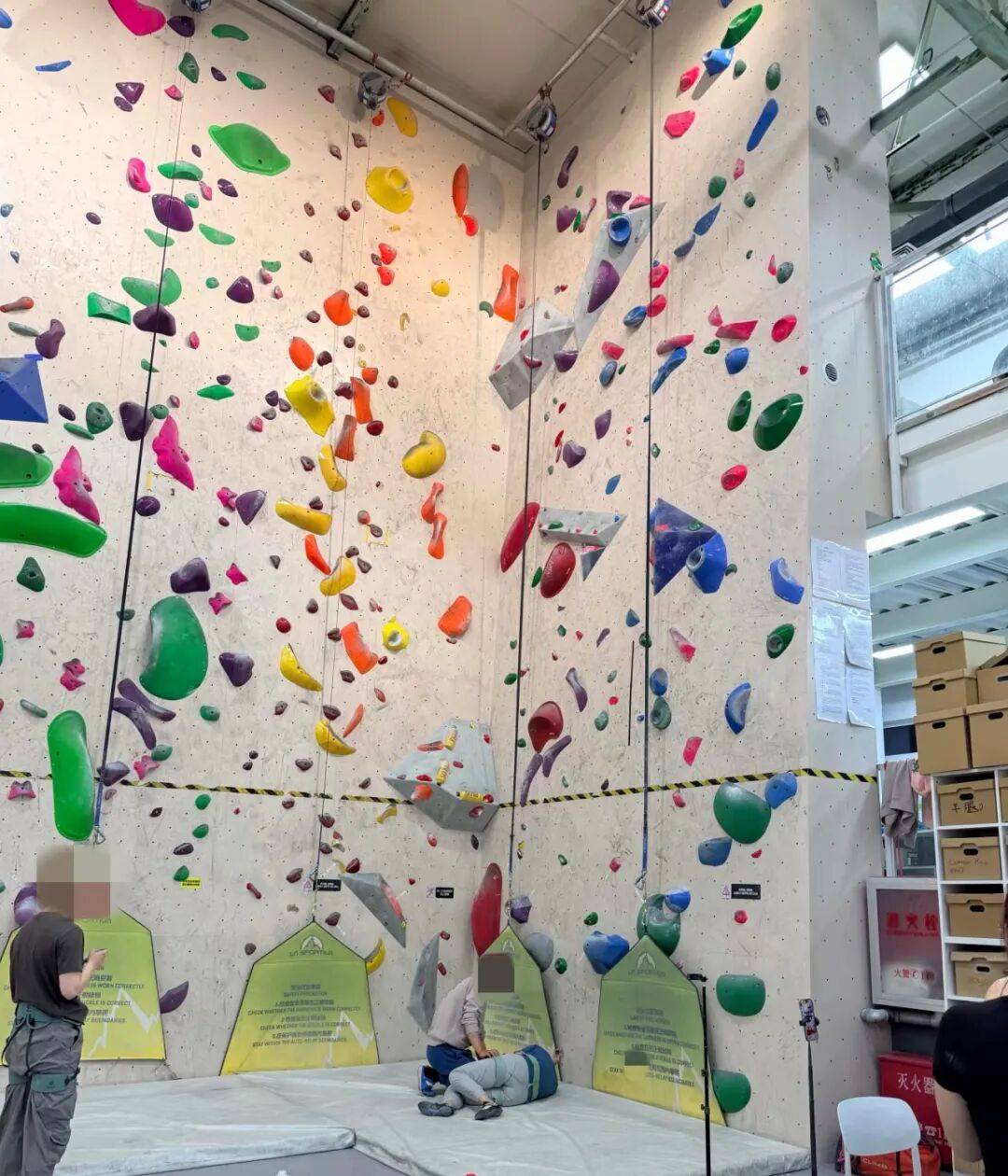
▲In a rock climbing gym, a rock climber fell and was injured. Picture/provided by interviewee
According to the sports standards formulated by the China Mountaineering Association, rock climbing is mainly divided into three types: difficulty climbing, speed climbing and bouldering. In the professional sports system, before athletes attempt difficult movements, in addition to long-term core strength reserves, they must also go through thousands of “body-receiving” falling drills to establish muscle memory that instinctively protects the trunk when falling.
However, in the commercial promotion in recent years, the original professional and high-risk attributes of rock climbing have been continuously diluted.
“The bouldering area is the area with the highest incidence of serious injuries.” Zhou Yuan explained to the Beijing News reporter that unlike high walls with protective ropes attached, bouldering does not use ropes and machinery at all. When a person lets go on a wall with an elevation of more than four meters high, the body’s weight and falling momentum are all borne by the body alone.
Under the influence of the acceleration of gravity, even if you are only three meters high, if you do not curl up and roll to relieve the force when falling off, but straighten one foot to support the ground out of instinct, the impact force several times the body weight will be concentrated and transmitted to the ankle joint in an instant. Even if the ground is covered with a 40 cm thick anti-collision pad, the bones may still be crushed instantly.
He mentioned that in countries where rock climbing is mature, risk avoidance relies on a strict access mechanism. After entering the gym, beginners must first participate in mandatory safety training and learn equipment inspection, knotting and body-holding movements. Only those who pass the venue’s safety assessment and obtain a certification card are allowed to climb independently.
According to many interviewed rock enthusiasts, “scan the code and climb, and the whole place is free” has become a common phenomenon in many new Internet celebrity rock gyms in China. Novices scan the QR code at the front desk to sign an electronic liability exemption agreement, put on their shoes and enter the climbing area directly. Admission safety notices are mostly limited to one or two verbal reminders at the front desk, or small text reminders on the wall that no one reads carefully. Some venues will not even arrange for professional coaches to conduct substantive fall recovery teaching.
Zhou Yuan feels that what changes these is the business model of rock climbing gyms.
He did some calculations and decided to open a standard commercial rock gym. The initial hard investment in venue rental, steel frame engineering, professional protective mats, and imported polyurethane rock points is usually between 1.5 million and 2 million yuan. Under the pressure of cost recovery, venues are highly dependent on passenger flow turnover. “If every individual visitor entering the venue is required to take a two-hour safety class and complete an assessment card before climbing, most customers who are trying out the experience will give up on the spot.”
In order to maintain passenger flow turnover, not only have the entry requirements been relaxed, but some venues have also reduced investment in safety management.
According to the national professional qualification certification standards, rock climbing instructors need to master protection station erection and emergency braking specifications, and intermediate instructors also need to have high-altitude rescue capabilities. However, in actual operations, in order to reduce labor expenses, some venues use on-site safety officers who are mostly part-time college students who are paid by the hour. They lack experience in sports protection and are difficult to accurately identify dangerous actions in the venue.
Facility hazards also exist. In order to control costs, some venues have not replaced the anti-collision protection mats on the ground for many years. The internal sponges have collapsed due to moisture and have gradually lost their buffering elasticity. In order to pursue visual novelty, some route setters have designed large-span dynamic jumps at heights that lack a safe buffer zone, further increasing the risk of climbers falling off and hitting the wall.
Zhou Yuan feels that while the entire industry is rapidly expanding driven by capital and passenger flow, soft service standards and professional supervision mechanisms to ensure personal safety have not yet been fully established.
The long tug of war
Once injured, there is often a long tug between the injured person and the climbing gym.
Zheng Xiaowan is going through this process. In January this year, she took a personal training experience class at a rock gym in Chengdu. Before entering the venue, the venue did not provide a risk notification letter and did not provide on-site training. Under the verbal instructions of the coach, Zheng Xiaowan climbed to the top of the rock wall and fell. The emergency department was diagnosed with a left trimalleolar fracture and required surgery to install a steel plate.
At first, the coach said that the venue was covered by public liability insurance and asked her to sort out the receipts for reimbursement. But when Zheng Xiaowan sent him tens of thousands of yuan in receipts for surgery fees and asked about subsequent compensation for lost work, the other party stopped replying. After several negotiations, the person in charge of the rock gym finally stated that rock climbing is a high-risk sport, and falling and falling injuries are inherent risks and should be borne by the individual.
Negotiations reached a deadlock, and Zheng Xiaowan decided to sue.
Similar situations are not uncommon in rock climbing disputes. Lawyer Li Huiling from Shaanxi Yunyi Law Firm is also a rock climbing enthusiast and a first-level national rock climbing referee. In the past two years, the number of claims consultations for the rock gyms she has taken over has increased significantly. “After most accidents, the injured believe that the venue failed to fulfill its safety guarantee obligations and demand major compensation; while the venue believes that rock climbing itself is a high-risk sport and injuries are inherent risks of the sport. The venue should not be held responsible if the facilities, equipment and personnel qualifications are legal and compliant. It is difficult for both parties to agree on the proportion of liability, and in the end they often have to go to court.”
Lawyer Li Huiling pointed out that when applying the law, such disputes mainly revolve around the venue’s safety protection obligations and the participants’ own boundaries of care.
On the one hand, the principle of “self-acceptance of risk” established in Article 1176 of the Civil Code mainly regulates liability immunity among participants and cannot directly be used as a defense for venues to exempt themselves from safety and security obligations. In addition, Article 506 of the Civil Code stipulates that liability exemption clauses for personal injury are legally invalid. Therefore, even if a venue requires customers to sign a liability exemption agreement, it cannot exempt them from tort liability due to facility defects or faulty guidance.
But on the other hand, the injured person does not “just get compensation as long as he is injured.” According to Articles 1198 and 1173 of the Civil Code of the People’s Republic of China, venues will only bear liability if they fail to fulfill corresponding safety obligations; at the same time, if the infringed party is at fault, the court will reduce the venue’s liability for compensation in accordance with the law.
Once it enters the judicial process, the core of the judge’s trial is to verify whether the venue has fulfilled its safety and security obligations commensurate with its high risk throughout the entire process, and to determine the compensation ratio based on the faults of both parties.
In judicial review, accidents are usually broken down into specific links for comparison: beforehand, whether the venue’s facilities and equipment, such as rock walls, protective mats, etc., meet national standards, whether the coach has legal professional qualifications, and whether substantial action guidance and risk notifications are provided; during the incident, whether the climbing area is maintained in order and whether the on-site safety personnel stopped dangerous behaviors in a timely manner; afterwards, whether the venue has basic first aid capabilities and whether there is any delay in treatment opportunities.
In addition, the judge will also consider whether the injured person himself has some fault, for example, knowing that he must wear a seat belt but not wearing it, ignoring prompts and insisting on challenging a route beyond his ability, etc.
The final determination of liability depends on the liability balance between the specific loopholes in the venue’s management chain and the negligence of the injured person’s own duty of care.
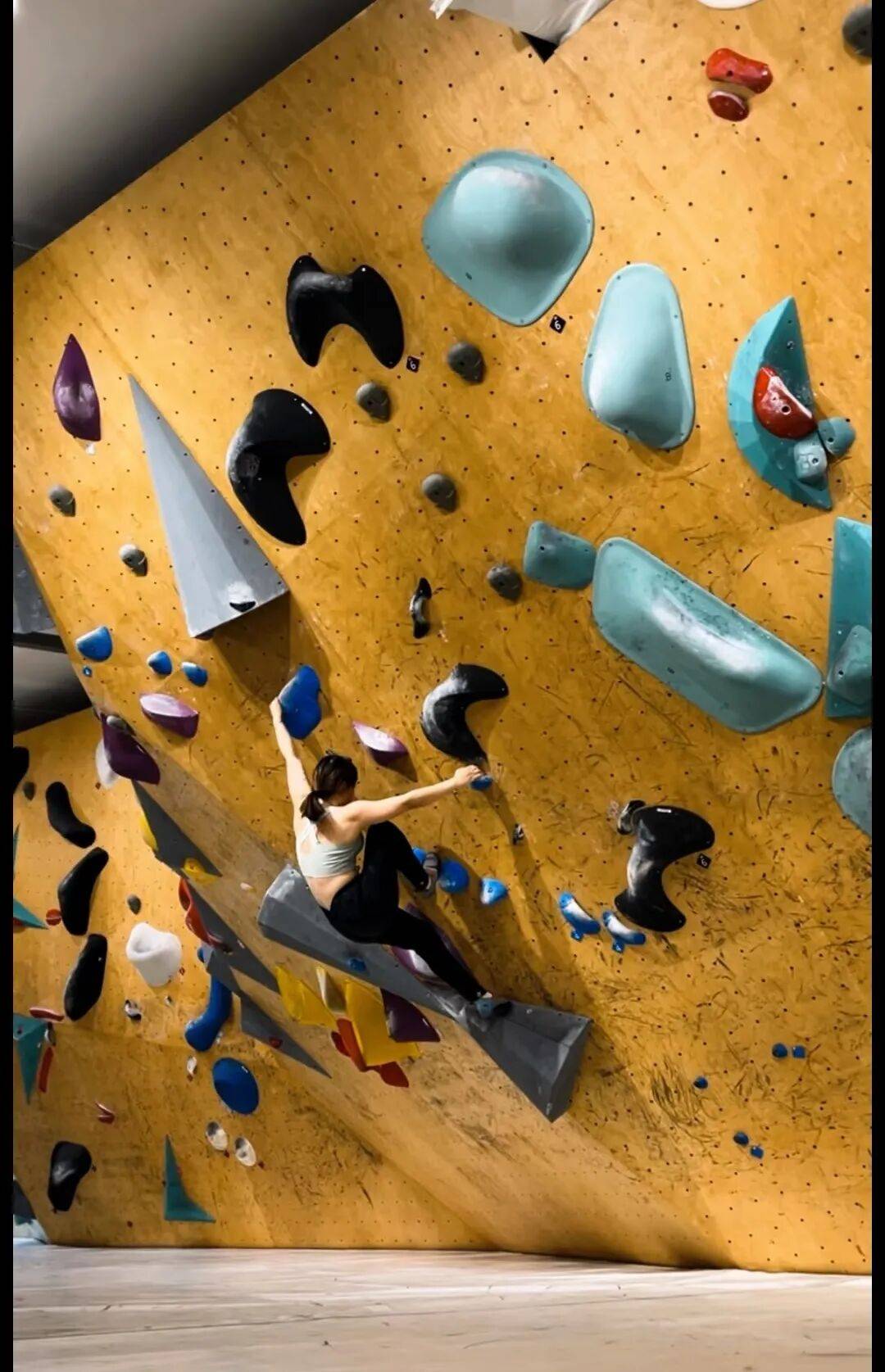
▲Lawyer Li Huiling is rock climbing. Picture/provided by interviewee
A reporter from the Beijing News searched for recent judgment documents on “rock climbing injuries” and found that “rock climbing disputes” are a relatively new thing, and there are some differences in judicial practice in various places, but the core revolves around the degree of fulfillment of safety protection obligations.
In a case heard by Zhuhai Xiangzhou District Court, the plaintiff fell off while climbing in the rock gym and became disabled. The court found that the coach knew that the main lock of the plaintiff’s safety belt had a defect that the rebound was insensitive, but failed to review it before climbing to the summit. Although the gym argued that the plaintiff was an experienced veteran, the court ultimately determined that the gym failed to fulfill its safety obligations and ruled that the gym should bear full responsibility.
In another dispute heard by the Chongqing Jiulongpo District Court, the plaintiff, an athlete who had received five months of systematic training, fell off while climbing in a bouldering area and was injured. The court held that the bouldering facilities were in compliance with national standards and falling off was an inevitable inherent risk. In view of the fact that the parties had the ability to independently assess risks and the on-site coach had not neglected his duty, the court ultimately ruled that the climbing gym was not responsible.
The cumbersome litigation, difficult appraisals and high time costs turn lengthy lawsuits into a war of attrition, which also causes most disputes to end in pre-trial mediation.
How to land safely
In Zhou Yuan’s view, in real rock climbing accidents, more risks still come from the lag in personnel management and safety awareness.
“The venues are expanding too fast, and the reserve of professionals cannot keep up,” Zhou Yuan said. Although regulations require certified instructors, obtaining qualifications requires systematic professional training and assessment. During peak customer flow periods, many gyms hire unqualified part-time students for on-site inspections in order to reduce labor costs.
They lack pre-judgment of dangerous actions, and in the event of a sudden crash, it is difficult to make effective emergency response in the first place.
In order to fill this loophole, Zhou Yuan’s rock gym began to try to set its own entry barriers.
After entering the store, new customers are not allowed to change shoes and go directly to the wall. Instead, they must first receive basic safety and falling instruction. The coach will demonstrate the standard falling and receiving movements on the mat: the moment you fall and touch the mat, bend your knees to cushion, gather your hands to protect your chest, sit back and roll to relieve the force, and it is strictly forbidden to straighten one leg or support the ground with one hand.
Novices can enter the climbing area only after completing the jumping action at a low level and being confirmed qualified by the instructor. Zhou Yuan introduced that in countries where rock climbing has matured, similar protection assessments and fall training have long been common rules in commercial venues.
In addition to internal access to venues, many practitioners also mentioned to the Beijing News reporter that reducing the accident rate requires joint corrections between the industry and the communication environment. In route design, route setters should follow safety regulations and avoid designing long-span dynamic movements in the novice area that can easily lead to uncontrolled falls.
In terms of communication, social platforms and rock climbing gyms should also reduce excessive packaging of high-risk sports, so that the public can clearly perceive the potential dangers of this sport before experiencing it.
In fact, after frequent accidents, regulatory and industry rules are constantly being refined.
In July 2025, the newly revised mandatory national standard “Opening Conditions and Technical Requirements for Sports Venues Part 4: Rock Climbing Sites” was officially implemented. The new national standard makes rigid specifications for professional qualifications, site facilities and equipment performance. It establishes for the first time standardized testing methods for core indicators such as rock wall bearing capacity and rock plate impact resistance. It stipulates the bearing strength of artificial rock walls and top protection anchor points, and requires anti-collision pads in bouldering areas to have sufficient buffer thickness and seamless splicing.
In addition, the new national standard also puts forward rigid requirements for the personnel ratio for safety protection for the first time, stipulating that venues must be equipped with social sports instructors holding national professional qualification certificates according to the climbing area area, and be equipped with first-aid kits and smooth emergency rescue channels.
The Mountaineering Management Center of the State Sports General Administration stated that it will continue to promote the system of employees holding certificates to work, and work with local governments to carry out regular on-site inspections of venue staffing, emergency passages and other safety hazards.
In February this year, the China Mountaineering Association issued a safety management initiative to venues across the country, requiring venues to implement safety notifications for beginners and certification requirements, regularly inspect rock walls and ground buffer facilities, and resolutely eliminate aging and damaged equipment. The initiative also proposes that venues should carry out emergency drills on a regular basis, prepare first-aid supplies and establish a joint rescue mechanism with nearby hospitals to prevent various safety accidents.
From 2015 to now, old rock friend Li Haochen has been climbing in rock gyms across the country for more than ten years. He has seen the process of this sport going from niche to mass popularity, and has also witnessed many accidents due to lack of preparedness.
Last year, he was at a newly opened rock gym when he saw a novice fall off the bouldering wall and sprain his neck. There was a lack of personnel with first aid knowledge at the scene, and there was no fixed neck brace in the first aid box. After calling 120, it was difficult to get the stretcher in and out due to the narrow passage of the venue.
In Li Haochen’s view, even though many rock gyms have posted safety instructions, many potential risks still exist. In the rock gym, he often sees novices with no foundation climbing up to high places with brute strength and then falling due to exhaustion; there are also people who lack safety awareness and randomly pass under the rock wall that others are climbing.
“Rock climbing can indeed bring a sense of accomplishment in challenging oneself, but it is always an extreme sport.” Li Haochen said that climbing upward requires time to build muscle memory and skill accumulation, and more important than climbing up is to remain in awe of danger.
Related Reading
- In the early morning, an international flight from Hong Kong made an emergency landing. 146 people were evacuated through emergency slides. Reports said the plane showed signs of fire; the airline responded2026-11-22
- The AI cheating incident in South Korea’s college entrance examination has been brewing, and Education Minister Choi Gyo-jin has resigned. Previously, Lee Jae-myung offered a large reward to investigate and punish those who cheated in the college entrance examination: 100 million won for every cheating case reported2026-11-22
- The spectacle of “Hai Hao” appears in Weihai, and the sea suddenly seems to be “boiled and smoking”2026-11-22
- Iran’s President: The ongoing economic war is “far more difficult” than a military conflict2026-11-22
- Why are T and K classified as high-speed passenger trains? How to choose Z, N and V for normal speed trains? The authoritative answer is here2026-11-22