On November 8, the fifth anniversary special live broadcast of “Zhang Chaoyang’s Physics Class” was launched on the Sohu Video Follower stream. At the scene, Zhang Chaoyang, founder, chairman and CEO of Sohu and a Ph.D. in physics, continued the course’s consistent hard-core derivation style, deriving the expansion of Legendre polynomials from the gravitational potential. He also communicated with three physics course representatives who have long participated in course discussions, university teachers and students, and Sohu video following science podcasters, reviewing the five-year history of the physics course.
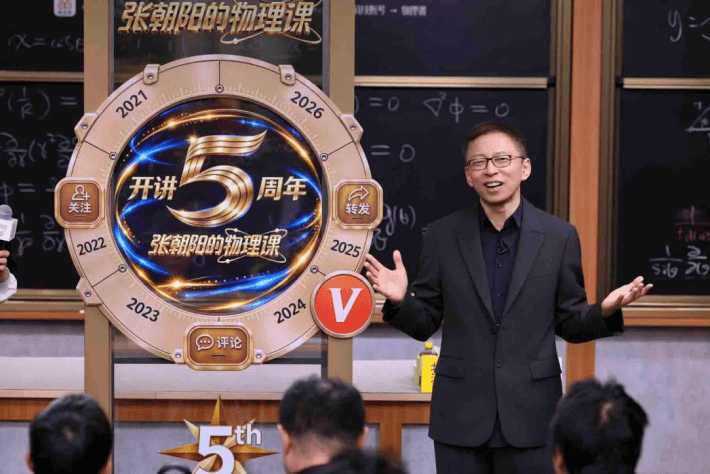
Zhang Chaoyang said that physics class was initially just a personal interest. In the new media era, it attracted public attention and became a popular brand in the field of science popularization. Up to now, “Zhang Chaoyang’s Physics Class” has been broadcast live for 298 times, with a total online time of more than 30,000 minutes. Over the past five years, it has worked with 5.4551 million people to study physical problems in quantum mechanics, relativity, astrophysics, fluid mechanics, electrodynamics, mathematical methods, classical mechanics, thermodynamics and other fields.
Using physical methods to solve mathematical problems: Roundtable looks back on five years of physics exploration
At the beginning of the live broadcast, Zhang Chaoyang continued the hard-core derivation style of physics class and gave a thirty-minute offline physics class. He started from the fact that gravitational potential and Coulomb potential are inversely proportional to distance, and conducted deductions around “the expansion of potential inversely proportional to distance”. His goal was to use physical thinking to solve the mathematical problem of expansion of Legendre polynomials. He said that Physics Class hopes to celebrate its fifth anniversary with hard-core derivation.
The inverse square law of an ideal particle can describe both electromagnetic force and Newtonian gravity. It is one of the most important laws in basic physics and is also the object of Zhang Chaoyang’s research and calculations today. He introduced that when describing the rotation and deformation of real celestial bodies, it is necessary to use Legendre’s expansion law for correction, and determining the expansion coefficient is the most critical step in the entire discussion. Traditional mathematical methods are quite complex to calculate, but Zhang Chaoyang changed his mind: using the conditions on the boundary of the equation to transform the problem into a matching problem of expansion coefficients. As a result, in just tens of minutes, he “solved a mathematical problem using physical thinking.”
During the round table session, Zhang Chaoyang had a conversation with class representatives Li Song, Chen Guangshang and Sun Bing. The four recalled the interesting issues discussed over the past five years: from the formation of the sun and nuclear fusion, quantum tunneling, to the “embedded” theory of differential geometry of general relativity, to wave packet propagation, light deflection and equivalent refractive index in curved space-time. Zhang Chaoyang said, “With this research-based learning method, I feel like I’m in a porcelain shop. Because I’m not burdened and not afraid of making mistakes, I often find a way out.”
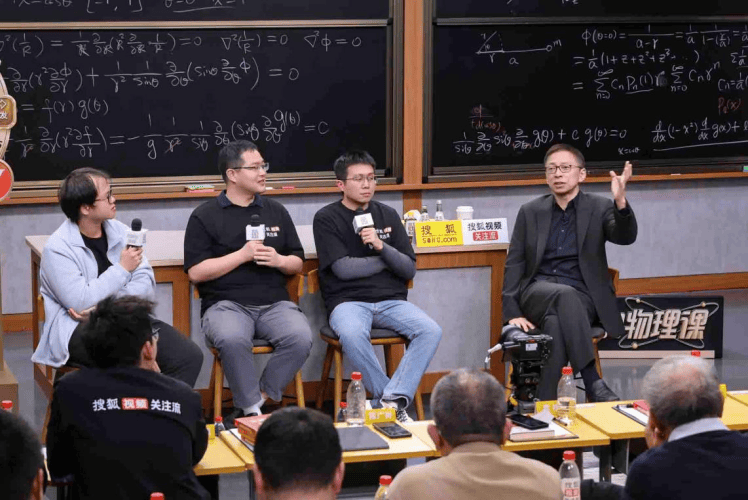
When class representative Li Song recalled quantum tunneling calculations, he said that Zhang Chaoyang’s way of “dividing potential barriers into pieces” was very interesting; Sun Bing mentioned that introducing differential geometry in a way different from traditional textbooks was a very impressive attempt in the past five years; Chen Guangshang recalled that Zhang Chaoyang tried to analyze light deflection in general relativity using the ideas of waves and equivalent refractive index, which gave a new picture to familiar problems.
From personal interests to events of public concern: “Only when you trust the horse and rein it can you persevere for a long time.”
Looking back five years ago, Zhang Chaoyang recalled in the live broadcast that he first wanted to calculate satellite altitudes and geostationary satellites while chatting on the snowy mountains. Later, he decided to teach physics while studying. Unexpectedly, driven by new media, this class, which was originally a personal interest, gradually became an event of public concern. Regarding persisting for five years, he admitted that he did not expect it to last such a long time. It was more about following interests and problems.
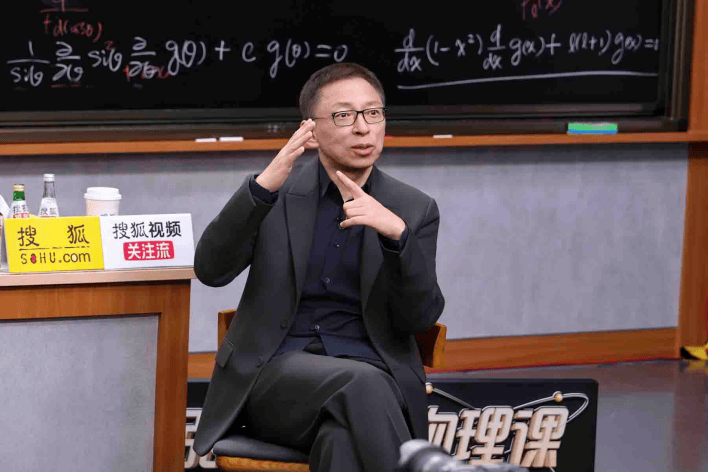
Rather than persisting, Zhang Chaoyang is more willing to talk about learning methods. He mentioned that others thought he was a Ph.D. from MIT and had not forgotten anything for decades. However, during his Ph.D., he studied condensed matter physics, which was more experimental, and he did not learn general relativity at all. “Everything I am talking about today is all what I have learned in the past few years. I am now selling what I have learned.” Because of this, he attaches great importance to learning methods, “use research methods to learn, one-third of the time is spent reading and gaining understanding, and more is spent thinking and deriving.”
In his view, speaking is part of thinking. Without the pressure of exams, papers, and asking stupid questions, he can maintain a high level of excitement and find a unique path. He also suggested reading less, calculating more, and deriving more, and don’t wait until all conditions are complete before starting. Zhang Chaoyang also revealed that the fourth book on general relativity and differential geometry will be launched at the Attention Flow Conference next spring.
For the next five years, Zhang Chaoyang did not give a very full road map. He said, “Next, we will continue to follow the horse’s rein, wherever we go, and finally we will be able to do it for a long time.” From personal interests to nearly 300 live broadcasts, from a blackboard to a group of scientific broadcasters and learners, the five-year achievement of “Zhang Chaoyang’s Physics Class” is to precipitate specific thinking, calculations and discussions into public knowledge content that can continue to grow.
Follow the active interaction between streamers and college students. Physics classes drive knowledge popularization live broadcast ecosystem
“Today is also a grand event for physics or science podcasters,” Zhang Chaoyang said. A number of broadcasters who are active in the popular science popularization track of Sohu’s video attention stream also gathered at the scene to witness the celebration of the fifth anniversary, including “Mr. Li Boiled Universe”, an expert in the field of asteroid defense, “Dr. Chen Zheng”, professor of physics at Beijing Jiaotong University, “Li Zhengyang”, Ph.D. in theoretical physics, “Teacher Sun Yue”, professor of Southeast University, “Professor Xiaole”, professor of South Central University for Nationalities, and “Dr. Fu Hong”, a popular medical science broadcaster. They participated in exchanges from the perspectives of physics teaching and subject transfer, and discussed the original intention and significance of professional science popularization.
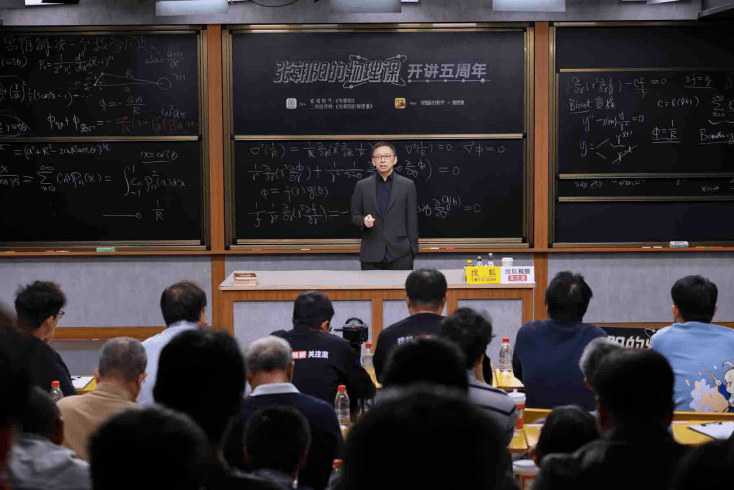
Dr. Chen Zheng said in combination with teaching that moving from gravitational potential to electric potential and establishing an analogy between gravitational field and electric field can help students understand electric fields. Other live broadcasters also mentioned that this derivation provided a different perspective of observation. Mathematics is not only a tool for solving problems, changing the way of entry, but also training new ways of thinking.
Teachers and students in colleges and universities have further led the topic to the hot topic of AI. A physics teacher from the High School Affiliated to Tsinghua University asked how AI would be used to expand the dissemination of physics classes after the fifth anniversary. Zhang Chaoyang said that AI is already helping to disseminate and organize course content, and also makes Chinese physics knowledge easier to retrieve, but learners still have to restore the derivation process in person. “I hope that some things are not told to me by AI, but figured out by myself.”
Related Reading
- The first in the country! How to learn “unpopular secret skills”? Who will teach? Dean’s interpretation2026-11-12
- The price of refined oil may drop for the sixth time this year. Filling up a tank will cost about 15 yuan less2026-11-12
- “Token hoarding” became a hot word in the “Double 11” circle, and after Li Jiaqi, Luo Yonghao also came to sell2026-11-12
- Does the United States really not want to fight Iran anymore?2026-11-11
- Fireballs are scattered around Shijiazhuang. How much is the value of “visitors from outside”?2026-11-11