On November 7, the Chinese U17 men’s national football team set off from Shanghai to Doha, Qatar, to prepare for the U17 World Cup (World Junior Championship), which will start later this month. This is the first time that the U17 national football team has participated in the World Junior Championships after 21 years. It is also the first time that China’s national men’s football teams at all levels have participated in international competitions since the 2008 Beijing Olympics.
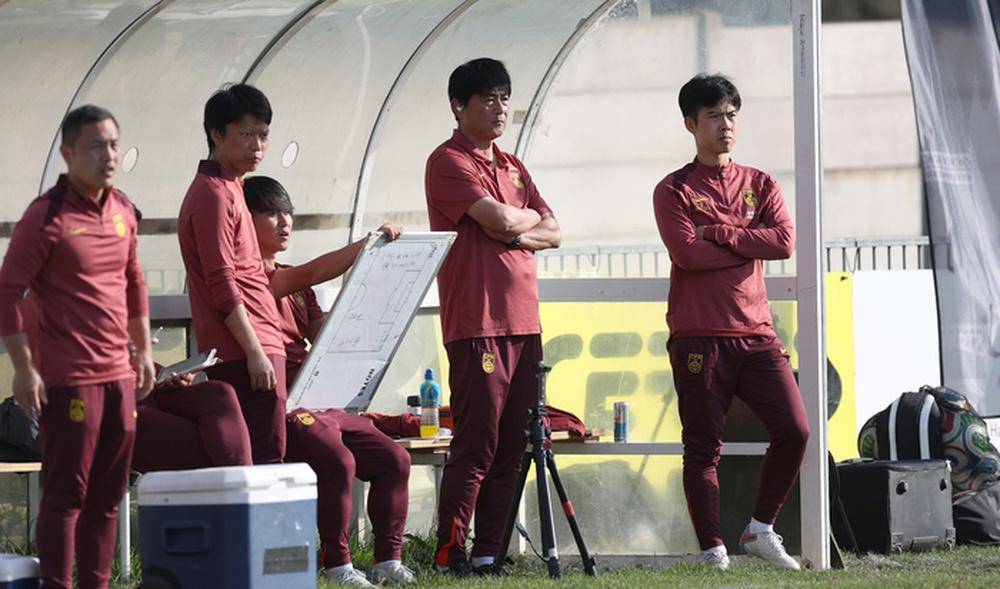
In an exclusive interview with a reporter from Xinhua News Agency, U17 national football head coach Toshi Ukishima said that he will use the final preparation period to improve the team’s physical fitness and technical and tactical abilities as much as possible. Although there is a gap with the world’s top teams, as long as it stands on the World Cup, the Chinese team’s goal in every game is to win. “With some opponents, we may only win once in ten times, but we must also study and seize the only opportunity.”
“Just relying on high-position pressing won’t work in the World Cup”
In preparation for this U17 World Cup, the Chinese team began training on November 2 and defeated the Shanghai Haigang U20 Men’s Football Team 3:0 in the teaching match on the 6th. After arriving in Qatar, the team will play two warm-up matches with New Zealand and Honduras to prepare for the first group match on November 20.
Regarding preparation arrangements, Ukishima Toshi introduced that training for four days and playing one game is a cycle. After arriving in Qatar, we will practice for 4 days, then play the first warm-up match, and then play the second game two days apart, in line with the World Cup rhythm of one game every two days; after the two warm-up games, we will practice for four days, and we will usher in the first group match.
The most ideal warm-up match opponents in Ukishima’s plan are European teams, but most European teams participating in the U17 World Cup will not come to Qatar in advance, and the Chinese team needs to arrive in advance due to the time difference. There are not many available opponents, and New Zealand and Honduras were finally selected.
He said that the team faces certain injury risks. The main center Zhao Songyuan was injured in the previous IFCS World Cup match and has not yet been able to participate in joint training. Since the domestic league is at the end of the season, many players also have minor injuries and are not in ideal physical condition.
“Zhao Songyuan suffered internal injuries caused by trauma. Whether he can play depends on his recovery. There is no definite conclusion yet. Some players have muscle reactions and need to postpone training and make adjustments.” Ukishima said, “Of course we hope they can participate smoothly, but at the same time, we must make alternative plans.”
Due to injury risks, Ukishima recruited 25 players to go to Doha with a roster limit of 21. When explaining the selection criteria, he said that the 21 places are very tight. First of all, priority will be given to versatile players who can play as a forward or a winger, a full-back or a full-back. Secondly, the recovery ability will be considered. The group matches will be held every two days, and recovery ability determines the depth of the bench; thirdly, it will be necessary to adapt to different tactical scenarios.
On November 8, Wan Xiang, Jin Yucheng and other players studying abroad in Europe will arrive in Doha, and all 25 members of the team will be present. After that, the focus of preparation will turn to physical fitness. Ukishima Toshio said: “Some of these players are in the (club) first team, some play in campus leagues, and some study abroad. The game cycles and physical reserves are uneven. We need to try to bring all the physical fitness to the same level.”
At the same time, adjustments are also needed at the tactical level. Ukishima Toshio said that during the Asian Cup, the team mainly engaged in high-position pressing, but in the World Cup, relying solely on high-position pressing will not work. It must be flexibly adjusted according to the characteristics of the opponent and the game period, and both midfield positioning and low-post defense must be used; at the same time, the discipline of cross defense and defense in front of the penalty area will be strengthened. “We need to allow all players to fully understand the unified tactics in a short preparation time and improve the quality of execution on the field.”
“The goal of every World Cup game is to win”
In the group stage of this U17 World Cup, the Chinese team will face Spain, Morocco and Fiji.
Just in October, the Chinese team had a warm-up match with three World Cup participating teams: Tanzania, Mexico and Argentina. As a result, they lost all three games and failed to score a goal.
Ukishima Toshi admitted that there is indeed a gap between the Chinese team and world-class teams. “When we played against the African runner-up Tanzania team, the opponent’s total high-intensity running (14 kilometers per hour) was 1.5 times that of ours. Reflected on the field, the opponent’s forwards penetrated forward and behind more frequently, returned faster after losing the ball, and the intensity of the offensive and defensive switching was one to two levels higher than that of the Asian opponents.”
He also mentioned that almost every team in Europe and South America has 2 to 3 players with outstanding personal abilities, which is also significantly different from Asian teams. Take the Spanish team as an example. There are several players in the team who were worth millions of euros at the age of 17, and some have already played in La Liga.
“If the average intensity of the Asian Cup group stage is 100 points, the intensity of the Asian Cup final against Japan can reach 130 to 140 points, then the intensity of the game against strong teams in Europe and Africa will be far more than 140 points.” Ukishima said, “I personally prefer technical flow, but the trend in modern football is that teams with stronger physical fitness have a higher probability of winning. When you go out of Asia, you will encounter players with extremely strong physical abilities.”
He said that judging from the experience of the Japanese team, Asian teams must improve their running ability, especially high-intensity running ability, if they want to compete with world-class teams. “My benchmark is that excluding goalkeepers, high-intensity running accounts for 30% of total running, high-speed running (above 21 kilometers per hour) accounts for 10%, sprint running (above 25 kilometers per hour) accounts for 3%, and forward sprinting accounts for 5%. This set of standards has been instilled in me since I took office.”
Facing the daunting challenge, Ukishima encouraged the players to cherish the opportunity to play against the world’s top peers. “The Spanish team’s high-level players generally do not appear in warm-up matches, and can only compete directly in the main match. Young players can personally experience the world’s top levels of their age, and the training value is very high.”
The gap is in front of him, but Ukishima’s attitude towards the competition goal has not slackened. “As long as we stand in the World Cup, the goal of every game is to win. Some opponents may only win once in ten times, so we must study and seize the only opportunity. We are not here to experience the atmosphere, and we do not regard qualifying as a hard task, but focus on each game – qualifying (in the group stage) is a result that can only be obtained after playing each game well.”
“It’s not common for players of this age to be so exposed.”
Since coaching the team in 2024, Ukishima believes that his most important job is to improve the decision-making and judgment capabilities of the younger generation of Chinese players in the game. “They themselves also feel it. In the domestic league, there is about 5 or 6 seconds of processing time after receiving the ball. In the Asian Cup, there are only 3 or 4 seconds left against Japan and less than 2 seconds against Argentina. It is difficult to make a leap in observation and judgment ability in a short time. The intensity of defensive confrontation within the team is critical – if the confrontation pressure is not enough, the ability to handle the ball within 2 seconds will not be developed.”
To this end, the team will use methods such as reducing the court area and limiting the number of touches to increase the intensity of confrontation during training. If players cannot maintain high intensity for a long time, they will shorten the duration of a single group, even to 30 seconds or 1 minute, to prioritize ensuring intensity and forcing decision-making. At the same time, the coaching staff strictly requires players to develop the habit of observing three times: before the ball is passed, from when the ball is passed to when they touch the ball, and the moment they stop the ball.
“Real skills are skills performed in a short period of time and in a small space – not stopping the ball, but immediately connecting to the next action after stopping the ball. This must be repeated day after day and become a habit.” Ukishima Toshi said frankly that the national training time is limited, and some players have lost their training habits after returning to the club, which will cause differentiation in ability. “I think we can reach the World Cup because players develop good football habits.”
In addition to training, Ukishima also faces another issue – how to guide players to deal with external attention. He believes that the Chinese U17 men’s football team has extremely high attention and exposure in the country, which is not common among people of the same age group. “In Japan, players of this age group usually don’t receive much attention and can mature slowly. These Chinese team players have sometimes been praised to heights they have not reached. In turn, they have to face a lot of negative comments when they are minors. Even mature professional players will be affected by online comments. This is a topic that Chinese football needs to deal with.”
In his opinion, the key is to teach players to correctly interpret the praise and criticism. “Youth management cannot rely solely on forced control. For example, I don’t allow players to drink Coke. Some players don’t need to drink in person, but they still drink in private. The key is to explain the principles clearly, let them understand why they can’t drink, and achieve self-discipline. This is not only the responsibility of the team, but also the family and school. You must participate. It is the same with life management and football training. Players must understand the reasons behind each requirement. At the same time, coaches themselves must continue to learn. Football is changing, and the social environment is also changing. We ourselves must constantly update our knowledge and keep pace with the times.”
He also warned the players: “Remember that there are people out there, and stay humble. You are only 3% or 5% better than other players at most. No matter how big your future opportunities are, you must not lose your original intention and attitude towards football, and you must not relax your skills, tactics and physical requirements. What you are most afraid of is that players have no subjective awareness and play in a muddle. If this can be done, the potential of this group of players is still very great.”
Related Reading
- The first in the country! How to learn “unpopular secret skills”? Who will teach? Dean’s interpretation2026-11-12
- The price of refined oil may drop for the sixth time this year. Filling up a tank will cost about 15 yuan less2026-11-12
- “Token hoarding” became a hot word in the “Double 11” circle, and after Li Jiaqi, Luo Yonghao also came to sell2026-11-12
- Does the United States really not want to fight Iran anymore?2026-11-11
- Fireballs are scattered around Shijiazhuang. How much is the value of “visitors from outside”?2026-11-11