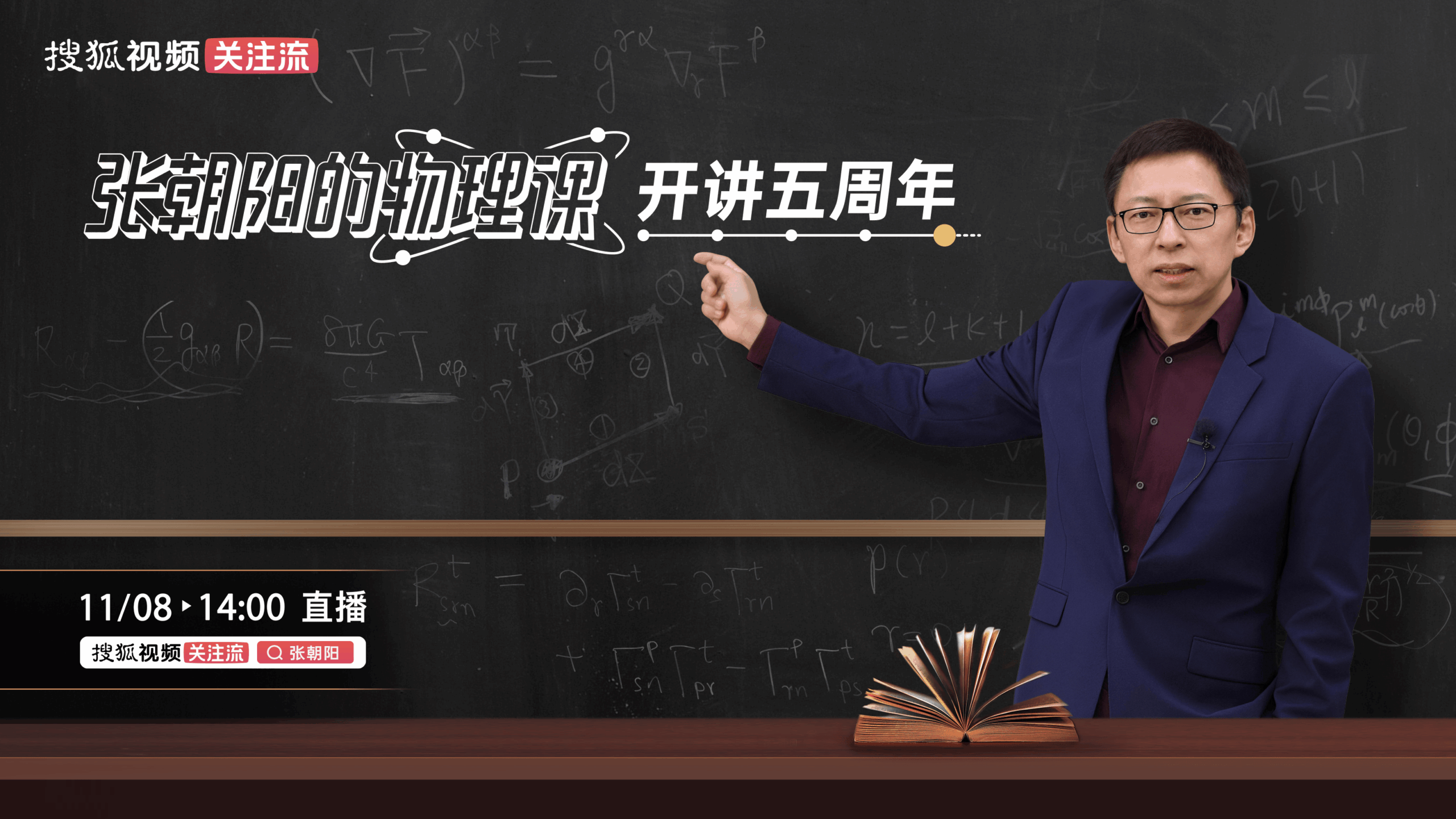
At 14:00 today, the fifth anniversary special live broadcast of “Zhang Chaoyang’s Physics Class” will be broadcast on the Sohu Video Follower stream. Zhang Chaoyang, founder, chairman and CEO of Sohu, Ph.D. in physics, will take everyone to review the hard-core derivation of Newtonian mechanics to quantum mechanics and the theory of relativity over the past five years. This special live broadcast is not only a look back on the fifth anniversary, but also a new start about curiosity and thinking.
When large models make answers within reach, you can enter a question and get the answer in a few seconds; when you encounter a difficult problem, the steps to solve the problem can be generated with one click. Searching is no longer laborious, and thinking seems to be handed over to tools. However, the easier the answers are, the more valuable independent thinking is. Zhang Chaoyang once said, “In the AI era, it is even more important to do calculations in person, otherwise people will become stupid if they passively receive information all day long. Only by doing calculations can they get into their heads.”
Looking back five years, a clear “hard-core derivation path” runs throughout. On November 5, 2021, Zhang Chaoyang gave the “unprecedented first physics class”. Over the past five years, Zhang Chaoyang has insisted on handwritten formulas and hard-core derivation. From daily problems such as satellite orbits and the whereabouts of raindrops, to quantum mechanics, general relativity and differential geometry, he does not shy away from complex calculations. Each line of formulas answers the same question: How were these results obtained step by step? Up to now, the course has carried out more than 290 live classes and more than 30 offline classes, with more than 30,000 minutes of online time.
The boundaries of the curriculum are also constantly extending outward. In 2022, physics class went offline for the first time, and Zhang Chaoyang used six blackboards to deduce the mass-energy equation. In 2023, the course was introduced to Tsinghua University, and a special series of university lectures was launched. Since then, it has continued to communicate with physics students from Chongqing University, Xi’an Jiaotong University, Beijing Normal University, and the Hong Kong University of Science and Technology. On December 31 of the same year, Zhang Chaoyang gave his first New Year’s Eve speech, decrypting the general theory of relativity to pay tribute to Einstein. This unique and hard-core New Year’s Eve format continues to this day.
In 2024, the basic science dialogue series “Zhang Chaoyang’s Physics Class” will be launched. In the past three years, Zhang Chaoyang has had many exchanges with top international scientists such as Nobel Prize winner David Gross, Xu Yihong, Kumrun Wafa, David Tang, Liu Ruowei, Subir Sarkar, Wen Xiaogang, etc., bringing basic scientific topics and cutting-edge scientific ideas such as quantum field theory, string theory, cosmology, and condensed matter physics into the live broadcast room. In these conversations, science is not a set of standard answers waiting to be recited, but is constantly advancing through conjecture, questioning, verification, and discussion.
In 2025, Zhang Chaoyang walked into the Beijing Planetarium and held a special offline physics class with the theme of “Light Deflection under General Relativity”, further extending the class from live broadcast rooms and university podiums to more scientific education scenes.
At the same time, the courses have also extended from live broadcasts to replays, short videos, texts and books, forming a continuously updated physics science popularization content system. Three popular science books of the same name “Zhang Chaoyang’s Physics Class” were published one after another, and the series was collected by the National Library of China, allowing the formula derivation in the live broadcast to be transformed into knowledge texts that can be read and retrieved for a long time.
Related Reading
- The first in the country! How to learn “unpopular secret skills”? Who will teach? Dean’s interpretation2026-11-12
- The price of refined oil may drop for the sixth time this year. Filling up a tank will cost about 15 yuan less2026-11-12
- “Token hoarding” became a hot word in the “Double 11” circle, and after Li Jiaqi, Luo Yonghao also came to sell2026-11-12
- Does the United States really not want to fight Iran anymore?2026-11-11
- Fireballs are scattered around Shijiazhuang. How much is the value of “visitors from outside”?2026-11-11