The U.S. Congress is ushering in a “blue wave” that may have an impact on the economic landscape of the United States and even the world.
According to Xinhua News Agency, many U.S. media predict that the U.S. Democratic Party will overpower the Republicans to regain control of the Senate and House of Representatives in the midterm elections to be held on November 3, and regain control of the U.S. Congress.
On the 4th, the major U.S. stock market indexes rose across the board, but the trends within the technology sector were clearly divided. The S&P 500 rose 1.58%, the Dow Jones Industrial Average rose 1,569.40 points, or 3.03%, and the Nasdaq Composite rose 1.44%. Among them, Microsoft and Amazon rose by 6.68% and 6.12% respectively, while the Philadelphia Semiconductor Index fell by 3.13%, indicating that the market has divergent judgments on the prospects of AI infrastructure investment.
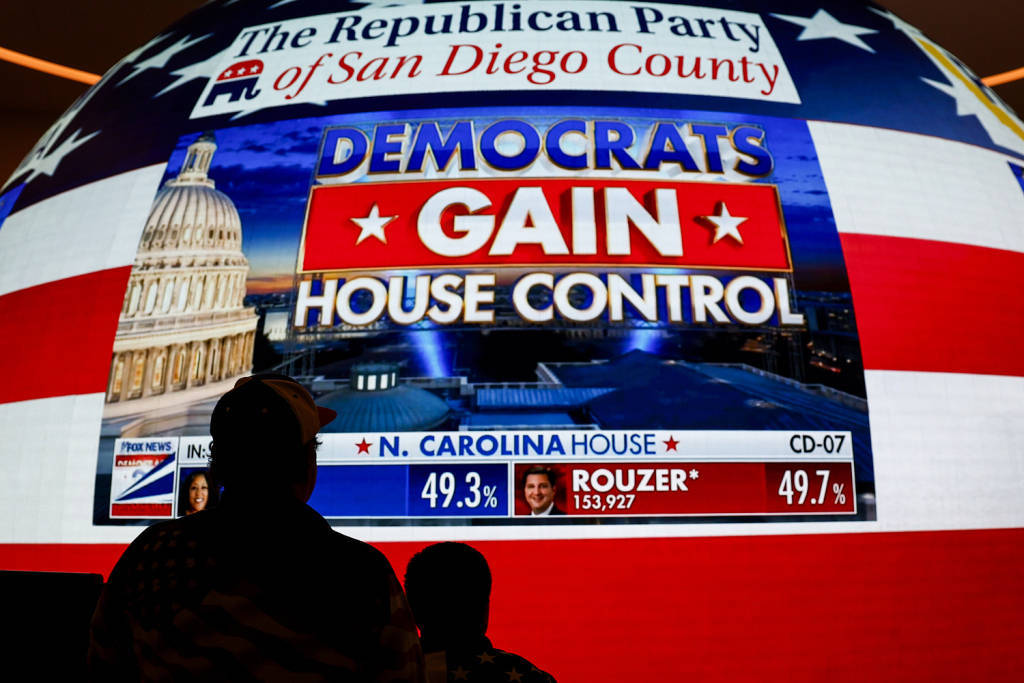
On November 3, 2026 local time, in San Diego, California, the United States, voters watched the presidential election broadcast on TV.選舉結果。
“If Wednesday’s overall rise is anything to go by, it’s that Wall Street is betting that the economy will be more predictable in the final years of Trump’s term.” The Wall Street Journal published an article on the 4th. “Of course, there are losers, especially chip manufacturers and other suppliers that play an important role in the artificial intelligence (AI) industry.”
In the first two years of his term, the Trump administration has been pushing to relax regulations and encourage the development of the AI industry. However, voters are dissatisfied with issues such as energy caused by data centers, pushing the Democrats to sweep both houses of Congress and win multiple gubernatorial elections. Public opinion generally believes that as the Democratic Party is about to regain control of Congress, AI infrastructure construction will face more stringent local approvals, energy cost constraints and environmental supervision. Policy changes in the construction of data centers in the United States may affect the global AI industry chain.
The new oversight powers would also allow Democrats to investigate many of the issues they have complained about, including the first family’s involvement in cryptocurrency transactions and alleged favoritism in government contracts. Expect more scrutiny on the relationship between technology companies and governments.
However, a report released by the US public relations company Edelman on the 4th clearly stated that the Democratic Party’s control of Congress does not mean that policy activities have stagnated. The Trump administration may promote its own policies more through executive orders, administrative rules and regulatory measures, while Congress may impose restrictions through supervision, budget negotiations and other methods. A big challenge for businesses is navigating an increasingly complex policy environment.
Will AI data center construction slow down?
Voter opposition to data centers is clearly bipartisan, but in national races, Democratic candidates tend to be more skeptical of AI than Republican candidates. In this election, Democrats won the gubernatorial elections in five states that are critical to data center development. Chip manufacturers and other suppliers that provide basic support for AI may become “losers.”
In states such as Texas and Ohio, voters focus on the impact of these projects on electricity costs, water consumption, etc. in surrounding areas, even though Trump has been playing up the narrative that “rejecting data centers will lose to China.” Ohio lawyer Austin Borrichter previously told The Paper that he doesn’t know or care about the connection between data centers and China, but he firmly refuses to accept one data center after another being built around it.
James Talarico, who won a U.S. Senate seat in Texas, criticized tech companies at a news conference this summer and asked the state Legislature not to offer what he called “preferential tax deals.” “There is no transparency, no accountability, and no community engagement right now,” he said. “AI should work for us, not against us.”
In Georgia and Texas, two states where data center developers are most active, Democratic gubernatorial candidates have called for temporary bans on new server rooms. The newly elected Democratic governor of Michigan, Jocelyn Benson, made the same call.
“Space data centers look quite attractive right now.” Billionaire Elon Musk wrote on his social platform X earlier on the 4th. The stock price of Musk’s aerospace and AI company SpaceX fell 3.8% that day. Shares of electric car company Tesla also fell.
Analysts say a pause in data center construction could slow the pace of artificial intelligence deployment, allowing hyperscale data center operators to charge customers more to boost profits. If large U.S. technology companies adjust their capital expenditure plans, it may affect GPU, server, power equipment and data center infrastructure suppliers, and affect the regional layout of global AI computing power investment. However, the relevant impact still depends on the specific policies of each state, the progress of project approval, and the investment adjustments of technology companies.
Some analysts also believe that the slowdown in data center construction may also alleviate Wall Street’s concerns that technology giants, in order to win the artificial intelligence competition at all costs, will excessively squander resources and ultimately lead to failure.
“In a world dominated by the AI craze, its impact is huge.” Bob Elliott, CEO of Unlimited Funds, an innovative American asset management company, told the Wall Street Journal. “This election is a warning to an industry that is largely built on expectations of unbridled growth in the future.”
Michael Antonelli, market strategist at Baird Private Wealth Management in the United States, further said that AI transactions occupy a large amount of resources in the U.S. economy, and the slowdown in the data center construction boom will allow the U.S. economy to allocate funds to other industries.
Investigations, subpoenas, policy uncertainty
On the 4th, the Dow Jones Industrial Average posted its best single-day performance since early April 2025, when Trump suspended plans to impose sweeping tariffs on much of the world. However, the entire business community, from banks to technology giants to Big Oil, is worried that the Democratic-controlled Senate will launch multiple investigations and use subpoena power. The party has pledged to focus on the Trump family and its corruption allegations and delve into donations from big businesses.
According to the “Washington Post” report, in the past two years, defense and technology companies such as Palantir, OpenAI and Meta have become targets of criticism from the Democratic Party. But with Republicans in control of Congress, where subpoenas and hearings require majority approval, official investigations into the companies have had little impact.
With Trump’s approval rating plummeting recently and public dissatisfaction with unregulated AI and data centers growing, companies close to Trump are preparing for the Democratic Party’s return to Congress and the ensuing congressional investigations.
Jim Himes, the top Democrat on the House Intelligence Committee, told a defense lobby group in a letter at the end of September that these companies may be required to hand over documents related to donations to Trump’s new White House ballroom.
Some of these defense and technology companies have contacted Silicon Valley Democratic strategist Cooper Tebow to ask which Democrats to donate to or recruit as board members in order to deal with possible future congressional investigations and regulatory pressure.
Companies with ties to Trump’s eldest son, Donald Trump Jr., and that have received Pentagon funds will be prioritized for investigation, the Washington Post reported, citing four people familiar with the lawmakers’ plans. Two of them added that companies related to Musk and the Department of Government Effectiveness (DOGE) he once led may also be prioritized for review, focusing on whether these companies obtain information and various relationships through DOGE when operating and benefit from it. In addition, companies that obtain non-compete agreements and equity stakes from the U.S. military may also be at the forefront of the review list.
For banks and financial institutions, including cryptocurrency companies, the biggest figure to watch is Massachusetts Democratic Sen. Elizabeth Warren, who is likely to take control of the Senate Banking Committee. Warren has been sending letters demanding disclosure of details related to dealings with the Trump family, artificial intelligence projects, initial public offerings and the Federal Reserve. She is likely to summon numerous CEOs to the hearings.
Additionally, the Trump administration’s lax approach to antitrust enforcement has encouraged companies in many industries to strike deals that they would not have attempted in years past. Wall Street expects that even if Democrats make gains in the midterm elections, there will still be a flood of dealmaking during the remainder of Trump’s presidency, as the power to challenge deals rests with the executive branch.
Edelman’s above-mentioned post-election business analysis report pointed out that the legislative deadlock does not mean a stagnation of policy activities. The Trump administration will continue to advance its priorities through administrative and regulatory actions while Congress attempts to challenge those initiatives, which could send conflicting signals to businesses on issues such as tariffs, immigration, labor, energy and financial regulation.
This challenge is particularly acute for businesses that rely on federal contracts, licenses, tax incentives or government funding, as well as energy and infrastructure developers, financial institutions and technology companies, as regulatory uncertainty can significantly impact long-term investments, operating costs and growth strategies.
“(These companies that are closely related to Trump) have made the most fatal mistake, forgetting that the pendulum has a basic law: it will always swing back, and most of the time it will.” Tebo said, “I am afraid that their lives will not be easy in the next few years.”
Agriculture, medical insurance, energy, military industry
Elsewhere, farm groups hope Democrats will expand the use of biofuels like corn and soybeans, which would help boost demand for the crops. Democrats tend to be more supportive of expanding the use of biofuels than Republicans in oil-rich states.
“The world needs more energy now.” Juan Luciano, CEO of grain trader Archer Daniels Midland, said on the 3rd in a conference call with analysts.
In addition, policy experts expect Democrats to push to reinstate an enhanced premium tax credit under the Affordable Care Act (ACA). Relevant subsidies have expired at the end of 2025, resulting in a significant increase in premium expenditures for participants in some U.S. health insurance markets in 2026. The market is in turmoil as the cost of Obamacare plans rises sharply due to the loss of federal support, leading millions of Americans to abandon their ACA plans. The trend of rising prices is expected to continue next year.
In addition, the “Medicaid” work requirements promoted by the Trump administration and included in the 2025 tax bill are also opposed by Democrats. According to the current regulations, the relevant requirements will in principle be implemented from January 2027, which may cause some insured persons who cannot meet the conditions to lose their medical insurance qualifications. But Ipsita Smolinsky, managing director of Capitol Street, a health care policy consulting firm, said that without Democrats in control of the White House, it may be difficult for Congress to change the policy.
Shares of defense contractors RTX, Lockheed Martin and Northrop Grumman also fell on the 4th. Some analysts believe that after the Democratic Party takes control of Congress, the Trump administration may face more congressional scrutiny on the defense budget and military spending, increasing the uncertainty in related appropriation negotiations. Some investors hope Congress can pressure the White House to end the trade dispute and war with Iran by blocking spending.
However, Trump still has a lot of power in diplomatic and military decision-making, such as launching military operations against Iran again or implementing tariff policies against certain industries.
Related Reading
- The first in the country! How to learn “unpopular secret skills”? Who will teach? Dean’s interpretation2026-11-12
- The price of refined oil may drop for the sixth time this year. Filling up a tank will cost about 15 yuan less2026-11-12
- “Token hoarding” became a hot word in the “Double 11” circle, and after Li Jiaqi, Luo Yonghao also came to sell2026-11-12
- Does the United States really not want to fight Iran anymore?2026-11-11
- Fireballs are scattered around Shijiazhuang. How much is the value of “visitors from outside”?2026-11-11