On November 3, local time, the United States officially voted for the 2026 midterm elections. This election involves 435 seats in the House of Representatives, 35 seats in the Senate, and governorships in 36 states. The latest statistics show that more than 59 million people across the country voted in advance, setting a new record for the number of early voters in the midterm elections.
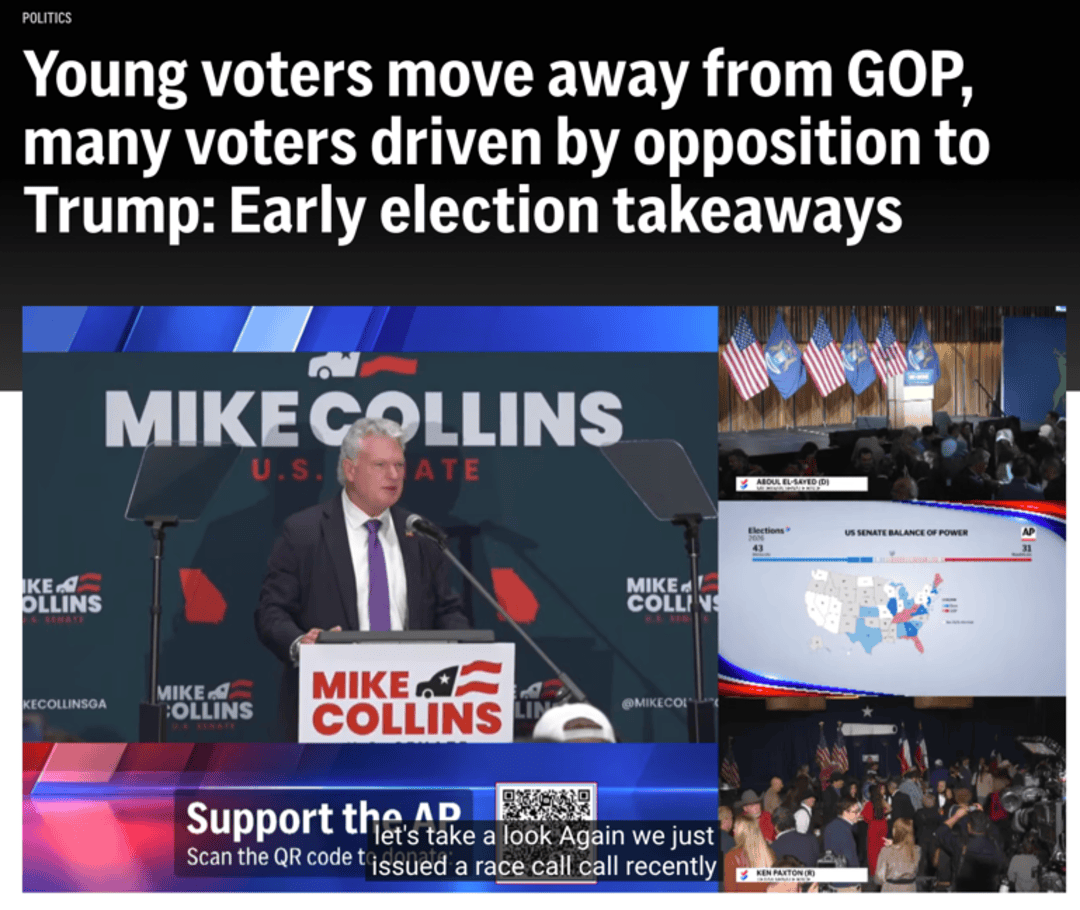
△The Associated Press reports that polls show that American voters are eager for change, and young voters are gradually moving away from the Republican Party.
As voters from all over the country entered the polling stations, the United States launched large-scale real-time coverage, and the latest voter surveys and preliminary vote counting results were also announced one after another. Voter participation, public concerns, and the special phenomena presented in this election have become important windows for observing this midterm election.
On the evening of the 3rd, voting ended in some states in the United States. According to US media predictions, the Democratic Party will regain several House seats from the Republicans in this midterm election and regain control of the House of Representatives.
On-site on voting day: active participation and attention from many parties
In the early morning of November 3, local time, polling stations across the United States opened one after another. Since the country spans multiple time zones, voting times vary from state to state. From the earliest opening of some polling stations at 5 a.m. in the northeastern state of Vermont to the last batch of polling stations in the far northwest state of Alaska, which closed at 1 a.m. ET on November 4, the national voting day spans about 20 hours. Voting in New York City will last from 6:00 to 21:00 on the 3rd, and in Washington, DC, from 7:00 to 20:00 on the 3rd.
Voting places in the United States are mostly located in schools, libraries, churches and community centers. According to statistics from the U.S. Election Assistance Commission, during the 2024 presidential election, a total of approximately 96,000 physical voting locations were used across the country, of which approximately 88,000 were open on official voting days.
Voting arrangements also vary from place to place. There are 75 Election Day voting centers in eight administrative districts in Washington, D.C., and voters can choose any of them to vote; Los Angeles County has opened 646 voting centers and 429 official mail-in ballot drop boxes; New York City designates polling stations based on registered addresses. These arrangements reflect differences in the way local governments organize elections in the United States.
Judging from the voting situation on that day, the voting in this midterm election presented several more prominent aspects.
The first is active voter participation, with a record number of early voters. According to statistics from the University of Florida Election Laboratory, more than 59 million people have voted early across the country, an increase of at least 13 million from the total early voting of approximately 45.9 million for the entire 2022 midterm elections.
Data from the New York City Election Commission showed that as of 15:00 that day, 664,807 voters had signed in at polling stations across the city. Together with about 690,000 early on-site voting in the previous nine days, the total number exceeded 1.35 million. The number of early in-person voting in New York City this year is about 60% higher than in 2022.
About 2.8 million people in Georgia have voted early, setting a record for the state’s midterm elections. The Secretary of State said that as of 10 o’clock that day, about 300,000 people had participated in the formal voting. The total number of voters in the state’s midterm elections in 2022 is about 3.9 million.
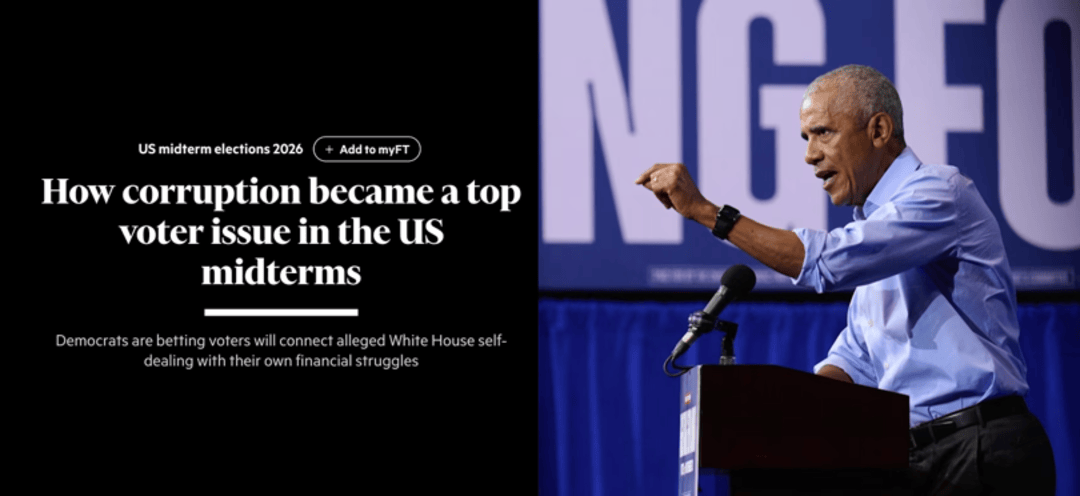
△The Financial Times reported that Democrats have made alleged corruption in the White House one of the key issues in their campaign, putting great pressure on the Republicans.
Secondly, voting organization in some areas was tested by weather and technical problems. According to reports, voting locations have been adjusted in some areas of Florida due to continued rainfall and flooding, and some areas in the southwestern United States have also been affected by heavy rains. In Westchester County, New York, a ballot scanning equipment malfunction occurred, and staff initiated emergency procedures to properly preserve paper ballots and wait for subsequent counting. Some polling locations in Pennsylvania and North Carolina extended voting hours due to technical issues. David Becker, executive director of the U.S. Center for Election Innovation and Research, believes that large-scale early voting may have alleviated organizational pressure on official voting day. Election experts also pointed out that most of the current problems can be dealt with through existing procedures.
In addition, the scale of election supervision and media coverage is cause for concern. The U.S. Department of Justice announced on November 3 that it would dispatch approximately 1,000 election supervisors and observers to 50 states across the country, calling this the largest election day supervision operation. The government emphasized that the move was aimed at safeguarding the legitimacy of the election, but some Democrats and electoral rights groups were concerned that related actions might affect voters.
At the same time, major U.S. news organizations launched large-scale reports. The Associated Press previously announced that it would invest more than 4,000 reporting and data collection personnel to track thousands of elections across the country. NBC will arrange special reports for 13 consecutive hours starting at 17:00 that day, and CBS, CNN, ABC and Fox News have also launched live election and data analysis programs.
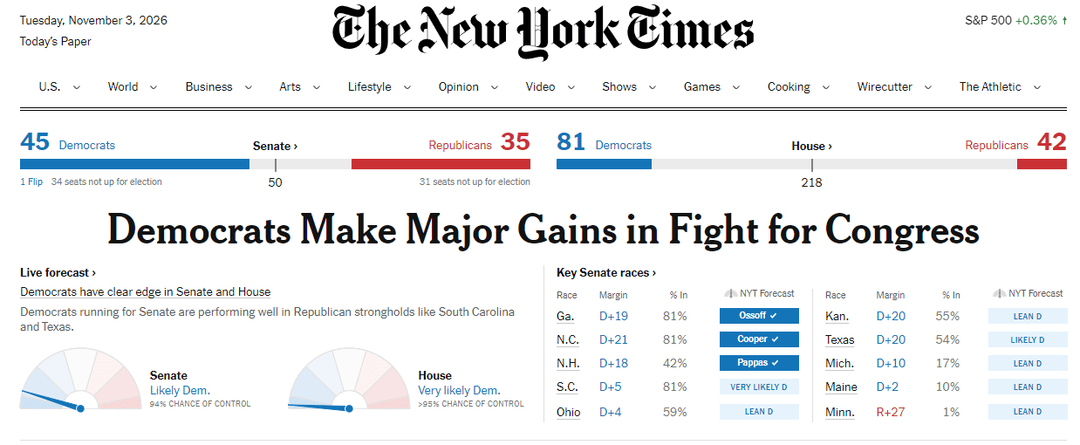
△The New York Times reported that the Democratic Party has demonstrated its strength early in the battle for control of Congress.
Starting from 18:00 Eastern Time on the same day, some states will gradually close polling stations. The Associated Press announced at 19:00 that Democratic Virginia U.S. Senator Mark Warner won re-election. Votes are still being counted in many key states at this point, and final control of Congress has yet to be determined. When the media announces a candidate’s victory, it does not mean that the election results have been officially determined. According to the U.S. election system, after the voting in various places, the local election agencies will complete the vote counting, verification and necessary reviews, and then the votes will be officially certified by the agencies designated by the states in accordance with the law. Certification times are not uniform across states. Most are scheduled from mid-to-late November to December. Some highly competitive constituencies may be delayed due to recounts or legal disputes.
Voters’ concerns: economy tops the agenda, with diverse issues
What American voters care about most is an important observation angle in this midterm election. The latest survey shows that economic issues still rank first, but compared with four years ago, the level of concern among voters of different parties has changed.
On November 3, Reuters and Ipsos released the latest poll. The results of interviews with 1,765 American adults showed that 48% of registered voters listed the cost of living as the primary issue in deciding to vote, 26% chose norms related to the democratic system, and 13% chose immigration.
Economic issues will also receive high attention in the 2022 midterm elections. A Pew Research Center survey that year showed that 79% of registered voters believed that economic issues were very important to voting, and this year this proportion increased to 84%. Prices, gasoline, housing and medical expenses are the aspects where ordinary Americans feel economic changes most directly. At a voting center in Detroit, Michigan, 34-year-old voter Natalia Towns said in an interview that day that medical care, gasoline and food prices all made her feel stressed. She believed that Democratic Senate candidates might be more helpful in reducing the cost of living.
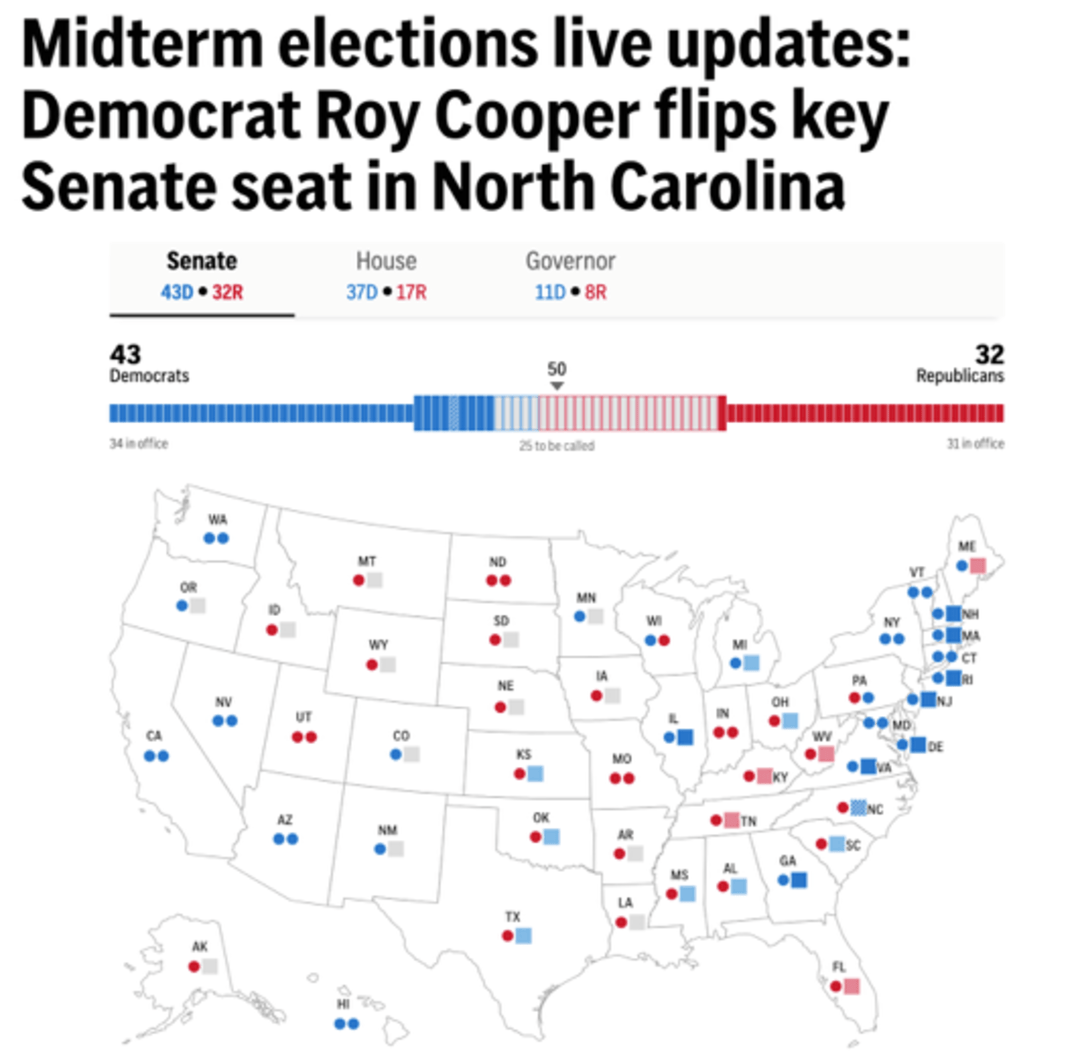
△The Associated Press reported that the Democratic candidate won a key Senate seat in North Carolina.
As polling stations closed one after another, American media also released preliminary surveys of actual voters. An Associated Press poll shows that about three-quarters of voters surveyed are dissatisfied or angry with the current direction of development in the United States, and about 70% hope that Congress will form more checks and balances on presidential power. Preliminary CBS exit polls show that Trump’s policy approval rating among voters surveyed is about 38%, and about 60% of voters believe that the president is one of the factors that affects their vote in the congressional election.
There are also differences in the focus of supporters of the two parties on issues such as immigration, crime and health care. The Pew survey shows that 72% of supporters of Republican candidates believe that immigration is very important, compared with 53% of supporters of Democratic candidates; when it comes to health care, 82% of supporters of Democratic candidates think that the issue is very important, compared with 53% of supporters of Republican candidates.
The international security situation has also entered voters’ horizons. A Reuters and Ipsos survey showed that 55% of respondents believed that the United States’ military action against Iran was not worth the cost, while 25% held the opposite opinion. The rise in energy prices triggered by the conflict in the Middle East has also further linked international security issues with the domestic economy.
△The Wall Street Journal reported that American voters are dissatisfied with Trump’s work performance, as well as the rising cost of living and the overall direction of the country.
From the economy and health care to immigration, public security and the international situation, American voters are concerned about a wide range of issues and are complex. Even when faced with the same problem, different groups have different understandings of policy directions and solutions.
What to watch in the election: Frequent records and fierce competition
If we extend the perspective from the voting day to the entire campaign cycle, there are several features worth paying attention to in this midterm election.
The first is that the number of early voters and the scale of campaign funding have both hit or are on track to hit records. The total number of early votes cast by more than 59 million people across the country has exceeded the entire 2022 midterm elections. OpenSecrets, a U.S. non-profit campaign finance research organization, predicts that total expenditures in this midterm election may reach US$11.9 billion, higher than US$8.9 billion in 2022. Even taking inflation into account, it is expected to set a spending record. Among them, expenditures by peripheral political organizations are expected to increase from approximately US$2 billion in 2022 to US$3.9 billion this year.
Secondly, there is fierce competition in some traditional Republican-dominated states. In Iowa, the Republican Party leads by more than 13 percentage points in the 2024 presidential election, but the gap in pre-election polls between the two parties’ Senate candidates this year once narrowed to less than 1 percentage point. Kansas has long been dominated by Republicans in the U.S. Senate, but this year the competition between Republican incumbent Senator Marshall and Democratic candidate Hamilton is equally fierce.
These traditionally farm states attract national media and significant campaign funds. In the final stage before the vote, Trump made a special trip to Iowa and Kansas to campaign. Agricultural production costs, energy prices and trade issues have also become important topics in local election discussions.
The third point of interest is the continued attention given to issues of election rules, judicial procedures and election credibility. On the eve of the election, a legal dispute ensued between the federal and state governments over the eligibility of some registered voters in California. On the evening of November 2, the U.S. Supreme Court rejected the federal government’s emergency request requiring California to take special handling measures for relevant ballots. In Alaska, a federal judge rejected a lawsuit filed by the Justice Department over similar candidates’ names and issues with election certification procedures.
Concern about the electoral process is also reflected in the polls. A Reuters/Ipsos survey showed that 77% of respondents believed that their votes could be counted accurately, but 45% believed that there was widespread election fraud in the United States. Trust in the specific vote counting process and concerns about the overall electoral environment coexist in the perceptions of some voters.
△The Wall Street Journal reported that the battle for control of Congress is still unresolved.
In addition, economic, social and international security issues are intertwined in this election, and debates on different political lines have also emerged within the two parties. In Michigan, a federal congressman who lost the Democratic Senate primary publicly supported the Republican candidate before the election, sparking controversy within the party.
The results of this midterm election will directly affect the power structure of the U.S. Congress in the next two years. If Democrats gain control of the House and Republicans retain control of the Senate, issues such as the federal budget, major legislation and government oversight may require more bipartisan negotiations. House committees are likely to step up investigations into the executive branch, while the Senate will still play an important role in confirming senior officials and federal judges.
If the Democratic Party gains control of both the House of Representatives and the Senate, it will have greater initiative in the legislative agenda and congressional oversight, but the presidential veto and existing Senate procedures may still restrict policy advancement. Even if Republicans retain control of both chambers, different positions within the party may affect the implementation of specific policies.
From a longer-term perspective, this midterm election will also provide new observation basis for the 2028 presidential election. The two parties can use the actual voting results of various states and different voter groups to evaluate candidates, policy propositions and their own political support base, providing a reference for future campaign layout.
As polling stations close across the United States, preliminary vote counting results will continue to be released. After months of campaigning, massive financial investment and highly active early voting, the final results of this midterm election are still to be tallied.
Related Reading
- The first in the country! How to learn “unpopular secret skills”? Who will teach? Dean’s interpretation2026-11-12
- The price of refined oil may drop for the sixth time this year. Filling up a tank will cost about 15 yuan less2026-11-12
- “Token hoarding” became a hot word in the “Double 11” circle, and after Li Jiaqi, Luo Yonghao also came to sell2026-11-12
- Does the United States really not want to fight Iran anymore?2026-11-11
- Fireballs are scattered around Shijiazhuang. How much is the value of “visitors from outside”?2026-11-11