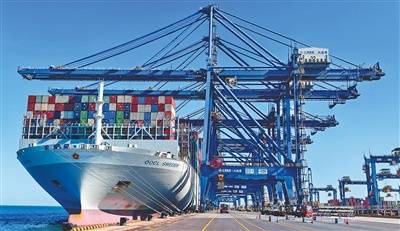
On October 7, at the Dalian Container Terminal in Liaoning Province, ships docking at the port were loading and unloading. Photo by our reporter Hu Jingyi
The river reaches the sea, and the port operations are busy. During the National Day holiday, the ports are busy with giant ships coming and going, loading and unloading, promoting the rapid inflow and outflow of domestic and foreign trade goods.
On the coast of the East China Sea, four giant container ships are lined up, fully automatic bridge cranes rise and fall accurately, and more than a hundred automatic guided vehicles shuttle silently. Three days before the National Day holiday, the cumulative operation of the Phase IV automated terminal of Shanghai International Shipping Center Yangshan Deepwater Port exceeded 79,000 TEU, an increase of 18.7% compared with the same period last year; the cumulative operation during the seven-day holiday is expected to exceed 180,000 TEU. “The entire process of ship docking, cargo loading and unloading, and route connection is intelligently dispatched to maximize the throughput efficiency of the port area.” Huang Hua, chief remote operator of SIPG Shangdong Branch, said.
As an important hub connecting domestic and international dual circulation, the port can be described as a “barometer” of economic development. In the first eight months of this year, my country’s total import and export value of goods trade increased by 17.6% year-on-year; the port cargo throughput was 12.06 billion tons, of which foreign trade throughput increased by 2.8% year-on-year.
Along the Beibu Gulf, trains shuttle; in Qinzhou Port, freighters line up… During the National Day holiday, the automated container terminal at Qinzhou Port in Guangxi maintains 24-hour continuous operation, with throughput expected to reach 45,000 TEUs from October 1 to 7. On September 16, the Pinglu Canal was officially opened to navigation, and the “circle of friends” in this sea area has expanded: iron ore and auto parts from Yunnan and Guizhou are sent south to ASEAN via rail-water combined transport; coal and bauxite from Guinea and Laos go north along the canal and into the southwest hinterland.
“The voyage to sea has been greatly shortened. Recently, many new customers have been added from Guigang, Nanning, Baise, Yunnan, Guizhou, Sichuan and other places in Guangxi.” said Zhang Minghe, deputy manager of the operations department of Honggang Terminal Co., Ltd., Qinzhou Free Trade Port Area, Guangxi.
Turning our attention to the northeast, on the afternoon of October 7, the OCEAN Alliance Europe Line “Orient Sweden” ship was docked steadily at the Dalian Container Terminal in Liaoning, and seven loading and unloading lines were operating at the same time. Dalian Container Terminal Co., Ltd. is responsible for more than 98% of the foreign trade container transportation volume in the Northeast region. It has opened 5 new foreign trade routes this year. “In less than 20 hours of docking time, we have to complete the loading and unloading of nearly 4,900 TEUs.” Qiu Li, the duty manager of the Operations Department of Dalian Container Terminal Co., Ltd., said that during the National Day holiday, the container terminal’s operation volume continued to remain high, and the total loading and unloading volume is expected to increase by about 20% year-on-year. “There are both grains shipped to southern provinces, and precision instruments, complete vehicles, equipment parts, etc. shipped to Europe.”
During the National Day holiday, the port upgrade will be “non-stop”.
The construction of the third automated terminal in Shanghai Port and Xiaoyangshan North Operation Area is in full swing, with all five automated quay cranes in place. Qin Tao, deputy commander-in-chief of the SIPG Engineering Headquarters, said that this new automated terminal will iteratively upgrade the new generation of automated terminal smart operation and management system independently developed by SIPG.
At the Qinzhou Port Automated Container Terminal, five 5,000-ton river-sea intermodal transport automated container berths are being constructed simultaneously, and large-scale excavation machinery is roaring. Soon, river ships from the Pinglu Canal will be able to dock alongside sea-going ships, and goods will be “transferred in water, directly unloaded and loaded” through gantry cranes, belt conveyors, floating cranes and other equipment, reducing landing and warehousing links and greatly increasing efficiency.
60 automated terminals have been built and put into operation across the country, including 30 automated container terminals, accounting for 27% of the global total; the fastest single-machine operating efficiency of the automated terminals in Shanghai Port and Qingdao Port in Shandong exceeds 60 natural containers per hour, and the average time in port for international container ships in major coastal ports is 1.7 days.
(Reporters Shen Wenmin, Hu Jingyi, Li Weijun, Ouyang Jie, Han Xin)
Related Reading
- The box office of 2026 National Day movies is 1.165 billion yuan! Nearly 800 million moviegoers were watched throughout the year2026-10-09
- The “touchstone” battle: Zheng Qinwen hits the semi-finals of China Open2026-10-09
- Three years after the Palestinian-Israeli conflict: The ceasefire has not stopped the fighting and reconstruction has no timetable2026-10-09
- Why was the Nobel Prize for Literature awarded to Anne?2026-10-09
- Undercover visits to release chaos: Good deeds turn into business? Why can’t I control this bucket of “released fish”?2026-10-09