On the Gold Coast of Changhai County in Dalian during the National Day holiday, three “Nana figures” made of fiberglass were surrounded by tourists and took photos. One is lying down, one is standing, and one is jumping up to welcome tourists’ touches and photos.
The real Nana is not here. This national first-level protected animal, the red spotted seal, is elusive and sometimes does not show up throughout the day. During the Mid-Autumn Festival on the eve of the National Day holiday, it was once surrounded by dozens of tourists at the beach at close range. Some people reached out to touch it, but volunteers loudly tried to dissuade it, but with “little success.”
Will the process of wild animals’ rewilding adaptation be worn away bit by bit in watching and touching them? Experts point out that the “Internet celebrityization” of wild animals is a double-edged sword. Using wild animals as “mascots” to divert traffic will certainly help popularize species science and enhance public awareness of conservation, but if not properly managed, it will also aggravate human interference, increase protection pressure, and may cause substantial harm to animals.
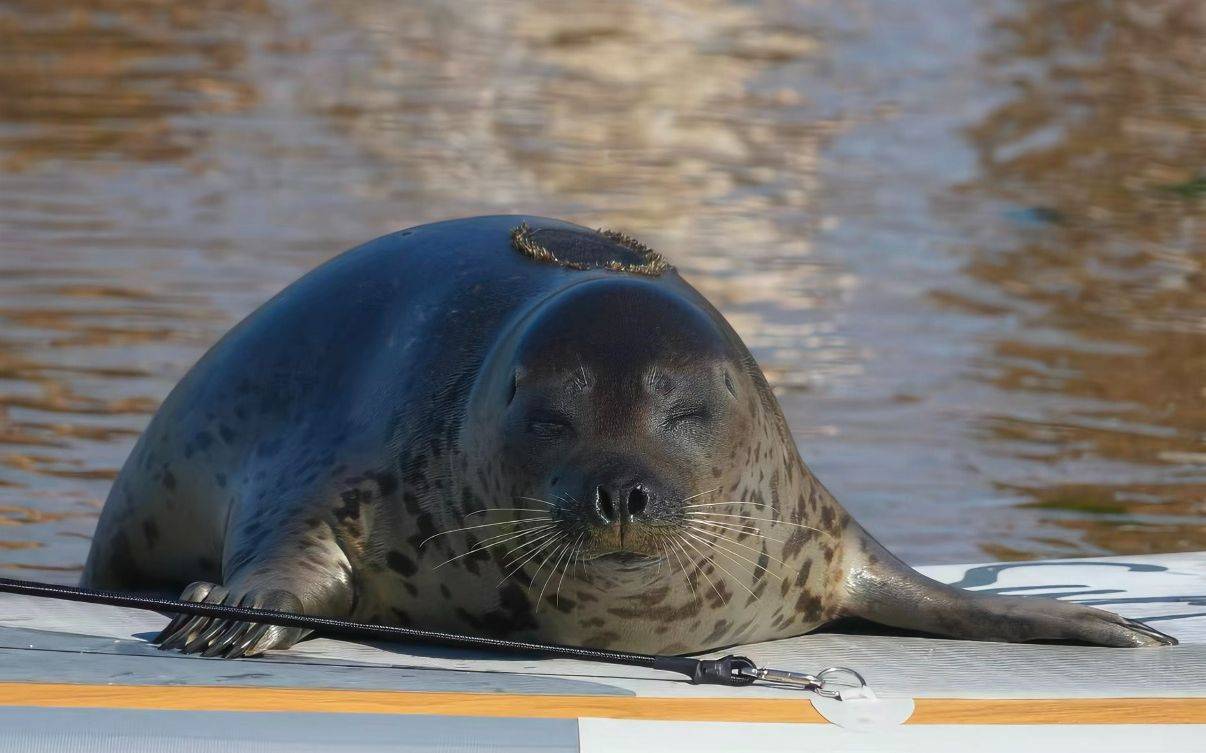
Nana the harbor seal. Screenshot of “Changhai Nana” social account
A rescued harbor seal’s “identity dilemma”
Nana’s story began when she got lost two years ago.
In the summer of 2024, the young bird traveled south from its birthplace of Liaodong Bay and drifted to Weizhou Island in the Beihai Sea of Guangxi. Harbor seals are a species in the high-latitude cold zone, and the southern sea is not suitable for long-term survival. Nana’s physical condition continued to deteriorate, and she had 5 obvious traumas on her body. She was “very weak” when she was admitted to the rescue agency.
After completing initial treatment in Beihai, Nana was transferred back to Dalian, Liaoning Province on November 25, 2025, and received rehabilitation at the Liaoning Provincial Institute of Marine Fisheries Sciences. After about two months of recuperation, its mental state, physical health level and coat color all returned to good condition, and all indicators met the standards. It was officially released into the sea on April 16, 2026.
However, after the release, Nana did not follow the migration of the population. It stayed in the waters of Dachangshan Island, frequently appeared in bathing beaches, and even took the initiative to approach humans. It often climbed onto bay pontoons, boats and water recreation facilities.
On September 7, 2026, in order to cultivate its ability to survive independently, the local marine department sent it to the cruising area of the harbor seal group – the ocean island waters away from human gathering areas. Only 6 days later, Nana swam back to the Golden Coast of Dachangshan Island after a long journey of about 140 kilometers (the actual swimming distance was estimated to be 200 kilometers).
The harbor seal, whose scientific name is the Western Pacific harbor seal, is the only pinniped marine mammal that can breed in my country’s waters. Under normal circumstances, they migrate to Liaodong Bay from October to December every year, give birth to pups on the ice from January to February of the following year, rest and molt from March to April, and gradually leave the Bohai Sea in late April to start their migration.
Dr. Yang Haile of the Shanghai Aquatic Wildlife Conservation Research Center analyzed in an interview with a reporter from the Beijing News that the spotted seal’s natural migratory habits give it certain navigation and spatial cognitive abilities, which provide a physiological basis for its return after the second release; judging from its first stay and second return, the waters of Dachangshan Island may have hydrological and hydrodynamic conditions, food resource conditions, beach conditions, etc. that are relatively consistent with its preferences.
The deeper reason lies in Nana’s rescue experience. Yang Haile pointed out that Nana was rescued and raised for a long period of time during her childhood, “which may have reduced her ability to integrate into the harbor seal group, leading to her departure after the first group release; it may also have reduced her vigilance towards humans to a certain extent, so her water selection preference does not avoid human activity areas.”
This just points to a core contradiction: the goal of wildlife rescue is to help injured individuals return to the wild and achieve independent survival. Sun Quanhui, a scientist at World Animal Protection, believes that “getting rid of dependence on humans and reducing unnecessary contact are the primary considerations in the rewilding adaptation stage.” What Nana is doing is exactly the opposite.
Information released by the Ministry of Agriculture and Rural Affairs in April 2026 shows that my country has issued and implemented the “Spotted Seal Conservation Action Plan” to build a pattern of coordinated advancement of in-situ and ex-situ conservation, improve the shelter and rescue network, carry out regular reintroduction of spotted seals, and promote the recovery of wild populations.
From the perspective of system design, the chain of “rescue-rehabilitation-rewilding-reintroduction” has been established, but Nana’s case exposed a weak link at the end of the chain: when a reintroduced individual “chooses” to stay in a human activity area, who will pave the way from “reintroduction” to “real return”?
In response to the management problem of overlapping protected areas and human activities, Zeng Cong, an associate researcher at the Shanghai Jiao Tong University Oceanographic College, told reporters, “It is difficult to completely avoid conflicts between humans and marine animals, but priority must be given to protecting populations, and individual management must not interfere with the rewilding process as the bottom line.”
“Relatives” are not cute, they are degradation of survival ability
On social media, images of Nana “taking the initiative to approach people” and “not afraid of people” were widely circulated, with comments such as “too cute” and “a good relative”. But in the eyes of some experts in behavioral ecology, the signals sent by these images are worrying.
Yang Haile said that if a rescued individual coexists in close proximity with humans for a long time after being released, it will further reduce its vigilance towards people as long as no harm occurs. For harbor seals stranded in human activity areas, their biggest natural enemy—the factor that may cause harm—is humans, so “their ability to avoid natural enemies/harm will indeed decrease.”
According to his analysis, long-term rescue and rearing when young may reduce their ability to integrate into the harbor seal group. “For individuals who have chosen to leave the group and stay in human activities areas, the difficulty in integrating into the wild population is the reason why they have to live in close proximity with humans for a long time after release. Of course, long-term coexistence with humans in close proximity after release will also make it difficult for them to integrate into the wild population.”
What is even more alarming is the possibility that this “family” behavior may be passed on to other harbor seals through a behavioral learning mechanism. Many animals have behavioral learning abilities, and mammals have stronger abilities in this regard. Whether the “relative” behavior can be passed on to other harbor seals through some kind of learning mechanism depends on whether the “relative” behavior can bring enough positive loop reinforcement benefits to other harbor seals.
The previous initiative issued by Changhai County also clearly stated that Nana “is less wary of humans and is particularly prone to stress reactions due to onlookers, feeding, chasing, and disturbance, and gradually loses her ability to hunt independently.”
CCTV reports recorded even more disturbing scenes: in addition to touching, inappropriate behaviors such as feeding, chasing and even riding occurred one after another. Tian Jiashen, director of the Marine Rare Animal Protection Research Office of the Academy of Marine Sciences affiliated to the Liaoning Academy of Agricultural Sciences, said bluntly: “For Nana, it has lost its vigilance and defense against people, which is not conducive to Nana’s independent survival.” Tian Jiashen said in an interview with CCTV that spotted seals are national first-level protected animals and cannot be fed, touched, chased, or enclosed. The correct approach is to maintain a safe distance and watch quietly from a distance.
Sun Quanhui gave a key criterion for judging this: “People think that close contact with wild animals is a sign of love for them, but it is exactly the opposite.” In Nana’s case, close viewing and touching not only interfere with her normal activities and strengthen her dependence on people at the psychological level, but the touching behavior itself also carries the risk of zoonotic disease transmission, posing a double hidden danger to the health of Nana and tourists.
The price of this “love” may be even heavier on a longer time scale. The “wildlife-friendly travel” advocated by World Animal Protection adheres to the priority of conservation and encourages tourists to appreciate the natural charm of animals in an environment where animals are properly cared for. Sun Quanhui further pointed out that a large number of tourists spontaneously uploading videos of direct or indirect contact with Nana on social platforms “will normalize unethical interactive behaviors” and have a negative impact on protection.
According to media reports, a B&B operator on Dachangshan Island said: “There are many people, so it is afraid and may not dare to go ashore.” A harbor seal that should have been basking in the sun on the reef and hunting in the shallow sea is losing the freedom to go ashore because of the “love” of onlookers.
Experts recommend delineating safety buffer zones and carrying out regular monitoring
During the Mid-Autumn Festival, volunteers loudly reminded the crowd to move back, but with “little success.” This detail reveals a problem: when the number of tourists continues to grow, on-site dissuasion and proposals alone are not enough.
The local government has launched a special management and protection operation, opened a “Nana Special Line” to guide tourists to the best viewing spots, and carried out regular patrols. During the National Day holiday, the local culture and tourism bureau placed cartoon sculptures on the beach for tourists to “play” in an attempt to alleviate conflicts between real-life leopards with a vicarious experience. According to Wang Chong, director of the Changhai County Culture and Tourism Bureau, civilized viewing reminders have been set up next to the sculpture, “Do not feed, do not touch, and do not disturb.”
An unnamed wildlife protection expert told reporters that these measures reflect a certain sense of management, but their effectiveness still depends on tourists’ willingness to cooperate rather than institutional coercion.
From the perspective of animal welfare management, Sun Quanhui suggested establishing a systematic and institutionalized guarantee mechanism: first, set up isolation facilities and delineate safety buffer zones; second, implement tourist restrictions and reservation management, and dynamically adjust the number of tourists; third, improve management regulations and impose corresponding penalties for violations; fourth, carry out normal monitoring, regularly evaluate the progress of Nana’s rewilding, and dynamically adjust protective measures.
At present, the “Wildlife Protection Law of the People’s Republic of China” has established the principle of “prioritizing protection, standardizing utilization, and strict supervision”. Article 6 of it clarifies that “any organization and individual has the obligation to protect wild animals and their habitats.”
Zeng Cong proposed a differentiated plan from the perspective of space management. He pointed out that in offshore scenic areas, demarcating large areas of sea areas as protected areas often faces great practical difficulties, and the cost of protection and social and economic development cannot be ignored. It may be necessary to focus on protecting areas where conflicts between humans and animals are relatively less concentrated. For special individuals such as Nana, the scenic area should consciously guide tourists and set up fences in areas that are not suitable to separate people and seals. “To avoid tourists and seals from hurting each other and reduce unnecessary losses to the scenic area. Because once a tourist is injured, it will cause damage to the city’s business card and the scenic area.”
Longer-term protection paths are also being advanced. In July this year, at the 48th UNESCO World Heritage Committee meeting held in Busan, South Korea, the Changshan Islands Migratory Bird Habitat in Dalian, Liaoning was successfully included in the World Natural Heritage. National first-level protected animals such as Western Pacific harbor seals in the area inhabit here all year round. Zeng Cong mentioned that Changshan Islands is also currently actively promoting the application and establishment of a national park. “Once approved, it is expected to play a relatively active role in protecting the entire harbor seal population.”
Before the system was fully in place, Nana oscillated between wildness and dependence every day. Where is the real Nana? Maybe by a certain reef, maybe trying to get closer to the crowd, maybe being surrounded by another group of onlookers. Sun Quanhui said that in the final analysis, Nana is still a wild animal. It cannot understand the calls for volunteers, nor can it understand the slogans of “civilized viewing”. If you want to reduce the interference of the crowd, you should not rely on the persuasion of volunteers, but a set of insurmountable and implementable rules. “Only the system can stop the crowd of onlookers.”
Beijing News reporter Zhang Jianlin
Related Reading
- (Photos from China) As evidenced by mountains and seas, “destination wedding” has become a new trend in marriage and love among Chinese young people2026-10-08
- Three years after the Palestinian-Israeli conflict: The ceasefire has not stopped the fighting and reconstruction has no timetable2026-10-08
- A technician at the Siberian Plague Research Center contracted the plague and died, and a female prisoner in Tennessee, USA, failed to be executed by lethal injection…Zhang Chaoyang shared global hot topics bilingually2026-10-08
- US has lost or sustained damage to 81 military aircraft worth up to $3.3 billion in Iran war, congressional report says2026-10-08
- Hurricane Isaias rapidly intensifies, evacuation orders expand across Gulf cities ahead of dangerous landfall2026-10-08