In Sanaa, the capital of Yemen, portraits of Abdul Malik al-Houthi can be seen everywhere. He appears on billboards with a traditional Yemeni dagger at his waist. His supporters would watch his impassioned speeches on big screens and wave banners bearing his face.
But the ubiquitous Abdul Malik al-Houthi seems to be nowhere to be found. He has not appeared in public for years, speaking only via pre-recorded videos or holding meetings via video from caves and safe houses. No one knows his whereabouts except for a few of his most trusted lieutenants. There is widespread speculation among Yemeni people that he is hiding in his hometown of Saada Province in northern Yemen, which has rugged mountains and a vast network of tunnels.
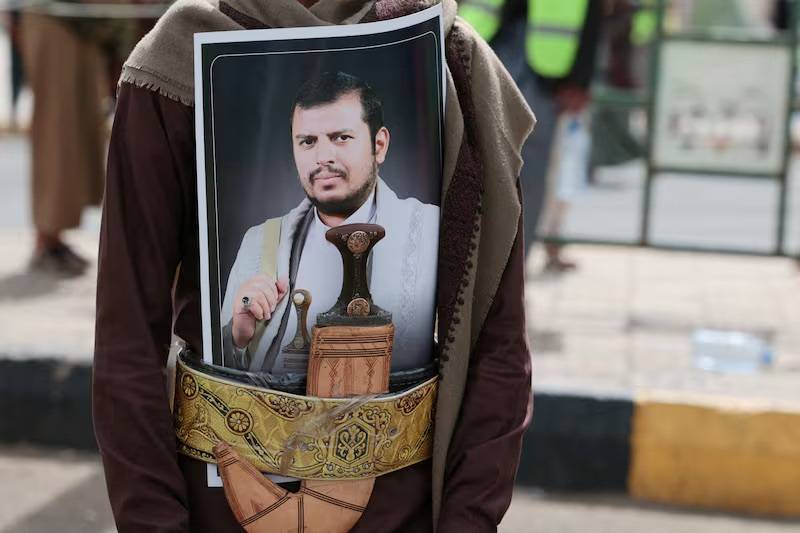
On July 17, 2026, in Sanaa, Yemen, a Houthi supporter pinned a poster of Houthi leader Abdul Malik Houthi to his dagger belt during a rally against the restrictions imposed by the Saudi-led coalition on areas controlled by the Houthis.
And it is this mysterious and elusive leader who commands a powerful army-the Houthi armed forces. In September, the Houthi armed forces swept across the west coast of Yemen and tightened their control over the Bab el-Mandeb Strait, embarrassing Saudi Arabia and the United States. In recent weeks, the group has continued to launch fierce attacks on Saudi Arabia, disrupting oil markets and strengthening Iran’s efforts to use global energy prices to pressure the United States.
As the offensive from all parties grows, the situation in the region becomes increasingly tense. According to Xinhua News Agency, Turki al-Maliki, spokesman for the Saudi-led multinational coalition, announced on social media on October 5 that 100 fighter jets from the multinational coalition participated in the “Yemen Dawn” military operation early that morning and destroyed 324 high-value targets. Strikes against moving targets continued. On the same day, Rashad Alimi, chairman of the Yemeni Presidential Leadership Council, issued a statement on the Saba News Agency controlled by the Yemeni government, announcing the launch of Operation “Yemen Dawn” to restore the operation of state institutions, liberate the capital Sanaa, and end the Houthi armed rebellion.
The Houthis have become an actor that cannot be ignored in the Middle East and the most important member of the “Axis of Resistance” led by Iran. How Abdul Malik Houthi got to where he is today must start nearly 40 years ago.
Houthi brothers in the mountains
The Houthi armed forces were founded in the 1990s, and their establishment is related to the special historical background of Yemen. “Houthi armed forces” is not the official name of the organization. They call themselves the “Ansar Allah” movement.
In the history of Yemen, the country of Yemeni Imams led by Zaydi Imams (religious and political leaders) has ruled Yemen continuously for thousands of years. Zaydism is a branch of Shia Islam that mainly exists in northern Yemen. However, since the second half of the 20th century, the influence of the Zayd faction has gradually declined.
In 1962, the Mutawakkilit Kingdom of Yemen (Kingdom of North Yemen) was overthrown by a military coup launched by Arab nationalists. The Zayd faction lost its power to rule Yemen for the first time in a thousand years. Since the 1990s, Yemen’s Sunni Salafists and Wahhabi missionaries, with the support of Saudi Arabia, have continued to erode the traditional sphere of influence of the Zaydi community, making the Zaydi community feel marginalized.
In order to reverse this situation, a young man named Hussein Houthi formed the “Young Believers Movement” from 1990 to 1992. The Houthi family to which Hussein belongs belongs to the Zayd sect, which claims to be a descendant of the Islamic prophet Muhammad. It has historically been quite influential in northern Yemen. His father, Baderdin Houthi, is a religious scholar of the Zayd sect.
Hussein quickly established a large network of followers that provided education and social welfare, but had yet to establish a clear organizational structure and armed branches. It is said that Hussein is a supporter of Iran’s Islamic revolutionary concept and promotes anti-American, anti-Israel and pro-Palestinian political ideas.
After the outbreak of the Iraq War in 2003, the Young Believers Movement intensified its criticism of the Yemeni government, causing then-Yemeni President Saleh to regard the organization as a thorn in his side. In June 2004, the Saleh government launched a crackdown on the Houthi armed forces. In September, Hussein was killed by Yemeni troops.
However, this incident became an important turning point in the early development of the Houthi armed forces. Badr al-Din’s youngest son, Abdul Malik Houthi, who was in his 20s (there are different accounts of his birth date), succeeded Hussein as the leader of the organization and changed the name of the organization to the “Houthi Movement”.
According to former Houthi armed spokesman Ali al-Buhati, Abdul Malik Houthi was thin and soft-spoken at the time, but strong-willed. The Houthi armed forces were in an extremely difficult situation at the time – they were extremely short of weapons and ammunition, and their members were mostly composed of mountain tribesmen who lacked education. He organized Hussein’s followers and began waging a guerrilla war in the mountains of northern Yemen.
It is said that Abdul Malik Houthi has demonstrated strong tactical ability, knows how to make full use of the rugged terrain in northwestern Yemen, and is able to withstand difficult combat environments with members of the organization. Buhati said he would personally direct the battle. Since then, Abdul Malik Houthi has established his authoritative role as the final decision-maker in the Houthis and in resolving internal disputes.
Between 2004 and 2010, six major military conflicts broke out between the Houthis and the Saleh government (the Saada War), and they eventually defeated the Saleh government and controlled almost the entire Saada province. The Saada war played a decisive role in the development and maturation of the Houthis, profoundly shaping the organization’s structure and internal texture, making it a cautious, secretive and highly disciplined organization.
“Slipper Army” takes advantage of Iran
In 2011, with the outbreak of the “Arab Spring”, popular protests broke out in various countries in the Arab world. The Yemeni people took to the streets to oppose the Saleh government, and the Houthis ushered in the opportunity to enter the national stage.
The group initially allied with protesters to force Saleh to hand over power to then-Vice President Hadi, thereby gaining the support of many Yemeni people. At the same time, the Houthi armed forces, based in Saada Province, took the opportunity to further expand their control area and evolved into a small army using weapons and equipment abandoned by the Yemeni government forces.
Around that time, Gamal Benomar, who served as the United Nations special envoy to Yemen from 2011 to 2014, became one of the very few foreign diplomats to meet with Abdul Malik al-Houthi himself.
Benomar recalled that their first meeting was in a crude safe house in Saada, which had been bombed by Yemeni government forces. The houses were empty, with many amputees, and Houthis wearing slippers and carrying old Kalashnikov rifles. Abdul Malik al-Houthi was “extremely mature for his young age and extremely polite.” “Although he is the leader of an elite militia, he is very affable and has a gentle manner.”
Beneath the surface, Abdul Malik al-Houthi has a way of ruling. He actively courted tribal leaders in northern Yemen and used family marriages to strengthen alliances with important families, clans and tribes. The alliance even included Sunni tribal leaders. With the support of various tribes, the Houthis have quickly emerged as the most powerful force in northern Yemen. What is even more surprising is that the Houthi armed forces and Saleh “resolved their differences” and formed an alliance in 2014. Both sides are keenly aware of the value of the other.
In 2014, Yemen’s political situation was turbulent and its economy was in trouble. The Hadi government gradually lost control of the country. With the support of the Yemeni army loyal to Saleh, the Houthis easily took over large areas of the north, including Sana’a, in September of that year. At the same time, they took control of most of Sana’s state institutions, and finally forced Hadi’s government to go into exile in the southern port city of Aden in 2015.
Saudi Arabia was shocked by the collapse of Hadi’s government because the Houthis’ seizure of power occurred at a critical period when the situation in the Middle East was deteriorating sharply. Since the outbreak of the “Arab Spring”, the confrontation between Iran and Saudi Arabia in the Middle East has continued to intensify, with the two sides engaging in fierce competition for influence and proxy conflicts in Iraq, Syria and Lebanon. After 2014, Iran gradually established its dominant position in the region by actively participating in the war against the extremist organization “Islamic State”.
In Saudi Arabia’s view, the cooperation between Iran and the Houthis is Iran’s conspiracy to encircle Saudi Arabia and has posed a major threat to Saudi Arabia’s national security. In March 2015, Saudi Arabia led the Arab coalition to intervene in the Yemeni civil war in an attempt to restore the overthrown Hadi government, and thus fell into a quagmire of a disastrous and extremely costly war.
The Houthis have not only withstood years of artillery bombardment and economic blockade by the Saudi-led coalition, they have also expanded their army and mastered the ability to use long-range drones and missiles to strike sensitive facilities deep in Saudi Arabia.
According to a report by the Financial Times, citing a former diplomat who had worked in Yemen, Saudi Arabia’s reasons for intervening in the Yemeni civil war were untenable because “the relationship between Iran and the Houthis was still in its infancy at the time.” Amwaj Media, a digital media in the Middle East headquartered in London, UK, also pointed out that the leadership of the Houthi armed forces was deeply influenced by the local environment in Yemen during the Saada War, when Iran provided extremely limited support to the organization.
It was with the expansion of the civil war and the need to jointly fight against Saudi Arabia that Iran began to have a closer relationship with the Houthis and provided the latter with weapons, equipment and military training services.
Bala Shiban, a research associate at the Royal United Services Institute in London, said training from Iran and Hezbollah was crucial for the Houthis because “it is this type of training that helped the Houthis transform from a militia into a more organized military force, with a consequent change in its structure and the way it operates.”
By the end of 2017, because Saleh defected during the civil war and announced support for the Saudi-led coalition, the Houthi armed forces launched a fierce attack on Saleh’s controlled areas in Sana’a, which eventually led to Saleh’s death. Since then, they have taken over most of Saleh’s sphere of influence and established absolute control over the Sana’a regime. Starting in 2020, the Houthi armed forces even began to launch a counterattack on the ground, approaching the city of Marib, the last stronghold of the Yemeni government forces in the north.
Relying on their increasingly powerful ground military strength and long-range strike capabilities, and with the mediation of the United Nations, the Houthis finally forced Saudi Arabia to reach a ceasefire agreement in April 2022.
According to an analysis by the U.S. Center for Strategic and International Studies (CSIS), the Saudi military has intercepted thousands of ballistic missiles, cruise missiles, drones and other long-range weapons launched by the Houthi armed forces. CSIS statistics show that from 2016 to October 2021, the Houthis launched a total of 4,103 attacks. Abdul Malik Houthi stated in his speech that his goal was to be able to hit any Saudi or Emirati target, and judging from the results, this was indeed achieved.
Extremely tenacious and extremely cautious
Since a new round of large-scale Palestinian-Israeli conflict broke out on October 7, 2023, the Houthi armed forces have once again come to the forefront of the conflict.
Abdul Malik al-Houthi took a tough stance and delivered a video speech from an undisclosed location, describing Israel’s blockade of Gaza as a crime against humanity and accusing Arab and other Islamic countries of “remaining silent in the face of genocide” and “emboldening the United States and Israel to commit more atrocities.”
In order to support the Palestinian Islamic Resistance Movement (Hamas), the Houthis used long-range drones and missiles produced by the organization to strike targets in Israel, and implemented a blockade of the Bab el-Mandeb Strait in November of that year, which once led to a significant reduction in ships passing through the Red Sea.
Continued attacks by the Houthis have also triggered retaliation from the United States and Israel. In January 2024, the United States, Britain and other countries began to launch air strikes against the Houthi armed forces. In March 2025, the Trump administration significantly increased the intensity of air strikes, causing considerable damage to the organization’s facilities.
However, the Houthis resisted fiercely and used hard-to-find mobile air defense systems and anti-ship missiles to frequently attack U.S. warships and fighter planes conducting air strikes, turning the U.S. military’s operations into a costly “sparrow war.” After consuming an estimated US$750 million in ammunition and losing 7 drones and 3 fighter planes, the United States and the Houthis finally reached a ceasefire agreement in May 2025.
According to a poll released by the Palestinian Center for Policy and Survey Research in October 2025, the Palestinian public’s support for the Houthis is much higher than that for any other regional actor. Since the war began, Abdul Malik al-Houthi’s face has appeared on posters in Istanbul, Tunisia and Tehran.
The Houthis have become increasingly bold in regional affairs, but Abdul Malik Houthi himself remains extremely cautious. As Israel successively killed Hamas leader Haniyeh and Lebanese Hezbollah leader Nasrallah and severely damaged the two organizations, the Houthis have become the most important Arab allies in the “Axis of Resistance” led by Iran, and Abdul Malik Houthi himself has become a thorn in the side of Israel and the United States.
In August 2025, Israel attacked the cabinet of the “Supreme Political Council” government under the leadership of the Houthi armed forces, killing many cabinet members, including the prime minister. In October, the Houthis announced the death of their army chief of staff, Mohammed Jamali, but did not announce the cause of death. Jamali was hit by the Israeli air force in August and has not been seen in public since.
According to Amwaj Media, citing Houthi armed sources, the organization has learned lessons from the death of Nasrallah and has begun to restrict the use of mobile phones or other electronic devices by military and security personnel and switch to face-to-face communication. Meanwhile, the Houthis have reduced meetings between their leaders and instructed individual military units to operate independently amid communications disruptions.
Abdul Malik al-Houthi remains unharmed in large part because few people know where he is. According to Reuters, citing people familiar with the matter, he almost never met face-to-face with foreign officials. Foreign officials who dealt with him would be asked to hand over their mobile phones, and then rely on a security convoy to go to the safe house. After passing the security check, they would be taken into a room, and he himself would communicate with those present through video conferencing.
With Abdul Malik Houthi rarely seen in the public eye, the group’s military spokesman Yahya Saraya has become the public face. Wearing a military uniform and standing upright, Sarea read the statement in a dramatic tone, elongating the pitch of certain words and suddenly raising his voice for emphasis. This unique expression is instantly recognizable.
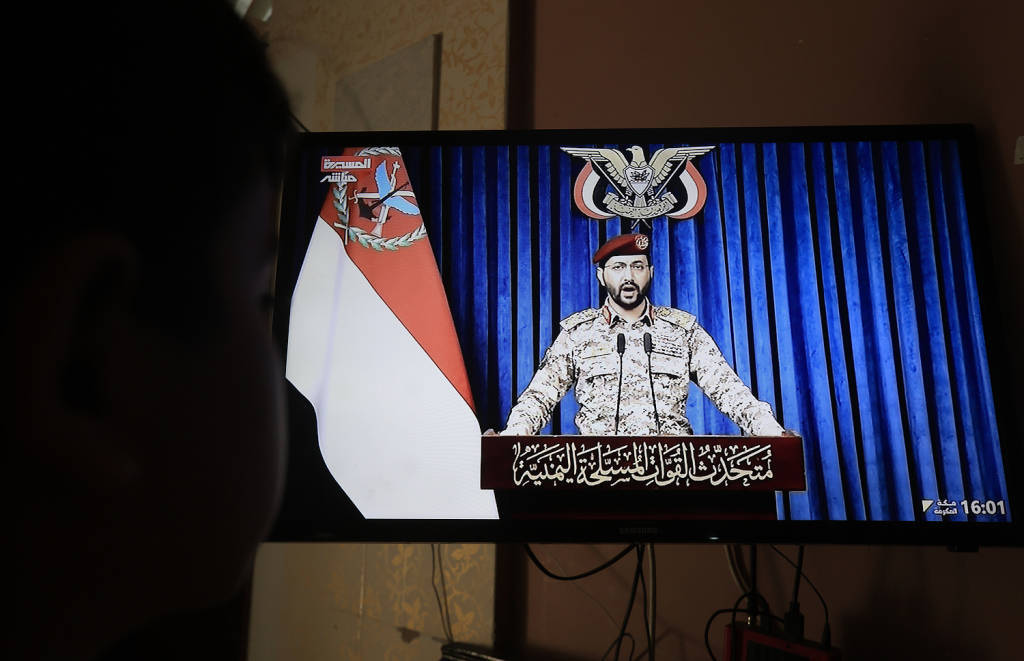
On October 4, 2026 local time, in Sanaa, Yemen, a person watched胡塞Armed spokesman Yahya Saraya delivered a televised speech.胡塞The armed forces claimed to have launched two missile and drone attacks on Aramco oil facilities in the Saudi cities of Riyadh and Quraysh in response to Saudi air strikes on Sanaa and other cities in Yemen. Visual China Map
On February 28 this year, the United States and Israel launched an attack on Iran, and the “Axis of Resistance” allies under Iran’s leadership gradually joined the war to support Iran’s counterattack. But what surprised the outside world was that the Houthi armed forces remained stationary for the first month after the war broke out and did not respond to the United States and Israel. What is also surprising is that in July this year, the Houthis took the initiative to escalate the military confrontation with Saudi Arabia on the grounds that Saudi Arabia attacked Sanaa Airport.
Today’s Houthis have established a “de facto state” – the power body “Yemen’s Supreme Political Council” under its leadership has its own government, army and media institutions. The organization controls about one-third of Yemen’s territory and two-thirds of its population, and controls important economic and administrative resources such as Sana’a and Hodeidah Port, including some state-owned economic institutions. The U.S. Department of the Treasury and other agencies estimate that the revenue generated by the Houthis through taxes, tariffs, levies and oil sales can reach US$2 billion per year.
More importantly, the Houthi armed forces have a huge arsenal of weapons, including long-range drones, long-range ballistic missiles, cruise missiles and anti-ship missiles, and their strike range can cover all Gulf countries and Israel. The Houthi armed forces have a large army, well-trained soldiers, and are very good at using drones to fight. While the group still relies on Iran for cutting-edge components, including guidance systems, it has been able to manufacture most of its weapons itself.
Related Reading
- Young people fall in love with RV travel! RV consumption faces new changes during the National Day holiday2026-10-06
- alert2026-10-06
- Yangtze River Delta Railway welcomes return passenger flow peak today: 3.9 million passengers are expected to be transported, ticket allocation will be dynamically adjusted2026-10-06
- Trump says he’ll start paying for ads after bipartisan pushback over taxpayer funding2026-10-06
- Norway announces that it plans to temporarily ban the use of AI glasses in specific places2026-10-06