How are you going to spend this National Day holiday?
If you haven’t planned yet
Consider adding stargazing to your schedule
Starting from the 1st
Pleiades star cluster accompanying the moon, Saturn opposing the sun and other wonderful celestial phenomena
輪番登場
Many of them are visible to the naked eye
Collect your holiday stargazing guide soon
↓↓↓
Pleiades star cluster accompanying the moon
On the first day of vacation, watch the “Seven Sisters” first
In the early morning of October 1, the moon moved close to the Pleiades star cluster, and the stars and the moon depended on each other. The Pleiades star cluster, located in the constellation Taurus, contains many stars and is one of the closest and brightest open star clusters to us.
In a clear night sky in the northern hemisphere, six or seven of the bright stars can usually be seen with the naked eye. Therefore, the Pleiades star cluster is often called the “Seven Sisters Star Cluster”. In ancient my country, it was called the Pleiades among the twenty-eight constellations.
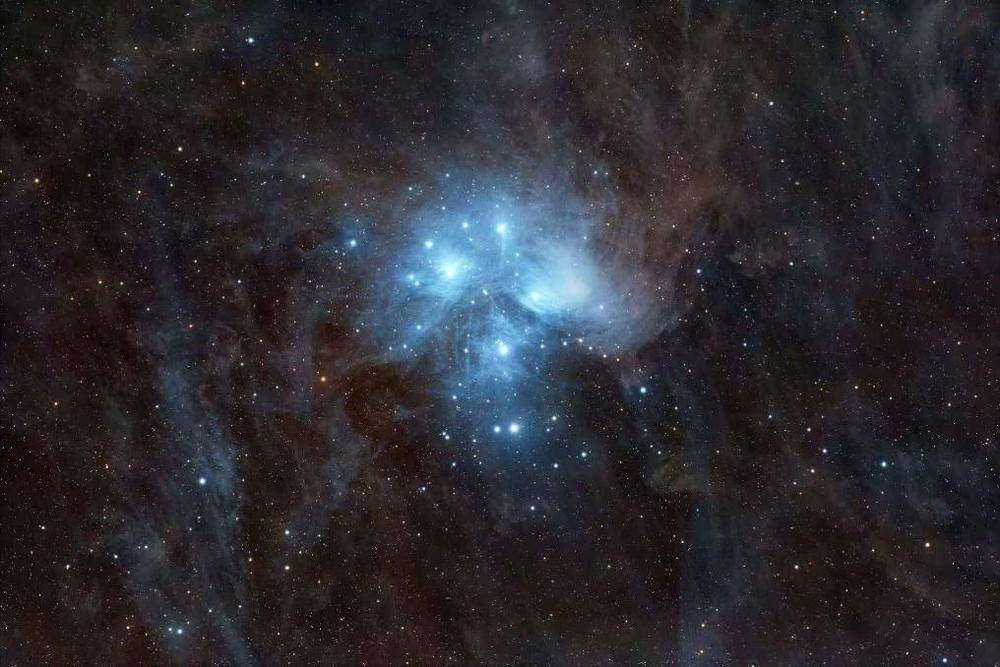
△On November 5, 2024, a starry sky photographer took a close-up of the Pleiades star cluster in Xinglong County, Chengde City, Hebei Province.
If you use an astronomical telescope to observe and photograph the Pleiades star cluster, you can not only see more stars, but also see blue dust clouds scattered around the bright stars, like a “small city of stars.” The number of stars currently confirmed to exist in the Pleiades cluster exceeds a thousand.
土星衝日
This month’s “highlight”: Lord of the Rings reappears
Saturn will oppose the Sun on October 4th. “Opposition” means that Saturn, the Earth, and the Sun are nearly aligned, with the Earth in the middle, and Saturn being the closest to the Earth, with all the illuminated faces facing the Earth. This opportunity only comes once every 378 days on average. During opposition, Saturn appears larger and brighter and is visible almost all night long, making it the best window for observing Saturn throughout the year.
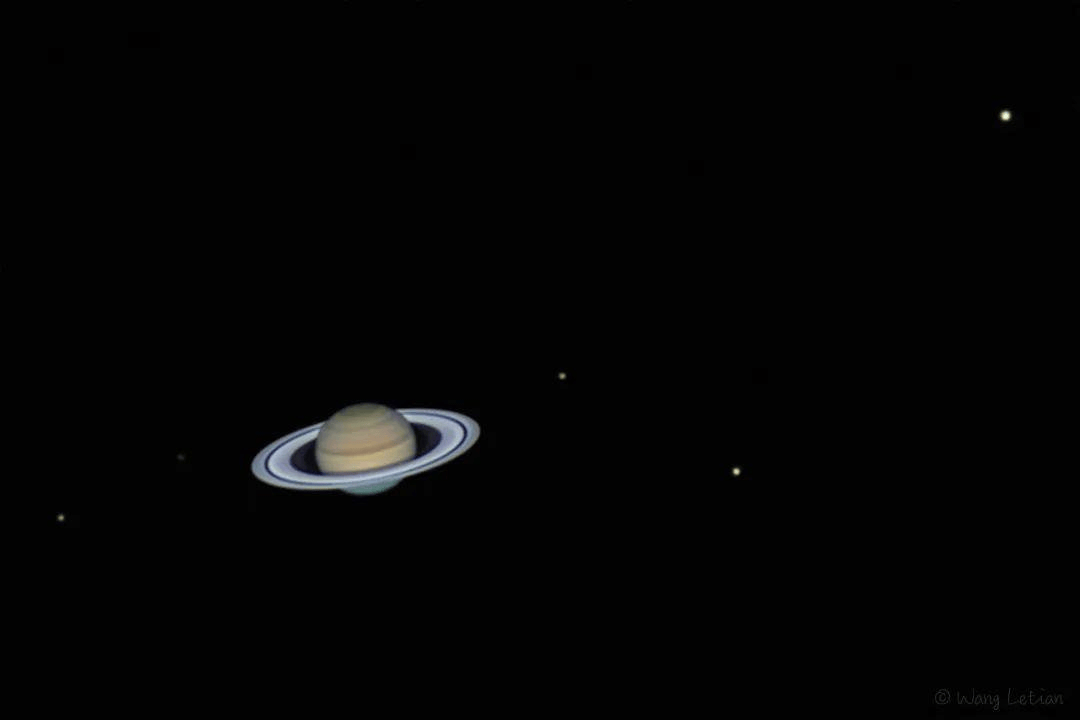
△Saturn opposition data map
As one of the most recognizable planets in the solar system, Saturn is nicknamed the “Lord of the Rings” because of its magnificent rings. What’s even more special is that the rings of Saturn were nearly “invisible” at the end of 2025. The inclination of the rings is rising this year, which is equivalent to the “Lord of the Rings” putting on the straw hat again.
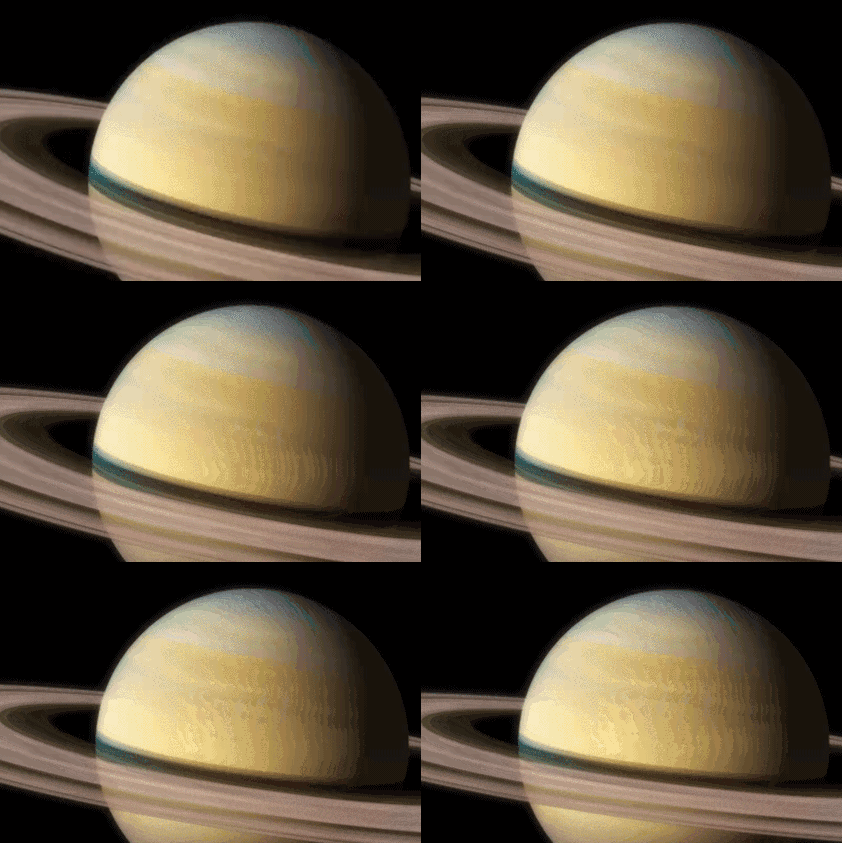
Observation is simple: Saturn rises from the east after sunset and is visible all night, rising to the highest point in the south sky around midnight; a bright earthy star can be seen with the naked eye, and the rings of Saturn can also be seen with an astronomical telescope.
火星伴月
The waning moon “dates” red Mars
At about midnight on October 5, a waning moon rose from the east, followed about 40 minutes later by Mars with a brightness of about 1 magnitude. Below Mars, there is bright Jupiter facing it.
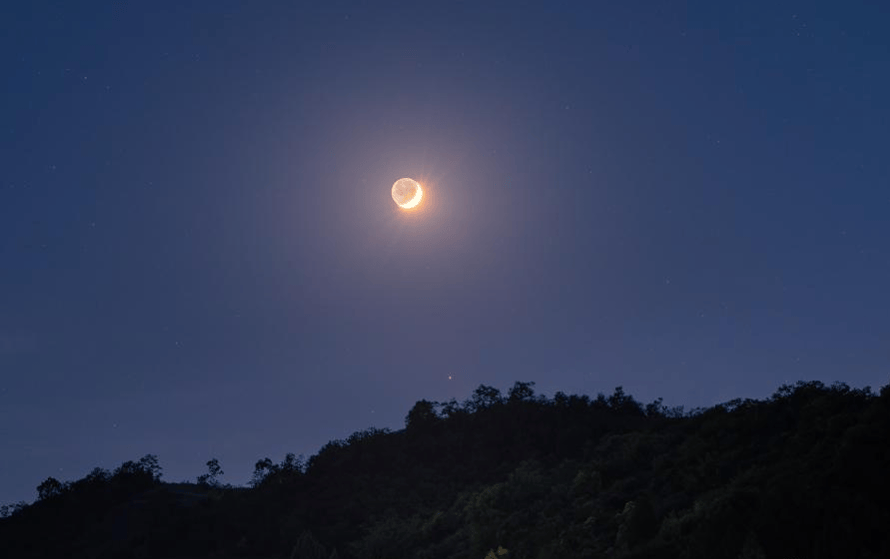
△On July 21, 2023, a starry sky photographer captured Mars accompanying the moon in Longnan, Gansu.
A planet accompanying the moon means that the moon moves very close to a certain planet. Mars is famous for its iconic orange-red color. It is a close neighbor of the earth and is highly recognizable. This “Dialogue between the Stars and the Moon” can be enjoyed without any equipment or naked eyes.
木星伴月
The second stop of the moon’s “visit”
In the early morning of the 6th, Jupiter “took over” the scene, with a brightness of about -1.9 magnitude. At this time, the moon stopped exactly between Mars and Jupiter; in the early morning of the 7th, its angular distance from Jupiter further shrank to about 6 degrees, making it appear even closer.
△On September 9, 2026, a starry sky photographer captured Jupiter accompanying the moon in Tongjiang City, Heilongjiang Province.
Jupiter is the largest planet in the solar system. It is so bright that a bright white “star” can be seen with the naked eye. The moon “visited” Mars and Jupiter in the early morning of two consecutive days. The moon’s “visit” is like a TV series, and it is worth staying up late to watch.
智神星
The second asteroid discovered by humans reaches opposition to the sun
On the 6th, asteroid Pallas No. 2 opposed the sun, with a brightness of about 8.3 magnitude. Pallas was discovered by German astronomer Heinrich Obers in 1802. It was the second asteroid discovered by humans after Ceres, so it is also called the No. 2 asteroid.
△A model of Pallas produced by the scientific team of NASA’s Jet Propulsion Laboratory and the University of Arizona based on existing observational data (left picture); a Pallas image taken by the European Southern Observatory (right picture).
Opposition of Pallas is an astronomical phenomenon in which Pallas moves in line with the earth and the sun during its orbit around the sun, and the earth happens to be located between the sun and Pallas at this time. At opposition, Pallas reaches its maximum brightness and is relatively close to the Earth, providing the best observation conditions.
During opposition, Pallas is visible almost all night. When observing, interested astronomy enthusiasts must first use detailed star maps or starry sky software to understand the location of Pallas, and then search for it through large-diameter binoculars or small astronomical telescopes.
space station transit
Two “new stars” streak across the night sky
In addition to celestial phenomena, the National Day holiday also has “artificial stars” to add to the fun: the Chinese Space Station and the International Space Station, illuminated by the sun, will shine in the night sky as “bright stars” one after another, accompanying the bright stars, adding a unique romance to the National Day.
△On November 7, 2022, the Chinese Space Station and the International Space Station, taken in Wanping Ancient Town, Fengtai District, Beijing, transited successively (multiple photo stacks).
Currently, the only large-scale manned space stations operating in orbit are the Chinese Space Station (Tiangong Space Station) and the International Space Station built and operated by multinational cooperation. The space station flies around the earth at high speed, and can only be observed clearly during a specific period of time and in a good environment. One to two hours before and after daily sunset and sunrise is the ideal window period for observing the space station.
Taking the Beijing-Tianjin-Hebei region as an example, the Chinese Space Station took the lead in the early morning hours; in the evening, the International Space Station appeared one after another, performing a wonderful space parade. Interested members of the public can use astronomical applets such as “Tianwentong” to locate their location and check the transit forecast of the Chinese Space Station and the International Space Station.
Observation precautions
先看天氣
Cloud cover, visibility, and atmospheric transparency directly affect the observation effect. Clear and cloudy nights are suitable for viewing. Stars are hard to find in places with thick clouds, rain and snow. Before setting off, check the weather forecast and local viewing maps.
△On September 3, 2026, the transit of the Chinese Space Station was taken at the Chinese People’s Anti-Japanese War Memorial Sculpture Park in Fengtai District, Beijing (multiple photo stacks).
Select an observation point again
How to choose a suitable observation point? By mastering the following selection points, you can find a venue with less light pollution and a better observation experience:
Urban parks and ecological green spaces: Choose open areas with little lighting at night, such as urban wetland parks, and avoid areas exposed to strong light. Rooftops of high-rise residential buildings and open-air rooftops: Climb up to observe under the premise of ensuring safety, and the field of vision will be wider; be careful to avoid close-range light sources such as rooftop billboards and neon lights. Urban and suburban areas: Significantly reduce light pollution. Open farmland, along the banks of reservoirs, and low gentle slopes are all high-quality sites, and the observation effect is far better than in the city.
Be sure to pay attention to safety
Before going out for stargazing, confirm the route to the observation point in advance, arrange the return journey, and bring hot water and food; when camping out for stargazing, choose a flat high ground, away from dangerous terrain such as valley bottoms, river mouths, and cliffs, and travel in groups to prevent mosquito bites; the stargazing period is mostly the coldest time of the day, so be sure to protect yourself from the cold and keep warm.
Autumn is getting stronger in October
The weather is getting cooler in many parts of the country
Keep warm when chasing “stars”
I wish you a romantic holiday with a starry sky
Related Reading
- Are the generals at odds? Cristiano Ronaldo announces his departure from the national team2026-10-01
- California’s Six Flags internet celebrity crossing the mountain is permanently closed, a former American music pastor cheated on his wife and killed his wife, a female prisoner in Tennessee will be executed…Zhang Chaoyang bilingually shares global hot topics2026-10-01
- The Chinese delegation has won 151 gold medals, and the diving team achieved the “100 gold medals” in the Asian Games2026-10-01
- “National subsidy” for buying a house is online, saving up to nearly 50,000 yuan in interest2026-10-01
- Two waves of cold air hit one after another during the National Day holiday, and temperatures in many places will hit record lows in six months. Rainfall will be heavy in the south during the first half of the holiday.2026-10-01