During the National Day holiday, the World Expo Museum’s “National Style – Exhibition of Qing Dynasty Emperors’ Clothing from the Forbidden City” has entered the countdown to the exhibition period. The Paper has learned that the exhibition will be held inOctober 7Ended, due to the “fragility” of silk fabric cultural relics,101 precious weaving and embroidery cultural relicsAfter returning to the Forbidden City, the exhibits will go into storage for long-term conservation and are not expected to be seen for several years.The National Day holiday is the last chance to visit the exhibition.Since its launch, the “National Treasures” exhibition has also left a reputation among the audience. Many viewers wrote in their notes about the exhibition that it “exceeded expectations” and “very worth it.”
Countdown to the “return to the palace” of more than 100 pieces of embroidery collected by the Forbidden City
As the first large-scale palace costume exhibition held in Shanghai, the lineup of this exhibition can be called “luxurious”. Nearly 90% of the exhibits in the exhibition have left Beijing for the first time, more than 30% are on public display for the first time, and three-quarters of the items are second-level or above cultural relics. The 101 pieces of woven and embroidered cultural relics are all collected by the Forbidden City. They include the robes and coats of the four emperors Kangxi, Qianlong, Jiaqing and Tongzhi, as well as the robes, clothing materials and related clothing accessories of six empresses including Cixi and many concubines. It can be said that a long-sleeping “royal wardrobe” has been opened to the public.
展覽現場
展覽現場
Clothing is not only about the gorgeous colors and exquisite craftsmanship, but also the strict status order, clothing system and aesthetic taste of the Qing Dynasty palace. Stepping into the exhibition hall, each piece of exquisite weaving and embroidery truly corresponds to the descriptions of palace costumes, colors and etiquette in ancient books.
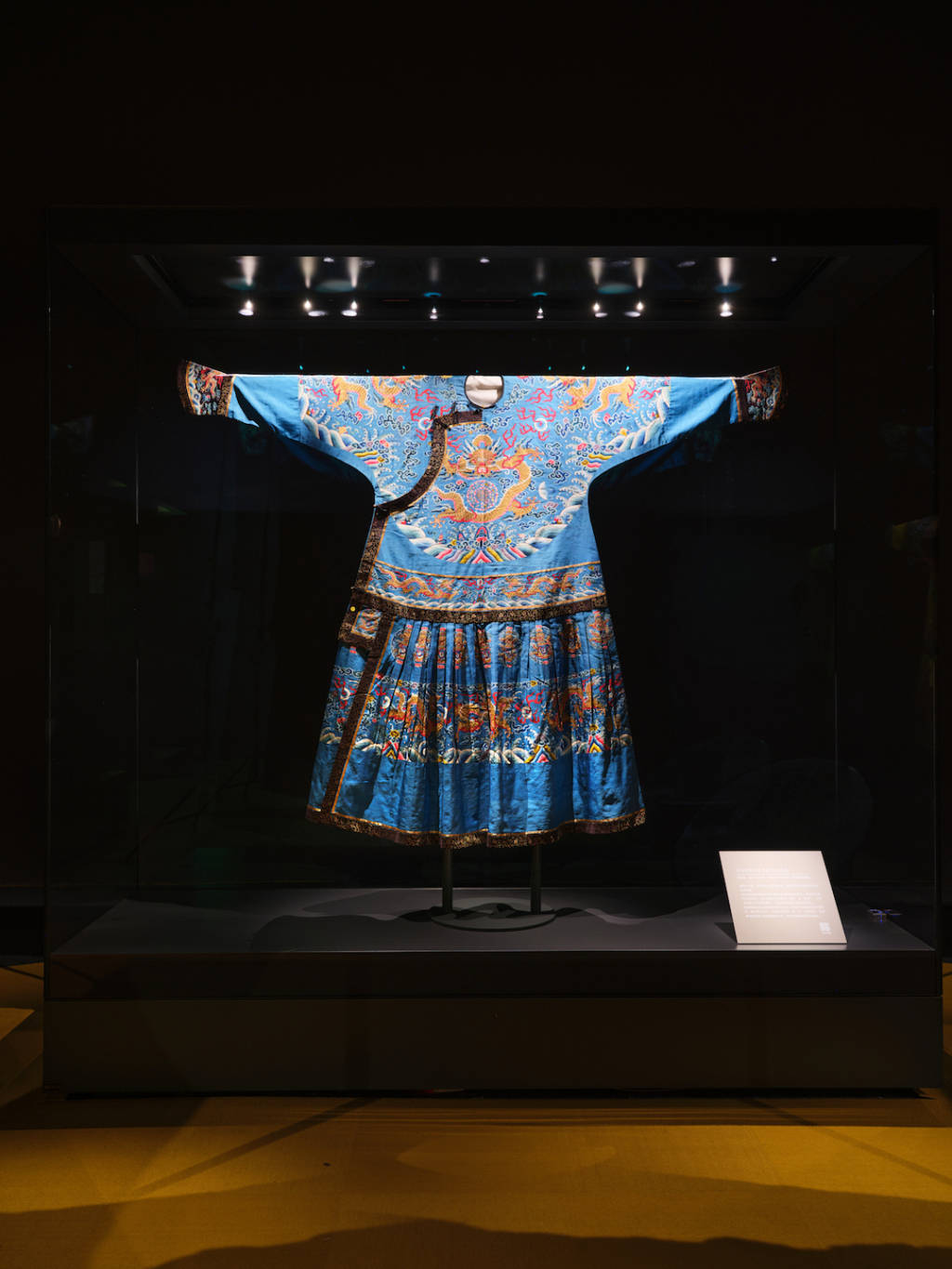
Exhibition site: Men’s court robe with moon white tapestry and gold dragon pattern
Hong Lina, the curator of this exhibition at the World Expo, told The Paper that silk fabrics are one of the most difficult cultural relics to maintain in the museum, no less than paintings and calligraphy. They are extremely fragile protein fiber cultural relics and have extremely high requirements for preservation and display conditions. Therefore, the exhibition period is strictly controlled to 90 days, and there will be no tour or extension. After the exhibition closes on October 7, these woven and embroidered cultural relics will return to the warehouse of the Forbidden City to “rest” and should not be seen again for a long time.
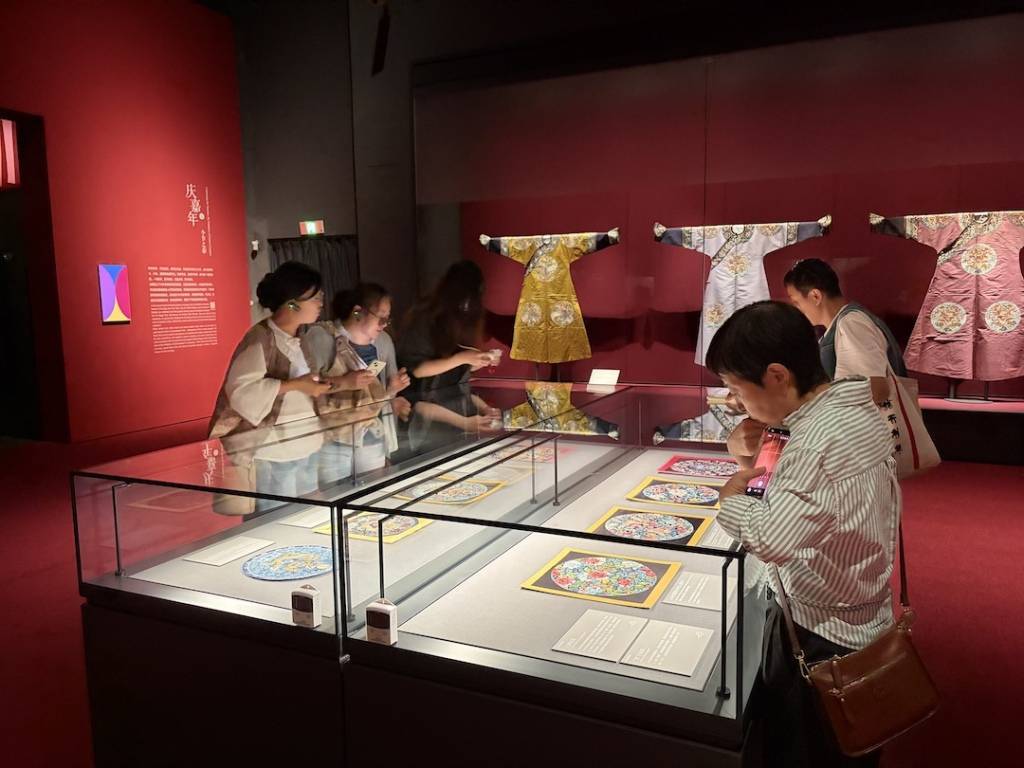
展覽現場
“In the past few days, the flow of people in the exhibition hall has obviously increased. Many visitors knew that the closing period was approaching and came here before the closing.” Hong Lina said that among the “nationally beautiful” visitors, young and middle-aged female visitors are the most interested. They often come to see the exhibition in Chinese-style attire that is consistent with the exhibition, becoming a scenery in the exhibition hall. The exhibition also attracts some professional visitors who are engaged in related research. They usually watch for 3-5 hours and study the details of the exhibits in depth.
Several pieces of clothing in the exhibition have words such as “Jiangning Weaving” and “Hangzhou Weaving” on them, revealing the production process of royal couture in the Qing Dynasty: after the emperor and queen’s costumes were customized and designed in Beijing, most of the production links came from the hands of craftsmen from the three Jiangnan Weavings (Jiangning Weaving, Suzhou Weaving, and Hangzhou Weaving). Jiangning weaving is good at makeup and flowers, Suzhou weaving is good at Song brocade, and Hangzhou weaving is good at weaving brocade. For the first time in a century, Jiangnan’s top craftsmanship has left the palace and returned to its native land. Naturally, the audience in the Jiangnan region feels more intimate and proud. Ms. Hao from Hangzhou saw the five-color silk woven in Hangzhou at a glance; Mr. Li from Jiangsu went to the Nanjing Yunjin Museum to learn about the makeup flower craftsmanship, and now he has seen the real thing in Shanghai.
“Since its launch, the exhibition has left a very high reputation among the audience, with a sampling satisfaction rate of over 99%. Many viewers wrote ‘exceeded expectations’ and ‘very worthwhile’ in their notes about the exhibition.”
Don’t miss every craftsmanship detail
For this exhibition, the World Expo Museum has specially customized special display cabinets that meet the exhibition requirements and are equipped with mirrorless glass. Constant temperature and humidity and low illumination standards below 50 lux are strictly implemented throughout the exhibition period to ensure that the cultural relics are always in the best preservation environment.
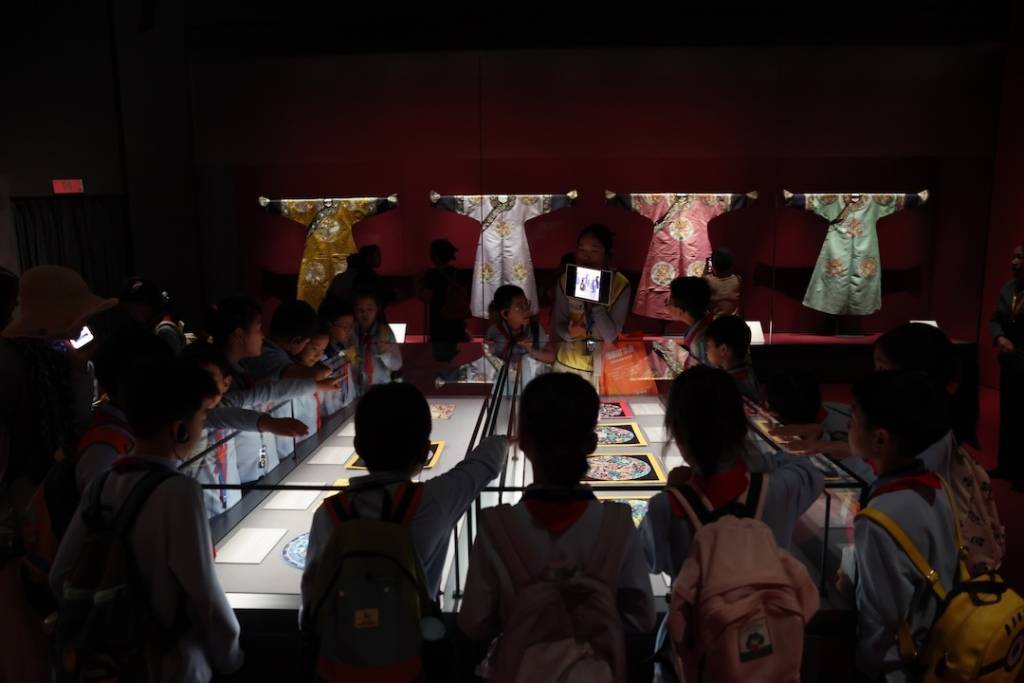
Hong Lina mentioned that many exhibits such as paintings are suitable for viewing from a distance, but this batch of weaving and embroidery exhibits encourages the audience to get closer and view them from different angles in order to clearly see the details of the weaving and embroidery craftsmanship.
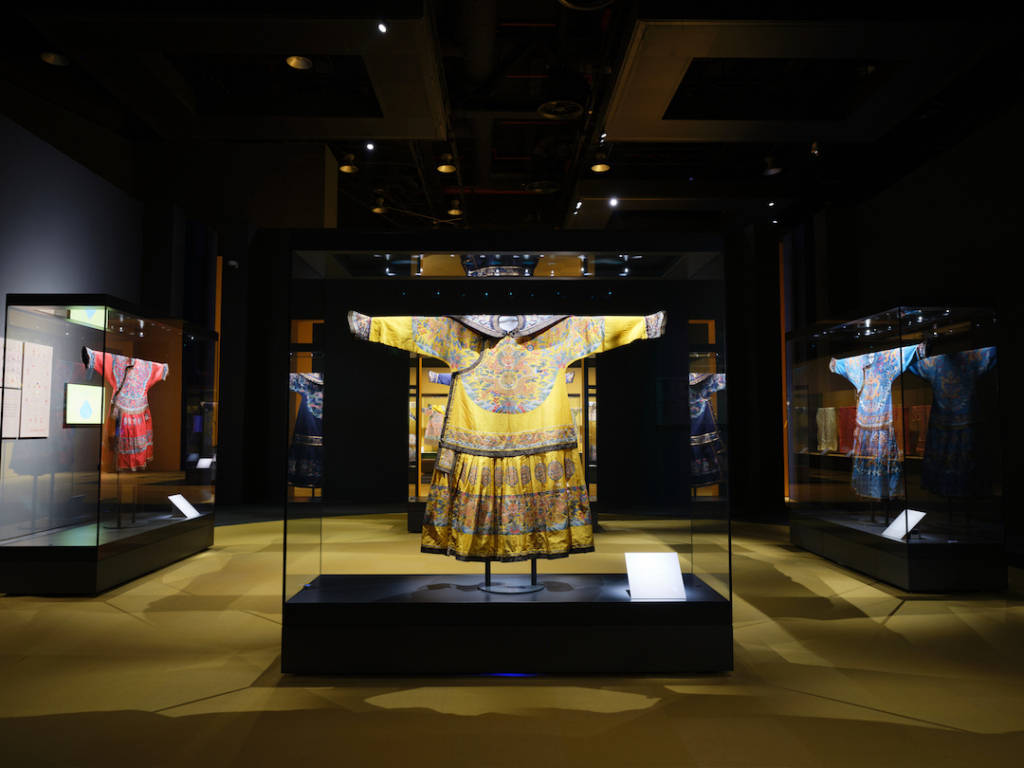
Exhibition view, Qing Dynasty, Qianlong period, bright yellow tapestry cloud bat longevity gold dragon pattern men’s single dragon robe
For example, a “bright yellow tapestry men’s single dragon robe with clouds, bats, longevity, golden dragon patterns” is displayed in the center display cabinet of the “Qing Jia Nian” unit. Compared with the two dragon robes on the left and right sides of the display cabinets, the three dragon robes only differ in color from a distance. A closer look can reveal the significant difference in texture between the tapestry and embroidery. Looking at the details, the biggest feature of this Qianlong imperial dragon robe is that it has a bright yellow background with many tiny pink bat, peach and peony patterns, which are not found on the other two dragon robes. “The ancient emperor’s birthday celebration was called the Longevity Festival, and the red bat symbolized great blessings in the sky, so it may be a custom-made dragon robe for Emperor Qianlong’s birthday.” “In addition, the perfect seam alignment technology of this dragon robe pattern can only be appreciated by getting close.”
展覽現場
展覽現場
At the scene, from time to time you will see some spectators holding magnifying glasses to observe carefully; some spectators hold professional camera equipment to take high-definition details of the exhibits from different angles. Ms. Fu, who is engaged in the research and reproduction of traditional embroidery and tapestry crafts, has come to the exhibition for the second time. She said, “There are so many details to see, such as yarn and makeup techniques. I have only seen them in books before. This time I can see them all in real life, and I can appreciate how powerful these techniques are!”
“What really touches people are the textures that cannot be fully recorded by the camera.” An audience member told The Paper, “I didn’t plan to watch it for so long, but now two or three hours have passed and I haven’t finished it yet. There are indeed many details worth savoring, and they can only be experienced on the spot.”
The imaginary “golden fur” is compared with the real thing
Most people first learned about peacock feather fabric when they read “Dream of Red Mansions”. However, because I have not seen any cultural relics to prove it, I just associate the image of peacock feathers. In the exhibition hall of the World Expo, there is a “dragon robe material with brown satin embroidery with peacock feathers and golden dragon pattern”, which is covered with “peacock feather thread”. The material is scarce and the production is complicated. It can be said to be a precious object for studying the court weaving and embroidery craftsmanship of the Qing Dynasty.
Qing dynasty sauce-colored satin embroidered peacock feather ground gold dragon pattern dragon robe material
Zhang Xin, the exhibition curator of the Palace Museum, said that although the bird-gold fur coat was not often worn in the palaces and palaces of the Ming and Qing dynasties, it was indeed a rare and rare garment that would surely amaze people. For example, the “Ming Huidian” stipulates that the queen’s regular clothes are: yellow for the shirt and dark cyan for the Xiapei, woven with gold clouds and dragon patterns, or embroidered or paved with green. Embroidery refers to embroidering with silk of various colors, and paving means using peacock feather threads of gold and green to cover the ground color. This craft tradition was called “Man Cui” in the Qing Dynasty’s regulations. The “Qing Hui Dian” stipulated that the crown prince, prince, county prince and Princess Gu Lun could all use Man Cui dragon pattern clothing. In the early Qing Dynasty, “Manchu satin” would also be awarded as a gift by the rulers to ministers with meritorious service. Therefore, an old family like the Jia family in “A Dream of Red Mansions” – whose ancestors fought with the dragon and survived a narrow escape, were named Dukes based on their military exploits, and had frequent contacts with the prince’s palace, might be rewarded with this kind of “green” python robe.
This “sauce-colored satin embroidered with peacock fur and multi-colored cloud bat flowers and gold dragon pattern dragon robe material” collected by the Palace Museum uses peacock green feather thread, colorful velvet and twisted gold thread to basically cover the sauce-colored satin ground at the tailoring area. Because it is just a robe material and not worn as ready-made clothes, there is no wear and tear.
展覽現場
Professor Dong Mei of the Central Academy of Fine Arts, who has been engaged in the study of “Dream of Red Mansions” for a long time, said that after seeing this exhibition, many colors that could only rely on imagination have become concrete. For example, a piece of bright red feather satin in the exhibition reminds people of the bright red clothes worn by everyone in “Dream of Red Mansions” when enjoying the snow; and fragrant color is a royal color, and it is true that only Yuanchun used it in the entire “Dream of Red Mansions”. The “sauce-colored satin embroidered peacock feather ground gold dragon pattern dragon robe material” can only be seen by changing the angle on site to see the different luster of the peacock feather structural color. “If I hadn’t seen the actual exhibits, I would have thought that the bird’s nest was a kind of literary imagination. It’s really amazing.”
These high-looking exhibits are the most “out of the circle”
Hong Lina told The Paper that in addition to the important exhibits such as the emperor’s robe, “bird gold fur”, and the first-class cultural relic “yellow land sash with four seasons flower pattern brocade”, some “high-looking” accessories are also not to be missed. , such as “tourmaline bracelet with emerald ornaments and eighteen pieces”, “azurite satin embroidered with eight pieces of patchwork pattern for happy encounters”, dotted emerald noodles, tapestry round fans, etc., have become the targets of the audience looking for “replicas” after visiting the exhibition.
Exhibition view, Qing dynasty, tourmaline and jade-decorated eighteen-child bracelet
The “Tourmaline Bracelet with Jade Decorations” contains two green emeralds sandwiched between a circle of pink tourmalines. Because of its soft and gorgeous color scheme, it is “gentle and smart with a Zen-like charm” and is deeply loved by female audiences. It is now one of the most popular exhibits on social media. The “Eight Tuan Buzi” azurite satin is embroidered with flowers of the four seasons in colorful silk. It is decorated with two swallowtail butterflies flying up and down, dancing in pairs. It is a traditional auspicious pattern of “a year of scenery” and “happy encounter”, which means good luck and is deeply loved.
Exhibition view, Jiaqing, Qing Dynasty, azurite satin embroidery with eight-tuple patchwork pattern for happy encounters
It is reported that since the exhibition was held, the World Expo Museum has co-organized nearly 10 related lectures, and almost all the lectures were full, and the lectures were sold out within seconds of the launch. The 4-5 supporting handicraft workshops held every week are also very popular, especially the “National Collection and Ancient Medicinal Dyeing Workshop” brought by Professor Shao Min of the Shanghai Theater Academy, allowing the audience to experience the charm of plant dyeing with their own hands. Activities such as children’s exploration of exhibitions and curators’ visits to schools allow more young people to learn more about traditional Chinese culture through the clothing patterns, etiquette culture, etc. in the exhibition.
Exhibition site: Ming Dynasty yellow silk tapestry with four seasons flower pattern, first-class cultural relic
The reporter learned from the museum that from October 1st to 7th, current students can enjoy a special fare of 38 yuan when purchasing tickets on-site with their student ID or student status information on Xuexin.com. During the National Day holiday, the handicraft workshops and children’s exploration and interactive exhibitions supporting the National Sourcing Exhibition are also on the schedule. Among them, the “Ancient Medicine Dyeing Workshop” also launched two-color over-dying for the first time.
Related Reading
- A statue of a princess near a cultural protection unit in Handan, Hebei Province was graffitied by children. The local government responded: It is an ordinary landscape facility and people have been sent to clean it up.2026-09-30
- The Chinese team won all 100 diving gold medals in the 14th Asian Games (high-resolution large picture)2026-09-30
- The strongest cold air in the second half of the year is coming, and the cooling calendar for big cities is released2026-09-30
- News 1+1丨What are the new changes in the new high-speed rail line during the National Day holiday?2026-09-30
- Who is leading in the selection of United Nations Secretary-General?2026-09-30