Interface News Reporter | 蔡星卓
Interface News Editor | 劉海川
September in Beijing is the migration season of migratory birds. In the small garden on the southeast side of the Lee Shing Hong Center office building in Wangjing, Beijing, the shadows of trees are reflected on the glass curtain wall. It looks like a piece of green, but it may become a fatal “trap” for birds in their flight. Recently, Ms. Liang, a volunteer for the 2026 North China Autumn Bird Strike Survey of the National Bird Collision Prevention Action Network, reported to Jiemian News that casualties of birds striking the glass curtain wall have occurred near the office building for many consecutive days. She recorded more than 20 injured or dead birds in 2 weeks, including the red-throated songbird, a national second-level protected animal.
Bird strikes against buildings and glass (hereinafter referred to as “bird strikes”) are becoming an increasingly prominent problem in cities. In September 2026, the “Global Bird-Friendly Building Policy Review and Implementation Path Study” (hereinafter referred to as the “Report”) released by Duke Kunshan University mentioned that currently, bird strikes have become the second largest human-induced cause of bird death after cat predation, seriously threatening the diversity of birds and the stability of ecosystems.
An interview with Jiemian News found that the bird collision incident in Wangjing is not an isolated case. Throughout the world, bird collisions are becoming a long-neglected issue in urban biodiversity protection.
Bird collisions occur frequently in Wangjing office buildings
Ms. Liang explained that the recent frequent bird collisions are because spring and autumn are the migration seasons for migratory birds, and Beijing happens to be located on the migration route. Jia Yifei, associate professor at the School of Ecology and Nature Conservation at Beijing Forestry University, also told Jiemian News that there are Yanshan Mountains to the north of Beijing and Taihang Mountains to the west. The easternmost side of Yanshan Mountains is connected to the Daxinganling Mountains. These mountains bring birds to Beijing. As far as the current autumn is concerned, in addition to the migration season, the young birds born in the spring also have a higher proportion of collisions with buildings due to their lack of survival experience. Jia Yifei said that it is still unclear whether the experience of avoiding glass curtain walls can be learned by birds, and there are also differences in the learning abilities of different species of birds.
He said that the flight paths of migrating birds are not fixed, and coupled with weather factors, the distribution of bird strikes in locations and years is uneven. In addition, more than 80% of birds do not survive after striking a building. “Many birds that hit buildings will not be noticed by people, and they may be picked up by stray cats in the city.” He added.
Jia Yifei said that there are many reasons for bird strikes, but the main reason is that most building facades are made of glass curtain walls. The report also mentioned that the problem of bird collisions is intensified due to multiple factors: direct causes such as visual traps caused by light transmission and reflection of glass, and interference with navigation by night lights; indirect causes include the popularization of glass curtain walls, transparent aesthetics, and failure to include protection in design and approval. During the spring and autumn migration seasons, birds lacking urban adaptability are at extremely high risk of collision when passing through cities.
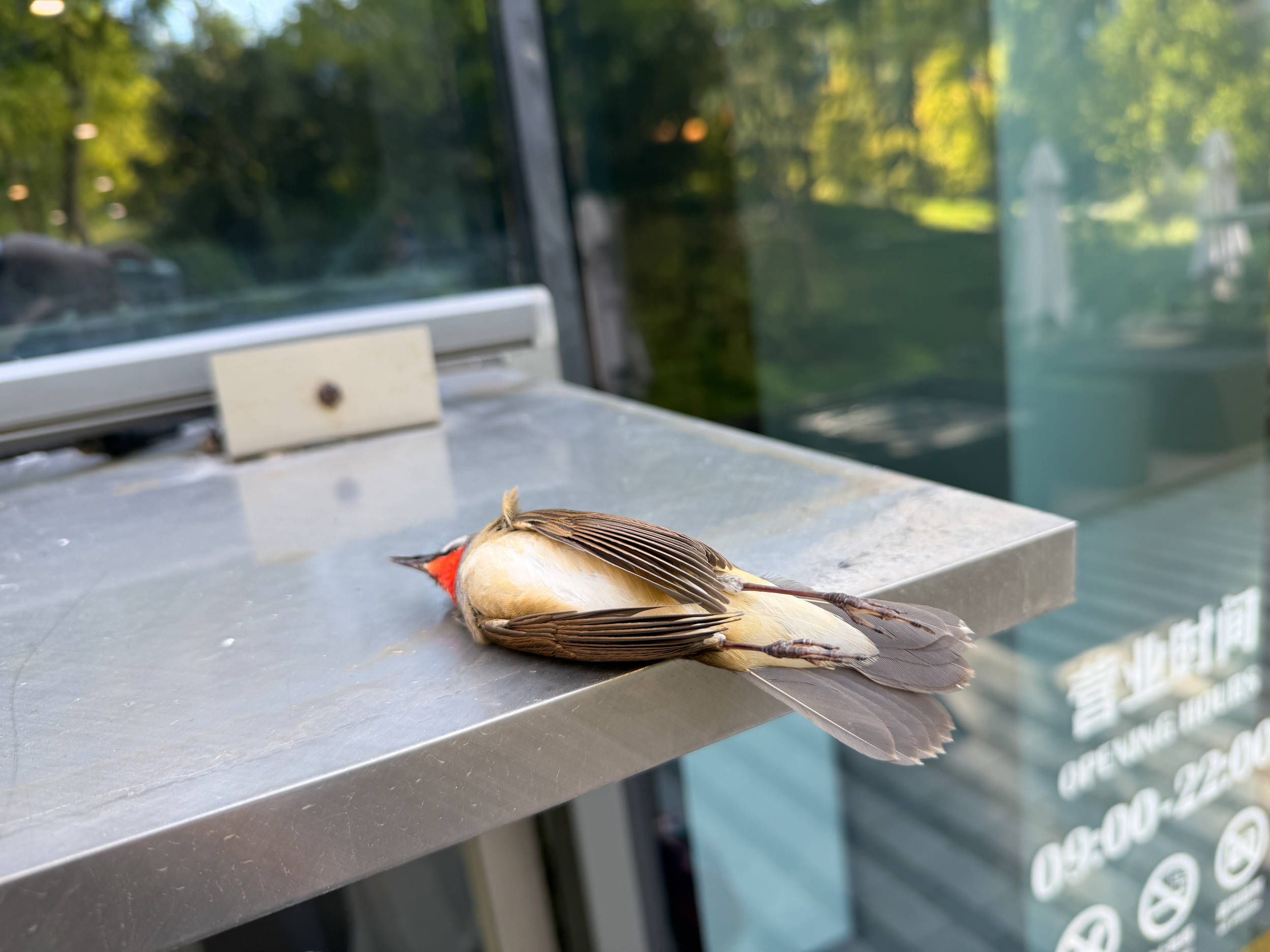
The red-throated songbird, a national second-level protected animal, was found dead downstairs in the Wangjing Lee Shing Hong Center office building. (Picture source interviewee)
Specific to Beijing, Jia Yifei told Jiemian News that buildings with good surrounding greenery, a high proportion of glass facades, and north-south facing buildings are more likely to have bird strikes in the morning when the sun is strong and the glass is reflective.
Staff at the property management office of the Lei Shing Hong Center office building (hereinafter referred to as the “property staff”) told Jiemian News that they received feedback about bird strikes last year and initially purchased bird repellents, whose effectiveness could not be verified. This year (2026), based on the advice of relevant professionals, they decided to post anti-bird collision stickers.
Regarding anti-bird collision stickers, Jia Yifei said that the principle is to allow birds to “see” the glass while ensuring light transmission. But he also said that in addition to the cost of the sticker itself, it is also necessary to consider the labor costs of high-altitude operations and the problems caused by the rotation of office tenants. “Bird impact stickers are affixed to the outside of the glass, so they will definitely have an impact on merchants,” he said. Property staff also told Jiemian News that they have communicated with relevant merchants about the placement of anti-bird stickers. If there is an impact on merchant stores in the future, other measures may be taken.
To prevent bird collisions, you can’t just rely on stickers
The bird strike incident at Lei Shing Hong Center is not an isolated incident. Worldwide, bird strikes are becoming a long-neglected issue in urban biodiversity conservation. According to reports, the number of birds killed by bird strikes in the United States every year is as high as about 1 billion, and about 16 to 42 million birds are killed in Canada every year. In South Korea, transparent sound barriers (a type of sound insulation facility) alone cause the death of about 186,000 birds every year. These data indicate that bird strikes are not a local or occasional phenomenon, but a global and systemic threat that is large enough to affect the long-term survival of bird populations.
Jia Yifei told Jiemian News that although anti-bird collision stickers cannot 100% prevent bird collisions, judging from the reality, urban building replacement frequency is low, and existing glass curtain wall buildings can be “restored” through stickers. However, existing remedies remain limited. He believes that from the perspective of building a bird-friendly city, we should start with the design of the building itself and reduce the use of exterior glass. He added that in addition to preventing bird collisions, bird-friendly cities also need to consider the diversity of landscaping and nighttime lighting management. The report also mentioned that bird collision prevention measures already have a mature research basis and practical plans. International practice has proven that bird strike mortality can be reduced by more than 90% through architectural design optimization, and the incremental cost of adopting an anti-bird strike solution in the architectural design stage is much lower than the later renovation costs. At the same time, bird strike prevention measures often produce synergistic benefits with other policy objectives.
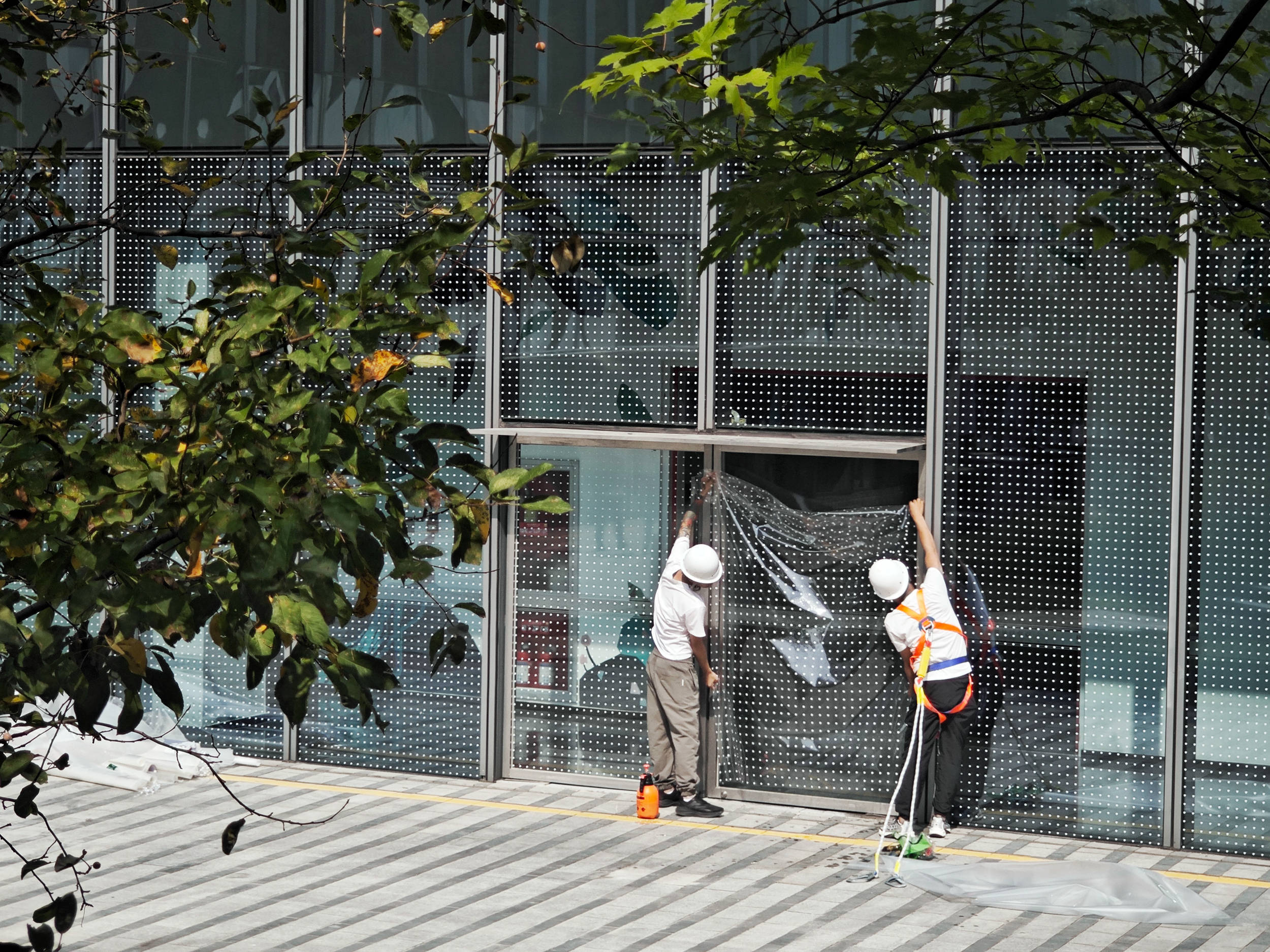
On September 23, 2026, in Beijing, anti-bird stickers were posted on the basement floor of the Wangjing Lee Shing Hong Center office building. (摄影:界面新闻/蔡星卓)
However, although design optimization is effective, implementation faces practical resistance. In terms of specific design standards, the report puts forward specific reference requirements for bird collision control height, glass materials, night lighting, landscape design, etc.However, if such standards are implemented, they will still face practical resistance.Liang Zeyuan, a national first-class registered architect, told Jiemian News that in my country’s architectural design practice, there are almost no provisions or regulations that force designers to consider the risk of bird strikes caused by glass facades. He also said that any design that makes birds realize that glass is not a reflection of the sky or plants may affect the transparency of the building and even affect the shape and cost of the building.
There are not no technical solutions, but they are also subject to cost and architectural effects. Liang Zeyuan recalled to Jiemian News that when he was preparing for the LEED AP exam (an international professional qualification in the field of green building), he noticed that there was a pattern design rule to prevent bird collisions in the industry. By drawing patterns on the glass at a certain distance, birds can recognize the existence of the glass and thus avoid collisions. However, this method is rarely used in China, mainly because it will affect the building’s transparency and user experience. In addition, there are “hidden” methods that take advantage of the difference in visual wavelengths between birds and humans, that is, using materials that are invisible to humans but visible to birds, but the cost is extremely high and there are few practical applications.
The difficulty in implementing design is inseparable from policies and systems. The report points out that the promotion of bird-friendly buildings already has a policy basis – the relevant action plan at the national level requires the inclusion of biodiversity protection into the urban policy system, and proposes to effectively protect 90% of the critical habitats of migratory birds by 2030, promoting China to transform from a conservation participant to a leader. Within this framework, bird collision prevention policies can serve as a concrete starting point for implementing national strategies. However, the current policy system is still in its infancy. Although Shenzhen released the country’s first special project to deal with bird collisions in 2025 and local explorations in Beijing, Shanghai and other places, there are still significant gaps at the national level such as standards that do not include quantitative indicators, planning that does not systematically consider the risk of bird collisions, and laws that lack mandatory provisions.
Related Reading
- Many places “limit height limits” on individual money2026-09-29
- Big Bang returns to perform in London, an avalanche in Nepal causes many people to lose contact, the starship hits orbit tonight for the first time… Zhang Chaoyang shares global hot topics bilingually2026-09-29
- days of weather chaos bring a nor’easter, major hurricanes and a ‘zombie storm’2026-09-29
- Double warning issued! There will be thunderstorms and strong winds above level 10 in these places, which will mainly affect the period2026-09-29
- Video丨Accelerating towards the global market From January to August this year, my country’s excavator exports exceeded domestic sales2026-09-29