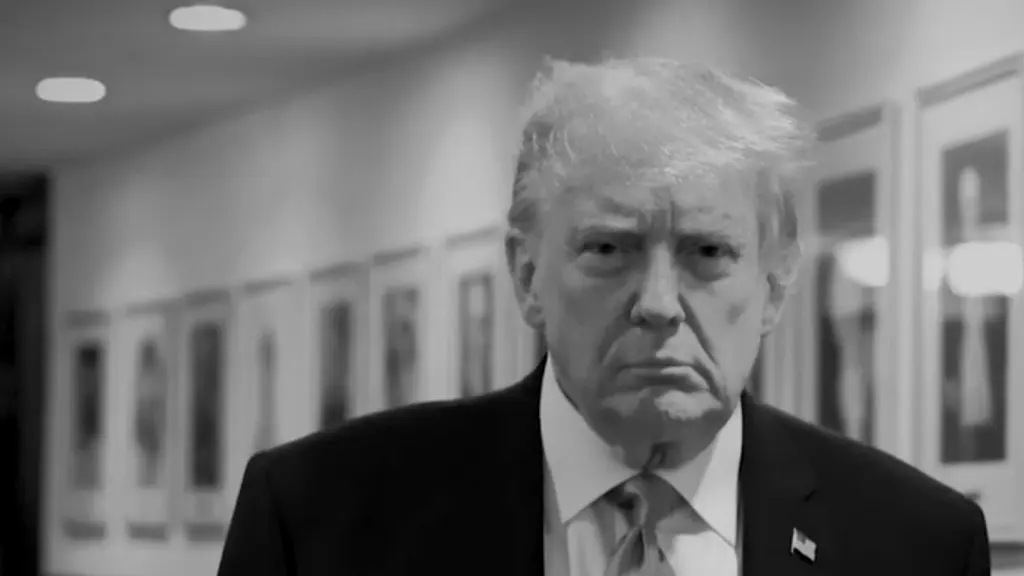

A screenshot of President Donald Trump’s 2023 ad for the 2024 presidential elections.

Reporter
President Donald Trump declares that “this is the final battle” in one of several taxpayer-funded television ads airing ahead of November’s midterm elections, prompting bipartisan scrutiny over whether the spots violate federal law.
The 30-second ad is a black-and-white video of Trump walking down a hall over audio of his warnings against “the deep state,” “warmongers,” “globalists,” “Marxists,” “communists,” and “fascists.”
Trump posted the same video on his Truth Social platform in 2023, but with one difference: Then, the monochromatic ad ended with words on screen calling on the viewer to join Trump’s campaign and fine print saying it was “Paid for by Donald J. Trump for President 2024, Inc.” This time, the 2026 ad says at the bottom: “Paid for by the U.S. Government.”
CNN reported that the ad aired during at least two NFL games on Sunday. CNBC also reported that the ad aired during Fox News Sunday, citing data from advertising intelligence company AdImpact, adding that the TV ad has cost more than $362,000 so far.
A second advert with the same “paid for by the U.S. government” disclaimer began airing on Wednesday. The ad, which featured the song “Love Me” by singer-songwriter JMSN, showed a montage of photos and videos of Trump, intercut with campaign talking points like “largest tax cuts in history” and “reigniting American manufacturing.” This ad, which CNBC reported also aired over the weekend, citing AdImpact data, has cost the federal government nearly $920,000 to date. It also apparently did not get the approval of JMSN, who posted on social media that he “would never authorize my music to be used for ANY political agenda or campaign.”
A third, which is a minute long, features scenic views of Mount Rushmore interspersed with parts of Trump’s speech there for the Fourth of July anniversary.
Advertisement
The ads appear to be part of a campaign blitz ahead of the November midterms, in which the GOP is hoping to defend its majorities in Congress.
Some lawmakers, including from his own Republican Party, are raising concerns with Trump and the White House over the advertisements. Asked about the ads by CBS News on Sunday, Senator John Kennedy of Louisiana said: “I don’t think any public official, including President Trump or Kristi Noem or John Kennedy, should spend public money on private ads for themselves.” (Kennedy was referring to former Homeland Security Secretary Noem, who came under fire for spending $220 million on an advertising campaign for border security.)
When asked about the “Love Me” ad, Senator Thom Tillis of North Carolina said that the use of taxpayer money was reminiscent of the far-right former Hungarian Prime Minister Viktor Orbán. “It’s inappropriate,” Tillis told reporters.
Rep. Thomas Massie, a Kentucky Republican and a vocal Trump critic, posted on social media about the “Final Battle” ad: “Don’t worry, using taxpayer dollars to run ominous campaign ads of the President has been done before and is completely legal… in banana republics.”
Advertisement
Democrats also raised questions. In a Sept. 24 letter to White House Chief of Staff Susie Wiles, Sen. Maggie Hassan of New Hampshire demanded answers on the “Love Me” ad’s production cost, the agencies and external contractors involved, the source of funds, and the legal and ethical bases for the spot. Hassan wrote in her letter that the ad “does not have a clear official government purpose and appears to run afoul of federal prohibitions.” Sen. Andy Kim of New Jersey posted to social media about the black-and-white clip: “How much taxpayer money did the government spend on this ad?”
In another Sept. 24 letter, congressional Democrats on appropriations panels wrote to the White House that the “Love Me” ad should be taken off the air, as it was “the sort of government propaganda one might expect in North Korea, not the United States of America, and it is an egregious and illegal misuse of Americans’ hard-earned tax dollars.”
Advertisement
But the White House has defended the ads—which it called, in a Sept. 25 press release, “public service announcements.” A White House official told TIME Friday that the ads weren’t political, didn’t have a call to action, and that the President wasn’t on the ballot.
A spokesperson instead said that the ads were “about reminding Americans to love their country and understand what makes it worth defending, at home, at our borders, and abroad.”
What does the law say?
Since the 1950s, yearly funding bills—including the appropriations measure the President recently signed—routinely ban the use of taxpayer funds for “publicity or propaganda.”
The Government Accountability Office, which investigates how appropriated funds are spent, has interpreted this to refer to material that is “purely partisan,” “self-aggrandizing,” or “covert.” But it also noted that administrations may need to advocate or defend their policies.
Advertisement
Some lawmakers have pointed to potential violations of the Hatch Act, the 1939 act that limits the political activities of federal civilian employees in the executive branch. The President is exempt from the Hatch Act, though some argue that White House employees who facilitated the airing of the ads aren’t. Last week, the non-profit advocacy group Public Citizen filed a complaint before the GAO and the Office of Special Counsel, which is responsible for overseeing Hatch Act violations, seeking investigation and enforcement of relevant laws.
In defense of the “public service announcements,” the White House has pointed to previous ad campaigns during the administrations of George W. Bush, Barack Obama, and Joe Biden. (During the Bush Administration, one campaign did violate the anti-propaganda measure.)
“When prior Administrations utilized the airwaves, it was called ‘public education,’” the Trump White House said. “When this Administration promotes pride in our country, many of those same voices call it ‘propaganda.’”