01. With a total of HK$75.5 billion in financing, how short of money is Zhipu?
Zhipu, the “first big model stock”, released a piece of heavy news late at night: it has raised funds again.
On September 13, Zhipu, the “first large model stock”, announced that it had completed approximately US$5 billion (approximately HK$39.3 billion) in financing, including approximately US$2 billion in share placement and approximately US$3 billion in convertible bond issuance. Among them, in terms of share placement, Zhipu will place a maximum of 21.965 million H shares at a price of HK$714 per share, a discount of approximately 9.96% to the closing price of HK$793 before the announcement. The company stated that all proceeds from this financing will be mainly used for the research and development of the next generation GLM model, the construction of a completely self-training system and the construction of related computing infrastructure.
After the news was released, on September 14, Zhipu’s opening stock price plummeted, and then continued to remain low. It closed down more than 9%, with the stock price at HK$721, and its market value shrunk to HK$335.7 billion.
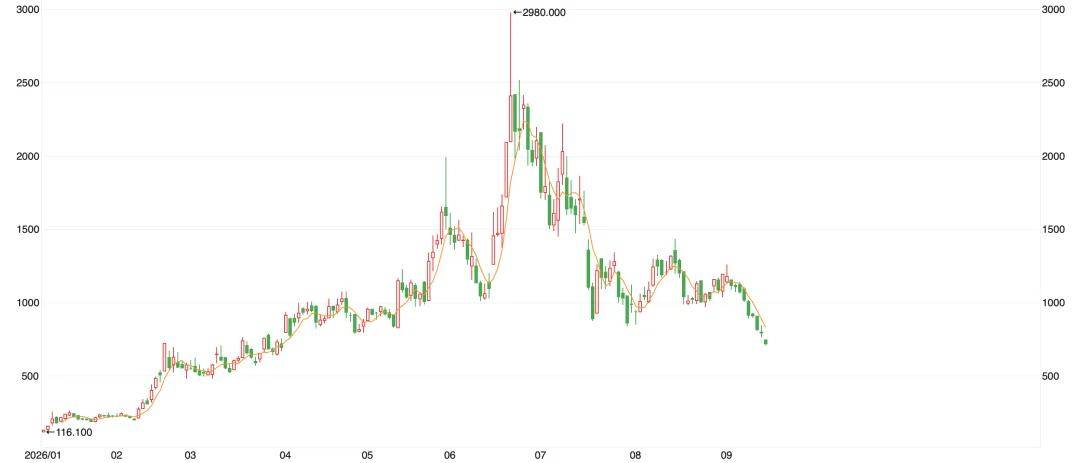
In the past period, Zhipu’s stock price has experienced a roller coaster ride. On June 22 this year, Zhipu’s stock price reached a high of HK$2,980, with a market value exceeding HK$1.33 trillion. However, the market trend began to turn after that, and combined with the release of the first batch of 25.68 million shares from cornerstone investors in early July, Zhipu’s share price has continued to come under pressure. If calculated from the historical high of HK$2,980, the stock price has retraced more than 75%, and since September alone, Zhipu’s stock price has retraced 39%.
Zhipu’s thirst for funds is obvious, and the capital market has also voted with its feet. After all, on July 13, Zhipu had just completed a round of new share allotment, raising HK$31.375 billion. In other words, including the HK$39.3 billion in financing, Zhipu had raised approximately HK$70.7 billion in just two months. Coupled with the capital raised when the Hong Kong stock market was listed in January this year, Zhipu has completed three rounds of very large-scale fundraising in just 9 months, with the cumulative financing amount exceeding HK$75.5 billion.
Such an intensive pace of capital expansion is rare in the Hong Kong stock market. But now, only two months have passed since the last round of fundraising, and Zhipu is short of money again?
This really surprised the market, and investors had different views on it. Some people say that large models are a “money-burning” thing, and it is normal to constantly replenish funds and ammunition. Some investors also expressed concerns: “It has been financed multiple times, and the price is getting lower every time.”
Why does Zhipu raise capital frequently? One reason is that it costs money so quickly.
The funds raised from Zhipu’s previous IPO have been basically used up in less than 8 months. According to the company’s announcement, the net raised amount of HK$4.896 billion from the global offering in January had been “fully utilized” according to the planned purpose by the end of August this year.
As of the end of August, approximately 34.92% of the proceeds from the company’s first placement had been used. This means that the HK$31.375 billion placement payment completed on July 13 cost nearly HK$11 billion in just 50 days. In previous placement announcements, Zhipu had stated that it expected the funds to be used up before the end of 2027. But at this rate of spending, the funds are estimated to only last until the first half of next year.
In this regard, Zhipu said, “As business progress and development accelerates, the pace of fund use under the original fundraising plan has accelerated accordingly.” Therefore, although the company still had HK$20.42 billion in unused cash reserves on its books, it raised funds again.
Regarding how to spend the money, Zhipu has made a plan. About 60% will be used for the research and development of the next generation GLM basic model and “Fully Self Training” system, as well as the deployment and upgrade of large-scale training, production inference, computing resources and related technical infrastructure. This is the bulk of this financing investment. In addition, approximately 25% will be used to optimize capital structure, supplement daily working capital and other general corporate purposes; approximately 15% will be used for business expansion, strategic investment and potential mergers and acquisitions, including minority equity investments or holding acquisitions of companies or assets that are complementary to AI technology.
Behind all this are the growing pains of Zhipu. Although the company’s revenue increased in the first half of this year, it is still in a state of long-term losses, and the “bills” for R&D and computing power of large models are still rising. At the same time, as competitors continue to evolve, Zhipu’s “scarcity” in the capital market is no longer what it used to be. Large model companies are still “burning money in exchange for growth,” but the competitive pressure on their shoulders has become heavier.
02. Wisdom spectrum needs a “brilliant”
In addition to facing pressure in the capital market, Zhipu has stirred up the market conditions of large model markets many times in the past half month. On September 2, Zhipu officially entered the Tmall platform and opened an official flagship store. The only products on the shelves are four Token packages with different prices. Users can place orders to buy AI computing power just like buying video memberships every day.
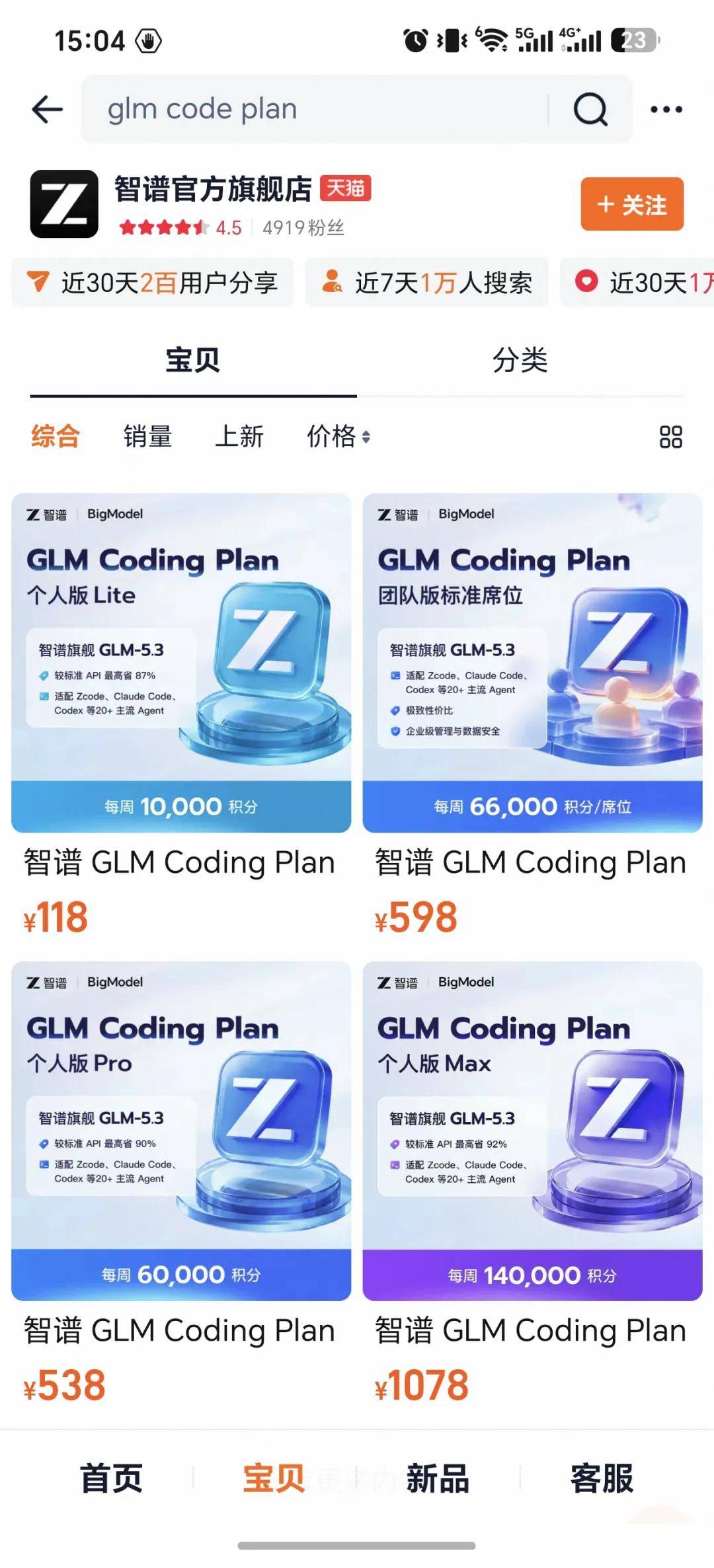
▲Screenshot of Zhipu Tmall official flagship store
In mid-August, an anonymous model called Ox Alpha became popular. It is oriented towards programming and agent tasks and supports millions of contexts and multi-modal inputs. Many netizens nicknamed it “Niu Lai”. On August 26, Zhipu claimed this model. The next day, the company’s stock price rose nearly 13%.
Behind the frequent actions, Zhipu also has anxiety and expectations. It needs another opportunity to be “great”. Three months ago, it stood on the top of a mountain with a market capitalization of one trillion Hong Kong dollars. Three months later, the stock price has retraced 75%.
The market’s previous optimism about Zhipu stemmed from the fact that it was a scarce large-model company target in the Hong Kong stock market, and it was also closely related to its technical narrative. Since this year, it has frequently benchmarked its development route with the leading AI company Anthropic, strengthened its model programming (coding) capabilities, launched flagship models with leading technical capabilities, and advocated open source models. This is in sharp contrast to the closed source of the leading companies, and has also aroused market expectations for the breakthrough of domestic large-scale models.
But this route of Zhipu is being copied by its peers. Kimi K3 of Dark Side of the Moon previously knocked GLM-5.2 from the number one spot on the Arena AI front-end development list. DeepSeek and Dark Side of the Moon have also reported preparations for listing. As domestic competitors evolve rapidly, the capital premium brought about by Zhipu due to “technology scarcity” is being rapidly diluted.
Competition in the large-scale model industry has entered into a trial of commercial hematopoietic capabilities. In particular, “first stocks” such as Zhipu are bound to accept more stringent scrutiny from the market.
The first half of 2026 financial report report submitted by Zhipu not long ago shows that the company achieved revenue of 954 million yuan, a year-on-year increase of 399.7%; gross profit was 252 million yuan, a year-on-year increase of 163.7%, and net loss was 2.072 billion yuan, a year-on-year narrowing of 12.1%. The most eye-catching one is the change in Zhipu’s income structure. In the first half of this year, open platform and API business revenue was 825 million yuan, a year-on-year increase of 2736%. The proportion of total revenue also increased from 26.3% at the end of last year to 86.5%. The proportion of localized deployment revenue was reduced to only 13.5%.
Previously, Zhipu mainly provided localized deployment of models for institutional customers, and transactions were mostly one-time authorization and project-based delivery. But now, it is starting to make API its main source of revenue.
Zhipu explained that this change in revenue structure is “essentially something that will inevitably happen after the leap in model capabilities.” In the past, model capabilities were not strong enough, and customers purchased delivery services; now model capabilities can independently run through the entire project, especially the coding capabilities are getting stronger and stronger. Users can call models according to tasks, which will bring continuous income. Zhipu’s annualized recurring revenue (ARR) has exceeded US$1.6 billion in August, an increase of 60% from US$1 billion in early July.
This year, news also spread in the market that Zhipu has officially completed the acquisition of Zhongke Jiahe, a domestic AI heterogeneous computing power software company, and has launched the construction of a 1GW domestic AI computing power data center. Everything costs money.
Overall, this is Zhipu’s embarrassing situation: although revenue and gross profit are growing, its adjusted net loss is increasing year-on-year. In order to boost market expectations and continue development, Zhipu needs to come up with new ideas to break the situation.