文丨文林
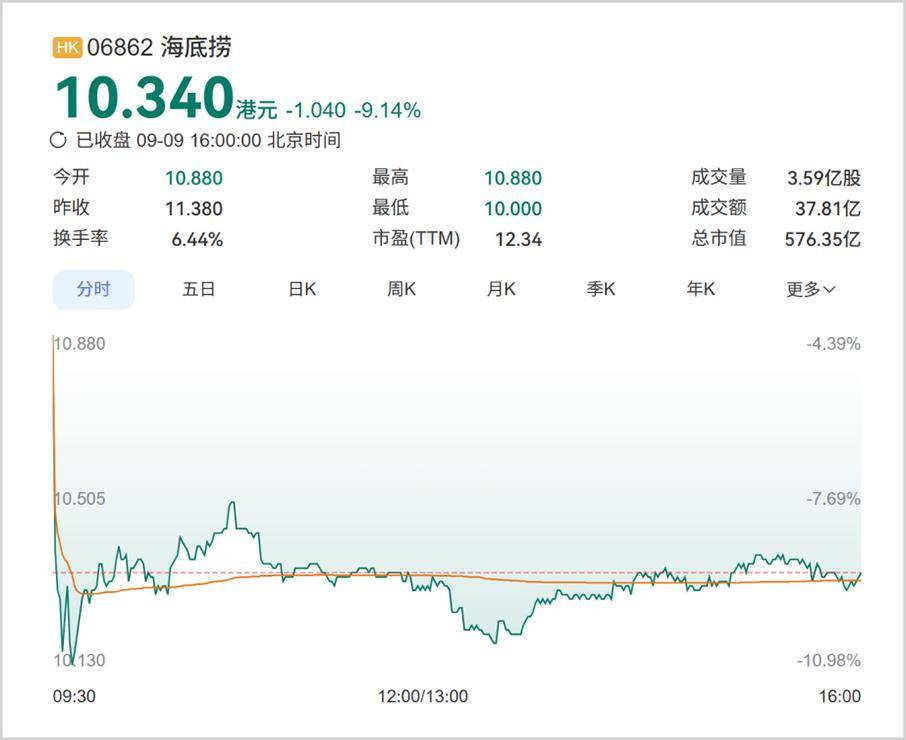
On September 9, Haidilao fell more than 12% during the session and closed down 9.14%. Its market value evaporated by nearly HK$5.8 billion in one day. Since then, the stock price has been falling. If we count from the closing price of HK$11.38 on September 8, to the closing price of HK$9.96 on September 14, the cumulative decline is approximately 12.5%.
The market generally believes that the cause of this plunge was founder Zhang Yong’s wife Shu Ping selling 259 million shares through the family trust platform SP NP, cashing out approximately HK$2.75 billion.
But if you only regard this crash as an ordinary “bad sell-off”, you may miss something more worthy of questioning: Why did Shu Ping sell stocks at a large discount? Why did Zhang Yong’s increase in holdings in May fail to stop this plunge? Two weeks before the reduction, Haidilao released an interim report with revenue growth of 7.9%. Why was it unable to stabilize market confidence?
Cashing out was the fuse, and the explosives may have been planted earlier.
[Behind the contradictory signals, why did the founder couple “increase and decrease”? 】
The market is sensitive to this reduction, first of all because of the conflicting signals.
In May this year, Zhang Yong increased his holdings of approximately 11.35 million shares in the open market at a price of HK$13.39 per share, at a cost of approximately HK$152 million. The announcement clearly stated that he was “confident in the company’s overall development prospects and potential growth” and did not rule out further increases in holdings. However, just four months later, Shu Ping sold 259 million shares at a discount of HK$10.62 per share.
In the same controlling shareholder system, Zhang Yong’s increase in holdings was interpreted as “an endorsement of confidence after the return of the soul figure”, while Shu Ping’s reduction in holdings was classified as a “private matter unrelated to the company.”Confidence can be claimed and doubt can be cut. The asymmetry of this signal itself will make the market particularly sensitive.
Secondly, although Haidilao’s announcement stated that Shu Ping’s shareholding reduction was “purely due to SP NP’s own capital needs and financial arrangements, it is a personal matter at the shareholder level and has nothing to do with the group’s business, operations, financial status and development prospects.” But it is the specific meaning of this “own financial needs” that has triggered more speculation and questioning.
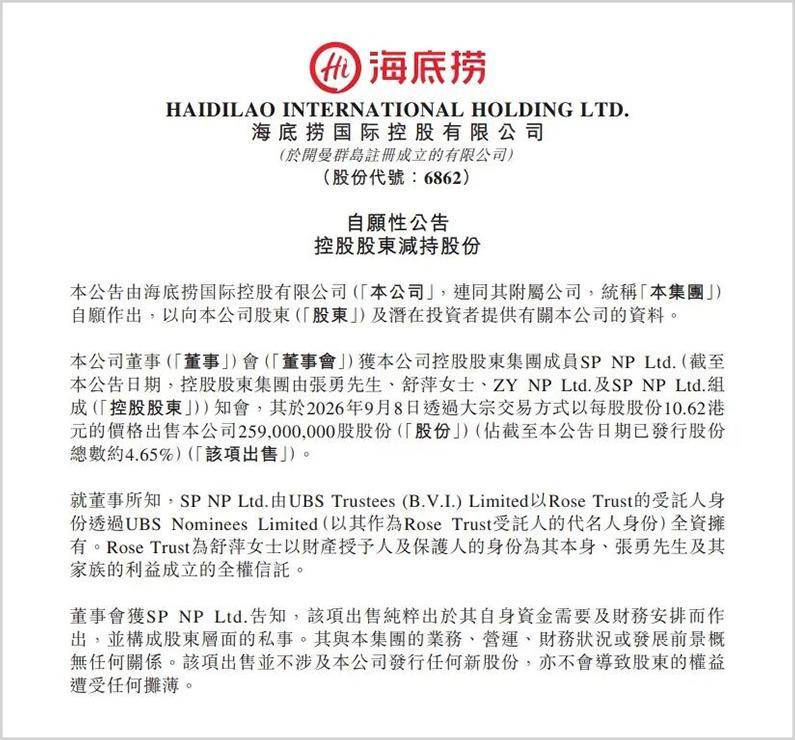
▲Picture source: Haidilao issued an announcement on shareholders reducing their shareholdings
Morgan Stanley once speculated in a research report that the reduction may be related to the new tax regulations on offshore trusts in the mainland.
It is understood that in July this year, the Ministry of Finance and the State Administration of Taxation jointly issued Announcement No. 21 of 2026, which for the first time systematically clarified the individual tax collection rules for offshore trusts. Individual income tax will be levied at a 20% rate on the establishment, existence and liquidation of trusts. It also set up an arrangement for declaration and payment within 90 days from the date of implementation without charging late fees. The window points to October 22. The holding reduction happened to fall in the middle of the 90-day window, and the amount of cash out was also highly close to the market’s estimated tax payment scale.
If this is the case, then the statement in the announcement that it has “nothing to do with the company” is worthy of scrutiny. Because Haidilao has maintained high shareholder returns for a long time, it also means that the founding family has obtained considerable cash returns through shareholding. Morgan Stanley estimates that the proceeds from this reduction are approximately equivalent to 31% of the dividends Zhang Yong and Shu Ping have received since Haidilao was listed.
And when a company’s stock price fluctuates violently due to the tax arrangements of the founding family, it no longer bears not only operational risks, but also governance structure risks. And this risk will not disappear just because it says “it has nothing to do with the company.”
At the same time, the timing of the reduction is also amplifying market uneasiness.
Just two weeks before this deal, Haidilao had just handed over its 2026 interim report. The interim report showed that revenue in the first half of the year was 22.337 billion yuan, a year-on-year increase of 7.9%, and core operating profit was 2.513 billion yuan, a year-on-year increase of 4.4%.
Both revenue and core profit increased, which is a decent report card from a numerical perspective. However, just two weeks after the release of the interim report, the founding family reduced its holdings at a discount, and the market’s interpretation inevitably became cautious. As a result, this seemingly good report card began to fail to withstand careful reading.
[The speed of repair of the main brand cannot support the new growth model]
Looking at Haidilao’s 2026 interim report, there are indeed many signs of recovery for the main brand: In the first half of 2026, the overall turnover rate of self-operated restaurants rose to 3.9 times per day, an increase of 0.1 times year-on-year; the year-on-year decline in same-store sales narrowed from 9.9% in the same period last year to 1.3%, and system sales also recorded a positive growth of 0.8%. These figures at least show that the downward trend of the main brand has been initially suppressed.
Moreover, Haidilao has not experienced deeper troughs. After blind expansion in 2021, the company once fell into an operating crisis. After taking over as CEO, Yang Lijuan led the implementation of the “Woodpecker Plan”, decisively closing about 300 poorly operating stores, accurately shrinking the front line, and helping Haidilao successfully turn losses into profits.
After that, the company launched the “Pomegranate Plan” in August 2024 to copy the supply chain, location selection and talent training capabilities to categories other than hot pot, trying to find a second growth curve outside of the main hot pot business. As of the first half of 2026, Haidilao owns a total of 21 other catering brands with a total of 183 stores.
From closing stores to stop losses to re-exploring growth, a series of self-rescue actions allowed Haidilao to defend its basic market in the most difficult time.However, Haidilao’s current repair speed is no longer enough to support the high-quality growth of the past.
In the first half of 2026, the unit price of Haidilao’s self-operated restaurants dropped from 97.9 yuan to 97.0 yuan, the average daily sales of the same store fell by 1.4% year-on-year, and the restaurant operating income was 17.837 billion yuan, a year-on-year negative growth of 4.0%.
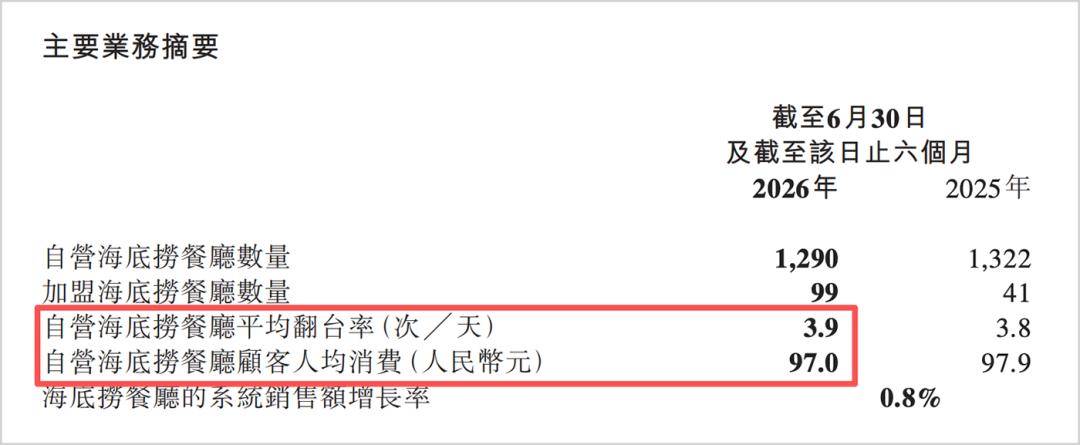
This means that the marginal increment brought about by the increase in turnover rate is being offset by the decline in unit price. Although there are more people entering the store, everyone spends less money. After the two are offset, it will be difficult for the main brand’s profit contribution to return to its previous high level.
There are two reasons behind this that are worth taking a closer look at.The first layer comes from industry structural changes.
According to the “2026 China Hot Pot Flavor Insight Report” released by the Red Food Industry Research Institute, the per capita consumption of hot pot nationwide has dropped from 87.4 yuan in the first quarter of 2023 to 58.1 yuan in the first quarter of 2026, and presents “two The “high-end, weak-waist” pattern means that the prices below 60 yuan focus on cost-effective meals for one person and light social situations, while the prices above 120 yuan focus on high-quality experience needs such as family gatherings and business banquets. The competitiveness of homogeneous products in the middle price range continues to weaken. Haidilao’s unit price of around 97 yuan falls right into the squeezed “waist” range.
The second reason comes from Haidilao’s own organizational bottleneck.
In this interim report, Haidilao made a rare public review of its past growth methods, admitting that growth “mainly relies on the management capabilities of stores” and provided strong incentives to store managers, but “the construction of headquarters functions is relatively streamlined.”
In the past, Haidilao only needed to run the hot pot restaurant well. The store manager was responsible for cultivating new store managers and developing new restaurants. The headquarters provided site selection directions and the store managers identified specific properties, forming a typical bottom-up fission mechanism. This mechanism works well at a scale of hundreds of stores, but when the company needs to promote takeout, multi-brand, franchise, middle office and overseas business at the same time, the organizational capabilities driven by a single store have hit the ceiling at the scale of thousands of stores.
In short, the main brand is still the foundation of Haidilao. The dine-in network of 1,290 self-operated stores is irreplaceable in the short term, but the speed of foundation repair is being caught up by the new growth model. Although Haidilao’s total revenue is still growing, the increase mainly comes from takeaways and sub-brands, while the main brand restaurant operating income is shrinking.
This structural change means that Haidilao’s growth narrative is switching, and the switching process itself may also be one of the sources of market anxiety.
[The growth story is there, but the profits have not kept up]
In Haidilao’s 2026 interim report, takeout and sub-license are the two most eye-catching businesses: takeout revenue was 2.051 billion yuan, a year-on-year increase of 121.2%, and the revenue share jumped from 4.5% to 9.2%; other restaurant operating income was 1.271 billion yuan, a year-on-year increase of 113.1%.
If we only look at the growth rate, the second curve seems to have already taken shape. But in fact, in the first half of 2026, Haidilao’s core operating profit was 2.513 billion yuan, a year-on-year increase of 4.4%; the net profit attributable to the parent company was 1.767 billion yuan, a year-on-year increase of only 0.47%. Revenues are growing significantly, but profits are almost at the same level. The gap in between is worthy of careful study.
First of all, although the growth rate of the food delivery business is amazing, it is essentially a business with low gross profit margin.
Every dollar of increase in food delivery revenue is accompanied by a simultaneous increase in rigid costs such as platform commissions and delivery fulfillment. Therefore, it can be seen that in the first half of 2026, Haidilao’s other expenses increased by 38.9% year-on-year to 1.510 billion yuan. The company explained that this was mainly due to the increase in food delivery and other platform expenses.
The data on gross profit margin is more direct. The company’s overall gross profit margin fell by 1.77 percentage points year-on-year to 58.41% in the first half of the year. Haidilao clearly stated in the financial report that one of the reasons was that the proportion of revenue from food delivery and multi-brand businesses with lower gross profit margins increased.
Secondly, the sub-brand business also faces problems with the pace of development.
The “Red Pomegranate Project” has been launched for more than two years, and has incubated many brands such as Yanqing Barbecue, Food stall hot pot, and Rusushi sushi. The food stall hot pot and sushi business has been recognized by the company as having the conditions for large-scale replication. However, the revenue of the entire multi-brand sector accounts for less than 6% so far, and there has yet to be a benchmark that can truly take over the main business.
It can be seen that diversification is a common narrative choice when the current main business growth is weak, but diversification itself requires continuous consumption of headquarters resources, supply chain capabilities and management energy, and it is difficult to contribute positive profits in the early stages. Therefore, the growth of takeaways and sub-brands is real, but they are still far from becoming profit engines.
Faced with such a situation, judging from the current actions and layout of Haidilao, there are two directions for future development worthy of attention.
One is to extend to high-end.At present, the unit price of Haidilao stores in Singapore has remained above S$80 for a long time. The average consumption of customers in North America once reached about twice that of the domestic market. The overseas market can be said to be the area with the most obvious brand premium.
However, high-end catering is not as simple as opening a more expensive store. It relies on the scarcity of ingredients, cooking skills and product stability. Haidilao’s supply chain advantage lies in standardization and scale effect, while high-end catering requires anti-standardization scarcity and personalization. This means that Haidilao may need to restructure its supply chain logic and brand positioning.
The second is to transform into a catering platform.Haidilao has designated 2026 as the “first year of China-Taiwan construction”, integrating product, supply chain, marketing, membership, talent, intelligence and other capabilities into the headquarters platform, and then replicating them in various sub-brands. This idea is logically established, but it is also very difficult.
You must know that the operational logic of different categories is very different. For example, sushi’s requirements for the freshness of ingredients and the timeliness of the supply chain, barbecue’s process requirements for charcoal fire and smoke exhaust systems, and fast food’s strict standards for meal delivery efficiency and cost control are all different from the operation and management of hot pot. Therefore, whether the middle platform outputs real platform capabilities or a set of general templates that are too popular needs to be slowly verified in practice.
In short, Haidilao’s plight is actually a microcosm of the entire hot pot industry. According to big data from Red Meal, from July 2025 to July 2026, the total number of hot pot stores nationwide dropped from approximately 452,000 to approximately 437,000. The game of inventory has intensified, and the industry has switched from “expansion is growth” to “efficiency is survival.”
What Haidilao now wants to challenge is no longer a certain competitor, but the growth model that it has relied on for success in the past two decades.
免责聲明
This article involves content about listed companies and is the author’s personal analysis and judgment based on the information publicly disclosed by listed companies in accordance with their legal obligations (including but not limited to temporary announcements, periodic reports and official interactive platforms, etc.); the information or opinions in the article do not constitute any investment or other business advice, and Market Value Watch does not assume any responsibility for any actions resulting from the adoption of this article.