On September 13, local time, US President Trump, who was visiting Ireland, once again confirmed that if the Republican Party wins the midterm elections in November, he will promote the payment of a “dividend” of US$5,000 to each adult US citizen. Faced with this plan, which may cost more than $1 trillion, Trump said that the United States can “easily” afford it and emphasized that he “always delivers on his promises.”
Almost at the same time, the Speaker of the U.S. House of Representatives, Republican Mike Johnson, publicly reminded that this money cannot be issued by the president with just one sentence. Johnson said the spending would need to be approved by Congress and that many details still need to be worked out.
On one side is “Republicans win, $5,000 per person”, on the other side is congressional leaders reminding that the checks are far from ready to be issued. Less than two months before the midterm elections on November 3, why has this check, which may cost more than $1 trillion, suddenly become a campaign promise of the Republican Party?
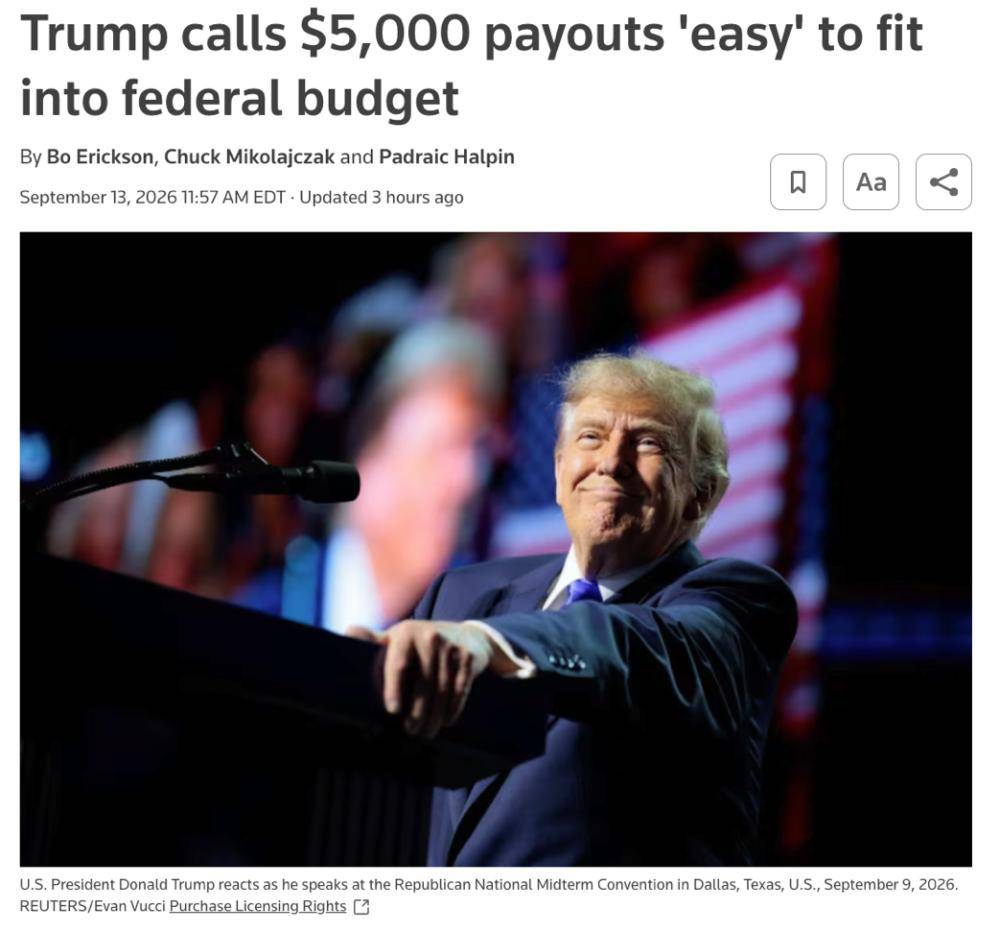
△ Reuters reported that Trump said that if the Republican Party wins the midterm elections, every adult in the United States will be given $5,000, and the government can easily honor it.
What’s going on with $5,000 per person?
On September 9, Trump formally proposed this plan for the first time at the Republican midterm election conference in Dallas, Texas. At that time, he announced that if the Republicans continued to control the House of Representatives and the Senate, he would push for a payment of $5,000 to every adult American citizen, calling it the “Trump Dividend.”
Trump directly linked the money to the election results, saying, “If the Republicans win, you win with us, and you will get $5,000.” He also said the money must be spent within the United States. But there is currently no complete plan for who is eligible, when payments will be made, and where the funds will come from. Vice President Vance later said that the funds may come from tariff revenue and described the recipients as middle-class Americans, which was not entirely consistent with Trump’s statement of “every adult citizen.”
This is also not the first time Trump has proposed sending money directly to Americans. He had previously proposed a $2,000 “tariff bonus” and a $5,000 “DOGE bonus” – that is, returning part of the money saved by the “Department of Government Efficiency” (DOGE) to cut federal spending back to taxpayers, but neither plan was ultimately implemented. But the biggest difference this time is that for the first time, Trump has so clearly linked cash payments directly to the results of the midterm elections.
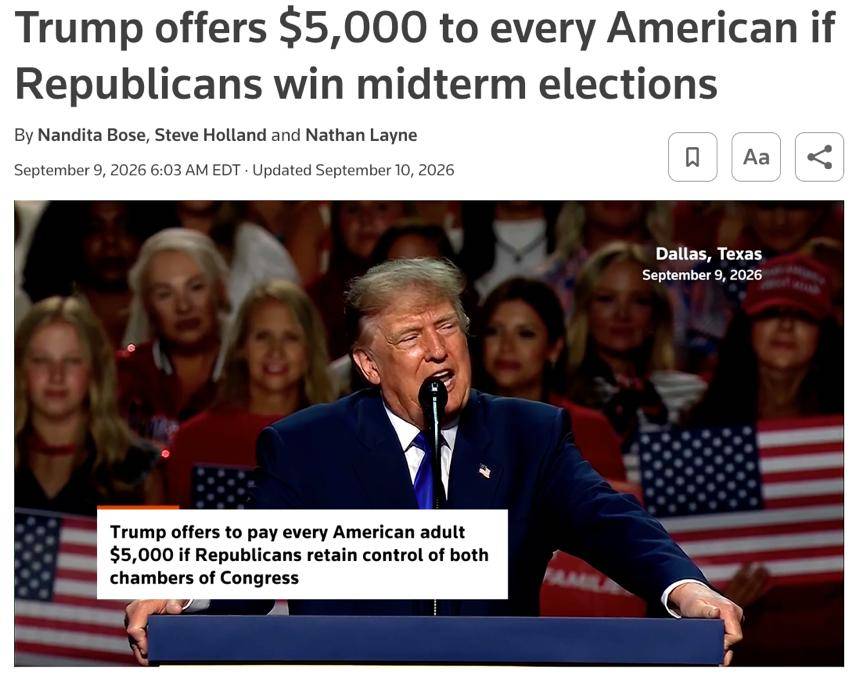
△ Reuters reported that Trump stated at the Republican mid-term election conference that if the Republican Party wins the mid-term elections, a “Trump bonus” of $5,000 will be given to every adult American.
Why play the “cash card” at this time?
$5,000 is not an isolated economic policy. It comes as the Republican Party is less than two months away from the midterm elections, and the economy and cost of living are becoming one of the main pressures facing Trump and the Republican Party.
A July survey by the Pew Research Center showed that only 24% of Americans think the current economic situation is “very good” or “good”, and 60% of the respondents believe that Trump’s economic policies have made the U.S. economy worse. In terms of congressional election intentions, the Democrats also lead the Republicans 43% to 37%. The Republican Party’s traditional strength on economic issues has also weakened.
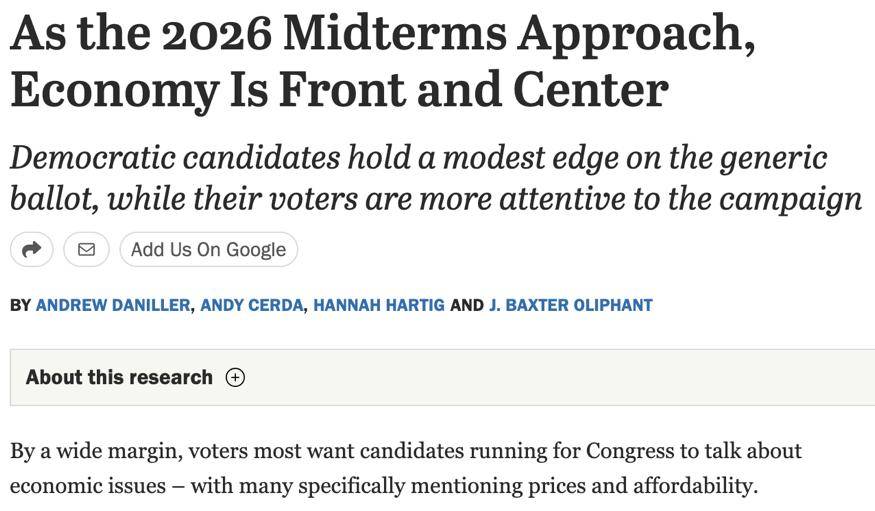
△A Pew Research Center survey in July showed that only 24% of Americans believe the current economic situation is “very good” or “good.”
Therefore, the American media generally linked the US$5,000 plan to the current election situation. The American media Axios News website pointed out that at a time when support for government economic issues is at a low level and voters are dissatisfied with prices and the cost of living, the $5,000 check links the election results with economic benefits that voters can directly feel.
From the perspective of campaign communication, $5,000 also has an obvious feature – complex inflation, interest rates, fiscal deficits and economic growth are difficult to convert into a simple campaign language; “If the Republican wins, you will get $5,000” is completely different. It links control of Congress with personal benefits that ordinary voters can directly feel.
In this sense, the $5,000 plan has also added a more direct economic issue to the Republican midterm elections: in addition to evaluating the economic performance of the past two years, voters will also face a new question—whether the $5,000 promise is possible to be fulfilled if the Republicans continue to control Congress.
Can this check be cashed?
There are at least three hurdles to getting from a campaign promise to actually getting into Americans’ bank accounts.
The first obstacle is Congress.U.S. federal government spending must be authorized by Congress. Zachary Price, a professor at the University of California, San Francisco School of Law and a constitutional scholar, pointed out that the U.S. Constitution stipulates that Treasury funds can only be spent after Congress passes an appropriation bill. There is currently no existing authorization that allows the government to pay $5,000 to every American adult, so the president does not have the authority to unilaterally implement the plan. House Speaker Johnson, a Republican, also made it clear that even if the Republicans win the election, Congress still needs to take action. The problem is that even if Republicans retain both chambers, they will likely still have a slim majority, and there are already questions within the party about the fiscal cost of the plan.
The second hurdle is where the money will come from.Based on the estimated 240 million adult citizens in the United States and US$5,000 per person, the total cost is expected to exceed US$1.2 trillion; some economists estimate that it may even reach US$1.35 trillion. At the same time, the U.S. federal annual fiscal deficit is currently about US$1.8 trillion, and the national debt has exceeded US$40 trillion this year. Mark Godwin, senior policy director of the Committee for a Responsible Federal Budget, a non-profit think tank in the United States, therefore pointed out that the United States, currently running under a huge deficit, does not have a fiscal surplus that can be distributed. In other words, without new revenue or corresponding spending cuts, the check will likely still end up increasing government borrowing.
The third obstacle is inflation.Michael Strain, director of economic policy research at the American Enterprise Institute, warned that such a large-scale fiscal stimulus would risk pushing up inflation again when the U.S. economy currently lacks significant spare capacity and is still facing inflationary problems. He believes that now “is a very strange time to stimulate the economy.” This also leaves the $5,000 plan facing a policy dilemma: Trump is trying to use cash to respond to Americans’ dissatisfaction with the cost of living, but if more than $1 trillion in spending pushes up prices again, it may in turn increase pressure on the cost of living.
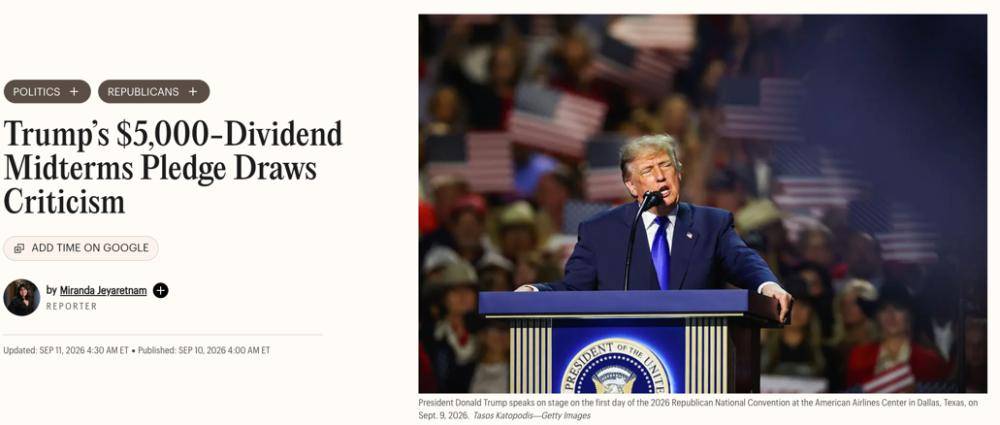
△Time magazine reported that Trump’s promise to distribute US$5,000 if he wins the midterm election triggered criticism.
There are only about seven weeks left before the November midterm elections. Against the background of low economic evaluation, the cost of living is still the focus of voters, and the competition in the mid-term elections is gradually heating up, Trump proposed a $5,000 plan to link control of Congress with economic benefits that voters can directly feel. However, it is still difficult to judge whether this promise can influence voter choice; even if the Republican Party wins the election, it also remains to be seen whether it can overcome practical obstacles such as Congress, finance and inflation, and finally fulfill it.