CCTV news:On September 16, the Pinglu Canal, the first national-level canal project to connect the river and the sea since the founding of the People’s Republic of China, will be opened to navigation.
The Pinglu Canal has a total length of 134.2 kilometers. It is constructed as a Class I inland waterway and can navigate 5,000-ton ships. In order to solve the problem of water level difference, the three major hubs of Ma Dao, Qishi and Qingnian built from top to bottom of the canal have all completed joint debugging with water. The seaworthiness test of the actual ship for the entire voyage has been completed, and the anchorage, service area, navigation aid facilities, etc. all meet the navigation conditions.
At present, the four major sectors of waterways, hubs, command and dispatch, and maritime law enforcement are all ready. There are 570 ships registered with the Maritime Safety Administration that are qualified to navigate the Pinglu Canal.
He Changhai, deputy captain of the Marine Affairs Department of Qinzhou Port District, said that navigation is about to begin and ships will soon pass through the lock. They check the ships that plan to enter and exit one by one. The ship’s dimensions, draft, and port entry and exit reports must not be missed to ensure that the ships pass through the lock safely.
As of September 12, the first batch of foreign trade goods in the Pinglu Canal have all successfully cleared customs. It is understood that the first batch of foreign trade goods in the Pinglu Canal will board the “Beigang Nanning Borun”, the first direct foreign trade ship between the river and the sea in the Pinglu Canal, sailing from Nanning Port via the Pinglu Canal to Can Tho Port in Vietnam.
Pinglu Canal: Project of the Century connecting the river and the sea
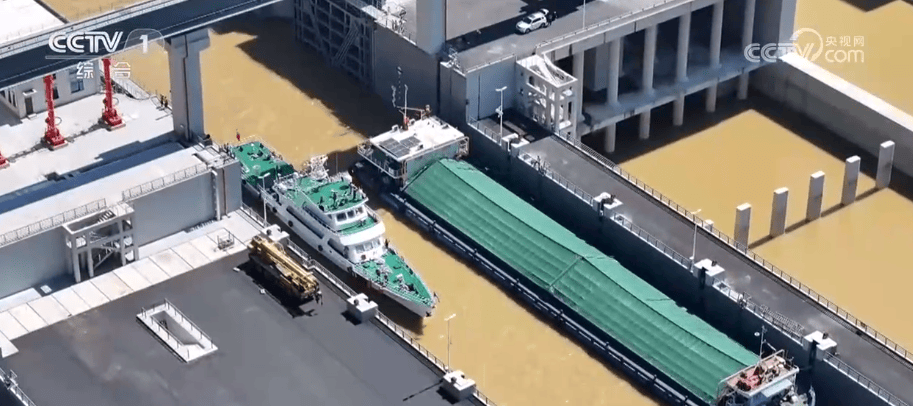
After the Pinglu Canal is completed and opened to navigation, it will directly open up the shortest, most economical and most convenient water transportation channel from Guangxi and southwest my country to the ASEAN region.
The Pinglu Canal starts from the mouth of the Pingtang River in Xijin Reservoir Area, Hengzhou City, Nanning, Guangxi, passes through Luwu Town, Lingshan County, Qinzhou, along the Qinjiang River and enters the Beibu Gulf, with a total length of 134.2 kilometers.
Since the water surface at the starting point is about 65 meters higher than the sea level at the mouth of the terminal, the canal is equipped with three cascade shipping hubs, which divide the canal channel into several steps to adjust the water level difference and ensure smooth and safe navigation. From upstream to downstream, they are: Madao hub, Qishi hub, and Youth hub.
The Madao hub is located in Hengzhou City, Nanning. It is the first tier upstream hub with the largest scale and the largest drop. The maximum drop in water level reaches 29.6 meters. It adopts the world’s first three-level superimposed water-saving ship lock. It is the world’s largest inland water-saving ship lock, with a water saving rate of over 60%. It has the three major advantages of “large drop, high water saving, and small footprint”.
The Qishi hub is located in Lingshan County, Qinzhou. It is responsible for the water level adjustment function and serves as a “relay baton” for the entire line. It is the link with the strongest connection function among the three major hubs.
Youth Hub is adjacent to Beibu Gulf and is the most downstream step. It adopts the largest mutual irrigation and mutual discharge type water-saving ship lock in China, with a water saving rate of about 50%. It is the only hub directly responsible for the intersection of rivers and seas and the prevention of siltation and salty water.
After the Pinglu Canal is opened to navigation, the inland navigation distance of goods from southwest China via the Pinglu Canal will be shortened by more than 560 kilometers compared with the Guangzhou Port, and the logistics channel that connects the east and west and connects the north and south will be further completed.
From Vietnam’s Yongan Port to Guigang via the Pinglu Canal, the transportation time is 5-7 days shorter than the traditional route.
Recently, a batch of potassium chloride weighing 3,012.66 tons was sent through the “Laos-Vietnam-Pinglu Canal-Guigang” route. It has now arrived at the Pinglu Canal Horse Road Hub and is about to go to Guigang.
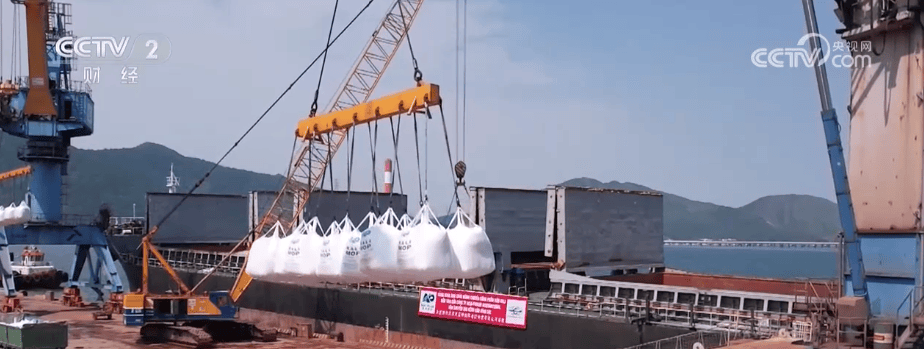
This time, when potassium chloride is imported from Vinh An Port in Vietnam, the route via Binh Lok Canal shortens the detour mileage by nearly 500 kilometers compared with the traditional route, shortens the transportation time by 5-7 days, reduces transfer and loading and unloading links, reduces logistics costs, and reduces cargo losses. This also marks the accelerated release of the channel effect of the Pinglu Canal in serving real industries, smoothing cross-border logistics, and promoting regional opening up.
The goods have arrived and the ship has arrived. Multimodal transport is available directly from rivers and seas.
The Pinglu Canal, the first national-level canal project to connect rivers and seas since the founding of the People’s Republic of China, will be open to navigation on September 16. Multimodal transport trains have arrived at the port, ships connecting rivers and seas have all berthed, and many new river-sea intermodal transport and new transnational shipping routes have completed preparations for their maiden voyages, marking that the modern logistics channel connecting rivers and seas in southwest China and ASEAN will soon be completed.
This train from Liuzhou is slowly entering the Liujing Service Area of Nanning Port. After the Pinglu Canal is opened to navigation, it will carry the river-sea combined transport ships directly to Hainan Yangpu Port.
This batch of ten boxes of special cement shipped from Liuzhou is one of the first batch of supplies for the Pinglu Canal, and this is just the beginning.
Kong Fanqiang, the owner of the cargo, said that they expect hundreds of thousands of tons of cement to be shipped out to sea through the Pinglu Canal every year. This time, they saved more than ten days through the waterway, and the cost of cement transportation alone can save hundreds of thousands of yuan.
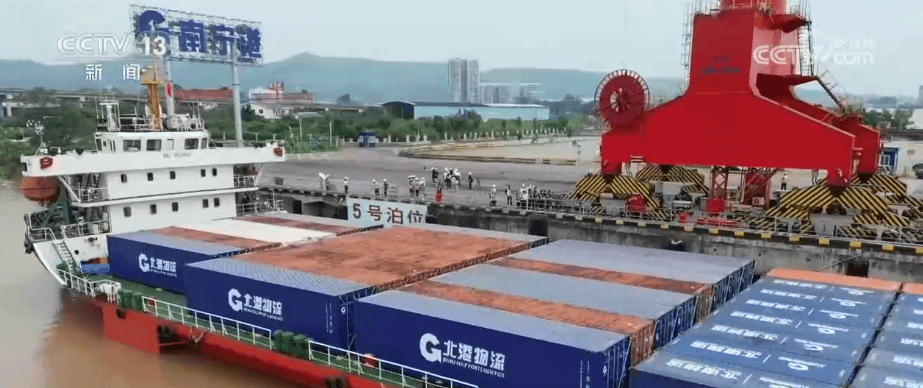
There is more than one cargo owner who has settled accounts like this. A large number of foreign trade companies in the southwest hinterland are looking forward to the opening of the canal, and more and more cargo ships have arrived.
Also on standby at Nanning Port is the “Beigang Nanning Borun” ship. This is also the first time that an international shipping ship has berthed at Nanning Port.
The arrival of this Panamanian foreign trade ship with a load capacity of 4,443 tons has achieved a historic breakthrough for foreign trade ships to travel directly from Beibu Gulf seaport to Nanning inland port. It also marks the formal formation of Nanning Port’s foreign-related shipping and river-sea direct foreign trade guarantee system. Relying on a complete port operation system, the direct route “Nanning Port-Can Tho Port, Vietnam” will soon make its maiden voyage.
It can be read from this cargo list provided by the local customs that the goods carried by the “Beigang Nanning Borun” include local building materials and chemical raw materials from Sichuan, Chongqing and Guangxi, as well as Wuling auto parts shipped from Liuzhou. These goods are transported from the southwest hinterland to Nanning Port via the main railway line, and then to Can Tho Port in Vietnam via the Pinglu Canal, truly achieving direct access from the river to the sea.
The Pinglu Canal not only opens up the downstream channel for Southwest goods to go to the sea, but also opens up an efficient path for overseas bulk raw materials to be imported into the Southwest industrial base. The “Yonghai 668” currently berthed at Qinzhou Port is loaded with potash fertilizer imported from Laos. It arrives at Qinzhou Port via Vietnam. It will then drive to the Madao hub and directly to Guigang Beigang Terminal via the Pinglu Canal.
Huang Jiantao, the person in charge of the company, said that after the Pinglu Canal is opened to navigation, they will also usher in a business peak, and it is expected to bring them new river-sea combined transport throughput of no less than 2 million tons in 2026 and no less than 10 million tons in 2027. It also opens up a new channel for southwest customers.
To lay a solid foundation for normal operations after the canal is opened to navigation, cargo source organization was started one year in advance.
Qin Zhenqiang, the person in charge of the logistics company, said that the team visited nearly 200 companies in Yunnan, Guizhou, Sichuan, Chongqing and other places, as well as Guangxi itself. At present, the supply of goods in the Pinglu Canal is relatively sufficient, and these companies are also very much looking forward to the real benefits that the opening of the Pinglu Canal will bring them.
Goods collection at ports along the line and iterative upgrades of smart ships
The Pinglu Canal is about to be opened to navigation, a new shipping pattern is accelerating, and the ship hardware system is also ushering in an update. The Pinglu Canal has entered a new stage of river-sea intermodal transportation and is ready for navigation.
The cargo and routes are all ready, and a new iteration of green and smart shipping ships are also in place. Here is the 5,000-ton Pinglu Canal smart ship demonstration ship “Beigang Canal 002”.
This “Beigang Canal 002” is one of the first batch of smart ship demonstration ships in the Pinglu Canal. The engine room equipment on the ship can collect data at the second level and provide early warning of faults. It can automatically dock, navigate autonomously, and remotely control. The energy efficiency system will be optimized in real time based on cargo, water flow, and speed.
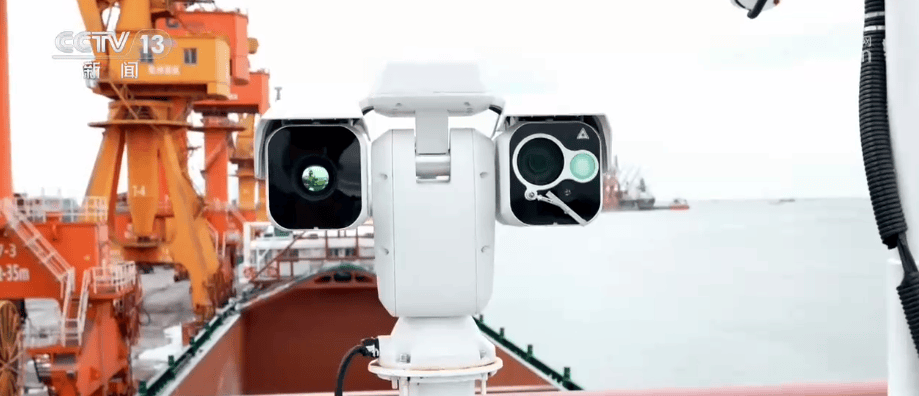
This is a set of six-eye panoramic cameras. It can monitor the situation of the surrounding waters. The situation of the surrounding 5 kilometers of waters can be seen through this set of high-definition observation heads. How to know from a further distance? There is a set of solid-state radars in front.
As a smart green demonstration ship tailor-made for Pinglu Canal, the “Beigang Canal 002” ship will participate in the construction of a complete “Iron River and Sea” shipping system. Currently, there are 570 ships with navigation qualifications, and 681 crew members have obtained the “Pingglu Canal Route Endorsement.”
Yue Hongyan, the person in charge of the logistics company, said that the vast majority of ships with navigation qualifications are 3,000 to 5,000 tons. The ship types include containers, bulk cargo and multi-purpose ships, which can cover the transportation needs of multiple types of goods such as sand and gravel, building materials, bulk commodities, containers, etc. This batch of ships is a concentrated reflection of the results of many years of standardized construction of the Xijiang shipping trunk line.
The navigation node of the Pinglu Canal is approaching. Reporters observed at ports along the Pinglu Canal that the entire chain is being upgraded, whether it is international ship berthing, foreign trade transfers or river-sea route connections.
Gu Rongchao, Secretary of the Party Committee and Chairman of Guangxi Beigang Xijiang Port Co., Ltd., said that in the future, we will continue to optimize the terminal operation process, improve the efficiency of foreign trade cargo, loading and unloading turnover, and open up the logistics chain from Nanning Port to Nanning Port, canal to sea, and direct access to ASEAN.
Local customs, border inspection and other departments perform their respective duties to ensure that goods of different types and flows in different directions can go to sea smoothly.
Lu Yu, deputy director of Yongzhou Customs, which is affiliated with Nanning Customs, said that Nanning Customs is actively planning to provide enterprises with “a la carte” customs clearance services based on various supervision models such as river-ocean combined transport and co-site supervision of domestic and foreign trade containers, and based on different route needs and transportation requirements of enterprises.
What can this canal bring to the Southwest?
The Pinglu Canal, which took four years to build and cost 72.7 billion yuan, will be fully open to navigation on September 16. What can this river change?
If you want to be rich, you must first build a road, this time a waterway.
This is the mouth of the Pingtang River in Hengzhou City, Nanning, Guangxi. This body of water is the starting point of the Pinglu Canal. From here, the canal goes all the way south and merges into the sea after 134.2 kilometers. The canal took four years to build, with a total investment of 72.7 billion yuan, averaging 540 million yuan per kilometer.
What did this investment change?
First of all, it completely ended the history of Guangxi being close to the sea but without rivers leading to the sea.
Open the map and you will see that the terrain of southern my country is high in the northwest and low in the southeast. These major rivers all pass through Guangxi, but they eventually flow into the South China Sea from Guangdong. Due to the lack of direct access to the sea, a large number of goods originally belonging to Guangxi and even the southwest region go to the sea from Guangdong. There are no rivers near the sea that can be navigated into the sea. Guangxi goods do not go through Guangxi Port. The Pinglu Canal runs from the mouth of the Pingtang River in Nanning, through Qinzhou, and along the Qinjiang River directly into the Beibu Gulf. The distance to sea has been directly shortened by 560 kilometers, allowing 5,000-ton ships to directly reach the Beibu Gulf port.
What does it mean to be 560 kilometers closer to the sea?
This citrus grove is already bearing fruit. When it matures and goes on sale in November, if you export via the Pinglu Canal, you will save not only the 560-kilometer journey, but also the waiting time for customs clearance, transshipment, and boating. The time it takes for fruits to be put on the tables of Southeast Asian consumers will be greatly shortened. In the future, more and more fruits will go to Africa through the Pinglu Canal.
Luo Zenggui, the person in charge of the company, said that after the opening of the Pinglu Canal, they can just declare customs at Nanning Port. Compared with Shenzhen Shekou Port, the drive time is shortened by 14 hours, and the cost of a container is saved by about 4,000 yuan. It only takes about 3 days to get to Ho Chi Minh City, Vietnam.
Time is shortened and money is saved. The bauxite mine in Baise, Guangxi has also recalculated its accounts.
Ning Ziran, the person in charge of the company, said that based on calculations for bulk cargoes such as bauxite and coal, the goods use the Pinglu Canal logistics channel. Compared with traditional road and railway transportation methods, single-ton waterway freight can be saved by 30%, and the overall transportation time is almost halved.
The Pinglu Canal lights up not just Guangxi. Pulling the line of sight further, the entire southwest region has a closer outlet to the sea. Yunnan’s agricultural products and green aluminum; Guizhou’s tea and photovoltaic products; Hunan’s engineering machinery and vehicle parts, including Sichuan and Chongqing in the outer circle, can all catch a ride on the Pinglu Canal.
On September 4, the train from Sichuan was already sending goods to Vietnam through the canal. Compared with taking the traditional route to the sea, how much freight can be saved every year by taking the canal from the Southwest to ASEAN? The answer is about 5.2 billion yuan, and comprehensive logistics costs can be reduced by 18% to 30%.
If you look further, the Pinglu Canal is making regional connections closer and closer, and it will become a new water transportation channel connecting China and ASEAN.
At the Madao Junction, Lao Wang met a group of colleagues from ASEAN countries.
Peng Somany, deputy director of the online television department of the Cambodian National News Agency, said that the opening of the Pinglu Canal can create new opportunities for connectivity between China and ASEAN. He hopes that Cambodia’s high-quality rice, fruits and various agricultural products can enter the Chinese market more efficiently.
Thai PPTV host and reporter Zhang Aizhe said that after the official opening of the canal, Thai companies will have a strong interest in transporting goods to China through the Pinglu Canal. This is a more convenient and efficient transportation channel and a rare development opportunity for Thai companies.
In the future, accelerated maritime economic connectivity, cross-border tourism corridors, vocational education cooperation, and a series of regional economic, trade and cultural cooperation will open up more new space for China-ASEAN cooperation.