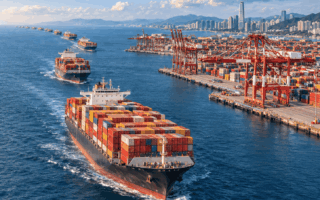
Ten years ago, Vietnam was hailed as Asia’s economic dark horse by global capital due to its cheap labor and super investment policies.
A large number of international giants have gathered to build factories, foreign trade data has skyrocketed year after year, and the outside world is generally optimistic about Vietnam’s return to the miracle of rapid growth.
In just ten years, the trend has completely reversed, with foreign capital withdrawing on a large scale, factories shutting down, the property market collapsing, and banks experiencing runs.
Many people in the industry bluntly say that Vietnam is repeating Japan’s bubble crisis in the 1980s, and its ability to resist risks is far weaker than Japan’s back then.
What seems to be a sudden economic turmoil is actually the inevitable consequence of Vietnam’s years of reliance on foreign investment and hollow development model.
Vietnam’s economic take-off is entirely dependent on demographic dividend and bottom-line preferential policies for foreign investment.
The domestic young population accounts for a very high proportion, with more than half of the young and middle-aged workforce, and the monthly salary is generally concentrated in the range of 1,000 yuan to 1,300 yuan.
The extremely low labor costs, coupled with the top-notch policies of rent-free for the first five years and 15% corporate income tax, are extremely attractive to labor-intensive enterprises.
Samsung, Foxconn, Intel and other companies have collectively launched the project, quickly supporting the fundamentals of Vietnam’s manufacturing industry.
Behind the radical opening up lies Vietnam’s development faults and passive situation in recent decades.
Prolonged wars and years of international blockades have completely destroyed local infrastructure and twice missed opportunities for global industrial relocation.
After the launch of reform and opening up in 1986, domestic ideological unification and policy adjustment took several years, directly lagging behind the pace of neighboring countries. The peak period of global industrial transfer in the 1990s came to an end, and Vietnam could only undertake the low-end assembly industries eliminated by other countries.
The Asian financial crisis in 1998 emptied Vietnam’s meager foreign exchange reserves and slashed GDP growth by half. In order to overtake in a corner, Vietnam gave up its conservative development ideas and implemented a radical opening model with free land and unlimited capital entry.
Relying on its excellent geographical advantages, Vietnam has received preferential trade treatment from many European and American countries, including zero tariffs and most-favored-nation treatment.
In 2018, the global trade pattern changed, and a large number of orders were transferred to Vietnam, which ushered in an unprecedented wave of capital influx.
At its peak, foreign capital controlled nearly half of Vietnam’s fixed asset investment, and the economic lifeline was completely controlled by external capital. Even if the popularity fell later, the proportion of foreign capital in the total economy was still far higher than the average level of Southeast Asian countries.
Behind the rapid rise in short-term data, Vietnam has become completely dependent on capital and has lost the initiative for independent development.
The development model dominated by foreign capital for many years has allowed Vietnam to form an industrial structure that is prosperous on the surface but hollow on the inside.
At present, more than 60% of Vietnam’s manufacturing capacity, 90% of the output value of the electronics industry, and more than 90% of the automotive market are all monopolized by foreign capital. Local companies can only undertake low-end parts assembly and simple processing, and have no access to core technologies and high-end industrial chains.
The core reason for this situation is that Vietnam is subject to strict external development constraints.
The trade dividends granted by Europe and the United States come with hard conditions, prohibiting Vietnam from supporting local companies and building industrial leaders. The country cannot use capital to tackle high-tech industries, nor can it cultivate local benchmark companies to participate in international competition.
At the same time, Vietnam has comprehensively promoted the privatization of state-owned enterprises, and the only competitive state-owned economic power in the country has continued to weaken, eventually forming a solidified pattern in which multinational giants monopolize the market and local small and medium-sized enterprises are unable to break through.
Vietnam’s manufacturing industry has been stuck in the OEM trap for many years, with low profits and no technology accumulation.
Samsung’s complete machines are assembled and produced locally. Vietnam can only obtain less than 8% of the revenue, and all core components are imported.
Shortcomings in talent and infrastructure further lock the possibility of industrial upgrading.
The proportion of local skilled workers is extremely low, the density of engineers is less than half that of the country, and there is a serious shortage of high-end industrial talents.
Port throughput, transportation network, and power supply systems are lagging behind. Frequent power outages in industrial parks have regularly restricted industrial production.
Due to the superposition of multiple shortcomings, Vietnam was unable to build a heavy industry system or form a complete industrial chain. It eventually became an affiliated economy of the U.S. dollar cycle, completely following the rise and fall of international capital flows.
If the Fed cuts interest rates, hot money will pour in and the economy will surge; if the Fed raises interest rates, capital will flee and industries will stagnate.
Intel’s suspension of chip factories and Samsung’s withdrawal of many production lines are direct consequences of the hollowing out of the industry.
After the growth of the real industry was sluggish, speculative capital poured into Vietnam’s property market on a large scale, spawning an outrageous asset bubble.
In 2015, Vietnam relaxed restrictions on foreign property purchases. Overseas hot money speculated wildly in real estate, and housing prices doubled and skyrocketed within a few years.
House prices in the core area of Ho Chi Minh City have exceeded 50,000 yuan per square meter, comparable to domestic first-tier cities, and the property market bubble has completely inflated.
In order to expand rapidly, local real estate companies have established high-risk leverage financing models.
Real estate companies mortgage land to issue bonds, then package them into financial products and sell them to ordinary people, borrowing new ones to repay old ones as rolling capital. This financing method that is divorced from physical income is essentially a typical Ponzi scheme. It is only a matter of time before it collapses.
After the Federal Reserve raised interest rates and triggered a flight of capital, the property market instantly lost financial support and the selling wave broke out. More than 1,200 real estate projects across the country were unfinished, involving an investment equivalent to RMB 285 billion, and the property market completely collapsed.
Among them, the financial fraud case involving the richest woman, Zhang Mei Lan, involved a total amount of US$12.5 billion, equivalent to 3% of Vietnam’s annual GDP.
Large-scale financial storms caused people’s wealth to shrink significantly, and market panic spread instantly. Depositors concentrated on running on Saigon Commercial Bank. The bank’s deposits plummeted by 80% in just a few months, and it was on the verge of bankruptcy and liquidation.
In order to prevent the national financial system from collapsing, the Central Bank of Vietnam provided an emergency bailout, injecting US$24 billion in five months. This huge amount of money accounted for a quarter of Vietnam’s foreign reserves and 5.6% of the country’s GDP. The price of the bailout was extremely heavy.
After the bailout, the sequelae continued to ferment, with foreign reserves shrinking, currency depreciation, housing prices plummeting, prices soaring, and people’s purchasing power plummeting. In order to preserve value, gold was purchased frantically. The domestic gold price far exceeded the international market price.
The property market, stock market, and foreign exchange market are all under pressure, and Vietnam has completely fallen into a full range of economic difficulties.
Vietnam’s current economic predicament is highly similar to Japan’s bubble crisis in the 1980s, but there are fundamental differences.
After Japan signed the Plaza Accord that year, the yen appreciated sharply, capital outflowed, domestic industries were hollowed out, and asset bubbles burst.
After experiencing the collapse, Japan relied on a number of the world’s top manufacturing companies such as Toyota and Sony to maintain its economic fundamentals.
The core competitiveness of high-end manufacturing has allowed Japan to remain firmly among the developed countries even after thirty years of stagnation.
On the other hand, Vietnam has the risk of replicating the bubble crisis, but it does not have Japan’s hard-core industrial base.
Vietnam does not have any independent core industries, no leading local companies, and no controllable core technologies. All manufacturing production lines, high-end technologies, and market shares are all in the hands of foreign capital.
After the withdrawal of capital and the shutdown of factories, there is no local industry that can support the economy.
After seeing the crisis clearly, Vietnam launched an all-round self-rescue, streamlining its institutions, increasing investment in science and technology, improving infrastructure, and tightening foreign exchange. However, long-term problems such as dependence on foreign investment, hollowed-out industries, and a fragile financial system have long been hard to recover from.
International institutions have lowered their economic forecasts for Vietnam, far exceeding the maturity of real estate bonds in previous years, and continue to put pressure on the financial market. Even if the risks of a small number of bonds are controllable, the collapse of public trust will trigger a new round of bank runs at any time.
Today, Vietnam has only two outcomes left, either consuming the national treasury for a long-term bailout, or allowing the bubble to clear and the economy to regress.
Regardless of the choice, short-term pain and long-term downturn have become a foregone conclusion for Vietnam’s economy.
Vietnam’s decade-long rise and fall has sounded the most straightforward alarm bell to all developing economies.
Relying on cheap labor and foreign investment can only bring about short-term false prosperity and will never become a core competitiveness.
Without local industry support, technology accumulation, and perfect financial risk control, all growth will be a castle in the air.
Excessive reliance on international capital will inevitably be harvested by the dollar cycle, and it will only be a matter of time before the bubble bursts.
The real economic rise has never relied on policy concessions to attract capital, but on consolidating industries, cultivating technology, and stabilizing the bottom line.
Related Reading
- World, line up to sell goods to China!2026-11-12
- Ni Runfeng, the “King of Color TV”, passed away. From a workshop technician to the head of a state-owned enterprise, his ups and downs in half a life defined an era of home appliances.2026-11-12
- Original “Fearless” Wang Jianlin regains control of Wanda Business Management, and his net worth has evaporated by 200 billion in ten years2026-11-12
- Original: The middle-class people are crazy about grabbing Archaeopteryx in Sam2026-11-12
- There is no more double 11 in the world, leaving businesses miserable2026-11-11