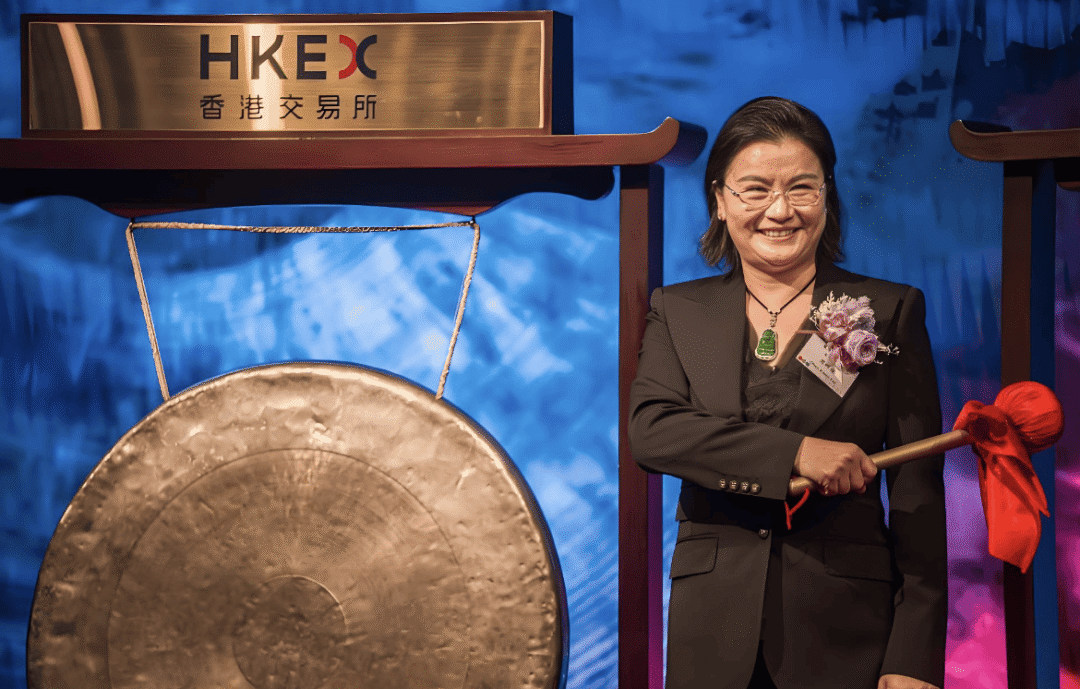
Author – Xiaoniao
Producer – her sister
The “2026 Hurun Rich List” announced that Zhou Qunfei became the richest woman in China with a net worth of 127 billion yuan.
The last time Zhou Qunfei attracted widespread attention was in May this year. At a state banquet for U.S. leaders and entrepreneurs, she sat calmly among a group of global business giants, with Apple CEO Cook on her left and Musk, the world’s richest man, on her right.
At that time, many people did not know the name and origin of the Chinese woman who was communicating with the world’s top technology giants at the same table, but the vast majority of them had actually been exposed to products related to her.
Lens Technology, founded by Zhou Qunfei, has been one of Apple’s glass screen suppliers since the first iPhone, and is also the core supplier of Tesla’s iconic central control large-screen glass. In addition, Huawei, Xiaomi, Samsung, OPPO, BMW, Mercedes-Benz, BYD and other well-known brands have close cooperation with her. The phone you are holding in your hand probably contains parts from Lens.
As early as 2015, Zhou Qunfei became the richest woman in China for the first time with a net worth of 50 billion. At that time, what she received was not congratulations, but overwhelming rumors. Zhou Qunfei ignored this. 11 years later, her net worth more than doubled and she became the richest woman again, slapping all the rumor makers in the face.
She lost her mother at the age of 5, went out to work at the age of 15, and became the richest woman in China at the age of 45. Zhou Qunfei, who “started with a collapse of heaven”, did not receive much favorable treatment from fate, but with the tenacity of a weed, he personally rewrote the direction of his life.
A working girl who refuses to accept her fate
Zhou Qunfei’s life can be called a “crazy start”.
In 1970, Zhou Qunfei was born in Chongxi Village, Hutian Town, Xiangxiang City, Hunan Province. There are five people in the family. His father lost two fingers due to an accident in his early years and was nearly blind. When Zhou Qunfei was 5 years old, his mother passed away.
From an early age, Zhou Qunfei began to share the pressure of making a living with his father. She goes up the mountain to cut firewood and grass every day, and then comes back to feed the pigs and chickens. She often leads her father on a stick and goes to the street to sell bamboo baskets for 80 cents each.
The backpack was made by my father. In order to support his family, he had learned various crafts from eight masters. Zhou Qunfei inherited her father’s curiosity about knowledge and new things. Although she was in the countryside, her heart was not here. She had long had the idea of going out and saving 10,000 yuan for her own education.
At the age of 15, due to his poor family background, Zhou Qunfei had to drop out of school and go to Guangdong to make a living, becoming one of the wave of migrant workers going south in the 1980s.
In Shenzhen, she found an assembly line job processing watch glass, earning seven yuan a day.
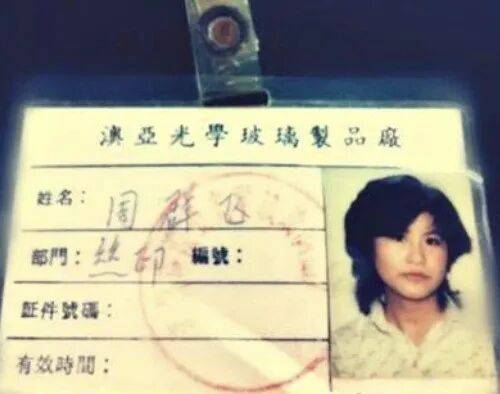
Zhou Qunfei’s work badge
Zhou Qunfei, who interrupted his studies, did not stop studying. The factory was close to Shenzhen University. She ground glass during the day and rode a dilapidated bicycle to night school at night. She passed the exams for an accounting certificate, a customs declaration certificate, and even a truck driver’s license. Everyone usually takes the exam for an ordinary car driver’s license, but she wanted to learn to drive a big truck. “I like to make new things, and I think it’s as boring as others.”
In the eyes of his relatives, Zhou Qunfei is a “domineering” person. In Hunan dialect, this word describes a person’s energy that refuses to admit defeat or accept fate. This is exactly what happened to Zhou Qunfei. And this character of not conforming to conventions and unwilling to accept the status quo ran through her subsequent life.

When Zhou Qunfei was young
Soon, she became dissatisfied with the repetitive work on the assembly line.
The processing of watch glass is relatively simple. There are only four or five processes such as cutting and polishing. Zhou Qunfei quickly mastered the essentials. Realizing that what she could learn from this job was really limited, she decided to resign and not continue to waste time.
Surprisingly, the resignation letter she submitted brought her a new opportunity.
The boss was impressed by Zhou Qunfei’s neat handwriting and her enthusiasm for trying to change, and asked her if she would be willing to take charge of the screen printing department that was being built in the factory. He was also vaccinated: the new department had nothing, no one to teach, and no experience to learn from, so everything had to be done by yourself.
Zhou Qunfei took over this challenge from scratch.
She borrowed a copy of “Seiko Printing” from a coworker in Beijing and treated the book as a master. She explored the technical principles bit by bit and then found ways to apply them to actual production.
In four years, Zhou Qunfei grew from an assembly line worker to a workshop supervisor in charge of a department independently.
In 1990, when the factory was halfway through expansion, funding and operating problems ensued, and the boss was ready to divest. Zhou Qunfei approached her boss and recommended herself, hoping that she would take over the management of the factory. To show her determination, she even issued a military order: “If you succeed, you will decide the salary; if you fail, I will work for you for the rest of my life.”

Zhou Qunfei was interviewed by Gansu Satellite TV
Zhou Qunfei’s desperate move brought a turnaround for the factory.
After taking over the factory, Zhou Qunfei’s self-taught screen printing technology really came in handy. She continued to improve the process and product quality, and the factory’s performance was booming, becoming the most profitable factory in the company.
The good times did not last long, and Zhou Qunfei was squeezed out and suppressed by people from other factories in the company. She and her boss also had differences in their business philosophy. Amid various restrictions, it was difficult for Zhou Qunfei to use his skills and there was little room for development.
Seeing no future, she chose to leave again.
Many companies offered Zhou Qunfei an olive branch. She had not decided to start a business at this time, but she was reminded by her cousin’s words: “If you work for anyone, it is just a part-time job, and you will still be punished.”
No matter who you work for, you will be controlled by others. In this case, why not just be your own boss?
On March 18, 1993, 23-year-old Zhou Qunfei took out more than 20,000 Hong Kong dollars saved by working multiple jobs over the years, and rented a three-bedroom farmer’s house in Shenzhen with his brother, sister, brother-in-law and several cousins to start his own business.
The rural working girl who refused to accept her fate began to work for herself.
Become the richest woman in China
Zhou Qunfei’s new “factory” is the living room of a rental house.
In the rented three-bedroom peasant house, Zhou Qunfei and his sisters slept in the master bedroom, while his male relatives crowded into the small bedroom, and the living room was transformed into a production workshop.
They began to undertake the screen printing business of watch glass, and the OEM fee was 1.5 yuan for each piece of glass printed. After becoming proficient, one person can print 7,000 sheets a day. Several people work until two or three in the morning every day to rush for orders.
The orders were placed one by one by Zhou Qunfei. In the era before the Internet, Zhou Qunfei held the industrial and commercial phone book and called one by one, looking for watch factories willing to cooperate.
With the division of labor and cooperation, the small family workshop gradually developed to a scale of dozens of employees. But fate played tricks on Zhou Qunfei again.
In 1997, as the Asian financial crisis swept through, many upstream customers’ capital chains were broken, and they were in arrears with balance payments and foundry fees for a long time. In order to pay his employees, Zhou Qunfei sold his house twice. “If the house is gone, you can buy it again, but you can’t buy back good employees.”
When faced with customers who really have no money, she asks them to use old equipment to pay off their debts, and pay off the bad debts bit by bit.
So, when the financial crisis ended and many companies suffered heavy losses, she had already rented a factory building in Bao’an District, opened up glass cutting, polishing, silk screen printing, coating and other processes, and established a complete watch glass production line.
Zhou Qunfei, who was able to keep the cloud open, did not just rest on his laurels, but kept observing new opportunities.
At the beginning of the millennium, many industries experienced dramatic changes. At a peer gathering in 2001, a friend who had taken an order from TCL was worried about the pain points of acrylic panels – at that time, most mobile phones used acrylic materials as screen protection panels, which not only had poor light transmittance, but were also easily scratched.
With a simple complaint, Zhou Yuefei heard the business opportunity: Since the glass produced in her factory can be sophisticated and wear-resistant, why can’t she overcome this problem?
She replaced the acrylic screen with a glass screen, and then led her team into research and development, repeatedly adjusting the thickness, hardness and light transmittance of the glass, and improving the processing technology originally used for watches and applying it to mobile phones.
In 2002, Zhou Qunfei’s team achieved a technological breakthrough and cooperated with TCL to launch the first mobile phone with a glass protective panel. Since then, mobile phone screens have begun to be fully upgraded to glass screens.
Zhou Qunfei opened up a whole new market. In 2003, she formally established Lens Technology Co., Ltd., focusing on the production of protective window glass for mobile phones.
Lens Technology Building
The name of the company hides many of Zhou Qunfei’s ingenious ideas. The word “Lens” is the homophony of the English word “lens” for “lens”. When foreign merchants search for “lens” on the Internet, Lens Technology Company will pop up.
In addition, the pronunciation of “Lansi” in Hunan dialect is similar to “hard to die”, which is also Zhou Qunfei’s expectation for the company and himself.
Soon, another important opportunity came knocking.
At that time, Motorola was preparing to launch the V3 mobile phone, with the goal of creating a flip phone known as the “world’s thinnest”. In order to achieve extreme thinness and lightness, manufacturers have put forward extremely high requirements for the thickness, printing accuracy and impact resistance of the glass panel: it must withstand rigorous drop tests and cannot break after being dropped. Even if it breaks, it must not hurt anyone.
The Motorola engineers even went so far as to ask, “If the phone breaks and hurts the president, the stars, can you afford it?”
In response, many suppliers were reluctant, but Zhou Yuefei chose to rise to the challenge. She led the team to constantly adjust temperature, time and process parameters, repeated experiments, and finally overcome the technical difficulties of improving glass toughness, and passed the test of Motorola.
Later, the global sales of V3 exceeded 100 million units, Lens Technology became famous in the first world, and orders from Samsung, Nokia, Sony and other well-known manufacturers rushed to Zhou Wei.
Motorola V3, one of the best-selling flip phones
“It can’t be done, it can’t be done, it can’t be done”, these words are not allowed in Zhou Weifei’s company. For the requirements of glass, as long as the customer wants it, Zhou Yuefei firmly believes that he can do it. Excellent craftsmanship has brought more and more opportunities to Zhou Qunfei.
In 2007, the first iPhone will be released. Apple founder Steve Jobs decided to change the original plastic panel to glass, placing almost demanding requirements on thickness, hardness, light transmittance, and machining accuracy.
When Zhou Yuefei sent the company’s samples to the Apple team, Jobs, who has always been known for being strict, couldn’t pick out any thorns. Since then, Lance Technology has continued to supply glass to Apple, and the business has expanded from the original mobile phone screen glass to mobile phone back covers, camera lenses, and exterior structural components for tablet computers, smart watches, and other products.
Phoenix.com interview with Zhou Weifei
Between 2009 and 2015, Lens Technology’s total revenue soared from $890 million to $17.2 billion, with an average annual growth rate of more than 50%. In the process, Apple contributed nearly 50% of revenue.
On March 18, 2015, Lansi Technology was listed on the gem of the Shenzhen Stock Exchange. On the same day 22 years ago, Zhou Weifei took his family and started a business in a rental house.
The listing of the company brought greater wealth and prestige to Zhou Yuefei, as well as questioning and discrediting.
At that time, there was a lot of malicious speculation about her private life on the Internet, and some people attributed her business success to “small three superior” and “benefits obtained by men” without substantive evidence, and even called Lens Technology “small three concept stocks”.
My daughter in the United States cried for several days after seeing the news and asked her mother why she didn’t stand up and explain.
Zhou Qunfei told his daughter that explaining would only lead to more discussion, and “silence is the best protest.”
Zhou Qunfei showed no concern for the rumors. During meetings, she would joke about the rumors and say, “The mistress is here.” However, she actually suffered from it.
No one would question the success of a male entrepreneur, as if it were a matter of course. And she, just because she is a woman, will suffer unwarranted attacks on her personal ethics when she goes public. “There is never a shortage of colored eyes.”
However, no matter how deep the prejudices of others are, they cannot stop Zhou Qunfei from moving forward.
In the same year that Lens went public, Zhou Qunfei became the richest woman in China for the first time with a net worth of 50 billion yuan, and was named the “world’s richest self-made woman” that year.
The day Lens went public
That year, Zhou Qunfei was 45 years old. It took her thirty years to transform from a rural working girl who dropped out of school into the richest woman in China, which is like a miracle.
“Glass Queen” and more
Becoming the richest woman does not mean that you will be able to sit back and relax.
For a long time, Apple has been Lens Technology’s most important customer, and related orders once accounted for half of the company’s revenue, and even exceeded 70% at its peak. Although such a cooperative relationship has brought huge profits, it also means that once Apple’s product sales fluctuate, it will be difficult for Lens to survive alone.
Lens Technology 2022 Annual Financial Report
In 2016, affected by factors such as declining sales of Apple products, Lens Technology’s net profit dropped by nearly 30% year-on-year. Regarding Lens’ dependence on Apple, there is also a metaphor in the market: if Apple sneezes, Lens will catch a severe cold.
Zhou Qunfei decided to take the initiative to break the business structure that had made her successful and no longer tied the company’s fate to one customer.
On the one hand, she continues to consolidate her technological advantages in the field of consumer electronics; on the other hand, she sets her sights on more new industries with growth potential and looks for the next growth curve.
The first new growth curve she looked for was new energy vehicles.
She has extended the technology and production capabilities originally serving mobile phone screens to the automotive industry, providing central control displays, smart cockpit glass and other products for new energy vehicles.
In less than 10 years of deployment, Lens has established cooperation with domestic and foreign car companies such as Tesla, BYD, BMW, and Mercedes-Benz, and the automotive business has gradually grown into the company’s new growth engine.
But Zhou Qunfei’s ambitions obviously don’t stop there.
In 2025, Lens Technology will cooperate with Zhiyuan Robotics to participate in the batch delivery of Lingxi X1 humanoid robots, and will be responsible for the production, assembly and testing of core components such as joint modules, controllers, and grippers.
At the same time, Lens has also appeared in emerging fields such as AI servers, smart glasses, and commercial aerospace.
In May this year, at a state banquet to welcome U.S. President Trump’s visit to China, Zhou Qunfei sat at the same table with Apple CEO Cook, Tesla CEO Musk, and Nvidia founder Jensen Huang.
Zhou Qunfei sits between Musk and Cook
The layout of this dining table is quite meaningful: Cook represents the consumer electronics market that Zhou Qunfei initially opened, Musk corresponds to the new energy automobile industry that she is deeply involved in, and Huang Renxun represents the artificial intelligence wave sweeping the world. From traditional industries to the latest wave, Zhou Qunfei can be seen in every change.
Starting from a piece of glass, her business has extended to many core areas of the global technology industry. The girl who once polished watch glass on the assembly line has now become one of the world’s business giants.
In the “2026 Hurun Women Entrepreneurs List” released at the end of October, Zhou Qunfei once again topped the list of China’s richest women after 11 years with a net worth of 127 billion yuan. Compared with 2015, her wealth has more than doubled.
In an interview, the host asked Zhou Qunfei, this is an era of very rapid technological iteration. For her, is this an opportunity or a challenge? Is she ready for this?
Zhou Qunfei’s answer was simple and decisive: “It’s an opportunity, and I’m always ready.”
Zhou Qunfei was not the only one who was always prepared. This year, the total wealth of Hurun China’s top 50 female entrepreneurs reached 1.93 trillion yuan, a record high, and the average wealth also reached 38.6 billion yuan, with 9 new faces joining the list.
From industrial manufacturing to artificial intelligence, more and more women are becoming leaders in different industries. They are actually participating in industrial changes, creating new business value, and becoming participants in technological breakthroughs.
The unstoppable wave of female entrepreneurship will continue.
References:
1. The Paper: The richest woman Zhou Qunfei revealed her family history: She is really not a mistress.
2. Asia cover character | Zhou Qunfei: Working at the age of 15, starting a business with RMB 20,000, and now worth RMB 80 billion. She sits between Cook and Musk
Related Reading
- World, line up to sell goods to China!2026-11-12
- Ni Runfeng, the “King of Color TV”, passed away. From a workshop technician to the head of a state-owned enterprise, his ups and downs in half a life defined an era of home appliances.2026-11-12
- Original “Fearless” Wang Jianlin regains control of Wanda Business Management, and his net worth has evaporated by 200 billion in ten years2026-11-12
- Original: The middle-class people are crazy about grabbing Archaeopteryx in Sam2026-11-12
- There is no more double 11 in the world, leaving businesses miserable2026-11-11