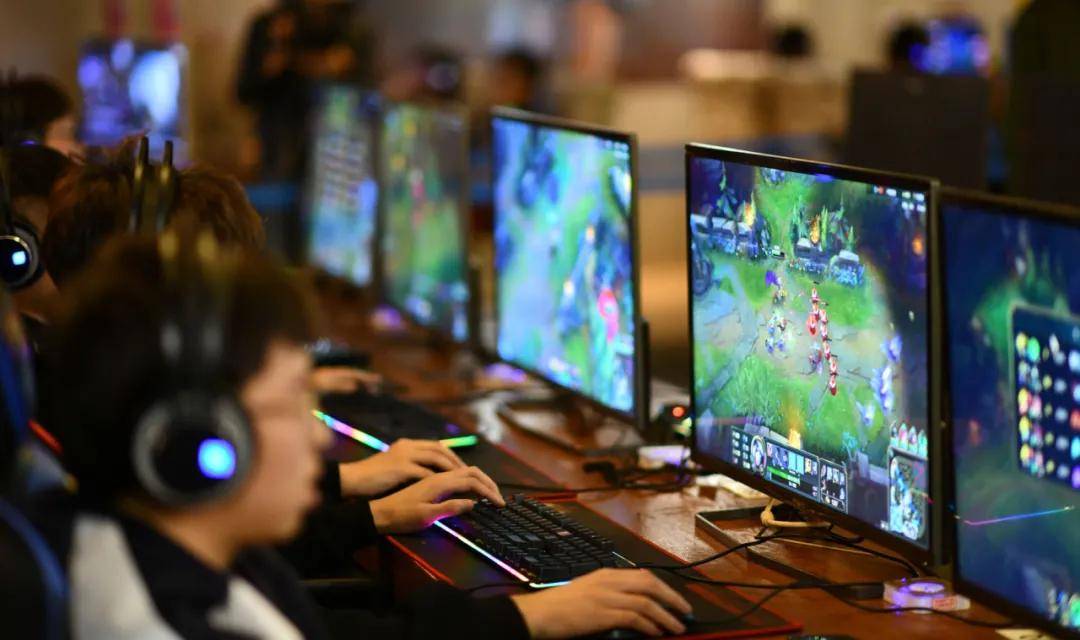
In order to find out what kind of business current Internet cafes are, I decided to go and smoke secondhand smoke for two hours.
At seven o’clock on Friday night, I spent 30 yuan to sit in the so-called “high configuration area” at a traditional Internet cafe in an urban village in Chancheng, Foshan. The peeling dark red sofa, the greasy mouse and keyboard, and the second-hand smoke that makes one’s throat tight, is basically an experience for a novice who doesn’t often go to Internet cafes. After holding on for two hours, I still had twenty yuan left in my account. After half an hour of cold wind blowing, I had only one thought in my mind: Who is still spending money on this kind of torture?
Early the next morning, I changed the battlefield. There is a new e-sports Internet cafe in the mall, and the Meituan early bird coupon is 24 yuan. There are separate wet and dry shower rooms, an all-in-one washing and drying machine, a top-of-the-line gaming screen, and even a “planet cabin” with a bed. The experience is getting better day by day. Interestingly, the attendance rate here during the day is higher than that of the traditional Internet cafe last night.
They are obviously Internet cafes in the same city, but why is one empty while the other is overcrowded? Why do traditional Internet cafes prefer to engage in crazy profit promotions such as “recharge 1,000 and get 1,300 free”, but they still can’t retain people?
In fact, it is because the old and new Internet cafes no longer sell the same thing. “Dead when selling machines” means that the machine time fee has lost its pricing power: it has been demoted from the protagonist of the income statement to a traffic portal. What really determines the life or death of an Internet cafe is how much money users spend during those few hours or even more than ten hours after they sit down. The machine-time fee can continue to exist, but it must accept this new position: from the revenue body, back to the admission ticket.
Let’s look at a set of data first: According to public industry statistics such as the China Internet Service Industry Association, in 2020 alone, more than 12,000 Internet cafe-related companies across the country have been deregistered and revoked; by 2025, the number of national Internet service market entities has rebounded to 122,600, and the annual revenue of venues has exceeded 101.68 billion yuan. These two figures have different calibers – the former is the number of company cancellations and the latter is the total number of market entities, but they can explain the same thing: old supply is being cleared, new supply is entering the market, and the industry is changing. The ones that died were those Internet cafes in urban villages that survived by selling cheap machines. The ones that survived and expanded wildly were those complex commercial entities that integrated bathing, dining, and accommodation into the space.
01
The endless cycle of traditional Internet cafes: the cost structure is locked
In the past, when you opened an Internet cafe, you could just buy a few computers with a network cable and earn money because your family couldn’t afford high-end computers at that time. Today, young people may have a thin and light laptop that is sufficient at home, but it is still painful to spend more than 10,000 yuan to purchase a high-end host computer. It stands to reason that this should be a great opportunity for Internet cafe leasing, so why is the traditional Internet cafe market still largely dead?
The first is a comprehensive attack by substitutes. Nowadays, mobile games are extremely developed, and light players do not need to go to Internet cafes at all. Even if hardcore gamers want to meet offline, they will settle the score: Spending the same money, why not go to a new internet cafe with a better environment and a cup of good coffee? The “cheapness” of traditional Internet cafes can no longer cover up the extremely poor experience.
Secondly, there is the overdraft trap caused by “only selling machines”. Look at the price list of that store: recharge 30 and get 10, recharge 1,000 and get 1,300. Some people think that prepayments generate cash flow, but the money collected in advance is not profit, but a liability. The hundreds or thousands of hours customers recharge will have to be cashed out sooner or later with electricity bills, Internet bills and labor. Once new customer recharges slow down and old customers continue to consume, this “cash flow” will become a “debt pool.” Prepayment just pushes the time of death back.
The real cause of death of traditional Internet cafes is that their cost structure is completely locked up: low rents in urban villages determine low customer orders. Low customer orders cannot support environmental upgrades. Without upgrading the environment, they cannot attract the incremental customer base who are willing to pay for the experience. If you can’t make money, you won’t be willing to spend hundreds of thousands to upgrade the exhaust system and replace a set of non-sticky keyboards.
If the environment is poor, young people won’t come; if young people don’t come, the boss won’t have money to upgrade. So since I was eliminated, why could I still sit in that night? Because the last batch of customers at Internet cafes in urban villages are often night shift workers from nearby factories. It’s not that they don’t know the environment is bad, they just don’t have a choice. When these people slowly found other places, the lights went out.
02 Internet fees are just tickets, “stay time” is the core business
Traditional bosses believe that the transformation of an Internet cafe is to add a few high-end computers. But industry data gave them a slap in the face: in 2025, the proportion of non-network fee revenue (catering, accommodation, value-added services) of Internet service venues has reached more than 60%, and machine-time revenue has dropped to less than 40%. This means that Internet cafes have long become a space rental business.
There is no fixed standard for the form of new Internet cafes: some are “e-sports + bathing”, some are “e-sports + youth hostel”, and some are “e-sports + chess and card room + billiard hall”. In the Internet cafe I experienced, not only were there top-end peripherals, but the private rooms were even equipped with disposable slippers and dental floss.
The machine time fee is just the ticket to invite you in. The real money is every minute you spend after sitting down. The longer the stay, the higher the conversion of catering, accommodation, and peripheral consumption. For a cup of coffee costing RMB 30, the gross profit may be higher than a machine running idling for two hours. By extending your stay and making money back in the composite business format, this is the trump card for new species to survive.
03 Content drives hardware: Why can hardcore games drive people back to Internet cafes?
I originally thought that Internet cafes were full of idle people who were not doing their jobs, but on-site observation found that the main force became office workers and college students. Why? Because there is too little private space left for them in the city. There is a power outage in the student dormitory, and the roommates have different schedules; the shared apartments for office workers are small and have extremely poor sound insulation. They go to Internet cafes not only to play games, but also to find a legal escape from reality.
What pulled them back offline was that game content forced hardware and social interaction.
Hard-core FPS games such as “Fearless Contract” and “Operation Delta” have extremely high requirements on frame rate and latency. Ordinary people can’t carry it with their thin and light notebooks. More importantly, this type of game relies heavily on five rows of black cards. Playing alone at home is like being in jail. Five people must get together to spray each other and report points. It is fun.
For example, this Internet cafe I went to directly bought a Zhuowei 600Hz refresh rate gaming screen, and a monitor costs seven to eight thousand yuan. This set of configurations can easily cost tens of thousands at home, but in an Internet cafe, you can use it with just a membership. The crushing feeling of top-notch hardware, coupled with the atmosphere of sitting in the same room with real people and playing games, are the real reasons that draw people back from home.
Those who were pulled back offline are actually a very specific group of people: they live alone or in shared apartments in the city, play hardcore FPS, and are used to playing black in five rows. Internet cafes meet the high-frequency needs of this group of people, and they are still far from “everyone goes back to Internet cafes”.
04 From urban villages to shopping malls: The number of female customers is a low-cost environmental audit indicator
We have talked about hardware and games above, but there is also a more subtle change happening – the gender ratio in Internet cafes is being rewritten.
To understand this change, we must first introduce a concept. Sociologist Oldenberg once proposed the concept of “third space”: home is the first space, the workplace is the second space, and informal public gathering places like cafes are the third space. Nowadays, complex Internet cafes are evolving into the “fourth space” for young people. It is a mixed zone that breaks the boundaries of entertainment, accommodation, and dining. Its greatest value is that it provides a sense of security that “neither socializes nor is accompanied by someone.”
Young people are afraid of loneliness and need to go to crowded places to confirm that “I am not alone”; but they are also extremely socially fearful and need a private room where they can close the curtains and don’t have to talk to anyone. Internet cafes in Japan have long been moving in the direction of “capsule hotels”, and Internet cafes in China are doing the same thing. Planet capsules are hard to get on weekends because young people need this kind of environment where they can live together in groups and be alone together.
In this “fourth space”, whoever can provide this sense of security can win the incremental market. To measure whether an Internet cafe has truly achieved this, there is an extremely intuitive indicator: see whether there are many female customers in the store.
I stayed in that new Internet cafe all morning. There were probably less than 20% women, but they were basically in private rooms and in a very relaxed state. It’s not that having more girls means you’ll definitely make money, but that female customers are more sensitive to the smell of smoke, hygiene, privacy and security thresholds. She was willing to sit down and explain that this store at least crossed the minimum threshold in terms of being smoke-free, cleanliness, and private room boundaries. This is more credible than the boss himself saying “We upgraded.”
05 Under the asset-heavy model, how to use digitalization to save labor costs?
Since the new Internet cafe wants to provide complex services such as catering, private rooms, and bathing, it faces a fatal reality: it focuses on assets and services, and the labor cost is extremely high. Private rooms need to be cleaned, meals need to be delivered, and shower rooms need to be cleaned. If it all depends on the number of people, the money earned can easily be folded into the salary.
At this time, digital systems have become standard equipment for new species. For example, Internet cafe SaaS systems such as “Xiao Ka Ge” open basic functions to stores for free or at low prices. Why are bosses willing to use it? Because for a single store, this system solves the most painful “accounting” and “manual” problems: self-service card opening, mini-program ordering, and intelligent power control, freeing employees from tedious cash registers and errands; the system can also monitor the status of machine seats in real time, reduce machine idling, and plug cashier loopholes.
For SaaS platforms, free software is about flow and ecology: store recharges and order funds flow through its channels, and the platform earns profit from payment services under the premise of compliance; by the way, it can also sell the supply chain of drinks and snacks.
But does digitalization mean “unmanned”? Quite the opposite.
The new Internet cafe I tried had at least three waiters on duty during prime time—one at the bar, one cleaning, and one taking customers inside. This may seem contradictory to “reducing costs and increasing efficiency,” but this is the essential difference between old and new Internet cafes: digitization frees employees from tedious cash registers and errands, allowing them to do things that machines can’t do – provide warm services and emotional value.
The owners of traditional Internet cafes are reluctant to buy systems or hire people, and in the end they can only let customers face greasy keyboards; while new Internet cafes invest the saved efficiency costs in better mattresses and faster cleaning speeds, forming a positive cycle. This is the true meaning of digitalization in this 100 billion market.
結尾
From the traditional Internet cafe in the urban village that makes people’s throats tighten with smoke to the new Internet cafes in shopping malls that even have dental floss, the two faces are based on the same business law: when computers themselves are no longer scarce, selling “computer usage time” loses pricing power.
Young people have not stopped paying for offline space, they just refuse to pay for supplies that are rough, single, and disrespectful of stay time. The machine time fee can continue to exist, but it must accept a downgrade – from the protagonist of the income statement to the position of admission ticket.
Operators who cannot see clearly this downgrade will continue to burn up their future cash flow in the cycle of “recharge 1,000 and get 1,300”. When the times abandon you, there won’t even be a “black out” prompt.
- END –
Related Reading
- World, line up to sell goods to China!2026-11-12
- Ni Runfeng, the “King of Color TV”, passed away. From a workshop technician to the head of a state-owned enterprise, his ups and downs in half a life defined an era of home appliances.2026-11-12
- Original “Fearless” Wang Jianlin regains control of Wanda Business Management, and his net worth has evaporated by 200 billion in ten years2026-11-12
- Original: The middle-class people are crazy about grabbing Archaeopteryx in Sam2026-11-12
- There is no more double 11 in the world, leaving businesses miserable2026-11-11