A group of “her forces” are rising in the capital market.
The richest woman has changed again.
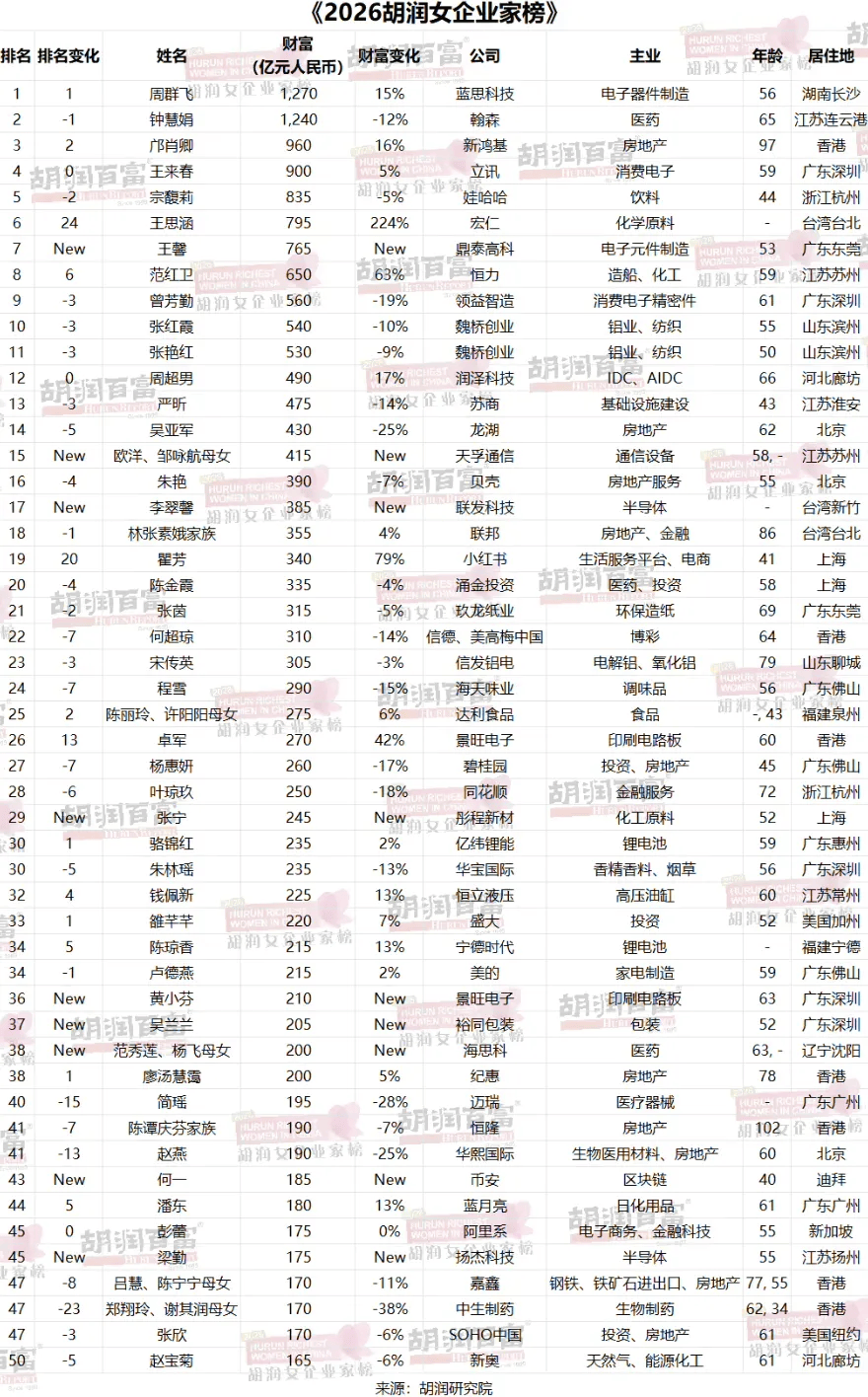
Recently, Hurun Research Institute released the “2026 Hurun Female Entrepreneurs List”, in which Zhou Qunfei, founder of Lens Technology, has become the new richest woman in China with a wealth of 127 billion yuan. It is worth mentioning that this is the first time in 11 years since 2015 that Zhou Qunfei has become the richest woman.
Also thrust into the spotlight is Lens Technology, which was built by Zhou Qunfei. Today, Lens Technology is the leader of the “fruit chain” listed in A+H, and its business extends from mobile phone glass to new fields such as AI smart terminals and AI servers.
Zhou Qunfei is not the only one standing at the top of the list.
Zhong Huijuan of Hansoh Pharmaceutical, Kuang Xiaoqing of Sun Hung Kai, Wang Laichun of Luxshare Precision, Zong Fuli of Wahaha, Wang Sihan of Hongren, Wang Xin of Dingtai High-tech… Covering the track from medicine to real estate, from consumer electronics to PCB, from daily consumer goods to electronic components, a group of female leaders are at the helm of well-known companies in their respective tracks.
These female bosses, whose wealth ranges from tens of billions to hundreds of billions, hold up half of the business world in manufacturing, medicine, consumption, technology and other fields, making “her power” an increasingly clear sight in the capital market.
127 billion, the richest woman has changed
The story of the new richest woman is actually a “history of the heroine’s struggle” about the founder Zhou Qunfei.
Zhou Qunfei’s starting point was not high, and it could even be said to be full of thorns. In 1970, she was born in a poor mountain village in Xiangxiang, Hunan. Her mother unfortunately passed away when she was 5 years old, and her father became blind due to an accident. The burden of life fell early on Zhou Qunfei’s young shoulders. In order to make a living, 15-year-old Zhou Qunfei dropped out of school after finishing his second year of junior high school and joined the wave of people going south to work.
As many Hunan netizens said, “Hunan people’s coming-of-age ceremony is a ticket to Guangdong.” The young Zhou Qunfei was no exception at that time. A ticket took her quickly to the distant world of adults.
After arriving in Shenzhen, Zhou Qunfei’s first official job was cutting and polishing glass on the assembly line of Aoya Optical.
During those years when he was working at Aoya Optical, Zhou Qunfei showed early on his extraordinary diligence and intelligence. In just four years, she not only became the supervisor of the factory, but also took night classes, studied accounting, and learned computers after work, and taught herself the screen printing technology. And these skills, like seeds of hope, quietly took root and sprouted in her heart.
The turning point of fate came in 1990. Aoya Optics, where Zhou Qunfei worked, was preparing to expand its processing plant and expand production. However, the boss at that time was preparing to withdraw capital and suspend production due to confusion and worry about the future. After learning the news, Zhou Qunfei went to his boss without any hesitation and said firmly: “Give me this factory. If I can’t make a profit, I will bear the loss. If I can make a profit, I will pay you the wages.”
After taking over the factory, Zhou Qunfei used the screen printing technology he learned to pioneer the printing of words and patterns on watch glass. Products with this innovative model are extremely rare on the market and are quickly sold out. With the continuous improvement of technology, the factory run by Zhou Qunfei has become the most profitable factory in the entire company. However, the good times did not last long, and internal strife among the company’s management became increasingly serious. In the end, Zhou Qunfei had no choice but to leave and start his own business with only his meager savings.
2001 was another critical point for Zhou Qunfei. At that time, at a friend’s gathering, an old friend received an order for TCL clamshell mobile phone panel design. He immediately thought of Zhou Qunfei, and this completely changed the company’s main business line, which was originally only engaged in watch glass processing.
At that time, Zhou Qunfei did not actually develop mobile phone glass technology, but with her keen business acumen and courage to try, she quickly applied watch glass technology to mobile phones. After many attempts and failures, she finally succeeded in developing and producing these mobile phone glass products. This feat also makes Lens Technology an early pioneer in this field.
In 2003, Zhou Qunfei used technology and equipment to invest in shares and co-founded Lens Technology, focusing on mobile phone protective window glass. However, the start was not smooth. The partners withdrew their funds in time, and Lens Technology once faced a bankruptcy crisis.
Fortunately, fate always seems to favor those who work hard, and a large international order pulled Lens Technology back from the edge of the cliff. In 2004, Motorola approached Zhou Qunfei and asked that the mobile phone glass not be broken when dropped vertically from a certain height. After several days and nights of research and development and attempts, Zhou Qunfei successfully accepted this order. The first batch of supplies was a great success, and Lens Technology became the focus of the industry. Since then, with the rise of smart touch-screen phones represented by iPhone, Lens Technology, which is deeply involved in glass technology, has become the main supplier of iPhone mobile phones.
On March 18, 2015, Lens Technology was listed on the GEM of the Shenzhen Stock Exchange. In October of the same year, the “2015 Hurun Women’s Richest List” was released, and Zhou Qunfei topped the list of “richest women” with a fortune of 50 billion yuan. In the following more than ten years, the top spot changed hands several times. She was always on the rich list, but she has not been able to return to the top.
In 2026, Zhou Qunfei reached the top again with 127 billion yuan. It has been 11 years since the last time.
Hundreds of billions of Lens, more than just a “fruit chain”
Lens Technology, run by the richest woman, is a super leading company with a market value of over 100 billion yuan. Based on the closing price on November 2, its total market value exceeds 130 billion yuan.
When talking about this billion-dollar leader, the “fruit chain” cannot be avoided.
In 2006, Apple decided to use a glass cover on the first-generation iPhone instead of the original hard-coated plastic material. At that time, there were only a few manufacturers in the world capable of precision processing of large-screen glass. Lens Technology relies on its deep technical reserves in the field of glass processing to start project cooperation with Apple.
Afterwards, then-Apple COO Jeff Williams recalled the details of the iPhone development and said, “We decided at the last minute to use glass instead of hard-coated plastic for the screen cover. During that time in China, it was great to see suppliers working hard to do something that had never been done before. Holes were drilled in the glass, reinforced, and then produced glass panels, which laid the foundation for mobile phone manufacturing around the world.”
The supplier Williams mentioned was Lens Technology.
This year, Lens Technology took the lead in applying CNC technology to glass processing, created original ultrasonic drilling technology, and independently developed matching inks. It was recognized by Apple and became one of Apple’s earliest suppliers in mainland China. Therefore, starting from the first generation of iPhone, Lens Technology has participated in the R&D and production of almost every generation and every new product of Apple, including iPhone, iPad, Apple Watch, Mac and many other Apple products.
During the cooperation process, Lens Technology has provided Apple with high-quality glass panels, back cover glass and other key components, and has continuously promoted technological innovation. For example, the pressure holding station on the iPhone back cover glass assembly line has achieved dual-temperature pressure holding, improving production efficiency and product quality.
However, Lens Technology’s reliance on Apple does not come without costs. In 2016, when iPhone sales declined for the first time since its release in 2007, Lens Technology’s orders from Apple plummeted, which indirectly led to the company’s first negative annual revenue growth since it went public.
Therefore, in the past many years, in order to get rid of the outside world’s stereotype of Lens Technology’s “success is a fruitful chain and failure is a fruitful chain”, Lens has made various attempts to “de-Apple”.
Specifically, in recent years, Lens Technology has expanded its business areas by continuously deepening vertical integration in addition to sticking to its main business. In the field of new energy vehicles, Lens Technology has established cooperative relationships with many well-known domestic and foreign automobile brands such as Tesla, BMW, Mercedes-Benz, Volkswagen, BYD, etc.; in the field of humanoid robots, the robot subsidiary’s revenue will exceed 1 billion yuan in 2025, and the annual shipment of humanoid plus quadruped robots will exceed 10,000 units.
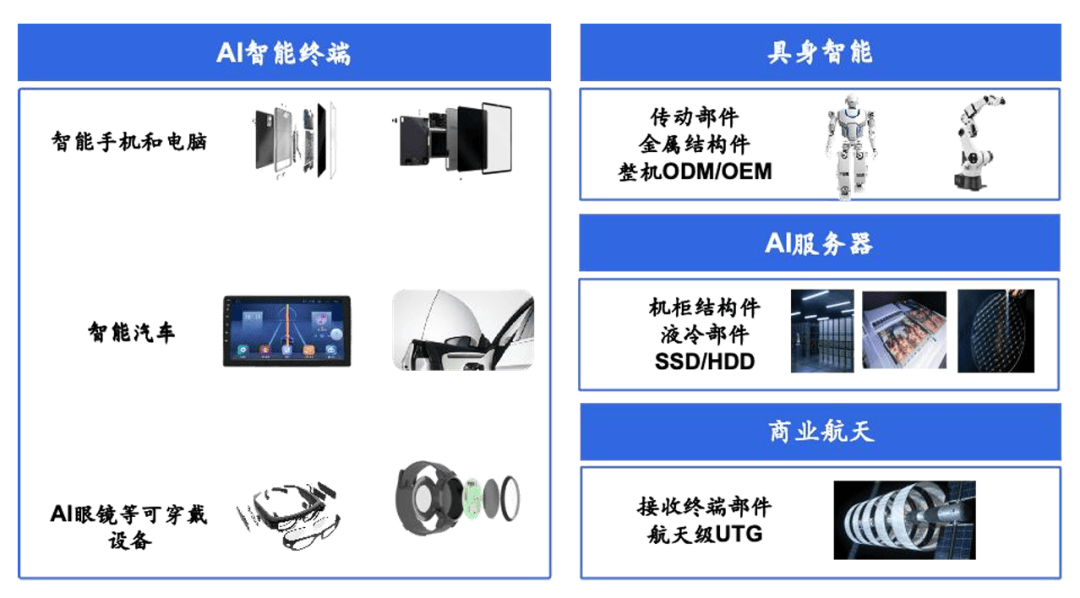
As stated in Lens Technology’s introduction, “The business covers structural parts, functional modules, complete machine assembly, etc. of AI smart terminals (including smartphones, AI glasses, smart cars, embodied intelligence, etc.), AI servers, commercial aerospace and other products.”
The “her power” of the capital market
From a working girl from a mountain village in Xiangxiang to a richest woman. Zhou Qunfei spent decades of struggle writing a legendary story.
And if you zoom out, you will find that Zhou Qunfei is not alone.
Take a closer look at the newly released Hurun Women Entrepreneurs List: the top 50 female entrepreneurs have a total wealth of 1.93 trillion yuan, a record high, with an average wealth of 38.6 billion yuan and a threshold of 16.5 billion yuan for the list. Behind Zhou Qunfei are Zhong Huijuan (Hansen Pharmaceuticals, 124 billion yuan), Kuang Xiaoqing (Sun Hung Kai, 96 billion yuan), Wang Laichun (Luxun Precision, 90 billion yuan), Zong Fuli (Wahaha, 83.5 billion yuan), Wang Sihan (Hongren, 79.5 billion yuan), Wang Xin (Dingtai Hi-Tech, 76.5 billion yuan), Fan Hongwei (Hengli, 65 billion yuan), and Zeng Fangqin (Lingyi Intelligent Manufacturing, 56 billion yuan).
Their names are almost all tied to PCB, consumer electronics, medicine and other tracks that are sought after by capital. The AI wave has pushed up the valuations of companies in the electronics industry chain, and has also increased the wealth of a group of female leaders.
Hurun Group Chairman and Chief Research Officer Hurun said: “Zhou Qunfei became the richest woman in China for the second time. When she first reached the top in 2015, Lens Technology had just been listed. She was an iconic figure in the smartphone supply chain; 11 years later, she returned to the top with AI hardware, smart car displays and smart glasses.”
According to Hurun, in the past 20 years, there have been eight women who have claimed the top spot on this list – Yang Huiyan ten times, Zhang Yin three times, Wu Yajun and Zhou Qunfei twice each, and Chen Lihua, Kuang Xiaoqing, Zong Fuli and Zhong Huijuan once each. The industries behind them range from packaging, real estate, medicine, and beverages to electronics. The changing crown of the richest woman reflects the changes in China’s economy itself.
Looking at the entire secondary market, the figure of Chinese women is becoming increasingly clear. According to Flush iFinD data, as of March 6, 2026, there are 388 A-share listed companies helmed by female chairmen, with a total market value of 6.43 trillion yuan. Among them, four companies, namely PICC, Luxshare Precision, Haitian Flavor Industry, and Gree Electric Appliances, have a market value of more than 200 billion yuan, and another eight companies have a market value of more than 100 billion yuan.
Before a company goes to the capital market, there is often another group of women who appear at an earlier stage – investors.
In 2025, China’s equity investment will enter the deep-water zone of “equal emphasis on quality and efficiency”. As the industry pursues certainty in the wave of hard technology and seeks anchors in cyclical fluctuations, female investors are participating in different ways: they do not rely on volume to win, but penetrate the business surface with deep empathy; they do not rely on short-term games, but rely on long-term companionship to build trust; they go beyond financial returns and are committed to creating a win-win innovation ecosystem for all parties. They are good at listening and good at capturing the team’s resilience, values and growth potential beyond data. They use clear and transparent communication to build trust, use nuanced empowerment to fulfill their promises, and transform “capital” into “partners”.
This is also the group that Rongzhong wants to record in its “China’s Best Female Investors List”. Over the past seven years, Rongzhong Research has released an annual list on International Women’s Day based on authoritative data, questionnaires and multi-dimensional indicators. A total of hundreds of outstanding female investor representatives have been included in this list. Their layout extends from hard technology, artificial intelligence to green technology and other cutting-edge tracks. What the list wants to illustrate is the rise of an investment philosophy: rationality without losing warmth, firmness while being tolerant, and progress without forgetting responsibility.
The “Rongzhong 2025 China’s Best Female Investors List” released in 2026 recorded such a group of women who are deeply involved in the primary market. They make early decisions in hard technology, artificial intelligence, green technology and other tracks, and accompany entrepreneurs all the way to the capital market.
Related Reading
- World, line up to sell goods to China!2026-11-12
- Ni Runfeng, the “King of Color TV”, passed away. From a workshop technician to the head of a state-owned enterprise, his ups and downs in half a life defined an era of home appliances.2026-11-12
- Original “Fearless” Wang Jianlin regains control of Wanda Business Management, and his net worth has evaporated by 200 billion in ten years2026-11-12
- Original: The middle-class people are crazy about grabbing Archaeopteryx in Sam2026-11-12
- There is no more double 11 in the world, leaving businesses miserable2026-11-11