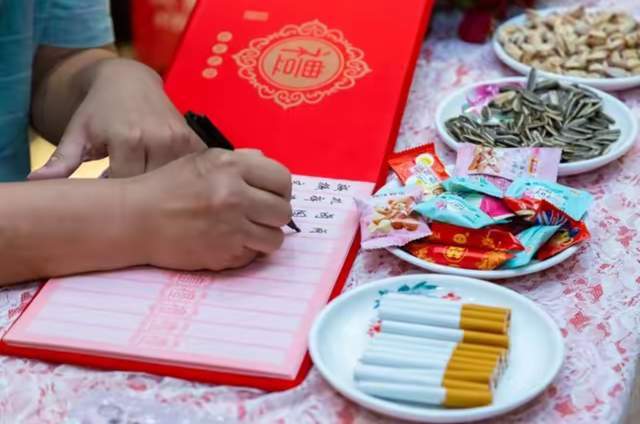
Recently, many places are intensively issuing “height restrictions” on molecular money. A fundamental contradiction has surfaced. A group with a median annual disposable income of only more than 20,000 yuan is being coerced by a set of human rules that “starts with 500 yuan.” This is not a moral question, but a simple arithmetic problem.
Article丨Female author of financial gossip: Jianshan
· · ·
Recently, many places are intensively issuing “height restrictions” on molecular money. Sanjiang in Guangxi advocates that gifts in rural areas should not exceed 100 yuan, Shangluo in Shaanxi has set a reference line for rural favor gifts not exceeding 100 yuan, and Lanzhou High-tech Zone in Gansu has also set the standard at 100 yuan.
At the beginning of 2026, the National Bureau of Statistics announced residents’ income data for 2025: the median per capita disposable income of rural residents was 20,711 yuan. This figure means that half of rural residents have less than 21,000 yuan in disposable cash throughout the year, and the average monthly cash is less than 1,726 yuan.
A fundamental contradiction has surfaced. A group with a median annual disposable income of only more than 20,000 yuan is being coerced by a set of human rules that “starts with 500 yuan.” This is not a moral question, but a simple arithmetic problem.
1./ An overlooked “hidden expense” /
To understand why “height restriction orders” are being issued intensively at this moment, we must first settle an account.
According to survey data from the Ministry of Agriculture and Rural Affairs in 2025, on average, each household in rural areas of my country participates in 15 to 20 banquets each year, and the expenditure on gifts accounts for 25% to 35% of the family’s disposable income, and even exceeds 40% in some areas. A follow-up survey of multiple villages by Renmin University of China came to a similar conclusion: rural residents’ favor expenditures accounted for 15.6% of their annual family income, almost double that of ten years ago.
The difference between these two sets of data is worth noting – the former is the passive expenditure of “participating in banquets”, while the latter is the full range of “active exchanges of favors”. No matter which caliber you take, the conclusion points in the same direction:
Favor expenditure has become the second largest cash outflow item for rural households after food.
Specific to individual cases, the parents of a villager in Liuyang, Hunan Province have almost no income and rely on their two daughters for family expenses. However, the annual gift money still costs 10,000 to 20,000 yuan, “more than the annual living expenses of an elderly couple.” A 58-year-old farmer in Zhoukou, Henan Province spent 18,000 yuan on gifts alone in 2024, which is equivalent to half a year’s income from farming.
Putting these two figures in the coordinate system of the median income of 20,711 yuan, the problem becomes very clear:
Expenditures on favors are not “icing on the cake”, but are squeezing the survival cash flow of rural families.
2./ Economic explanation of the alienation of molecular money/
The gift-giving system is a mutual financial mechanism that allows for small deposits and lump sums. Today you get married and I give you a gift. Tomorrow I do something for you and you give me a gift in return. The funds are exchanged for time and space in the network of acquaintances. This mechanism works well in traditional villages with low population mobility and stable community structures.
But two structural changes upset this balance.The first is population outflow.When young and middle-aged workers migrate to cities in large numbers to work, rural social networks degenerate from “long-term repeated games” to “one-time games.” You may not be able to take back the gifts you gave when you went out, because you may not return to the village to hold a drink, or the other person may no longer be in the village when you hold a drink.The trust foundation of mutual finance has been weakened, and Sui Li has changed from “saving money” to “consumption”.
Survey data from the Chinese Academy of Social Sciences in April 2025 showed that the actual dining rate for wedding banquets in rural areas across the country was only 38.7%, a drop of nearly 30 percentage points from 2020. Most people leave after the ceremony, and “eating cold seats” becomes the norm. This just confirms that the financial nature of human relations is being stripped away: people are still “paying”, but they are no longer “consuming” the social event itself.
The second is the self-reinforcement of the equilibrium point of comparison.When a village’s gift standard rises from 100 yuan to 300 yuan, the individual’s optimal strategy is to follow. Because if you are less casual than others, you will be excluded from the social network, and the gift money you will get back when doing things in the future will also shrink. This is a typical “prisoner’s dilemma”: everyone wants to get out less, but no one dares to get out first.
The result is a one-way ratchet effect on gift money standards. The average wedding gift in rural areas in the central region in 2025 is 1,280 yuan, an increase of 64% from 2020. Research by the Ministry of Agriculture and Rural Affairs shows that the cost of a single table for a rural banquet has soared from 200 yuan in 2015 to 800 yuan in 2025, and even exceeds 1,500 yuan in some areas.
Molecular money has been transformed from a tool for emotional expression into a “social tax” – you pay not to obtain services, but to purchase the right to “not be excluded.”
3./ Time window for policy implementation/
Once you understand the economic nature of the problem, you can understand why policies will begin to be intensively launched in the second half of 2025.
In October 2025, Vice Chang Jiang Wensheng of the Ministry of Agriculture and Rural Affairs clearly stated at a press conference of the State Council Information Office:
Encourage all localities to put forward advocacy standards for the amount of rural betrothal gifts, gift limits, and the types of rural banquets that can be handled, the number of tables, and the cost of dishes, etc., “so that farmers can have evidence to rely on when handling weddings and funerals.”
The logic of the policy is not complicated. The core function of advocacy standards is to provide a “coordination signal.” When the government says that “a gift in rural areas should not exceed 100 yuan,” it is actually telling all villagers: You can only give away 100 yuan and you won’t be laughed at, because this is not because you are stingy, this is the “spirit from above.”
This is equivalent to rescuing individuals from the “prisoner’s dilemma”. Before, everyone was waiting for others to surrender first, but now the government stands up and says, “I will be the one to surrender first.”
The deeper context is macro-level considerations. Since 2019, the Central Committee’s No. 1 Document has deployed rural customs changes for seven consecutive years. This is obviously no accident. After the poverty alleviation is completed, preventing “reduction in poverty due to courtesy” and “returning to poverty due to courtesy” has become an inevitable requirement to consolidate the results. When favor expenses account for more than 30% of income, any increase in income will be swallowed up by this bottomless pit. The per capita disposable income of rural residents actually increased by 6.0%, but the growth rate of favor expenditure far exceeded this figure.
From this point of view, the “high limit on the share of the money” is not a simple change of customs, but a targeted reduction of the cash flow burden on rural households.
The “weakness” of advocacy standards also needs to be faced squarely, as they are not mandatory. The biggest difficulty in limiting the amount of gifts is the extremely high cost of supervision. Rural areas are a society of acquaintances, and private transfers between neighbors, correction fees, and help costs may all become substitutes for gifts. Just as the “high limit” on betrothal gifts gave rise to “get-off gifts” and “change fees”, the reduction in the explicit standard of family money may be accompanied by an increase in hidden burdens in other categories.
But this does not mean that advocating for sexual standards is meaningless.Its value lies not in “controlling every transfer” but in changing the direction of social norms.
When enough villages begin to implement the 100-yuan standard, when the Red and White Council actually “supervises” at the banquet site, and when village cadres take the lead in simplifying the process, a new social equilibrium point will gradually be formed. 100 yuan has changed from an “unavailable” number to a “taken for granted” standard. This in itself is a migration of social norms.
More importantly, the signals released by the policy are being received by the market. Many places have begun to encourage the formulation of “banquet menus” and rely on village halls and canteens to provide services to benefit the people. If these supporting measures are implemented, they will further reduce operating costs and reduce the space for inflation from the supply side.
The “de-financialization” of rural human relations may have entered an irreversible stage. When the social network in the village becomes more and more loose, when “following the etiquette without eating” becomes the mainstream, and when the policy provides a decent “step” for everyone, returning to “disregarding etiquette and favoring affection” is no longer a moral appeal, but a rational collective choice.
Related Reading
- Original milk tea shop “rebellion”? Selling coffee in the morning and beer in the evening, what do you want to do to grab jobs in convenience stores?2026-10-01
- Trump to begin sending $500 ACA refund checks to 1 million Americans2026-10-01
- Original After losing more than 70 billion in 5 years, the “big brother of Huanjing Real Estate” is waiting for the “white knight”2026-10-01
- Senate blocks bill restricting stock trading by members of Congress2026-10-01
- Original: Young people who want to buy a house are waiting for a big benefit2026-10-01