World
Americas
Trump says Canada becoming ‘associate member’ of EU could be a ‘hostile act’
 Lex Harvey,
  Hanna Ziady
0:32
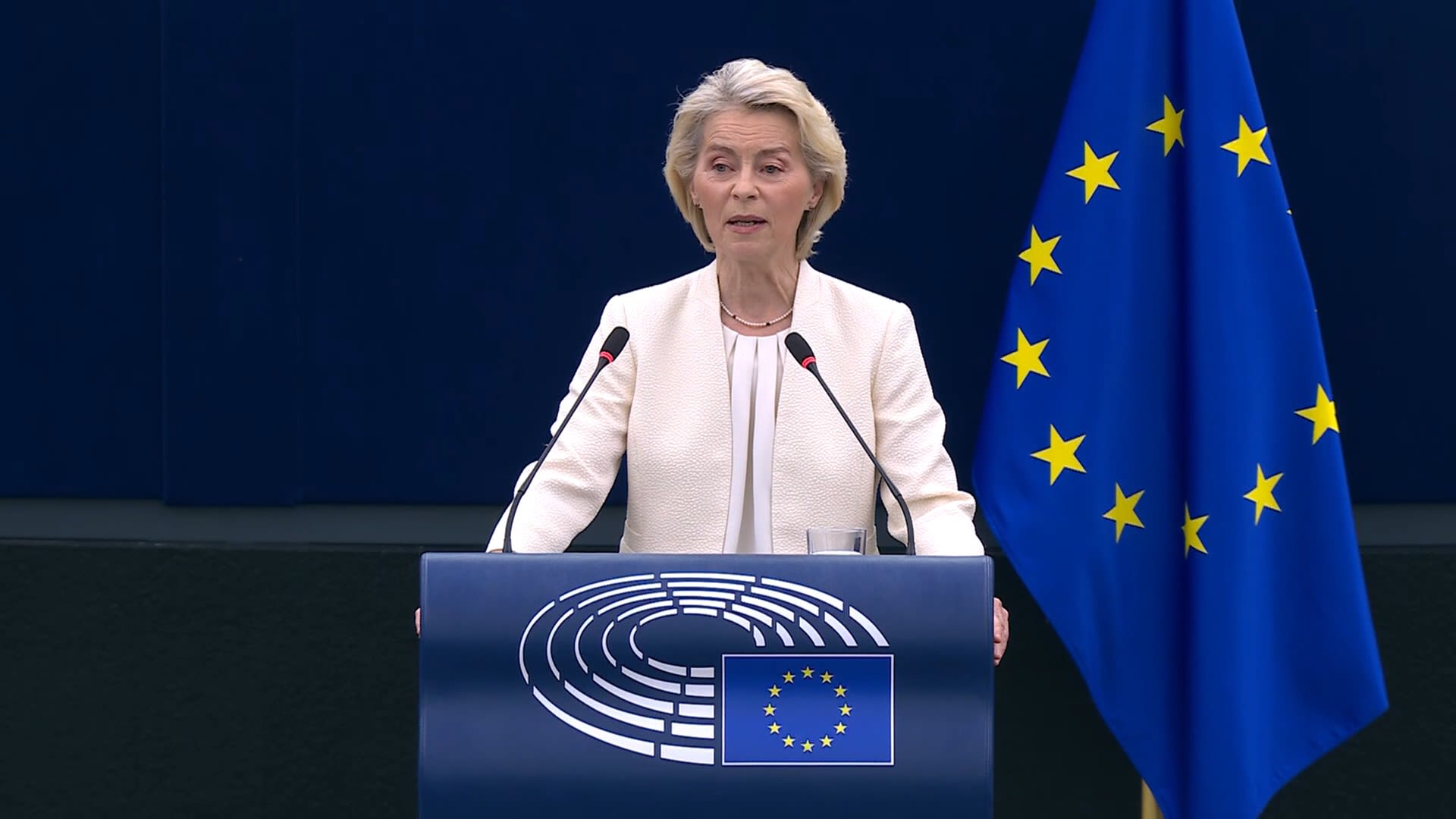
European Commission President Ursula von der Leyen proposed Wednesday that Canada become the bloc’s first “associate member,” provoking a fresh tariff threat from US President Donald Trump.
The move is aimed at shoring up their economies in the face of increasing trade tensions with the United States. But Trump said Wednesday the US could put “heavy tariffs” on the European Union if he considers any new agreement with Canada to be a “hostile act.”
“If it’s a good intention, that’s fine. If it’s a bad intention, we’ll put very heavy tariffs on Europe, which is a possibility,” he told reporters.
Canada is currently locked in a trade war with the US, its largest trading partner, adding urgency to efforts to get closer to the the European Union.
Trump has also repeatedly called for Canada to become the 51st US state, an idea firmly rejected by Canadian Prime Minister Mark Carney.
Carney was a guest at von der Leyen’s state of the union address in Strasbourg, France, where she remarked that “in this new world we must urgently reimagine our partnerships and build global coalitions for our resilience and democracies.”
“In short, we want to bring the relationship with Canada to the highest level possible,” she said.
Carney, meanwhile, is keen to foster a much closer relationship with the EU, saying Sunday that Canada was pursuing a “unique alliance with the European Union.” He made headlines with a speech at Davos, Switzerland, earlier this year stressing the need for “middle powers” to act in concert amid a “rupture in the world order.”
Despite the backdrop, von der Leyen stressed Wednesday that the decision to join forces with Canada was “not a partnership against anyone else, but for our common strength,” though the EU has also been on the receiving end of Trump’s tariffs on allies over the past year.
It is unclear what elements associate membership might entail — or whether all EU member countries are supportive of the plan. Here’s what we know.
Why Canada can’t be a full EU member
Canada, a member of the British commonwealth, shares deep cultural and historical ties to Europe and resembles European models when it comes to its parliamentary democracy, universal health care and social welfare, among other things.
Canada even shares a small land border with Europe, through Denmark on Hans Island, a small landmass off northwestern Greenland. The French territory of Saint Pierre and Miquelon also sits about 20 kilometers (12 miles) off the coast of Newfoundland.
But while Canada would likely satisfy the political, economic and legal standards for joining the bloc, there is one obvious barrier: It is not geographically in Europe.
To get into the EU, a country must follow a strict, multi-stage process called accession, and its candidacy must be unanimously approved by all 27 member states.
Canadian Prime Minister Mark Carney during a Bloomberg Television interview in Toronto on September 14.
There is a queue of countries waiting to get in, with nine currently recognized as candidates for EU membership.
Other European countries, such as Norway and Switzerland, are not formal EU members but partner with the bloc on trade and open borders.
“Associate membership does not exist,” said Tinatin Akhvlediani, head of EU enlargement at the Center for European Policy Studies, a Brussels-based think tank. Countries including Ukraine, Moldova and Georgia have “association agreements” in place with the EU, but these entail alignment with the bloc’s laws, something Canada is unlikely to want, she told CNN.
What would a ‘unique alliance’ look like?
According to a Wall Street Journal report at the weekend, among the things European and Canadian officials have discussed: reducing trade barriers; laying underwater cables linking Europe and Canada; redirecting pipelines to grant Europe access to Canadian gas; building new AI and tech infrastructure; and even granting Canadians the right to live and work in Europe visa-free.
Under these terms, Canada would have a relationship with the EU that is unprecedented for a country outside Europe. The EU’s ambassador to Canada told the Canadian Press last week that the partnership would be unlike anything that currently exists, without giving specifics.
In her speech, von der Leyen highlighted plans to cooperate on intelligent manufacturing, technology, defense, cyber security and artificial intelligence. Canada and the European Union would also work on energy, critical minerals and batteries, she noted.
The allies already share a substantial trading relationship, which has grown steadily since large parts of the EU-Canada Comprehensive Economic and Trade Agreement came into force in 2017. However, the deal still needs to be ratified by 10 EU member states, including France, Italy and Poland.
Bilateral trade in goods and services reached €130.8 billion ($151 billion) last year, according to the European Commission, up more than 80% over the past decade. Major EU exports to Canada include cars, machinery and pharmaceuticals. Canadian exports to Europe include crude oil, fertilizer, critical minerals and base metals.
What have European leaders said?
Carney, a former governor of the Bank of England, has strong ties in Europe from his banking days and has cultivated his relationships with like-minded European leaders since becoming prime minister in March 2025.
In Paris last year, during his first official foreign trip as leader — which was notably not to the US in a break from modern tradition — Carney described Canada as “the most European of non-European countries.”
Since then, several European Union countries have floated the idea of Canada joining the bloc, including Finnish President Alexander Stubb, who once called the possibility “a marriage made in heaven.”
Stubb and Carney reportedly text each other daily and are known for squeezing in a jog or a game of ice hockey between meetings on official trips.
“Wouldn’t it be lovely if Canada was the 28th state of the European Union rather than the 51st state of the United States?” asked Stubb, according to the Journal.
French President Emmanuel Macron (R) gestures as he greets Canadian Prime Minister Mark Carney during the G7 summit, in Evian, France, on June 15.
In March, French Foreign Minister Jean-Noël Barrot raised the idea of Ottawa joining the EU, telling a conference that “maybe Canada at some point” will sign up, according to the Canadian Press.
That’s not to say all EU leaders would support Canada’s bid, and approval would require a unanimity that the bloc has often struggled to achieve.
The German government has already questioned whether the term “associate member” is even appropriate, although a spokesperson said it was open to discussing new partnership models with Canada, Reuters reported.
Carney received a standing ovation from lawmakers when he attended von der Leyen’s speech and is due to address European lawmakers Thursday.
What’s the reception been in Canada?
Canadians are largely in favor of strengthening relations with the EU, though support for full membership remains split, according to recent data.
A survey conducted earlier this month by Canadian polling firm Abacus Data found about 80% of Canadians said Canada should deepen cooperation with the EU on foreign policy, defense and economic priorities — a six-point increase from when the question was last asked in February.
A further 56% of those surveyed said Canada has more in common with EU countries than with the US, according to the survey. Nearly half (49%) said they would support Canada joining the EU, with support higher among centrist and left-leaning voters.
However, some in Canada are skeptical of cozying up to the EU, fearing it could further isolate Canada from its southern neighbor and largest trading partner, while others are concerned about a loss of sovereignty.
Pierre Poilievre, the leader of Canada’s opposition Conservative Party, called Carney’s effort to deepen ties with the EU “out of touch.”
“We will NEVER be the 51st U.S. state. And we will NEVER be the 28th EU state,” he wrote this week in a post on X.
Paid Content
Paid Content
Download the CNN app
Scan the QR code to download the CNN app on Google Play.
Download the CNN app
Scan the QR code to download the CNN app from the Apple Store.


