Text | On the outside and inside Chen Zijie
Editor|Cao Binling
At 11 o’clock in the evening, Yang Han closed the computer, and the 12-hour spin came to an end. But she is off work and her nerves are still there. If there is a problem with the data, she will be on call 24 hours a day.
It has been three years since Yang Han graduated. He holds a bachelor’s degree in computer science from the 985 Program and a master’s degree from a top 20 QS university. He has always been on the AI line and has accumulated internships and resumes in several large companies. He has also been the person in charge of the AI direction of a start-up company.
With this solid resume and super high work intensity, it stands to reason that the income should be outstanding among the others. But Yang Han’s current monthly salary is barely equal to the head R&D of advanced manufacturing, and can only be ranked in the middle among major Internet companies.
This is related to her “courageous retreat” and returning to the research institute to work as a prototype. But aside from this aspect, she still has something to say: “AI practitioners really don’t have the glory that the outside world imagines.”
The current AI narrative brings together the most enviable jobs and the most enviable salaries. Large-scale model algorithms, agent development, AI Infra, etc. often start with hundreds of thousands, and there is no upper limit; in the talent plans of large companies, an annual salary of one million is just the starting price.

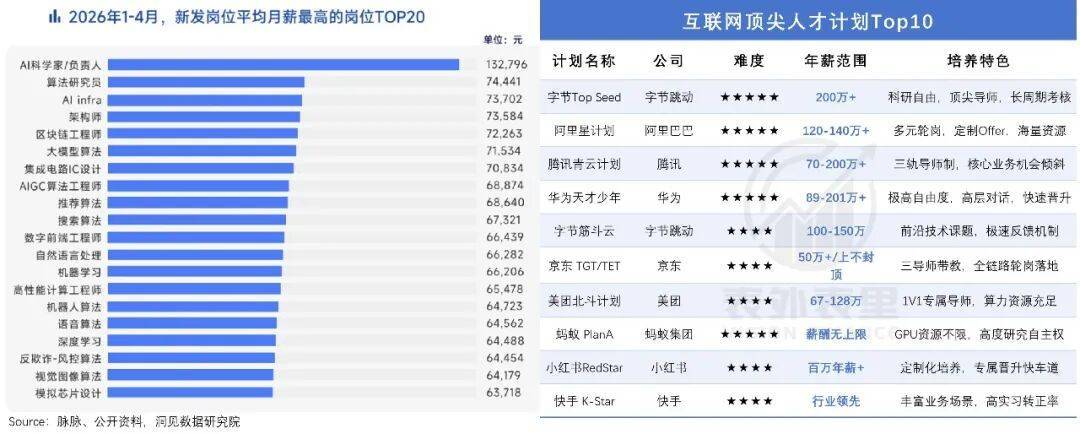
However, the high salaries generated by hot money only belong to a small group of people at the top of the pyramid. These extremely high values are like a huge pulling force, driving up the “average salary” of the entire AI industry. The people below the top of the tower feel a huge gap.
The huge gap between input and output has to be filled by everyone. The overtime hours and anxiety index of ordinary people have long outstripped the salary increase.
The B side that cannot be illuminated by the spotlight is the daily life of most people.
1. The threshold has been raised, and school recruitment has become social recruitment.
Every time when he talks about his classmates who have top three master’s degrees and receive zero offers from the school, Chen Mo is always told back: “It’s just a lie. They just didn’t get a satisfactory offer.”
This was indeed the case in previous years. With their algorithm papers and internships, Chen Mo’s senior students still had the opportunity to squeeze into AI unicorns or major companies, even if their majors were not very relevant or they did not have undergraduate degrees. But this year the market has really changed: During the autumn recruitment period, he applied for nearly 200 positions in companies large and small, with no geographical restrictions, but none of them passed the test.
Many of Thomas’s classmates and friends also received nothing after investing in the sea. He was able to get 4 offers because of the “985 Bachelor’s and Master’s degree in Computer Science + AI-related thesis + internship with major manufacturers”. He did not relax in every link, and it took him four or five years to finally stand out.
“The Internet is beginning to look like the financial industry, which emphasizes ‘capital allocation’ and all experiences must be strongly related.” Thomas lamented the cruelty of competition. In the past, newcomers in the workplace had a period of growth, but now companies have lost patience, and school recruitment has turned into social recruitment.
Mike has witnessed with his own eyes that the barriers to entry are being raised step by step.
When he was choosing a direction for the postgraduate entrance examination four years ago, the metaverse and blockchain were still the most popular labels. Unexpectedly, AI has been soaring since then, evolving from being able to hold conversations to being able to draw pictures and generate videos. Last year, the direction of job search by people around me became “intelligent agent development”. This year, what everyone is talking about has become “office agent”.
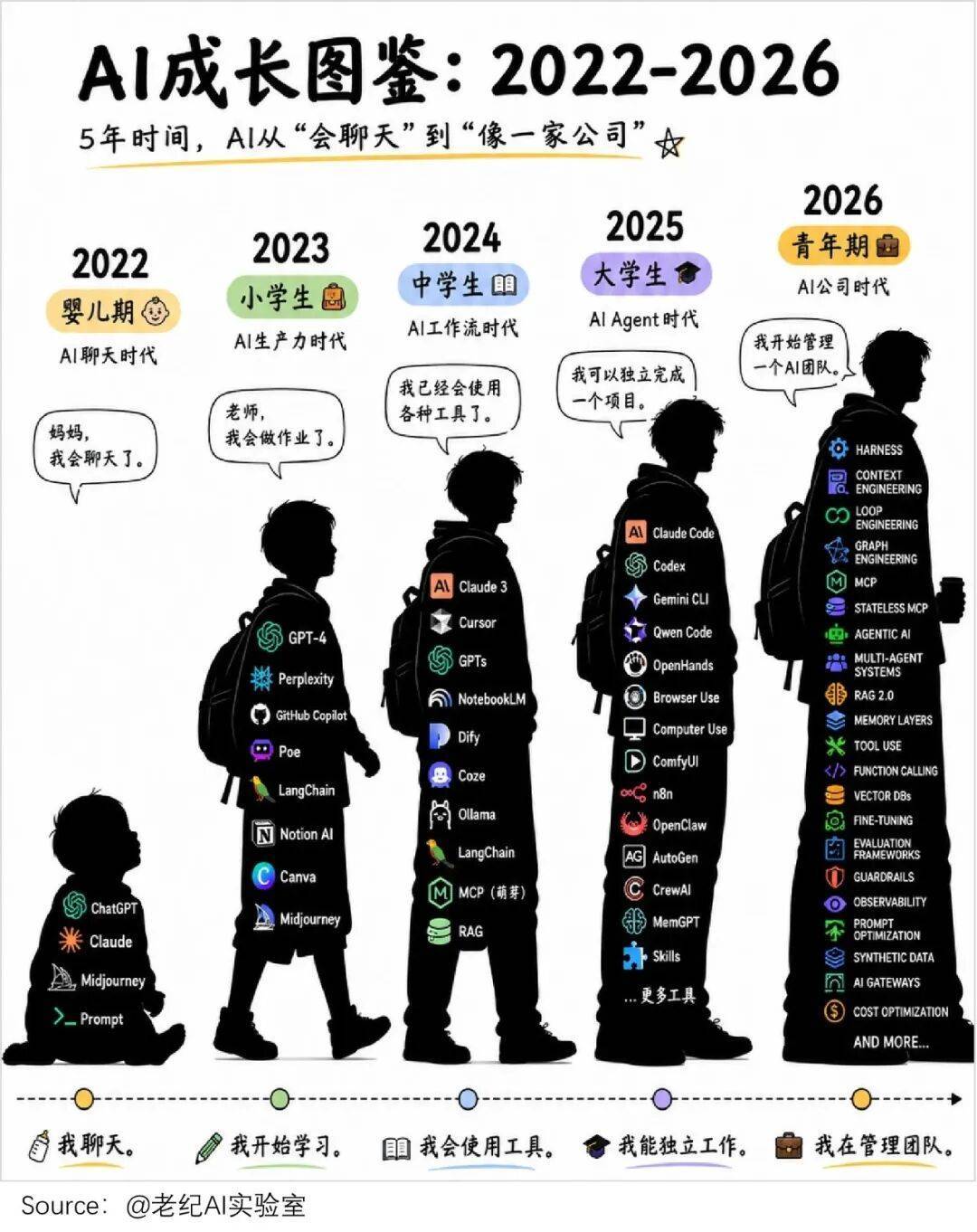
With the rapid iteration of technology, intelligent agent development, word prompt experts, and workflow construction… these sought-after new types of work have not yet warmed up, and in the blink of an eye they have become victims of evolution.
What’s even more helpless is that AI is getting smarter and more like people who can actually do the job, and many old jobs are being replaced at an accelerated pace.
In the past two years, Mike’s classmates had no worries about finding jobs. Big AI companies were expanding wildly, and the salaries they offered were getting higher year by year. Students will even take the initiative to delay graduation – graduate a year and a half later, save two more internships, send two more papers, and package their resumes more perfectly, so that they can get better offers in the second year.
Until the emergence of coding agents, the premium of handwritten code was wiped out. Large companies have begun to stop recruiting junior employees, eliminate outsourcing, and merge middle offices. “In the past, a department had to hire three people for front-end, back-end, and testing. Now it may only hire one AI full-stack developer, and the next person can do the work of three people with the help of an agent.”
In this process, the money has not increased much, but the requirements have increased a lot.
When AI engineer Wu Le receives a task from his leader, his first reaction is to turn on the AI: give the background conditions to the AI for analysis, let the AI complete the task, and then ask the AI to write a document for him to study, and then report to the leader after learning.

Not only that, after the company was given AI tools, its expectations for output also increased. The work that used to be delivered in half a day is now seen by leaders in two hours. Even Wu Le often feels that he is struggling and feels that he is not using AI but being pushed by the rhythm of AI.
“Candidates must not only have traditional development experience, but also be ‘AI native’ (experience in using AI and the ability to control AI). Both are indispensable. Newcomers who have just entered the workplace simply cannot do it.” He said frankly, so companies are not willing to recruit novices and slowly train them, and they want people with the ability to “get started as soon as they come in.”
Of course, companies have reasons to be ruthless: they don’t have much room for error.
2. Countdown to squeezing the “bubble” and people find their place again
After spending the morning at the AI conference, Mike felt like he was stuck in an “infinite loop.”
In the same company, Team A built a “cloud desktop agent”, Team B “used AI to reconstruct industry workflows”, and Team C said “native AI works with one click”. Although the names are different and the PPTs are different, the underlying models are the same, the tool calling logic is similar, and even the implementation scenarios are highly overlapping.
“The three teams are competing for the same batch of customers and the same order.” Mike said bluntly, but “horse racing” has long become a tacit consensus in the industry. A company has divided into many independent groups, allowed free development and competition, and finally left behind a mature project.
Regardless of the cost, thousands of trials and errors, and even violent defeats, everyone seems to have a countdown hanging above their heads, trying to find the correct fuse to detonate before the stopwatch reaches zero.
Yang Han knew that the invisible big hand pressing the countdown was called “money”.
As the most expensive track at present, for every 10 yuan invested in global venture capital in 2025, 6 yuan will flow into the pockets of AI companies. This year has further intensified. In the first quarter, the financing scale of AI start-ups accounted for 81% of global VC financing; Chinese and American technology giants have continued to raise the cap on capital expenditures, spending hundreds of billions upon hundreds of billions.
The scale of investment is staggering, but the returns have yet to be realized. MIT analyzed more than 300 enterprise AI projects and found that 95% had no quantifiable profit impact.
“Everyone is already on this high-speed train, and no one wants to be left behind.” Yang Han increasingly feels that as time goes by and investment increases, the anxiety of returning money continues to expand. No matter which direction the team is working in, they are eager to achieve results as soon as possible.
Last year, after ChatGPT and Claude made money using coding, domestic application layer players also flocked in; coding is based on smarter models, so teams such as those focusing on basic models are also facing increasing R&D pressure.
As a result, internal horse racing is intensively staged in various companies: multiple teams are exploring directions at the same time. Even if the work has been advanced to 80%, as long as the effect is not comparable, it may be stopped at any time, and the entire business line will be destroyed. But technology is still being iterated, and every update will make all the things done before meaningless.
Moreover, “for technology to really take off, it must combine user needs, solve real problems, and obtain data for next-generation optimization.” Yang Han said, but no one can accurately say how AI will intervene in life in a year’s time. Current innovations such as AI glasses and AI headphones are just exploration, and no one can give a clear answer.
This is the current dilemma of AI, and it is also the most anxious thing for everyone who invests money in it.
What falls on Yang Han and his colleagues is that the plan that was originally scheduled for three months or half a year may be overturned by the effects of a new model next month. The team’s work methods, structure, and positions have changed frequently, especially middle managers, who have become the first to collapse in the AI industry.
“In the beginning, the middle managers were the most popular ones. The technology was not advanced but the income was very high. People from big manufacturers turned to AI middle managers one after another.” However, repeated project interruptions, route changes brought huge frustration, and performance indicators that were always difficult to reach made the middle managers more and more haggard.
So she withdrew from the front line and did not focus on the top titles, branding or products, but went to the lower levels such as AI infra. After all, she was always doing things like model training.
Mike, who just graduated last year, also joined a state-owned enterprise “for stability”. At that time, the big factories were still expanding their enrollment, and friends around him were obsessed with it. His choice was considered by many to be a “waste of academic qualifications.”
However, as an intern in AI R&D, he has experienced the experience of staying up all night to sort out documents and upgrade functions during the product research phase. He also knows that these painstaking efforts may just be a whim of the leader.
“Before you can make something successful, you must go through repeated attempts, pivots, overthrow plans, and start over. The pain in the process is an inevitable price.” Many of his friends stay up all night every day, are ready to be laid off at any time, and go to work with the mentality of “working on a daily basis”. That is not the life Mike wants.
He chose to understand AI in a longer period, thinking of it as a black box—with an attitude of having expectations for the black box, but being cautious and wait-and-see. The AI-related management position of a state-owned enterprise has become a good place. It is not far from AI, and it can also allow him to move more steadily and see a wider field.
Although the price is that the annual income is only 200,000, Mike has become the envy of his friends: “In this industry where the more you advance, the more anxious you become, everyone wants to slow down.”
Related Reading
- In the early morning, an international flight from Hong Kong made an emergency landing. 146 people were evacuated through emergency slides. Reports said the plane showed signs of fire; the airline responded2026-11-22
- The AI cheating incident in South Korea’s college entrance examination has been brewing, and Education Minister Choi Gyo-jin has resigned. Previously, Lee Jae-myung offered a large reward to investigate and punish those who cheated in the college entrance examination: 100 million won for every cheating case reported2026-11-22
- The spectacle of “Hai Hao” appears in Weihai, and the sea suddenly seems to be “boiled and smoking”2026-11-22
- Iran’s President: The ongoing economic war is “far more difficult” than a military conflict2026-11-22
- Why are T and K classified as high-speed passenger trains? How to choose Z, N and V for normal speed trains? The authoritative answer is here2026-11-22