It has been three years since a new round of Palestinian-Israeli conflict broke out on October 7, 2023. After about two years of fighting, a ceasefire was achieved in the Gaza Strip in October last year. Now, nearly a year has passed since the ceasefire agreement was implemented. What is the current situation in Gaza? How far is it from truly getting out of the war?
Although there has been a ceasefire, the conflict has not stopped
Data from the health department in the Gaza Strip show that since the outbreak of the new round of Palestinian-Israeli conflict, Israel’s military operations in the Gaza Strip have killed more than 74,000 Palestinians and injured more than 175,000.
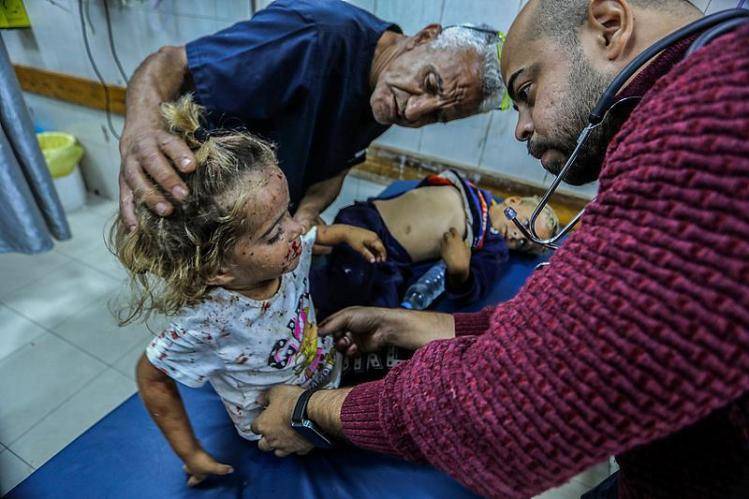
▲On October 5, 2026, two injured children were treated at Nasser Hospital in Khan Younis, Gaza Strip.
On October 10, 2025, the Gaza ceasefire agreement officially came into effect. According to the first phase of the arrangement, Israel suspended large-scale military operations and withdrew its troops from some areas. The remaining Israeli detainees were released. Israel also released hundreds of Palestinian prisoners and detainees.
Since then, there has been no renewed large-scale military action in Gaza, but sporadic conflicts and Israeli air strikes have continued.
Gaza’s health department said at least 1,400 Palestinians, including women and children, have died since the ceasefire last October;
The Israeli military said its strikes were targeting Hamas militants and accused Hamas of trying to rearm. Hamas denies this.
At the same time, the actual scope of Israeli military control continues to expand.
The so-called “yellow line” drawn in the first phase of the ceasefire once allowed the Israeli army to control about 53% of Gaza’s land, but now Israel’s actual control has expanded to about two-thirds.
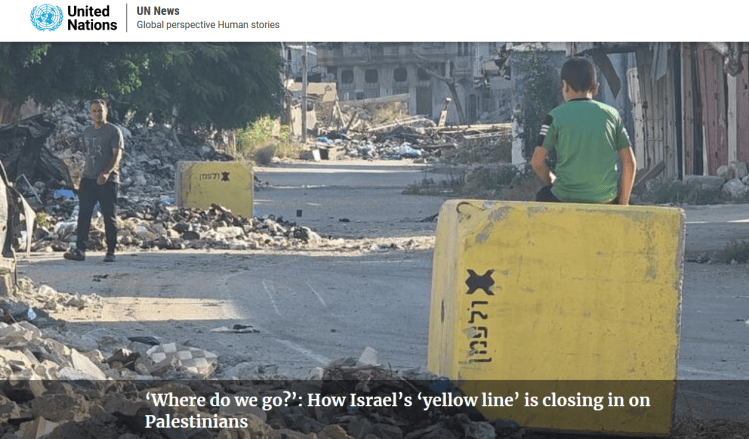
▲In Gaza City, yellow concrete isolation piers stand among the ruins left by the war, marking the “yellow line” area designated by Israel.
Displaced, survival is still difficult
Reuters reported that as the “Yellow Line” continues to advance, more Palestinians are forced to be displaced.
About 2 million people have been further squeezed into shrinking coastal areas and can only live in tents and damaged buildings.
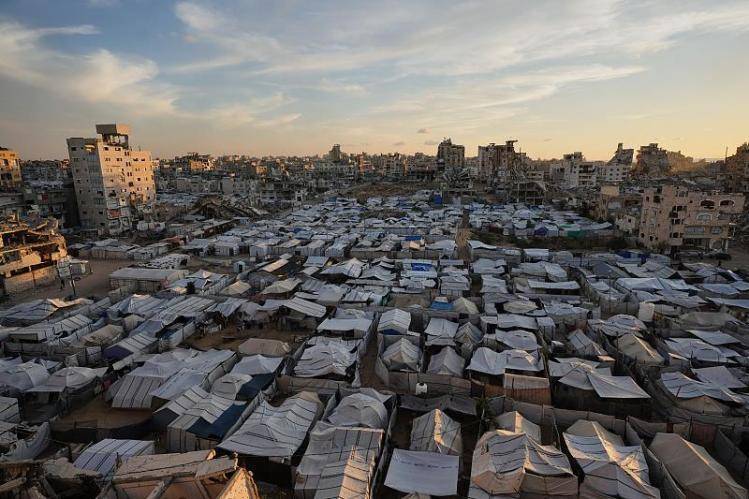
▲October 6, 2026, Gaza City, a temporary tent camp set up for Palestinian displaced persons who have lost their homes.
Three years of conflict has also left a large number of people still missing. The UK-based news website Middle East Eye quoted the report of the Palestinian Independent Human Rights Commission as saying on October 6,
Currently, more than 11,000 people are missing in Gaza, including those believed to be buried under rubble and those suspected of being forcibly disappeared. The Palestinian Center for Missing and Enforced Disappearances estimates that approximately 2,500 to 3,000 of these persons may be involved in enforced disappearances.
According to reports, some people disappeared during ground military operations, while others lost contact while looking for assistance, returning home, or passing through military-controlled areas.
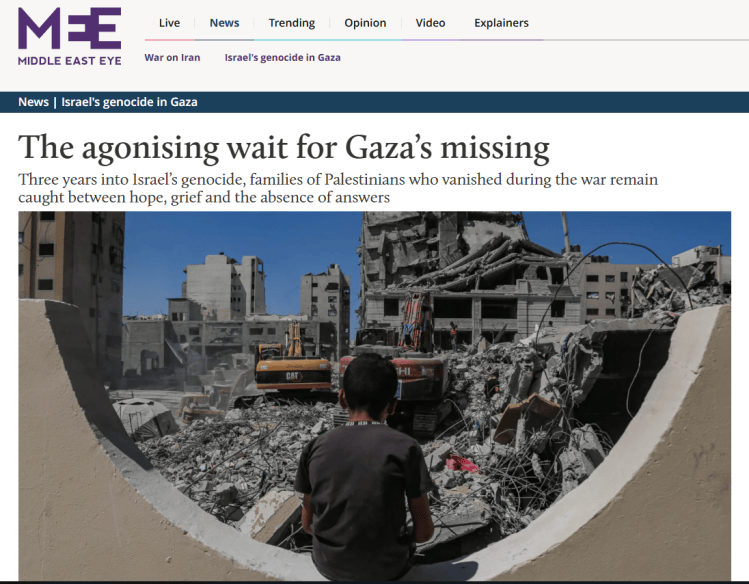
▲ “Middle East Eye” reported that the families of some Palestinians who disappeared during the war are still waiting for answers in hope and grief.
At the same time, the basic survival pressure in Gaza remains severe. After the ceasefire, supplies entering Gaza increased, but aid agencies believe it is still far from enough to meet demand. Data from the “Comprehensive Food Security Phase Classification” of the global food crisis monitoring agency show that,
More than 1.2 million people in Gaza still face severe food shortages.
Reuters quoted a report released by the agency in August this year as saying,
From the beginning of the ceasefire to the end of May this year, an average of about 227 trucks carrying humanitarian and commercial supplies entered Gaza every day, less than half of the minimum 600 trucks per day stipulated in the ceasefire plan.
Post-war road map reaches stalemate
Bigger obstacles remain in the follow-up phase of the ceasefire agreement.
In July this year, the so-called “Peace Commission” led by the United States proposed a 15-point road map, which planned for Hamas and other armed groups in the Gaza Strip to hand over their weapons, followed by the gradual withdrawal of Israeli troops, and for the International Stabilization Force and new Palestinian security forces to be responsible for local security.
Hamas later said it agreed to hand over the weapons to the custody of the U.S.-backed Palestinian technocratic government. However, Israel insists that it will not withdraw its troops until Hamas is completely disarmed. The two sides reached a deadlock.
▲Screenshot of Reuters report
The International Stabilization Force, which was originally planned to take over some security responsibilities, has not yet been formally established. Currently, a commander has been selected, and U.S. Major General Jasper Jeffers will be responsible for relevant work; Indonesia, Morocco, Kazakhstan and other countries have pledged to provide personnel. According to the long-term plan, the size of this international stabilization force is about 20,000 people, and 12,000 Palestinian police officers will be trained at the same time.
The Gaza Regional Governing Council, the Palestinian technocratic body established in January this year and planned to be responsible for daily governance of Gaza, has not yet entered Gaza.
Gaza’s reconstruction funding gap is huge
Another huge problem left by the war was reconstruction.
Today, in large swaths of the devastated area, residents still scavenge materials from building rubble to reinforce tents and temporary shelters.
In September this year, the so-called “Peace Commission” announced a preliminary reconstruction plan of US$2.45 billion.
A report released by the United Nations Conference on Trade and Development in September showed that the funds needed for Gaza’s recovery and reconstruction have reached approximately US$71.5 billion, and this number is likely to continue to rise.
Initial reconstruction funding announced so far represents only a fraction of overall needs. The bigger problem is that war destroys more than just homes and roads.
▲On September 30, 2026, in Gaza City, a Palestinian female volunteer helped farmers pick olives. Assessments by the Food and Agriculture Organization of the United Nations and the United Nations Satellite Center show that as of June 2026, about 90% of Gaza’s olive groves have been damaged, and only 3% of agricultural land is still accessible and undamaged.
According to data from the United Nations Conference on Trade and Development, about 92% of Gaza’s economic entities that can create jobs and income have been damaged or destroyed, and more than 90% of the working-age population is currently without a job.
This means that Gaza is not facing simple infrastructure repair, but the reconstruction of the entire economic and social operating system.
Home is broken, the road ahead is still unclear
Although the existing ceasefire plan proposes to encourage Palestinians to stay in the Gaza Strip, right-wing Israeli politicians have recently continued to intensify their advocacy of so-called “voluntary immigration.”
Israeli Defense Minister Katz said last month that without outmigration, “ultimately there is no real solution to the Gaza problem.” As early as 2025, the Israeli Ministry of Defense established a special agency responsible for promoting the “voluntary immigration” of Gaza residents.
This claim was strongly opposed by Arab countries and widely questioned by the international community. Israeli officials have said there are no plans to use force to relocate Gaza’s population.
With large areas of Gaza devastated, the living space of about 2 million people constantly being squeezed, and reconstruction still being delayed in full, local residents are increasingly worried about the future.
▲On October 2, 2026, displaced Palestinian youths played football next to a tent camp in Khan Younis, southern Gaza Strip.
Three years later, the intensity of the war in Gaza has declined, but a real post-war order has still not been established.
When the Israeli army will withdraw, how to solve the armed problem, who will govern Gaza, how to start reconstruction, and whether the approximately 2 million residents can continue to stay in their homes – these most critical questions still have no answers.
Related Reading
- Customs reminds: Don’t take these “souvenirs” back home2026-10-08
- Solve the century-old chemical mystery of “how homochirality occurs spontaneously”! Official explanation of why this year’s Nobel Prize in Chemistry was awarded to these two scientists2026-10-08
- Chinese scientists successfully develop nuclear optical clock2026-10-08
- Democrats cry foul as U.S. lifts sanctions on Serb nationalist, MAGA-linked firm gets huge Bosnia energy contract2026-10-08
- Weeks before Election Day, the nation’s campaign finance regulator can’t enforce the law2026-10-08