How student protests grew into a nationwide crisis in France
Unrest over teacher shortages and rundown schools has become a test for the government and a weapon for the far left and far right
0.5×0.6×0.7×0.8×0.9×1.0x1.1×1.2×1.3×1.4×1.5×1.6×1.7×1.8×1.9×2.0x2.1×2.2×2.3×2.4×2.5×2.6×2.7×2.8×2.9×3.0x
- What began Sept. 17 as a teachers’ strike over unfilled positions at a single high school outside Paris has spread across France, with a student union claiming 1,800 schools were blocked, disrupted or closed Tuesday.
- Students are demanding more teachers, smaller classes, shorter school days and safer buildings, but clashes with police have left schools damaged and injured hundreds of students and officers.
- The government calls students’ concerns legitimate but blames violent groups and the hard-left party LFI for the unrest, while LFI accuses officials of repression.
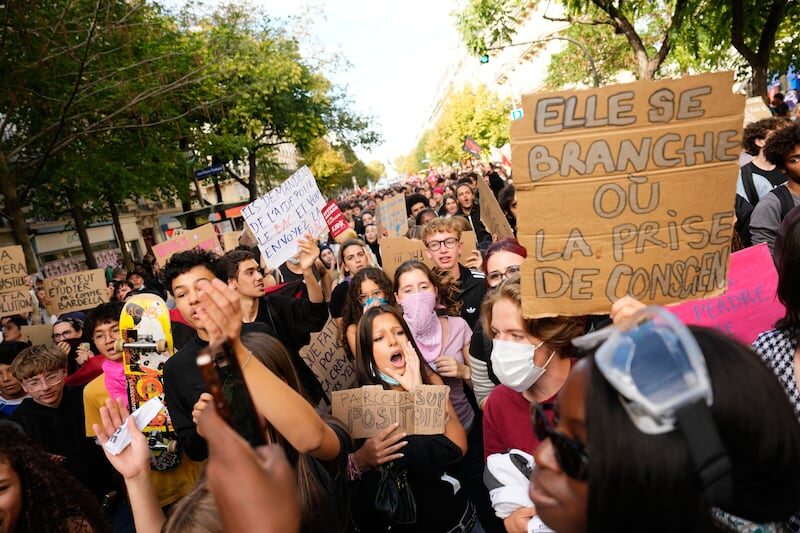
What began as protests over missing teachers, overcrowded classrooms and deteriorating schools has grown into a nationwide crisis in France, drawing hundreds of thousands into the streets and triggering violent clashes between demonstrators and police.
Students say years of underinvestment have left them with teacher shortages, long school days and deteriorating facilities. The government says those legitimate concerns have been overtaken by violent groups, while unions and opposition parties accuse officials of responding to young protesters with excessive force.
The Union Syndicale Lyceenne, a high school students’ union, said the movement had reached a “new record” on Tuesday, claiming 1,800 schools were blocked, disrupted or closed. Less than three weeks earlier, it had all begun at a single school outside Paris.
What sparked the protests?
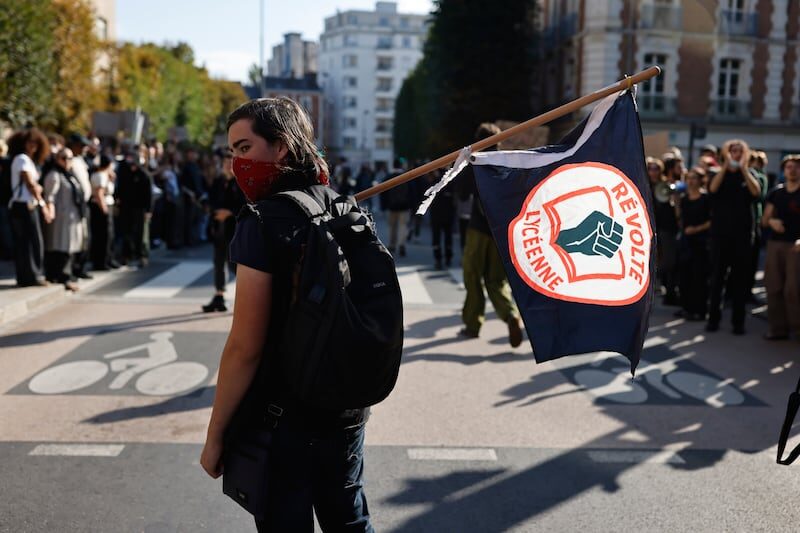
On Sept. 17, teachers at Lycee Antoine-de-Saint-Exupery, a high school in a suburb southeast of Paris, went on strike over unfilled positions, including those of a math teacher, French teacher, history teacher, school nurse and social worker.
Students joined the teachers the next day and blockaded the school on Monday, Sept. 21. Lawmakers from France’s hard-left party, La France Insoumise (LFI), were present at the blockade, sparking debate over whether the party helped fuel the protests ahead of April’s presidential election.
Laurent Bessiere, a math teacher at the school, is among those who remain skeptical of the party’s involvement.
“We can’t help but think that perhaps some people want to exploit the situation, but we certainly didn’t get involved in that,” Bessiere told France Inter.
The day of the blockade, students marched to the regional education office, where staffing decisions for their school are made, and requested a meeting to demand that the vacant positions be filled.
The students were granted a meeting a few days later and were surprised by how successful the protest had been.
“We were quite proud of ourselves because we didn’t think the blockade would go this far,” Tessa, a student at Saint-Exupery, told France Inter. “Even though some people were just doing it to skip classes, we managed to get answers to our problems and even some solutions.”
Although the students were granted a meeting and the school received a new director of vocational and technological training, tensions continued to rise. Firework mortars were set off inside the school on Sept. 23, and classes were canceled the next day after a bomb threat.
Another high school north of Paris set up its own blockade on Sept. 25. Within a week, the movement had reached more than 1,000 schools.
What are students demanding?
Although missing teachers were the original spark, with students describing waiting weeks or longer for substitutes, the movement has expanded beyond staffing to address the broader conditions students face in public schools.
On social media platforms such as TikTok and Instagram, students have described rundown classrooms with more than 30 students. They are demanding smaller class sizes and shorter school days.
According to EUalive, students’ placards at a protest at Lamartine high school read, “8 a.m. to 6 p.m. More hours of lessons than sleep.” Manon Aubry, an LFI member of the European Parliament, quoted a student as saying, “We can’t study surrounded by cockroaches and windows falling on us.”
The movement is also addressing inequalities between schools in poorer suburbs and those in wealthier areas. Some students from wealthier parts of Paris say they have joined the protests because they recognize the gap between conditions at their schools and those in poorer areas, where students have expressed concerns about their futures.
“They say we can’t become engineers, doctors, when every person here can succeed,” Human, a senior at the school where the protests originated, told France Inter.
Although students are united on their demands, they disagree over tactics, with many rejecting the violence and feeling uneasy about the direction the protests have taken.
A student at the origin school told France Inter she’s troubled by schools where students are “having fun damaging, burning trash cans,” and a junior in Lorraine told L’Est Republicain that “It’s not right, even if the demands are legitimate. There’s no point in burning down the high school, even if it is the only way to make yourselves heard.”
Why have the protestsbecome violent?
As the movement spread beyond the school where it began, its lack of central leadership made it increasingly difficult to control. Students with different motives joined the demonstrations, along with people who did not attend the schools involved.
Some participants set off fireworks, damaged property and threw objects at police, leading government officials to argue that what began as a legitimate student movement had been overtaken by people seeking confrontation.
Thursday marked a shift in what security forces described as more radical rhetoric. Arson destroyed the entrance hall of Nelson-Mandela high school in Nantes, and a firetruck was looted and burned in Marseille.
Some students have blamed outsiders for the increasing acts of violence. A student at Nelson-Mandela told France 3 Pays de la Loire that the violence “was caused by people from outside our school, and we don’t know anything about their demands.”
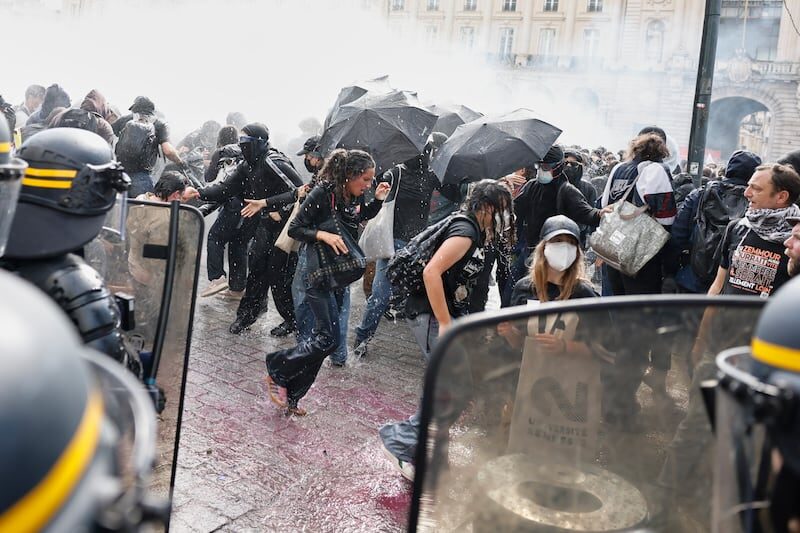
The government responded by deploying riot police to schools and demonstrations across the country. Officers have used tear gas and dispersal grenades to break up crowds, while thousands of protesters, most of whom are minors, have been arrested.
The tactics have drawn scrutiny after several teenagers were seriously injured, including a 15-year-old who lost his hand after reportedly picking up a police grenade during a clash in northern France. Conflicting accounts regarding the incident have made it one of 10 investigations being conducted by the General Inspectorate of the National Police.
On Tuesday, Prime Minister Sébastien Lecornu told the National Assembly that 215 students, 85 school workers, and 715 police officers had been injured since the protests began, with arrests at about 6,100.
What does the French government say?
French officials have said that the students’ original concerns about teacher shortages and school conditions are legitimate. Lecornu has directed government ministers to consider how quickly absent teachers can be replaced, whether the length of the school day should be reviewed and what repairs are needed in aging school buildings, with initial proposals expected by the end of October.
At the same time, the government argues that the movement has changed as it has spread. Officials have described the escalating clashes as “urban violence” and accused LFI and other far-left groups of exploiting students’ concerns for political purposes. The government has defended deploying riot police as necessary to protect schools and restore order, even as students, teachers and opposition leaders criticize its response as disproportionate.
“Many false reports have circulated about the actions of law enforcement,” Lecornu posted on X. “Instructions on proportionality have been given to police officers and gendarmes. What triggers their intervention is violence … the situation is serious enough without needing a political class that fans the flames and stokes the violence.”
Depuis plusieurs jours, l’ultra-violence a frappé à la porte de nos lycées. Des élèves, des personnels éducatifs, des policiers et des gendarmes ont été blessés. Ces violences doivent être condamnées sans condition.
Beaucoup de fausses informations ont circulé sur l’action des…
— Sébastien Lecornu (@SebLecornu) October 6, 2026
How are France’s political parties responding?
LFI has openly supported the student movement while denying the government’s claims that it organized or fueled the unrest.
Jean-Luc Melenchon, leader of LFI, called the government’s crackdown irresponsible and has accused Lecornu of ordering repression against the students.
“This ferocity is irresponsible with an obvious racist aftertaste,” Melenchon posted. “Hands off our youth. Elected officials and activists, step in wherever you can.”
Les lycéens en mouvement sont inoffensifs. Le gouvernement Lecornu a ordonné la répression. Cette férocité est irresponsable avec un arrière-goût raciste évident. Pas touche à nos jeunes. Élus et militants insoumis interposez-vous partout où vous le pouvez.
— Jean-Luc Mélenchon (@JLMelenchon) September 28, 2026
Marine Le Pen and the far-right National Rally have focused primarily on security, portraying the unrest as evidence that the government has lost control. Le Pen has promised to restore safety in French schools and called for a new law making participation in a riot a clearly defined offense.
“The Republic must guarantee the right to demonstrate,” Le Pen posted on X. “But it also must recall a simple boundary: no cause justifies violence.”
La République doit garantir le droit de manifester. Mais elle doit aussi rappeler une frontière simple : aucune cause ne justifie la violence.
Lorsque la violence devient une méthode politique, c’est toujours la liberté de chacun d’entre vous qui est menacée. pic.twitter.com/MubWPi0ri7
— Marine Le Pen (@MLP_officiel) September 30, 2026
The protests come about six months before France’s presidential election, and give each party an opportunity to reinforce its message. LFI is presenting itself as an ally of frustrated students, while the National Rally is emphasizing law and order, and President Emmanuel Macron’s allies are trying to show they can address students’ concerns while maintaining control.
Where do the protests stand now?
French authorities estimated that more than 250,000 people demonstrated across the country Tuesday, while organizers placed turnout at 450,000. Although some demonstrations were peaceful, clashes broke out in several cities, police used tear gas and water cannons, and nearly 500 people were arrested.
The government is now opening a national student consultation and directing high schools to hold forums where students can discuss their concerns. Ministers are expected to present their first proposals by the end of October, but no agreement has been reached, and it remains to be seen whether those steps will be enough to end the blockades and demonstrations across the country.
Related Reading
- Customs reminds: Don’t take these “souvenirs” back home2026-10-08
- Solve the century-old chemical mystery of “how homochirality occurs spontaneously”! Official explanation of why this year’s Nobel Prize in Chemistry was awarded to these two scientists2026-10-08
- Chinese scientists successfully develop nuclear optical clock2026-10-08
- Democrats cry foul as U.S. lifts sanctions on Serb nationalist, MAGA-linked firm gets huge Bosnia energy contract2026-10-08
- Weeks before Election Day, the nation’s campaign finance regulator can’t enforce the law2026-10-08