China News Service, Wuhu, Anhui, October 2nd. Title: From “flowers in one season” to “prosperous in all seasons”, new harvest news in villages in southern Anhui
Author Jiang Wanqi
“I didn’t catch up with the cycling competition in September, so I came here specifically to ‘make up for the ride’ this time.” During the National Day holiday, in Xiangshuijian Village, Eqiao Town, Yijiang District, Wuhu City, Anhui Province, Chen Yu, a cyclist from Nanjing, squatted on the ground to check the tires. He said that he planned to ride along the Rainbow Highway to the Xiangshui Jianshang Reservoir. “There are golden rice fields along the way, which is more comfortable than seeing flowers in March.”
Eqiao Town is located along the river in southern Anhui. Eqiao Tea Market has a history of distributing tea since the Ming and Qing Dynasties. It has won the title of “The First Tea Market in Jiangnan” because of its “buying tea from all over the country and selling tea from all over the country”, and has become an important tea distribution center in China. Every spring, tens of thousands of acres of rapeseed flowers bloom in Eqiao Town, and many tourists make a special trip here for an outing.
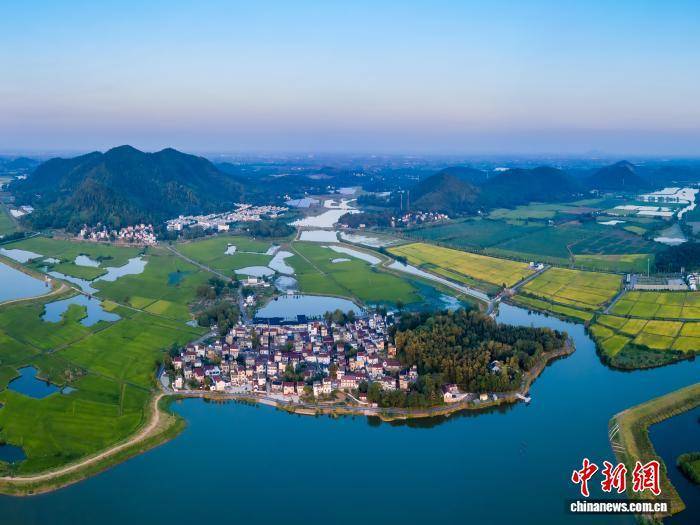
Xiangshui Jian Village in Eqiao Town in the early morning. (Data map) (Photo provided by Yijiang District)
“The farmland here mainly follows a two-season rotation of ‘one rice and one oil’. After the rice is harvested, rapeseed is planted, and after the rapeseed is harvested, seedlings are transplanted. The fields are not idle and people are not resting all year round.” Lu Liangping, the first secretary of the Xiangshuijian Village Party Committee, recalled that tourists have been coming here since 2012. “Tourists took photos and posted them online, and gradually more and more people came.”
If “One Season of Flowers” is the first business card Xiangshui Jian hands to the outside world, then hidden behind the sea of flowers is an unfolding panorama of the four seasons. “Relying on flower appreciation in spring, fishing in summer, picking in autumn, and folk customs in winter, we create a continuous consumption and tourism scene all year round.” said Dai Wei, deputy director of Yijiang District Agriculture and Rural Water Affairs Bureau.
Walking along the highway to the halfway point of Fushan, you can see the “Thirty Thousand Feet Yunding Cafe” run by Cheng Tingting, a “post-90s generation”. Looking out the window, you can have a panoramic view of the green mountains and the blue lakes.
“Many guests drive here from out of town, holding coffee and watching the sunset on Fushan Mountain for half a day.” Cheng Tingting said, “We will set different packages according to seasons and holidays. We sold 500 photography experience coupons before the National Day.”
Qiang Rongrong, a young man who returned to his hometown to start a business, is the “third generation of tea” in Eqiao. She used local materials to develop “tea-flavored buns”, which can sell up to several thousand in a single day. She is also planning to build a tea-themed study and healing B&B. “Many people want to live on the top of the mountain for a day or two, and I want them to stay.”
The space is expanding and business formats are diversifying. At present, there are more than 30 business entities such as farmhouses, picking gardens, and cafes in the village. In the past three years, the village has received an average of more than 500,000 tourists per year.
“Plant four-season fruits so that everyone can pick them every season.” Tao Shengfei, born in the 1990s, runs the “Little Peach Farm” locally. He uses short videos to attract traffic to the farm and attract many tourists to check in. “There is no shortage of scenery in the countryside, but there is a shortage of people who turn scenery into stories.” Tao Shengfei said. In line with the preferences of young people, he also launched new ways of playing games such as “ice tea around the stove” and pastoral drama.
“As soon as the industry develops, the villagers will have something to do, and people will be needed for cleaning and greening maintenance.” Lu Liangping said, “Dozens of vacant houses in the village have attracted tenants from out of town, and now tourists also come to inquire about and buy agricultural and sideline products.”
According to Dai Wei, in order to celebrate the harvest, local activities such as cultural performances, agricultural product markets, and Guishan Village parade check-in were held. “We not only want to be lively for two days, but also want tourists to remember this village and be willing to come next year.”
Related Reading
- Winning three gold medals in the Asian Games, I am still a high school student when I return!2026-10-03
- Railway passenger flow reaches its peak during the National Day holiday. These are the corners where luggage is most likely to be lost and the wrong bag taken.2026-10-03
- The first defeat in 60 years, the national football team lost to Palestine 0:5, coach Shao Jiayi apologized2026-10-03
- “It feels like 100 million people are here!” Tourists at Mingsha Mountain in Dunhuang filled the entire mountain like trying to make beans.2026-10-03
- New energy vehicles face the “Charging Test” during the holidays. How to deal with it?2026-10-03