編者按:Mountains are the bones, water is the veins, and green is the soul. Everywhere is green, writing the ecological answer sheet of Chinese modernization. All localities have implemented the concept of “lucid waters and lush mountains are invaluable assets” with practical actions, so that ecological dividends can benefit thousands of households. CCTV specially planned a report on the theme of “Why China·Green World”, walking through the mountains and rivers, going deep into the grassroots, recording the vivid stories of green expansion, green protection, green development and living green in various places, outlining the magnificent picture of building a beautiful China, and participating in the green appointment together, panoramically showing the vivid practice of harmonious coexistence between man and nature.
Qingliangfeng National Nature Reserve is located at the junction of Anhui and Zhejiang provinces. It is located in She County, Huangshan City, Anhui Province, covering an area of 41,418 acres of mountain forest. There are 7 kinds of national first-level protected plants such as ginkgo, yew, and grevillea growing here, and 12 kinds of national first-level protected animals such as South China sika deer, black muntjac, and clouded leopard live here. It is known as the “species gene bank” of East China.
The morning light first shines through, and the cool peak forest sea surges. Wang Shanqing, director of the Shexian Management Station of Qingliangfeng National Nature Reserve in Anhui Province, is preparing to patrol the mountain.
Wang Shanqing’s father is an old forest ranger. The name “Shan Qing” was given to him by his father, hoping that the mountains would always be green and the water would flow forever. In 1988, 18-year-old Wang Shanqing took over the responsibilities of his father.
At that time, he was assigned to a protection site at an altitude of 700 meters. The conditions on the mountain were difficult – there was no water, electricity, and roads. All food and accommodation were in a small bungalow. He could only light a kerosene lamp at night, and patrolling the mountain relied on his feet.
Wang Shanqing told reporters that every time he patrols the mountains, he has to bring a week’s worth of rations, cook his own meals, and manage the mountains and forests by himself. This kind of life lasted for 6 years.
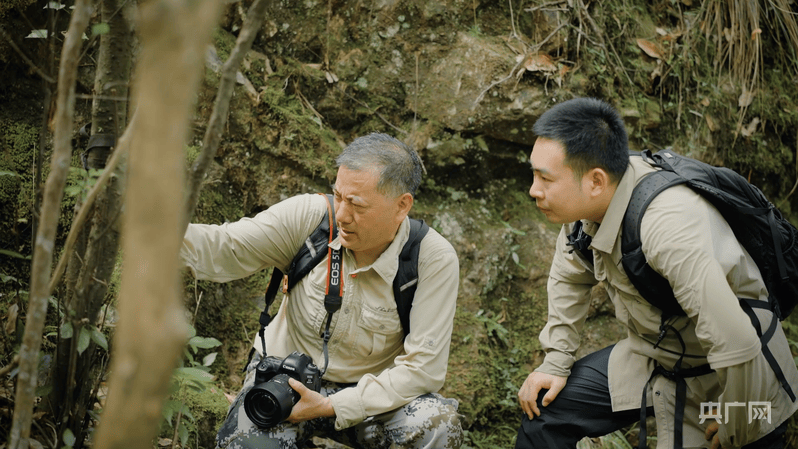
Wang Shanqing (first from left) led his team members to patrol Qingliang Peak (photo by CCTV reporter Liu Hao)
Forest fire prevention, animal and plant protection, ecological monitoring, everything is related to ecological security. Under Wang Shanqing’s leadership, the reserve has had no man-made fires for 37 consecutive years and no poaching cases for 20 consecutive years.
Now that the forest is safe, he is thinking about the breeding of rare plants again.
Ulmus elegans is a national second-level protected plant. There are 4 species in the world, and Qingliangfeng accounts for 1 of them. In order to find Ulmus longissima, Wang Shanqing dug through thorn bushes and climbed steep slopes during the day. At night, he read information and compared it with illustrated books. Finally, he found 50 or 60 wild Ulmus longsequensis populations on the mountain. However, it is extremely difficult to breed Ulmus elata naturally. Since 2016, he has led a team to collect seeds and cultivate them every year during the seed maturity season. Today, at the foot of the mountain, there are more than 500 elm seedlings cultivated by Wang Shanqing.
In addition to protecting plants, with the cooperation and support of Wang Shanqing and his team members, university scholars also discovered a new species in Qingliang Peak – Chen’s Newt.
Wang Shanqing told reporters that a few years ago, when Wang Suben’s team, associate professor at the School of Life Sciences of Anhui Normal University, came to the mountain for scientific research, they discovered a species of salamander in a clear pool in a canyon at Qingliang Peak. After Wang Supen’s research and demonstration, it was confirmed as a new species, and the final results were published in the authoritative international zoological journal “Animals”.
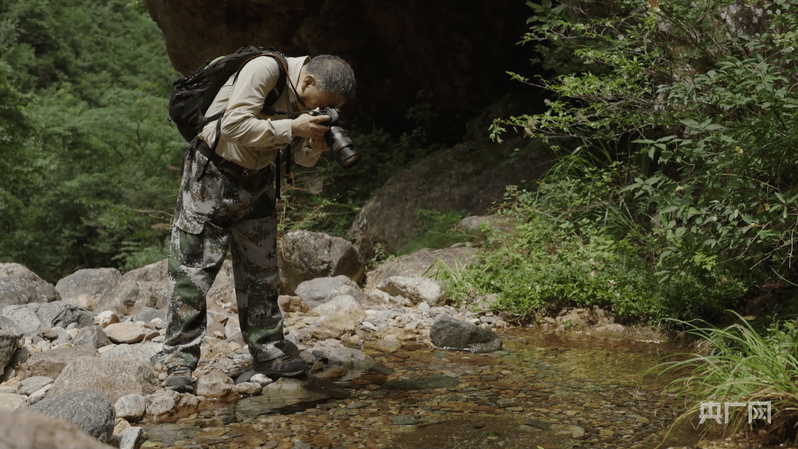
Wang Shanqing takes photos of Chen’s newt (photo by CCTV reporter Liu Hao)
Over the years, under the protection of Wang Shanqing and his team members, 68 species of nationally protected wild animals have been monitored in Qingliangfeng Nature Reserve, and 3 small communities of wild ginkgo and 1 wild yew population of national first-level protected plants have been discovered. The number of wild plants in the reserve has also increased from the original 1,570 species to 1,987 species.
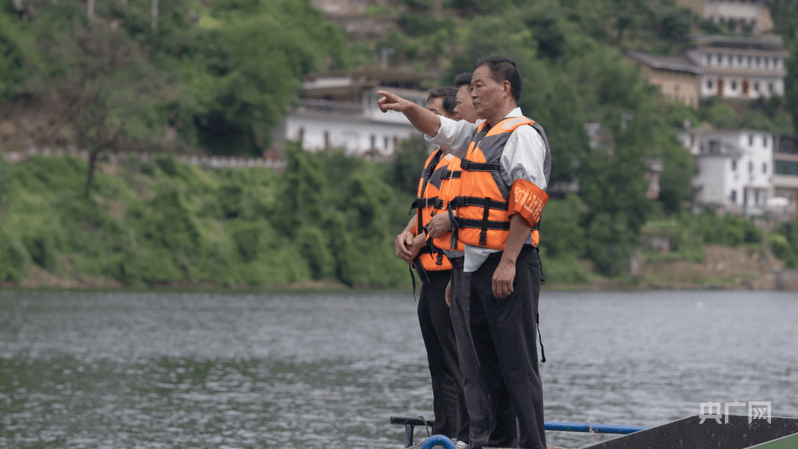
Wang Shougen (first from right) and his team members conduct patrols on the river (photo by CCTV reporter Liu Hao)
Wang Shanqing’s spirit of protecting green waters and green mountains is now being passed on. His young colleague at the station, Hong Xin, is 28 years old and has worked at the She County Station of the Qingliangfeng Reserve for five years. Like Wang Shanqing, he has dedicated his youth to this “green career.”
When a reporter asked if he had ever thought about leaving, Wang Shanqing said that he had had many opportunities, but he could never let go of Qingliangfeng – “This is not only my father’s expectations, but also my youth. This is my home.”
On the bank of the Xin’an River at the junction of Anhui and Zhejiang, 62-year-old Wang Shougen is the president of the “Water Guardian” non-governmental volunteer association of the Xin’an River (Jiekou Town Section of Shexian County). After the complete withdrawal of fishing in 2020, 393 fishermen from the town came ashore, and the problem of illegal fishing became prominent. Relying on the experience of “Which waters are popular for hiding nets and which areas are popular for fishing”, Wang Shougen gathered up seven or eight old brothers and started to protect the river with small wooden boats. Today, the association has grown to dozens of people, all of whom have become full-time “water guardians.”
“This river has supported my family for several generations, and now it’s my turn to protect it.” Wang Shougen said simply.
He told reporters that there was great resistance when the fishing ban was initially implemented, and many people did not understand it. Some fishermen said: “You used to fish harder than anyone else, and now you are here to take care of us?” Wang Shougen did not argue and always came to the house with a smile to persuade. Even the stubborn Lao Yu was influenced by him and changed from multi-pole fishing to a river protection propagandist.
Relying on decades of accumulated hydrological experience, Wang Shougen and his team members divided the 32.3 kilometers of water into four key areas and implemented grid inspections. At dawn and dusk, they collected garbage and persuaded violators to leave. “Green waters and green mountains are really back. I often take pictures of the sunset on the river and the leaping silver carp, and many people like it.” He said, “Let future generations still see schools of fish and drink clean water. No matter how hard it is, it’s worth it.”
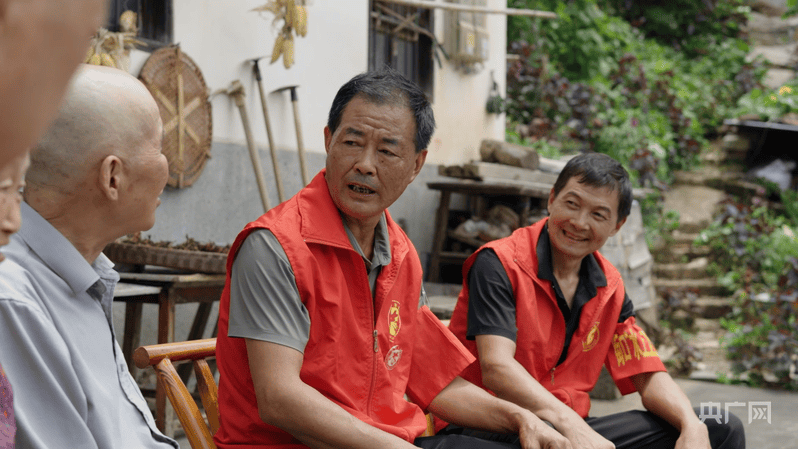
Wang Shougen (second from right) and team members carry out policy presentations (photo by CCTV reporter Liu Hao)
One protects the mountain and the other protects the water. On the Qingliang Peak, the South China sika deer stroll leisurely, and the grevillea sprouts new shoots; in the Xin’an River, the clear water flows, and the fish swim. The forest rangers of the past have turned gray, but the green mountains remain evergreen; the fishermen of the past have changed their boats, and the green water has become clearer. The moving practice of Wannan’s landscape is vividly interpreting the concept of “lucid waters and lush mountains are mountains of gold and silver” – this protection is a commitment to the original intention and a belief passed down from generation to generation.
【Green·Experts Say】
“Shan Qing” and “Shou Gen” are not only the names of the two guardians, but also symbolize the power of ecological protection in southern Anhui to take root in the mountains and rivers and work for a long time. From the absence of man-made fires for 37 consecutive years and the breeding of rare plants, to fishermen quitting fishing and turning into “water guardians”, the changes in Qingliang Peak and Xin’an River show that biodiversity protection is inseparable from the strict management and scientific monitoring of natural reserves, as well as the extensive participation of the community and intergenerational relay.
Landscapes and rivers are interdependent living communities. Protecting forests means conserving water sources and protecting species; protecting rivers also maintains the integrity and stability of regional ecosystems. The practice in southern Anhui has inspired us that ecological protection must combine institutional guarantees, scientific and technological support and public action, so that protectors have responsibilities, participants have gains, and latecomers have faith, and promote the transformation of green waters and green mountains from natural endowments into ecological benefits that are shared by the people and benefit from generation to generation. (Professor Jiang Zhongguan, School of Resources and Environmental Engineering, Anhui University)
Chief planner: Zhang Jun Yu Feng
Supervisor: Wu Gang Gong Xinhui
Coordinator: Tao Yude
Producer: Wang Tingting
Planning: Luan Xiaolin Zhou Ran
Reporter: Liu Hao
Voiced by: Bao Yuyun
Related Reading
- Video | my country’s first 100-megawatt giant “power bank” was successfully connected to the grid2026-10-03
- Marching in China2026-10-03
- Each prize has been increased to 12 million Swedish kronor, and the Nobel Prize will be announced next week2026-10-03
- Car owners talk about the “awkward journey” of high-speed charging: Some people went to 4 service areas and queued for 3 hours to charge. Some people queued for 4.5 hours to charge and still had limited charging.2026-10-03
- UAE refuses permission for Israel to send flights to pick up people in Dubai2026-10-03