On the first day of the National Day holiday (October 1), the cold air will continue to move eastward and southward, and many places in the south will also join the cooling ranks. From the 3rd, a new wave of cold air will appear. Under the continuous influence of two waves of cold air, temperatures in many places in the north and south will hit record lows in the second half of this year, and many places in the south of the Yangtze River will also begin the process of entering autumn. During the first half of the National Day holiday, rainfall was widespread in the south and continued in some areas of the southwest, requiring prevention of secondary disasters.
Two waves of cold air hit one after another
Temperatures in many places in the north and south will hit record lows in six months
Yesterday, the strongest cold air in the second half of this year continued to affect our country. The temperature in northern Qinghai, central and eastern Gansu, Ningxia, northern Shaanxi, central and southern North China, and eastern Northeast China dropped by 6 to 10°C, with local temperatures ranging from 12 to 16°C.
On the first day of the National Day holiday, this cold air will continue to move eastward and southward. Huanghuai, Jianghuai, Jiangnan, central and northern parts of South China and other places will experience a cooling of 4 to 8°C, with local temperatures around 10°C. At the same time, temperatures in the north will gradually begin to rise.
However, cold air is active during the holidays, and it is expected that another cold air relay will move southward from October 3 to 4. At that time, the temperature in the north will fluctuate again. Some areas such as Shaanxi, Gansu, Ningxia, and northern China will cool down by 8 to 10 degrees Celsius. At the same time, many places will be accompanied by northerly winds of magnitude 4 to 6, and gusts of magnitude 7 to 8.
Cold air is coming one after another, and temperatures in many places in the north and south will hit record lows in the second half of this year. In big cities, today the highest temperatures in Harbin, Changchun, Zhengzhou, Hefei, Wuhan, Hangzhou and other places will set new low records for the second half of this year; the lowest temperatures will also hit new lows in large areas. The lowest temperatures in Wuhan, Nanjing and other places may drop to 10 to 11°C on the 6th.
During the National Day holiday, the coldness in many places in the north and south has become significantly worse. The public needs to put on clothes in time to prevent catching cold. As the temperature fluctuates and declines, the front edge of autumn may also advance southward, and many places in the south of the Yangtze River are expected to start the autumn process during the National Day holiday.
Heavy rainfall in the south during the first half of the holiday
Northern China and other places will experience rainfall from the 2nd to the 4th
It is expected that before October 5, affected by the intersection of cold and warm air currents, rainfall will be larger in the south, rainy weather will continue in the southwest and other places, and strong convective weather may occur in some areas in Jiangnan, South China and other places. From October 2 to 4, as the high-altitude trough moves eastward, there will also be a precipitation process from west to east in North China and Northeast China.
The Central Meteorological Observatory predicts that today there will be moderate to heavy rain in parts of southern Shaanxi, northern and southeastern Chongqing, western Hubei, western Hunan, Guizhou, eastern Yunnan, northwest Guangxi, eastern and southern Guangdong, southern Zhejiang, Fujian and other places. Among them, there will be heavy rain in parts of eastern and southern Guizhou, northwest Guangxi, southeastern and central Guangdong, southern Zhejiang, and western Fujian.
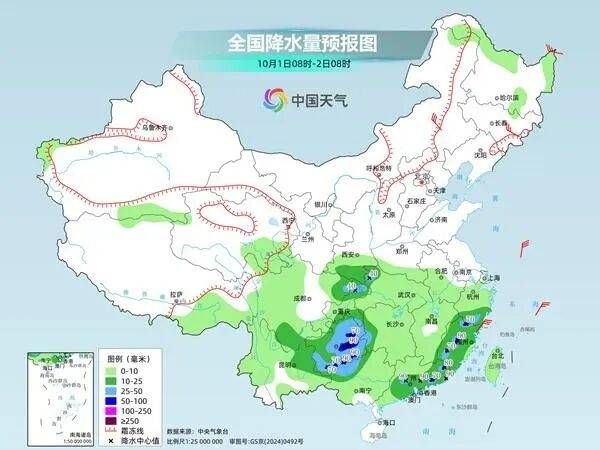
Tomorrow, there will be moderate to heavy rain in parts of central and southern Henan, northern Anhui, central Hubei, northern Hunan, central and western Guizhou, southern and eastern Guangdong, western Fujian, central Inner Mongolia, and southeastern Tibet. Among them, there will be heavy rain in northern and central Guizhou.
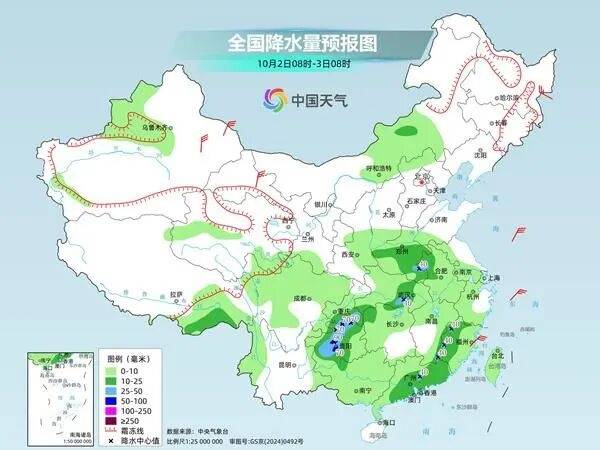
The day after tomorrow, there will be moderate to heavy rain in parts of most of Guizhou, eastern Yunnan, southeastern Chongqing, western and northern Hunan, southern and eastern Hubei, northern Jiangxi, central and southern Anhui, southern Jiangsu, northwest Zhejiang, northern Guangxi, northern Guangdong, central Inner Mongolia, central Liaoning, and southeastern Tibet. Among them, there will be heavy rain locally in western Hunan, southern Guizhou, and northwest Guangxi.
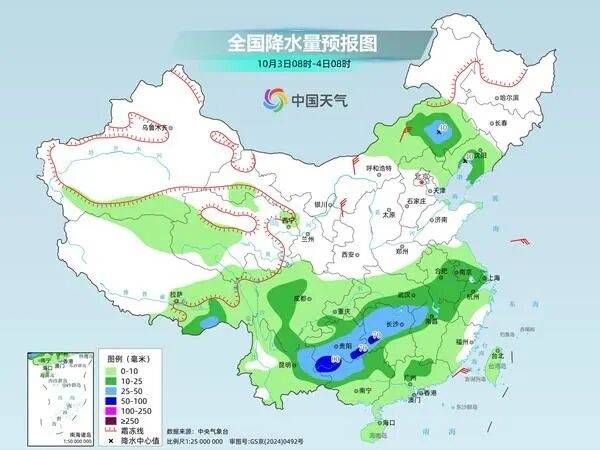
During the first half of the National Day holiday, rainfall is widespread in the south, and rainfall lasts for a long time in some areas of the southwest. It is necessary to be alert to secondary disasters such as landslides and mudslides that may be caused by continued rainfall. Affected by the cold air, there will also be rain in North China, Northeast China and other places. The public needs to bring rain gear when going out, drive slowly and pay attention to travel safety.
Related Reading
- The Chinese delegation has won 151 gold medals, and the diving team achieved the “100 gold medals” in the Asian Games2026-10-01
- “National subsidy” for buying a house is online, saving up to nearly 50,000 yuan in interest2026-10-01
- Cornell agrees to outside review into university’s handling of gang rape allegation, Hochul says2026-10-01
- Video丨Which cities are the most popular for traveling during the National Day holiday? Big data forecast →2026-10-01
- Video丨The bright “Chinese red” and ancient buildings are framed together to feel the strong National Day atmosphere in various places2026-10-01