Xinhua News Agency, Beijing, September 30th: The United Nations Security Council will hold the fourth round of intentional voting on the selection of the next Secretary-General on September 29th. According to multiple international media reports, current Secretary-General of the United Nations Conference on Trade and Development and former Vice President of Costa Rica Revica Greenspan leads the race with a slight advantage.
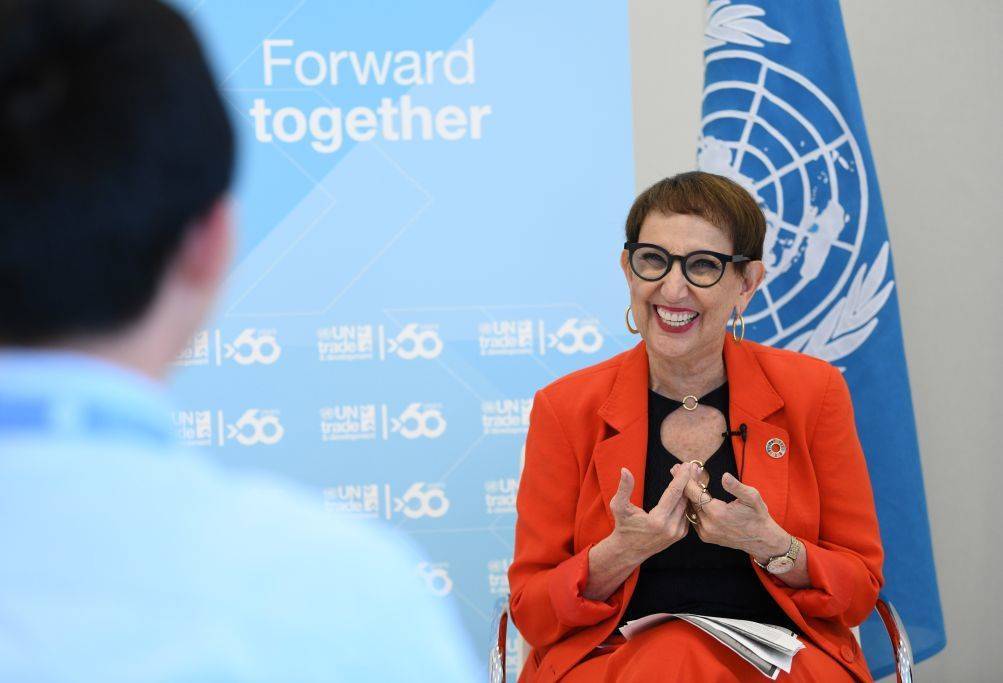
On June 10, 2024, in Geneva, Switzerland, Greenspan, Secretary-General of the United Nations Conference on Trade and Development, accepted an exclusive interview with a reporter from Xinhua News Agency. Photo by Xinhua News Agency reporter Lian Yi
The Security Council’s intention voting is conducted behind closed doors, with only representatives of Security Council members present, and the voting results are not officially recorded or announced to the public. Intentional voting generally requires multiple rounds, and the voting options include “encourage”, “dissuade” and “not express an opinion”.
Reuters, AFP and other media quoted sources as saying that Greenspan received 10 votes to “encourage”, 3 votes to “dissuade” and 2 votes to “not express an opinion”. Caroline Rodriguez-Burkitt, Guyana’s Permanent Representative to the United Nations, ranked second, receiving 8 votes to “encourage”, 6 votes to “dissuade”, and 1 vote to “not express an opinion.” Rafael Grossi, the current director general of the International Atomic Energy Agency from Argentina, received 8 votes for “encouragement” and 7 votes for “discouragement”.
Diplomats who asked not to be named disclosed to the media that Greenspan led in the first round of intention-to-hold voting on July 30 and the third round of intentional voting on September 18, while Rodriguez-Burkitt led by a narrow margin in the second round of voting on August 21.
The selection of the next United Nations Secretary-General will start in November 2025. Former Chilean President Michelle Bachelet withdrew from the race after the third round of voting. There are currently seven candidates, including former Senegalese President Macky Sall, Ecuadorian diplomat Ivonne Baki, former UN General Assembly President Maria Fernanda Espinoza, also from Ecuador, and former UN Deputy Secretary-General Olara Otunnu from Uganda.
In the Security Council intention vote, a candidate must receive at least 9 “encouragement” votes and none of the five permanent members of the Security Council “dissuade” before he can be recommended by the Security Council and appointed by the United Nations General Assembly. This means that the five permanent members need to agree on candidates.
According to common practice, the early voting does not distinguish between permanent and non-permanent members. In the later voting, the five permanent members use ballots of different colors from those of the non-permanent members to confirm whether the five permanent members have “dissuade” votes. Jerome Bonafon, the rotating president of the Security Council this month and France’s Permanent Representative to the United Nations, said on the 29th that there was no color distinction in the day’s vote.
Bonaparte did not say when the next round of voting would be held. Reuters reports that more candidates may still join the race.
Before the current Secretary-General Antonio Guterres was elected in 2016, the Security Council held six rounds of intention-to-hold votes.
According to the unwritten practice of the United Nations that has lasted for decades, the position of secretary-general should be held by representatives of member states from different geographical regions to reflect fairness and regional balance, and the candidate cannot be from the five permanent members of the Security Council. In accordance with rotation practices, the next Secretary-General should be from Latin America and the Caribbean. Five of the current seven candidates are from the region.
Related Reading
- News 1+1丨What are the new changes in the new high-speed rail line during the National Day holiday?2026-09-30
- Flight to Tel Aviv broadcasts emergency alert, diverts to Saudi Arabia after reported feud between pilots2026-09-30
- Emergency notices for many scenic spots: National Day tickets are sold out; Jiuzhaigou: sold out from the 1st to the 5th; Daocheng Yading: fully booked 5 days ago; Palace Museum: fully booked from the 1st to the 6th; Sanxingdui Museum: 1st2026-09-30
- 56-year-old Vucic: Resigning but not leaving the game2026-09-30
- OpenAI will suspend the release of new models due to security issues2026-09-30