“This is my last night in this building.”
On the evening of September 27, local time, Serbian President YaAlexander Vucic stood outside the presidential palace in Belgrade and addressed supporters who chanted his name. “I’m very proud of what we accomplished together,” he said.
Minutes later, he signed his resignation and formally resigned from the Serbian presidency, ending his second and final presidential term ahead of schedule. The next morning, he handed over the presidential powers to Serbian National Assembly Speaker Ana Brnabic, who will act as president.
For the 56-year-old Vucic, resigning from the presidency does not mean quitting. He has previously announced that he will participate in the upcoming parliamentary election on October 25 as a candidate of the ruling Serbian Kadima Party, and has made it clear that he will run for the position of prime minister.
For the Serbians, they will face two elections in the next three months that are related to the future and destiny of the country: one is an early parliamentary election due to nationwide protests; the other is a presidential election that must be held within three months due to Vucic’s early resignation.
It is difficult to determine what the results of the two elections will be, but Vucic, who resigned from the presidency, is obviously not ready to leave.
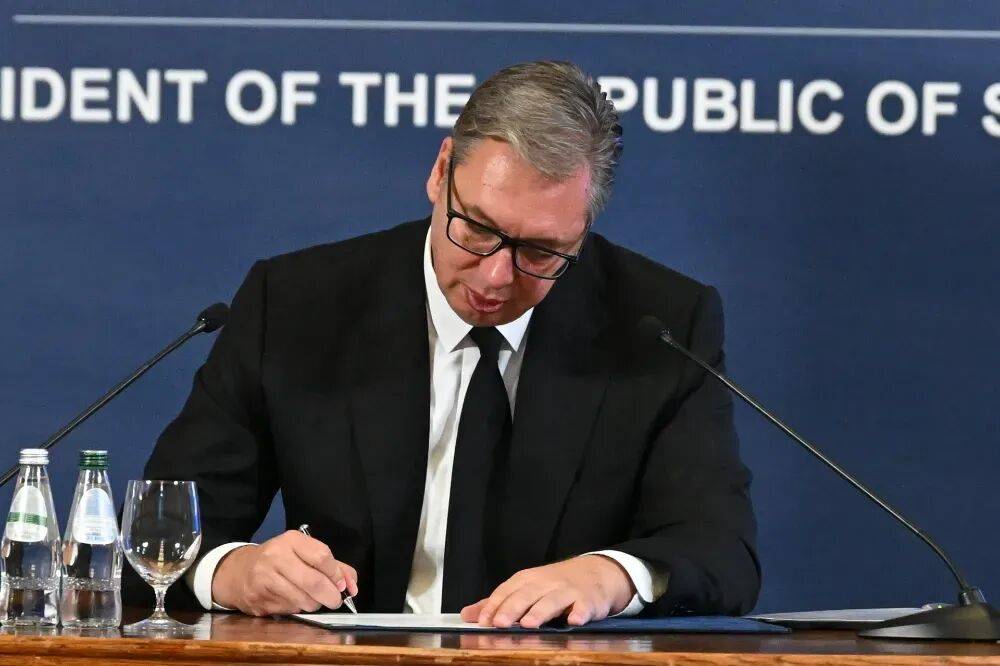
▲On September 27, 2026 local time, in Belgrade, Serbia, Serbian President Vucic signed his resignation, officially resigning as the President of Serbia, ending his second presidential term ahead of schedule. Picture/IC photo
Resignation with advance notice
Vucic’s resignation has been announced for a long time.
On June 27 this year, Vucic publicly stated at a rally in front of the Serbian National Assembly that he would resign as president “in a few weeks” and called for early presidential and parliamentary elections. He said in his speech that this “may be the last time he addresses such a large crowd as president.”
Vucic was elected president for the first time in April 2017 and will be re-elected in May 2022. According to the Serbian constitution, the president serves a five-year term and can be reappointed only once. Vucic’s second term was originally scheduled to end in mid-2027, but he chose to resign early.
Behind this is a protest that has lasted for nearly two years.
Starting in November 2024, a continuous wave of protests broke out in Serbia. The trigger for this protest was a tragic accident that occurred in the northern Serbian city of Novi Sad on November 1 of that year.
Novi Sad, located on the Danube River, is the capital of the Autonomous Province of Vojvodina and the second largest city in Serbia, after the capital Belgrade. On November 1, 2024, a roof collapse occurred at the Novi Sad train station, killing 16 people.
As the station had just completed renovations, the accident quickly raised public questions about the quality of the work, oversight, corruption and government accountability. Initially, it was students in Novi Sad who took to the streets to protest. Subsequently, protests spread to many cities across the country and continue to this day, becoming one of the most serious domestic political challenges since Vucic came to power.
As the protests continued, Vucic promised to release judicial documents about the accident and said he would release some arrested protesters.
In January 2025, the then Prime Minister Miloš Vucevic even resigned under pressure. But the protests have not ended. Many protesters and opposition parties have stated that they will challenge Vucic and his Serbian Forward Party in the election.
Outside analysts believe that continued domestic pressure is an important factor in promoting early elections for the National Assembly, and Vucic, who wanted to run for prime minister, resigned from the presidency early. When he “announced” his resignation in June, he pointed the finger at external forces, saying that some external forces had tried to destabilize Serbia in the past year and a half. He also said that he would help the Serbian Kadima Party win the trust of the people.
For more than two months since then, Vucic has been preparing. He travels throughout Serbia and often participates in live media events. He also recently announced that the under-construction express highway to Golubac, the “Danube Corridor” project, will be completed by May 2027. The journey from Negotin to Belgrade will then be shortened to less than two hours.
On September 5, the Serbian Forward Party announced that it would nominate Vucic as the leader of the parliamentary election list and the candidate for prime minister. On the same day, Vucic expressed his acceptance of the election and said he would resign to run for office after completing recent state activities and overseas visits. On the 9th, he signed a presidential decree to dissolve parliament and announced that an early parliamentary election would be held on October 25 this year.
On September 14, Vucic once again stated that he would resign as president on the 27th. After resigning, he would run for prime minister as an “ordinary citizen.” On September 27, Vucic ended his nine-year presidential term and turned to target the Prime Minister’s Office.
According to Tian Dewen, a researcher at the Russian and Eurasian Institute of the Chinese Academy of Social Sciences, resigning as president and announcing his candidacy for prime minister is Vucic’s strategic adjustment of “retreating to advance.” He told the Beijing News reporter that due to the Serbian Constitution’s presidential term limit of no more than two terms, Vucic was unable to continue running for the presidency, so he chose to resign and run for the parliamentary election and compete for the position of prime minister.
In fact, compared to the president who is more ceremonial, the prime minister holds the real administrative power of the country and can directly coordinate economic construction, project implementation, foreign investment cooperation and social governance. Tian Dewen said that this means that becoming prime minister may be more conducive to Vucic continuing the established line of governing the country.
It can be said that Vucic never thought about leaving.
The rising political star of the Balkans
Vucic was born in Belgrade on March 5, 1970. At that time, this was still the capital of Yugoslavia.
His grandparents came from Ciplic near Bugojno in central Bosnia. They were expelled by the Croatian fascist organization “Ustasha” during World War II and later settled near Belgrade. According to Vucic, his grandfather and dozens of relatives were killed by the “Ustasha”.
Vucic comes from a well-off family. His father is an economist and his mother is a journalist. He himself also received a good education. In 1994, Vucic graduated from the University of Belgrade Law School.
In his early years, he went to Brighton, England to learn English and did business in London for more than a year. After returning to China, he worked as a reporter in Pale, Bosnia. Vucic was a fan of Red Star Belgrade when he was young and witnessed the 1990 stadium riot between Dinamo Zagreb and Red Star. This riot was regarded as one of the triggers for the disintegration of Yugoslavia.
It can be said that Vucic witnessed the country’s most chaotic period when he was a teenager – the disintegration of the country, the intensification of ethnic conflicts, and constant wars and riots. These may be one of the reasons why Vucic joined the nationalist party Radical Party very early.
In 1993, Vucic, who was only 23 years old, joined the Radical Party, a far-right party with Serbian nationalism and the establishment of a “Greater Serbia” as its core. In the same year, he was elected to the National Assembly and was one of the youngest faces in the assembly at the time. The following year, he was elected Secretary-General of the Radical Party and served until 2008.
In 1998, the then President of the Federal Republic of Yugoslavia, Slobodan Milosevic, appointed Vucic as Minister of Information. This experience became a key turning point in his political career. At that time, the war in Kosovo was intensifying. As Minister of Information, Vucic took a series of controversial measures. Many of his remarks at the time are still used as a weapon to criticize him.
After the Kosovo war ended, Milosevic stepped down and Vucic also lost his government position. In 2000, he was elected as a member of the Federal Assembly of Yugoslavia in the federal election. Since then, he ran for Belgrade mayoral elections in 2004 and 2008, but ended up losing both times.
For a young politician, these failures could mean the marginalization of a political career. But for Vucic, this became the starting point for him to re-find his political path.
During this period, the Federal Republic of Yugoslavia was reorganized into Serbia and Montenegro in 2003, a loose federation. In June 2006, Montenegro voted for independence in a referendum, and Serbia subsequently announced that it would inherit the status of Serbia and Montenegro as subjects of international law and become an independent country. In 2008, Kosovo unilaterally declared independence, but Serbia refused to recognize it. This problem continues to this day.
At the same time, serious divisions occurred within the Radical Party over the issue of European integration. Nikolic, the party’s founder and vice-chairman, quit the Radical Party in 2008 and founded the Serbian Forward Party.
Vucic subsequently joined the Kadima Party and became the party’s deputy chairman. Outsiders believe that this is a real turnaround in Vucic’s political career. He has gradually transformed from a radical nationalist to a political figure who emphasizes European integration, and this has also brought him step by step to the pinnacle of power in Serbia.
“As a politician, Vucic has extremely strong political toughness and game-playing ability. His political stance has completed the transformation from an early nationalist hawk to a pragmatic and stable ruler. He knows how to stick to the bottom line on issues of principle and make flexible compromises on development issues.” Tian Dewen said, “This has also made him the core political leader of Serbia in the past ten years.”
In 2012, the Serbian Kadima Party and its allies won the presidential and parliamentary elections. Nikolic was elected president, Vucic served as first deputy prime minister and defense minister, and became chairman of the Kadima Party, becoming a high-profile political figure in the Balkans.
12 years from Prime Minister to President
In the early 21st century, the Kosovo issue became an insurmountable problem in Serbian politics.
After becoming First Deputy Prime Minister, Vucic began to participate in the EU-led dialogue between Serbia and Kosovo. In 2013, with the promotion of the EU, Serbia and Kosovo reached the Brussels Agreement, which started the normalization of relations between the two parties and the negotiation process for Serbia’s accession to the EU.
In March 2014, the Kadima Party and its allies won a resounding victory in the parliamentary election. Vucic successfully became the Prime Minister of Serbia and was re-elected in 2016. In 2017, Vucic participated in the presidential election and was successfully elected in the first round with 56.01% of the vote.
In May 2022, he was successfully re-elected with a high vote and began his second five-year term.
According to the Serbian constitution, the president has a more ceremonial position, while the prime minister is responsible for the country’s administration. However, because Vucic has long held the real power of the Kadima Party and the ruling coalition, the outside world generally believes that he is the one who has always held political power in Serbia.
According to Li Jun, a researcher at the European Institute of the China Institutes of Contemporary International Relations, Vucic’s presidential career can be said to be very successful. During his nine years as president, Vucic effectively safeguarded Serbia’s independence and made outstanding contributions to Serbia’s peaceful development.
During his tenure, Serbia’s economy and people’s livelihood have been significantly improved. An important example is that Serbia’s GDP has grown from more than 30 billion euros at the beginning of his term to nearly 100 billion euros now, and per capita wages have increased from more than 300 euros to more than 1,000 euros. At the same time, Serbia has made great progress in infrastructure, education, medical care and other aspects.
Tian Dewen also believes that Vucic is a typical pragmatic and strong nationalist politician. Since 2014, he has served as the prime minister and president of Serbia, and has long dominated Serbia’s domestic and foreign affairs.
“During his term as president, Vucic achieved overall stability in the country’s macro situation.” Tian Dewen said that internally, he reversed Serbia’s previous weak economy and high debt, making it a benchmark for economic growth in the Western Balkans and significantly improving its national infrastructure and industrial foundation.
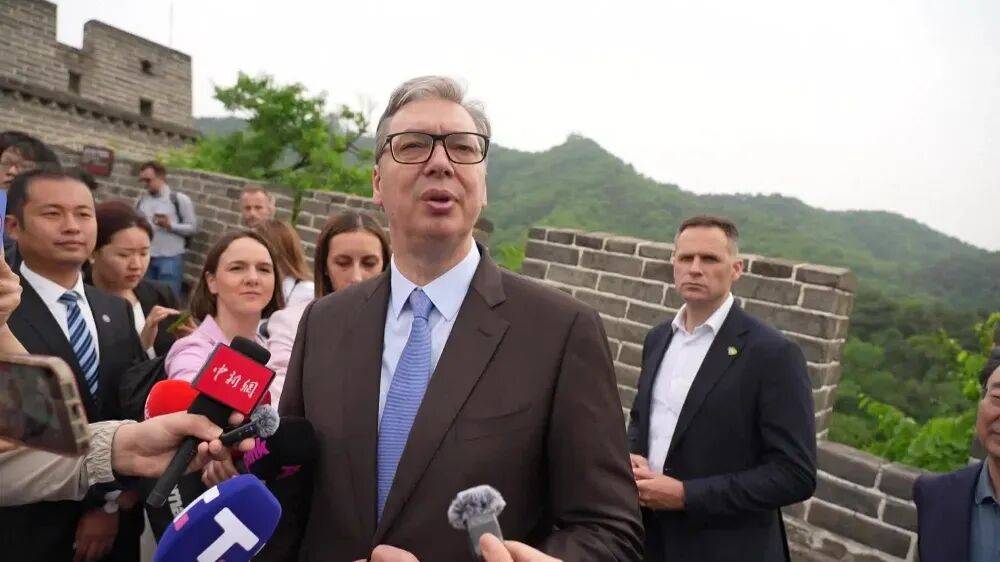
▲On May 24, 2026, in Beijing, Serbian President Vucic came to the Badaling Great Wall to feel the beauty of the world cultural heritage. Picture/IC photo
At the diplomatic level, Serbia, located in the north-central part of the Balkan Peninsula, has long been sandwiched between the EU and Russia. Its special geographical location puts Serbia in a difficult position. However, Tian Dewen believes that Vucic has maintained strategic autonomy by pursuing a “small country balancing strategy.”
On the one hand, he continues to promote Serbia’s EU accession process and promotes institutional reforms that adapt to the EU; on the other hand, he resists Western pressure and adheres to the bottom line of Kosovo’s sovereignty. Tian Dewen said that Vucic protected Serbia’s national interests and diplomatic space to the greatest extent amid the game between major powers.
Li Jun also said that Vucic has adhered to “diversified and balanced diplomacy” for many years, worked hard to develop relations with major countries in the world, and strived for a good international environment for Serbia’s stability and development.
Serbia formally applied to join the EU in 2009 and launched accession negotiations in 2014. It is still an EU candidate country. The European Commission reported in 2025 that Serbia has opened 22 of the 35 negotiating chapters. The speed of negotiations mainly depends on Serbia’s rule of law reforms and the normalization of relations between Serbia and Kosovo.
But in more than ten years in power, Vucic has also faced more and more challenges. Tian Dewen said that the long-term strong centralization model has led to the concentration of power in Serbia, the ecological imbalance of public opinion, and the accumulation of governance disputes. Especially after the Novi Sad accident in 2024, Vucic encountered the most severe public opinion crisis since taking office, and the problem of political polarization in Serbia has gradually become apparent.
Tian Dewen believes that “Vucic is a mature and pragmatic politician in the complex geopolitical environment of the Western Balkans. He has outstanding achievements in stabilizing the economy, safeguarding sovereignty, and expanding diplomacy, but he also has structural problems of accumulated social conflicts.”
Two elections in three months
“I call on everyone to concentrate and absolutely focus on the parliamentary elections and strive for victory, because the parliamentary elections will determine the future direction of Serbia.” Before submitting his resignation on September 27, Vucic said on the Serbian radio and television station RTS program. He also said that the presidential election will be held more than a month after the parliamentary election.
On the morning of September 28, Vucic transferred the presidential powers to the Speaker and Acting President Brnabic. According to regulations, the term of the acting president shall not exceed three months, and a presidential election must be held during this period. This means that the first round of voting in Serbia’s presidential election must be held before the end of December.
The election time has not yet been set, and the list of candidates has not yet been announced. The prospects of this presidential election are full of uncertainty. Since Vucic is no longer able to run, who will become the presidential candidate recommended by the ruling Kadima Party has become a major focus of attention from the outside world. Some analysts believe that Brnabic, as Vucic’s most loyal ally, is one of the potential presidential candidates.
However, before the presidential election comes, the first thing Serbian voters have to face is the parliamentary election on October 25. This election is seen as a key test for Vucic’s more than ten years in power. The Kadima Party led by him will directly face off against the main opponent “Student List” due to protests.
According to the Serbian Constitution, after the parliament elects a new National Assembly, the process of forming a cabinet will be initiated. At that time, the acting president will propose a candidate for prime minister to the National Assembly after listening to the opinions of the elected representatives of all parties. The candidate for prime minister submits a government platform and proposes a list of government members. After the National Assembly approves it with a majority vote of all members, the new government is formally established.
Li Jun believes that Vucic resigned from the presidency in order to fairly participate in the parliamentary election and thus run for the position of prime minister. Judging from the current polls conducted by some institutions, the support rate of the Kadima Party has reached nearly half, which is ahead of the main opposition and is more likely to win the parliamentary election.
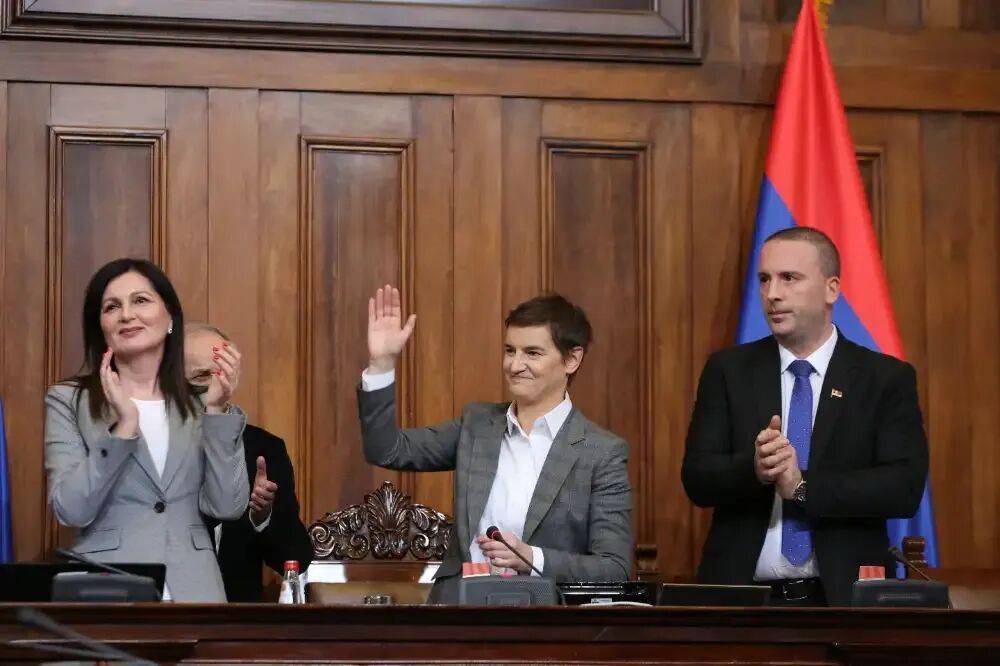
▲On March 20, 2024 local time, in Belgrade, Serbia, the Serbian Parliament elected Brnabic, Prime Minister of Serbia and Vice Chairman of the Kadima Party, as the new Speaker of the National Assembly of Serbia after three days of debate. After Vucic announces her resignation, she will act as president. Picture/IC photo
Recent opinion poll data shows that the support rate of Vucic and the Kadima Party is approximately 46% to 48.6%. Coupled with its solid political party foundation and accumulation of governance, many outsiders believe that the Kadima Party has a higher probability of winning the election. This also means that the possibility of Vucic returning to the Prime Minister’s Office is very high.
If the government is successfully formed, Vucic will return to Serbia’s administrative core. However, continued public protests and the consolidation of the opposition may significantly reduce its governing space. Tian Dewen said that in particular, if his party’s seats shrink significantly, it may need to jointly form a cabinet, and his domestic governance and external cooperation will be more constrained.
If Vucic becomes prime minister, it is foreseeable that Serbia’s domestic and foreign policies will not undergo a fundamental change, and the overall situation of China-Serbia friendly cooperation will remain stable. Tian Dewen said that Vucic will further promote the implementation of practical cooperation between China and Serbia and continue the diplomatic line of balance, independence and diversity.
During Vucic’s more than ten years as Prime Minister and President, China-Serbia relations have been deepened and upgraded. “Vucic is friendly to China and has visited China nine times. He is known as an old friend of the Chinese people.” Li Jun said that during his tenure, he has also long been committed to deepening the traditional friendship between China and Serbia and promoting practical cooperation between the two countries.
Vucic can be said to be one of the most familiar foreign leaders to the Chinese public. Many people on social media affectionately call him “577.” In the past ten years or so, he has visited China nine times, and he has appeared at events such as the Belt and Road International Cooperation Summit Forum, Summer Davos, the Winter Olympics, the 80th anniversary of the victory of the Chinese People’s War of Resistance Against Japanese Aggression and the World Anti-Fascist War held in China.
Relations between the two countries have also been continuously upgraded. In 2016, China and Serbia established a comprehensive strategic partnership. In 2024, Serbia will become the first European country to jointly build a community with a shared future for the new era with China. When Vucic visited China in May 2026, China and Serbia issued a joint statement on continuing to promote the construction of a community with a shared future. During this visit, he was also awarded the “Medal of Friendship”, China’s highest foreign honorary medal.
Even on the day he resigned as president, Vucic specifically emphasized that the China-Serbia strategic partnership and the friendship between the two peoples transcend “any position, term and time.” In his resignation speech, he thanked “Chinese friends” for their help to Serbia and hoped to leave a good diplomatic foundation for the future Serbian government and new president.
Related Reading
- Emergency notices for many scenic spots: National Day tickets are sold out; Jiuzhaigou: sold out from the 1st to the 5th; Daocheng Yading: fully booked 5 days ago; Palace Museum: fully booked from the 1st to the 6th; Sanxingdui Museum: 1st2026-09-30
- OpenAI will suspend the release of new models due to security issues2026-09-30
- Starting from October, these new regulations will affect your and my lives.2026-09-30
- “Clear love is only for China!”2026-09-30
- Supreme Court denies Christa Pike’s final bid to stop her Tennessee execution2026-09-30