Iran’s continuous capture of U.S. unmanned submarines indicates that the secret war between the two sides in the Strait of Hormuz continues.
According to a CCTV International News report on September 27, Iran’s Islamic Revolutionary Guard Corps announced on the 27th that its navy, through coordinated operations such as intelligence surveillance and electronic warfare, successfully captured an advanced U.S. unmanned submarine carrying out espionage missions in the Strait of Hormuz.
This is the second unmanned submarine captured by Iran recently. Previously, Iran’s Islamic Revolutionary Guard Corps announced on September 8 that it had captured a US military Dive-LD unmanned submarine in the Strait of Hormuz.
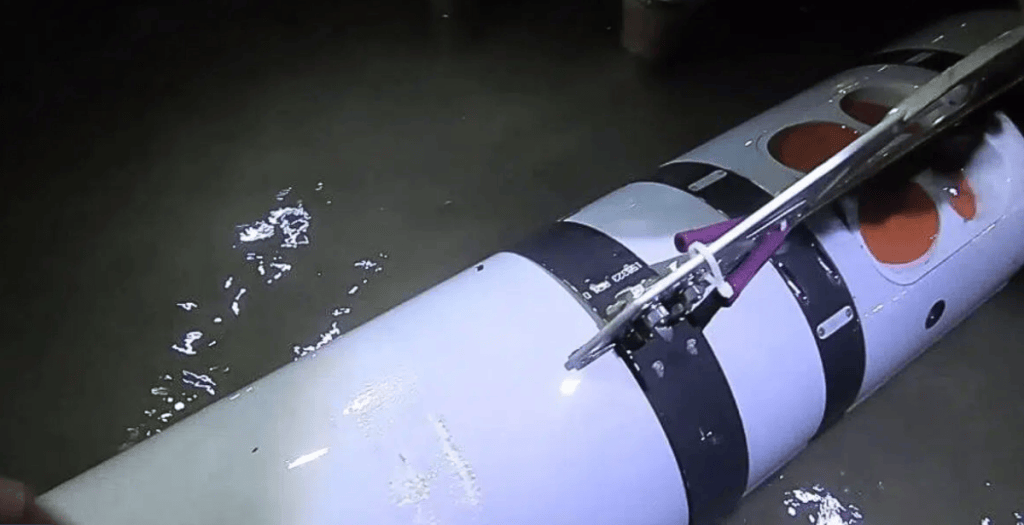
Iranian media announces the capture of the unmanned submarine “Remus 600”
US military unmanned underwater vehicle may carry out secret mine clearance mission
According to Iranian media reports, the unmanned underwater vehicle, called “Remus 600”, is an advanced intelligent underwater unmanned equipment. It has been seized by the Revolutionary Guards Navy and data recovery work is being carried out by experts. The Revolutionary Guards Navy solemnly declares that Iran will take decisive and continuous actions against dangerous behaviors and unauthorized passage activities in the Strait of Hormuz.
Subsequently, the U.S. military denied Iran’s claim that it had captured the unmanned submarine. Capt. Tim Hawkins, a spokesman for U.S. Central Command, told Al Jazeera that the United States remains “actively in control of all of our combat unmanned equipment assets.”
Remus 600 is an unmanned underwater vehicle developed by the Woods Hole Oceanographic Institution with financial support from the U.S. Office of Naval Research. According to the Woods Hole Oceanographic Institution, Remus 600 has a diameter of 32.4 centimeters, a weight of 240 kilograms, a maximum diving depth of 600 meters, a mission endurance of nearly 70 hours, and a maximum speed of 5 knots. The submarine adopts a modular design and can reconfigure sensors according to specific mission requirements, including synthetic aperture sonar, new NSWC-PC LSG magnetometer, short-range dual-frequency side scan sonar, etc. The sensor payload supports autonomous large-scale search and target positioning, as well as the reacquisition and classification of targets (mines) in its ultra-long range.
Military expert Wang Yunfei analyzed to The Paper (www.thepaper.cn) that the Remus 600 can perform underwater surveillance and reconnaissance, mine clearance and other tasks. The Remus 600 “captured” this time should be performing underwater mine clearance tasks. Its high-precision sonar and other equipment are suitable for dealing with bottom-sinking mines and anchor mines.
According to CCTV News, on September 19, local time, Brad Cooper, commander of the U.S. Central Command, released a video announcing the status of shipping in the Strait of Hormuz and U.S. military operations in the area. Cooper said that the main navigation channel in the Strait of Hormuz has been cleared of mines and thousands of ships have passed through it. Gulf partners have shipped more than 1 billion barrels of crude oil through the Strait of Hormuz. He also said the volume of crude oil, cargo and liquefied natural gas transported through the region in the past two weeks has reached the highest level in the past six months.
Judging from the capture of U.S. unmanned submarines, the secret war between the United States and Iran over mine blockades and counter-blockades in the Strait of Hormuz has been ongoing. On the one hand, the United States relies on air superiority to continue to suppress Iran’s mine laying operations, attacking mine-laying ships and ground mine storage and deployment equipment; on the other hand, it continues to dispatch naval unmanned equipment, including unmanned undersea vehicles, to conduct secret surveillance and mine clearance operations.
In early September, the U.S. Central Command struck two Islamic Revolutionary Guard Corps launchers on Larak Island in Iran. Earlier reports said that the United States discovered that Iranian personnel were preparing to launch rockets equipped with mines. The system reportedly enables Tehran to lay mines from land without having to send conventional mine-laying ships into waters where they can be easily detected and attacked. During the military exercise, Iranian media showed images of vehicle-mounted launchers firing multiple rockets into the sea.
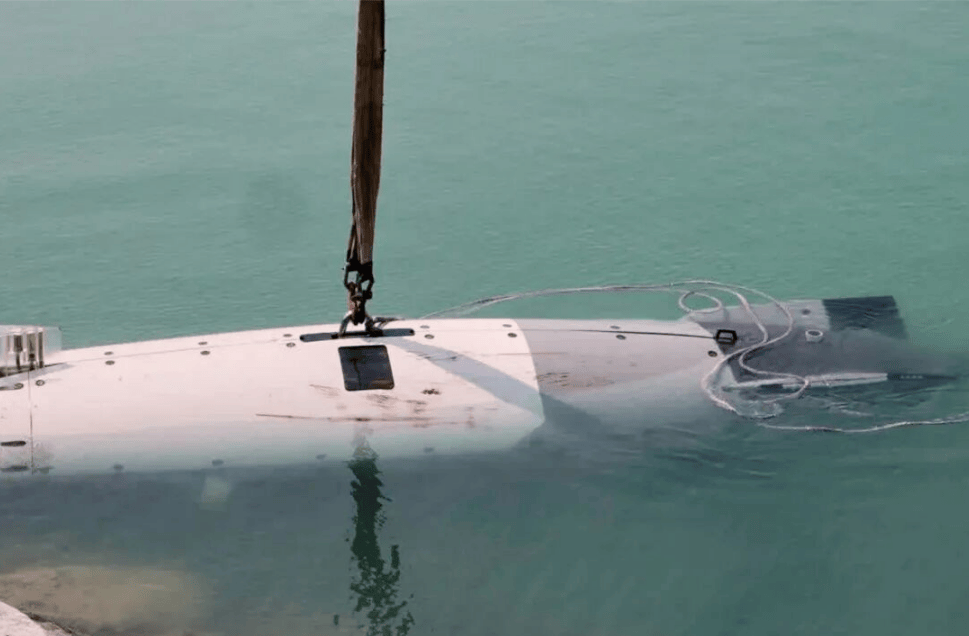
Iran announced the capture of the US military’s Dive-LD unmanned submarine.
The US military tests the performance and tactics of maritime unmanned equipment through actual combat
Before “capturing” the unmanned underwater vehicle Remus 600, Iran captured a US military Dive-LD unmanned underwater vehicle on September 8. The U.S. Central Command later responded that the submarine had a “malfunction” more than a day ago and did not carry any sensitive data or classified equipment.
Iran claimed that the Revolutionary Guards Navy captured the unmanned submarine at the entrance to the Strait of Hormuz through a “complex intelligence reconnaissance and combat operation.” The statement stated that the submarine uses relatively advanced underwater equipment technology and will be delivered to the US military in 2025. The Revolutionary Guards later released relevant information about the submarine, which showed that the equipment is a large autonomous underwater vehicle from the United States, about 5.8 meters long and weighing nearly 3 tons. It can operate continuously underwater for up to 10 days and can dive to a maximum depth of 6,000 meters. The submarine can be used to perform tasks such as underwater reconnaissance and surveillance, seabed mapping, mine detection, and support for anti-submarine warfare.
Dive-LD is a large autonomous underwater vehicle that can perform tasks such as mine countermeasures, seabed mapping, intelligence collection, and underwater infrastructure inspection. When Anduril, the company that developed the submarine, delivered the first submarine of this type to the U.S. Navy in April last year, it promoted that it was “the most reliable and flexible” and could operate under harsh conditions for up to 10 days.
After the incident, the US military tried to downplay its impact, saying that the unmanned submarine “failed” more than a day ago while performing a water reconnaissance mission in the Middle East to provide support for the war against Iran. In addition, a US spokesperson countered that the malfunctioning unmanned submarine was an “older model” and did not carry any sensitive data or confidential equipment, nor did it carry any confidential sonar or radar equipment.
“It’s an understatement on the surface, but that doesn’t mean it’s easy on the inside. These unmanned submarines are still advanced equipment for Iran and other countries, such as the high-precision sonar carried by the submarines,” Wang Yunfei said. “If Iran cracks the technical details of data return, sonar and other equipment, it will leak relevant secrets of the US military.”
Brian Clark, director of the Center for Defense Concepts and Technology at the Hudson Institute, an American think tank, believes that Iran will almost certainly try to dismantle the hardware of the captured U.S. unmanned submarine and “reverse engineer” the mechanical system. However, the software of the submarine has internal defense capabilities and is not easy to crack. “It could help the (Islamic Revolutionary Guard Corps) better improve its own designs,” said Farzin Nadimi, a senior fellow at the Washington Institute for Near East Policy.
Previously, Iran copied American RQ-170, MQ-1 and other drones after capturing them, and launched Iranian versions of the products.
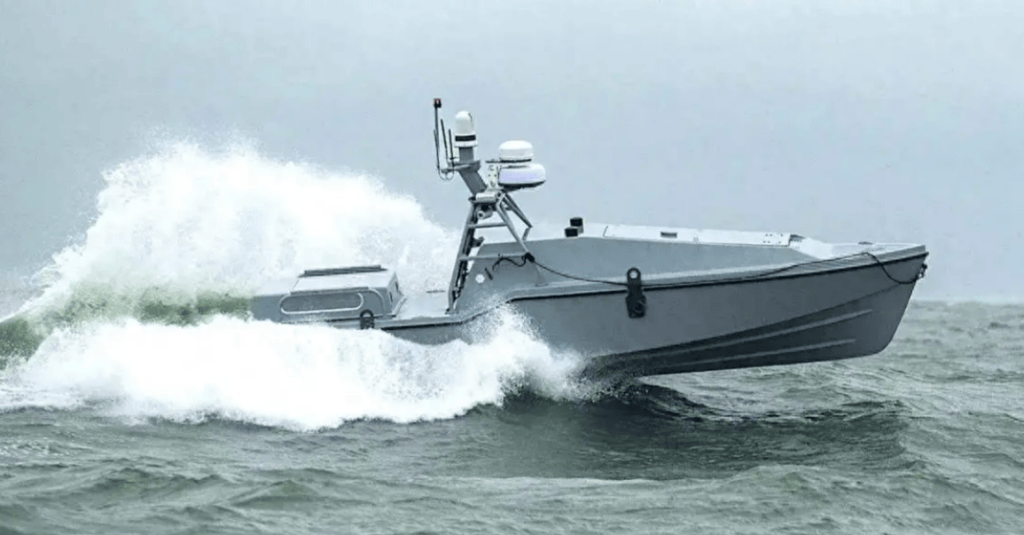
The American “Pirate” unmanned boat can carry different loads and perform different tasks.
Military expert Han Dong observed that from the first time the US military used a suicide unmanned boat to attack an Iranian port in actual combat to the continuous capture of unmanned submarines by Iran, the US military has increasingly used maritime unmanned equipment in military operations against Iran, and underwater covert warfare has been carried out quietly. On the one hand, the purpose is to reduce casualties in military operations; on the other hand, it tests maritime unmanned equipment and explores related tactics through actual combat.
At present, the United States has used maritime unmanned equipment, including unmanned boats, unmanned submarines, etc., in actual combat for the first time in its military operation against Iran.
The U.S. Central Command posted a video and post on social media on July 13 saying that in the early morning of that day, the U.S. military used unmanned sea boats to attack Iran. This is the first time the U.S. military has used maritime unmanned boats in actual combat. The U.S. Central Command stated in a post that the U.S. military used multiple “one-way attack unmanned surface vessels” to “successfully attack an Iranian submarine and ship maintenance facility.” Three “pirate” unmanned surface vessels hit the port of Iran’s Bandar Abbas naval base.
According to the video posted by the US military, the US military surface unmanned ship rushed towards the Iranian target, and then a violent explosion occurred.
The “Pirate” unmanned vehicle is an unmanned surface vehicle (USV) developed by the American company Saronic. The boat is about 7.3 meters long, has a maximum speed of 35 knots, a payload of about 453 kilograms, and a range of up to 1,000 nautical miles. It has autonomous navigation capabilities and can perform various tasks such as monitoring and reconnaissance. After modification, it can be loaded with explosives and become a suicide unmanned boat.
It is reported that the US military is investing heavily in unmanned naval systems, including underwater and surface ships, hoping to monitor vast sea areas, collect intelligence, and track enemy ships and submarines without putting soldiers at risk at a lower cost.
“After the end of the Cold War, the U.S. military has hardly encountered a stronger opponent. This war against Iran is a rare opportunity for the U.S. military to test new equipment and new tactics, and it deserves attention.” Wang Yunfei said.
Related Reading
- Many places “limit height limits” on individual money2026-09-30
- Original It’s hard to get a ticket for the National Day in Yading, Daocheng. Someone offered 500 yuan to grab a ticket. The cultural and tourism department responded.2026-09-30
- Private hospitals put dental supplies on the table2026-09-30
- US “Starship”‘s first Earth orbit flight ends early2026-09-29
- Ahead of rare execution, lone woman on Tennessee death row says ‘I am at peace’2026-09-29