Every reporter|Liu Xuqiang Every editor|Zhang Jinhe Liu Yanmei
The transformation picture of “switching between old and new”
The annual list of the top 500 private enterprises is not only a change in corporate revenue rankings, but also a reflection of regional economic vitality.
On September 22, the All-China Federation of Industry and Commerce released the “Top 500 Chinese Private Enterprises in 2026” list, and the provincial territory was announced simultaneously.
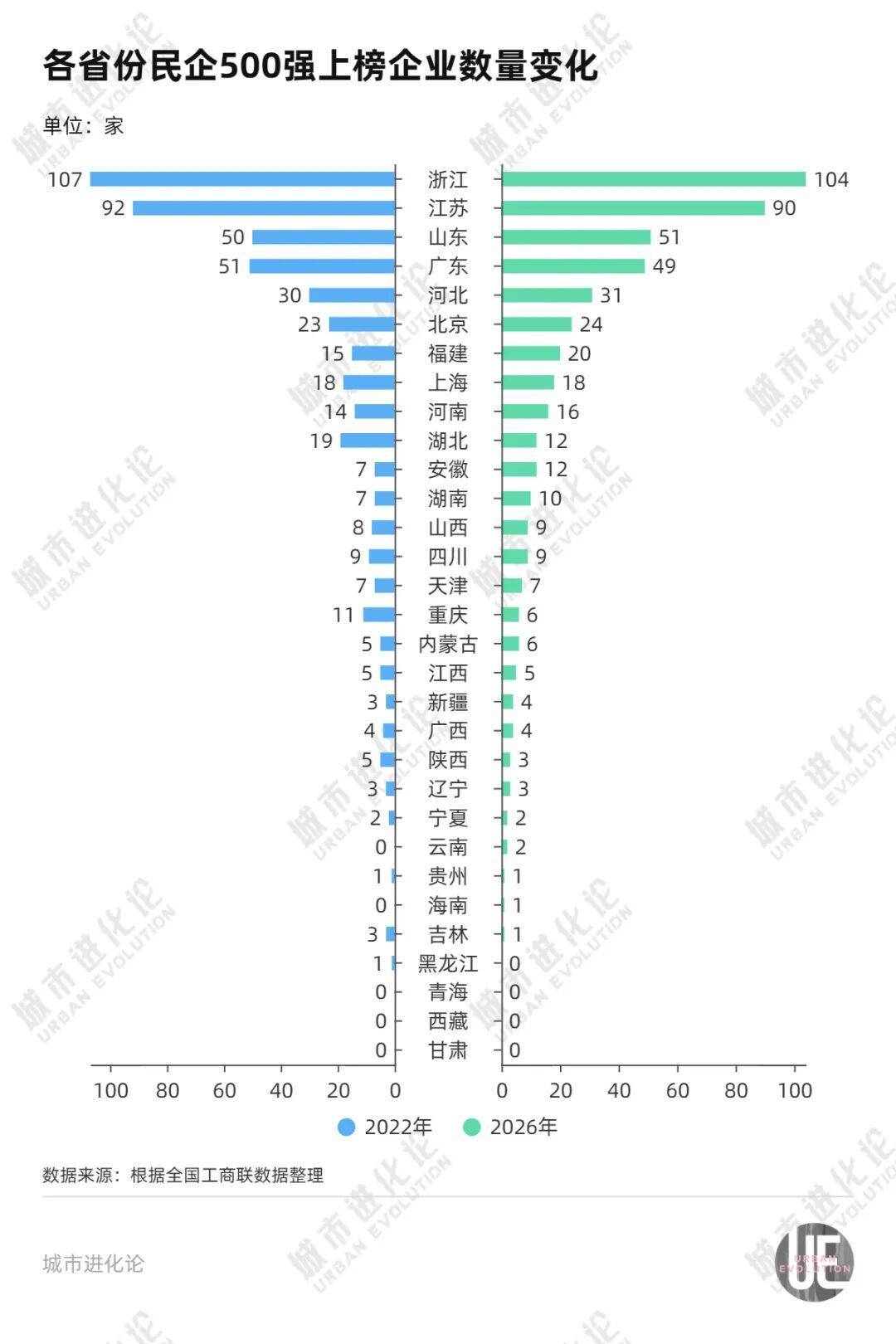
Among them, Zhejiang, Jiangsu, Shandong and Guangdong rank among the top four in terms of number of companies on the list, accounting for over 60% of the total. Looking at the longer term, from 2022 to 2026, Zhejiang, Jiangsu, and Guangdong will each lose 2 to 3 companies, while Shandong will increase by 1 company. The overall head pattern is relatively stable.
The bigger changes are in the midstream. In the past five years, the number of companies on the list in Fujian and Anhui has increased by 5 each, making them the provinces with the fastest progress; while Hubei and Chongqing have decreased by 7 and 5 respectively, becoming the regions with the most “blood loss”.
Between the advancement and retreat of the list, a transformation picture of the regional economy’s “new and old switching” is emerging.
01
頭部競速
In the past five years, the total revenue of the top 500 private enterprises has increased from 38.32 trillion yuan to 44.93 trillion yuan, an increase of 17.2%; the members of the “100 Billion Club” with revenue exceeding 100 billion yuan have increased from 87 to 110, showing a significant expansion trend.(Note: The years in the article are all the years the list was released. Each annual list is sorted and shortlisted according to the company’s revenue in the previous year. For example, “2026 revenue” refers to the list data released in 2026, which corresponds to the company’s 2025 revenue. The same below.)
However, the entry threshold for the top 500 companies has dropped from 26.37 billion yuan in 2022 to 25.60 billion yuan in 2026, not rising but falling. The revenue scale has become larger and the entry threshold has become lower – which means that growth is mainly concentrated in leading companies.
This is equally clear at the provincial level.
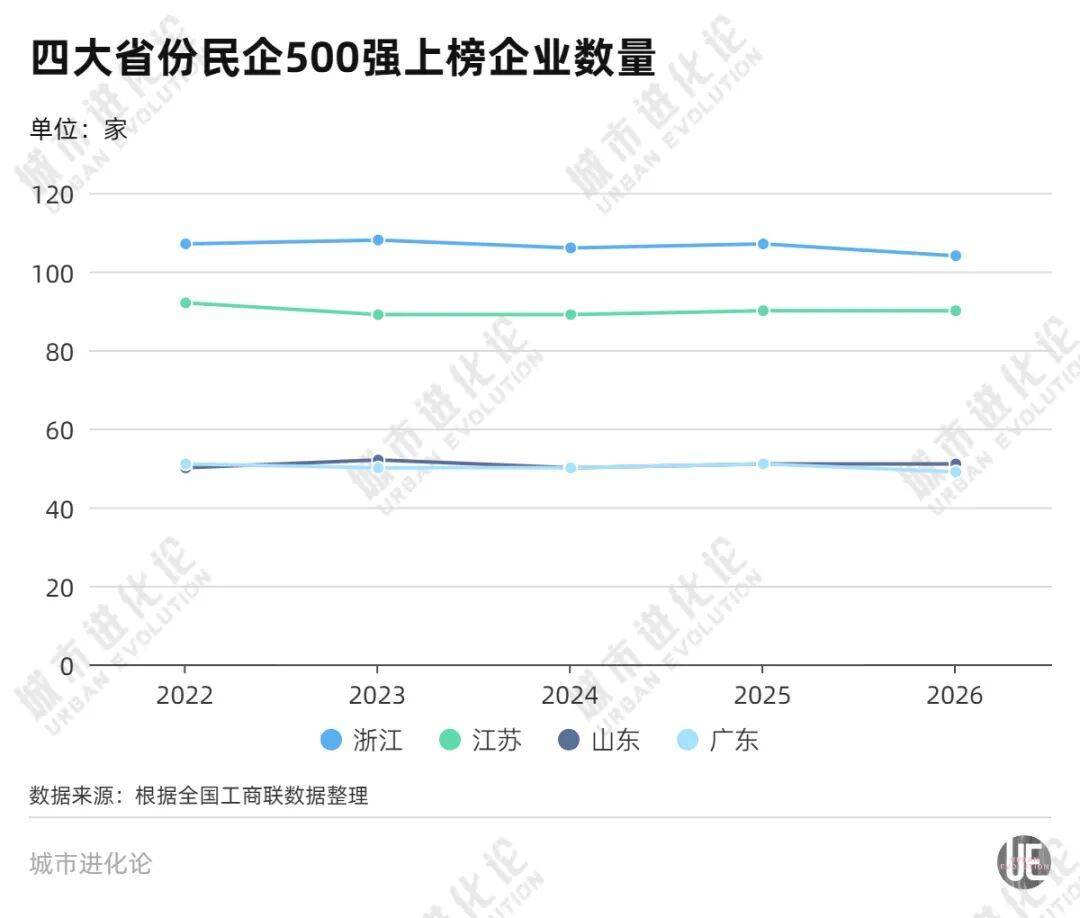
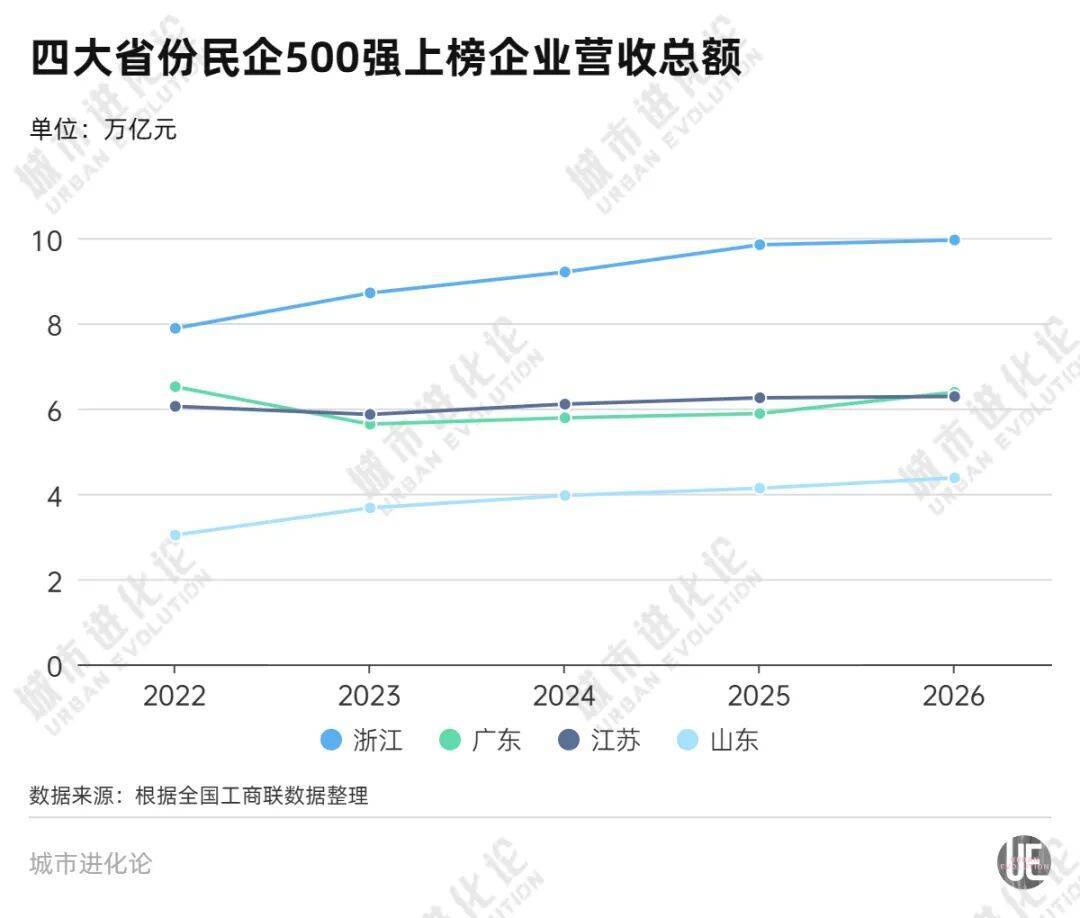
Zhejiang, which has long ranked first in the country in terms of the number of companies on the list, has slightly dropped from 107 to 104 in the past five years; but its total revenue has increased from 7.88 trillion yuan to 9.95 trillion yuan, an increase of 26.3%, and per household revenue has increased from 73.6 billion yuan to 95.7 billion yuan. The members of the “100 billion club” have increased from 18 to 23.
Followed by Jiangsu, the number of companies on the list decreased from 92 to 90 during the same period, the total revenue increased from 6.05 trillion yuan to 6.28 trillion yuan, and the per household revenue increased from 65.8 billion yuan to 69.8 billion yuan. However, the number of members of its “100 billion club” dropped slightly, from 13 to 12.
More pressure comes from behind. Data from the 2026 list shows that Guangdong’s 49 shortlisted companies achieved revenue of 6.38 trillion yuan, overtaking Jiangsu’s 90 companies and 6.28 trillion yuan in one fell swoop. The comparison of per household revenue is even more disparate: Guangdong’s is 130.1 billion yuan and Jiangsu’s is 69.8 billion yuan, a difference of nearly double.
Both are provinces with large private economies, but there are obvious structural differences between Guangdong and Jiangsu. Guangdong is mainly driven by a few super enterprises, while Jiangsu relies on the support of huge medium-sized enterprises.
The latest data shows that the combined revenue of Huawei, BYD and Tencent reached 2.44 trillion yuan, accounting for nearly 40% of the total revenue of the companies on the 2026 list in Guangdong; the total revenue of the 13 “100 billion club” members was 4.54 trillion yuan, accounting for about 71%.
In comparison, the total revenue of 12 companies worth 100 billion yuan, including Jiangsu Hengli, Shenghong, Shagang, Hengtong, and Zhongtian Iron and Steel, was 3.10 trillion yuan, accounting for less than 50%. In addition to the 100 billion echelon, a large number of tens of billions of private enterprises are densely distributed, and the industrial landscape spans petrochemical, steel, textile, new energy, medicine, logistics and other tracks.
Let’s look at Shandong again. The number of companies on the list has increased from 50 in 2022 to 51 in 2026. It seems that there is only one more company, but the total revenue has increased from 3.03 trillion yuan to 4.38 trillion yuan, an increase of 44.5%, which is the most prominent among the four provinces.
Echoing this is the huge expansion of the 100 billion echelon: from 5 to 12 companies, an increase of 7 companies in five years, which has equaled Jiangsu (12 companies) and is approaching Guangdong (13 companies). Behind this, petrochemical companies such as Hongrun Petrochemical, Luqing Petrochemical, Qicheng Petrochemical, Jingbo Holdings, and Fuhai Group have intensively broken through the 100 billion line, forming the main force in this round of expansion in Shandong.
02
增量冠軍
In the iteration of the list, the echelon differentiation of waist provinces is accelerating. From 2022 to 2026, the number of companies on the list in Fujian increased from 15 to 20, and in Anhui from 7 to 12. The two places each had a net increase of 5 companies on the list, ranking first in the country in terms of increase.
Judging from the total revenue during the same period, Anhui increased from 250.05 billion yuan to 538.44 billion yuan, and Fujian increased from 839.98 billion yuan to 1.59068 billion yuan. The growth rates of the two major provinces reached 115.3% and 89.4% respectively, ranking among the top in the country.
What is more significant is that the two provinces have taken two different growth paths.
The characteristics of chain breakthroughs in Anhui’s hard science and technology are relatively prominent. Comparing the list of private companies on the list in 2022 and 2026, Anhui has added 7 new companies including Sungrow, NIO, Guoxuan Hi-Tech, Shannon Core, iFlytek, Tiankang Group, and Lingtong Group, as well as Wenyi Group(real estate), Lu’an Iron and Steel(鋼鐵)Two companies in traditional fields have withdrawn from the list.
Between advances and retreats, almost all growth momentum is concentrated in emerging industries: Sungrow, NIO, and Guoxuan High-tech have strung together a complete new energy industry chain of “photovoltaic equipment-new energy vehicles-power batteries” to form an industrial cluster effect of upstream and downstream collaboration;
iFlytek and Shannon Core are supporting the industrial echelon of artificial intelligence and semiconductors, forming the second main line of growth.
Fujian has embarked on a diversified growth model of “manufacturing chassis + consumer brands + global trade”.
Comparing 2022, in 2026 there are nine new companies in Fujian including Luckin Coffee, Wanchen Biotechnology, Pupu Technology, Fuyao Glass, Zongteng Network, Yibai Group, Minhai Energy, Shengyu Investment, and Jinrhodium Metal. At the same time, two real estate companies, Fuxin Group and Mingcheng Holdings, and Sanan Group in the LED field will withdraw.
Analyzing the list of new companies, Fujian’s incremental structure presents a clear hierarchy:
With the existing “hard-core” manufacturing industry, CATL’s revenue jumped from 130.4 billion yuan in 2022 to 423.7 billion yuan in 2026. It has single-handedly significantly increased the revenue level of private enterprises in Fujian Province. Fuyao Glass has been shortlisted for the top 500 camp, further strengthening Fujian’s leading advantage in high-end manufacturing;
There are also new highlights on the consumer side. Three new consumer brands, Luckin Coffee, Wanchen Biotech, and Pupu Technology, are on the list, marking the rise of new consumer formats in Fujian from scattered growth to maturity;
At the same time, it has consolidated its traditional advantages on the trade side. Logistics and supply chain trading companies such as Zongteng Network, Yibai Group, and Shengyu Investment have been shortlisted, fully unleashing Fujian’s talent to deeply explore global trade by relying on the “Maritime Silk Road” and overseas Chinese merchant networks.
03
結構轉型
While the number of the top 500 private enterprises in Fujian and Anhui is growing rapidly, the private enterprise landscape in Hubei and Chongqing is undergoing a major “blood change.”
Hubei has experienced the most dramatic decline, from 19 companies to 12 companies, with a net loss of 7 companies. It is the province with the largest decrease in the number of companies in the country from 2022 to 2026.
In the exit list, Sunward Holdings, Golden Horse Triumph, Xinqi Construction, Xinba Construction, and Xinten Construction almost all have real estate-related brands. They once “sailed” into the top 500 companies by riding on the east wind of urban development, but also collectively faded out amid the in-depth adjustment of the industry.
However, while Hubei’s private real estate sector is “ebbing”, new trends are also coming. According to the latest list, circular economy track companies such as GEM New Materials and Xinzi Renewable Resources have successfully made the list.
The change in Chongqing was equally dramatic, with the number of companies falling from 11 to 6, a net decrease of 5 companies. Among the eight companies that exited, five were related to real estate, namely Jinke Investment, Dongyin Holdings, Zhongang Investment, Chongqing Huayu, and Chongqing New Oupeng. It was almost a collective departure of real estate private enterprises.
In the vacated position, Thalys, Zongshen Group, and OPPO (Chongqing) manufacturing companies took over to fill the position.
Compared with Hubei and Chongqing, which still have new forces filling their positions between advances and retreats, Shaanxi has been more like a continuous “one-way contraction” in recent years.
In recent years, the list of companies in Shaanxi has been reduced from 5 to 3, and the list remains at LONGi Green Energy, Taisheng Shenghe and Rongmin Holdings. Xi’an Maike and Dongling Group, which once supported the appearance of private enterprises in Shaanxi, were both 100 billion-level enterprises and the most prosperous signs of Shaanxi’s private economy. Now they have both entered bankruptcy and reorganization.
It is worth mentioning that LONGi Green Energy, which remains on the list, also briefly touched the 100 billion threshold. However, the photovoltaic industry is under pressure, and now LONGi’s green energy revenue has fallen back below 100 billion yuan. At this point, the “100 billion club” of Shaanxi private enterprises has returned to zero again.
The ups and downs of leading private enterprises in Hubei, Chongqing and Shaanxi provinces actually reflect the switching of local industrial momentum. When the old industry recedes, only new momentum can take over to avoid “retreating but not advancing” and regain admission in the next round of regional competition.
記者|劉旭強
編輯|Zhang Jinhe Liu Yanmei Du Hengfeng
Related Reading
- ICE officer who shot man in Austin was issued a body cam but wasn’t wearing it2026-09-23
- Xueshan closes its doors and refuses visitors, and “black climbers” fall into a vicious circle2026-09-23
- Financing gaps, climate change and cross-border transmission: the “last mile” of malaria elimination in a small West African country2026-09-23
- Asian Games2026-09-23