By Courtney Rozen
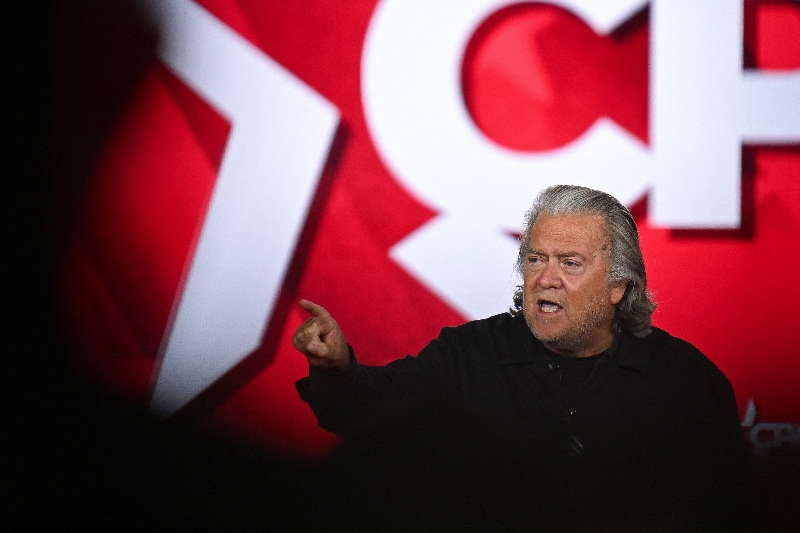
WASHINGTON, Sept 15 (Reuters) – Progressive U.S. Senator Bernie Sanders and Steve Bannon, a close ally of President Donald Trump, called on Tuesday for restrictions on AI systems, uniting two political adversaries around concerns that the technology will harm humans.
The two were due to appear at the same Washington gathering as concern about AI’s risks spreads beyond Washington and Silicon Valley.
Speaking first, Sanders, a self-described democratic socialist, warned about the “growing threat” of AI and said the industry needed to be regulated with binding safety rules.
“AI has the potential to eliminate tens of millions of jobs, wiping out entire professions and making it harder for our young people to enter the workforce.”
He added, “As many scientists believe could happen, this technology will escape human control with potentially catastrophic consequences.”
Sanders drew applause from the room when he criticized tech executives for centralizing control over AI technology, including SpaceX CEO and former Trump adviser Elon Musk.
“Last month, we learned that AI has been used for the first time ever to create new viruses. In the wrong hands, this could lead to new bioweapons and a potential global pandemic that could lead to the deaths of tens of millions of people,” Sanders said.
Bannon, a former White House strategist during Trump’s first presidential term, has criticized Trump’s approach to overseeing AI, placing the blame for the president’s unwillingness to regulate the technology squarely on tech companies. On his Monday podcast, Bannon said Congress should not pass laws that prohibit states from enforcing their own rules for the technology.
UNLIKELY BEDFELLOWS
The decision of Sanders and Bannon, who are on opposite ends of America’s ideological divide, to speak at the same gathering on Tuesday underscores how concerns over AI and data centers are cutting across party lines and producing unlikely political bedfellows.
Trump on Monday downplayed concerns expressed by industry leaders over the weekend about the misuse of artificial intelligence harming people, saying the U.S. already has guardrails in place for the powerful technology.
Backing Trump’s position on Tuesday, Republican U.S. House Speaker Mike Johnson said there cannot be a moratorium on artificial intelligence development without losing the competitive edge to China and that AI companies can regulate themselves.
“They can self-regulate. They don’t need the government to tell them to slow it down. If they want to slow it down, they should,” Johnson told reporters.
The view that regulations will harm U.S. companies’ ability to compete with their Chinese counterparts is shared by tech executives, including Nvidia CEO Jensen Huang.
Recent surveys have found majorities of Americans worry the technology could be used to eliminate jobs, raise costs for families or otherwise cause social harm.
BACK FROM RECESS
The U.S. House of Representatives ended its long summer break on Monday, with members in the House and Senate holding private conversations about whether or not to legislate on AI, especially after Trump said there was no need for legislative action.
Congress has been criticized in the past for lacking the collective expertise to rein in or regulate technology companies.
Speaking to Reuters, Republican Senator Bernie Moreno of Ohio said, “This process of legislating takes so long. Imagine AI four years in. We’re dealing with stuff that isn’t even relevant in four years.”
Residents in several states have also challenged proposals for new data centers, a critical component of the AI boom. According to a Reuters/Ipsos poll published in June, 77% of Americans worry AI-driven data centers will raise electricity costs.
Anthropic researcher Jacob Coxon captured public attention last week when he said he resigned from the company, in part because the “people building AI earnestly believe that it could kill us all by the end of the decade.”
Also on Tuesday, Andrew Ferguson, the chairman of the U.S. Federal Trade Commission, expressed suspicions over AI companies seeking antitrust exemptions while they also lobby for new regulations.
Reuters previously reported that U.S. senators are debating a bill that would block states from enforcing their own laws governing certain risks posed by AI models. Previously, efforts to restrict state AI laws failed in the U.S. Senate.
Sanders and Bannon addressed the same event as AFL-CIO President Liz Shuler, who leads the largest federation of labor unions in the U.S.
Sanders, along with House progressive Rep. Greg Casar, has called for the U.S. to pass legislation halting development of AI tools that are capable of “overthrowing or undermining the U.S. government,” until the government creates a new agency to police the technology. Casar and Sanders have not released specifics.
(Reporting by Courtney Rozen. Additional reporting by Tim Reid and Richard Cowan. Editing by David Gregorio and Nick Zieminski)