You still have to build a “gas truck” without qualifications, and make a profit at a loss?
190
Produced by Huxiu Automobile Group
Author|Yang Jie
Title picture | Photographed by Tiger Sniff
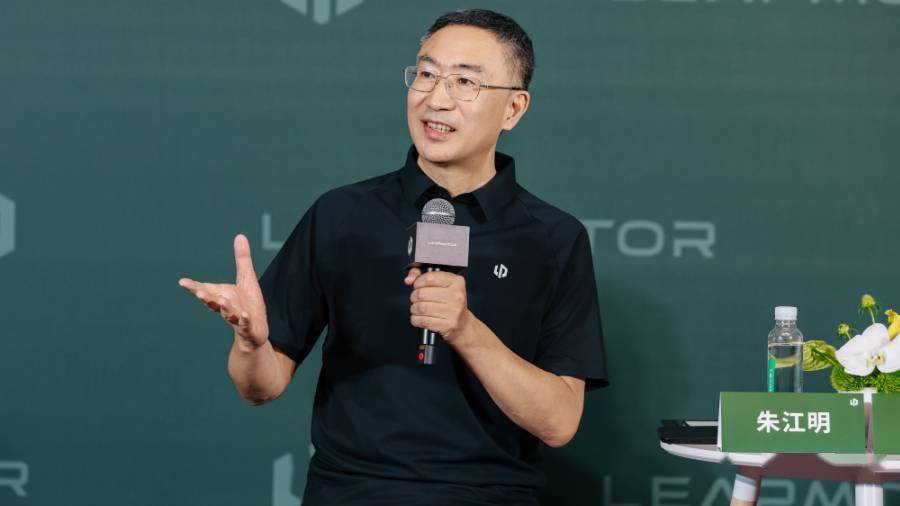
On September 16, 2026, Leapmotor released the LEAP5.0 architecture and three core technologies. Among them, the debut of the MM-i multi-mode hybrid electric drive marks Leapmotor’s official entry into the plug-in hybrid track, completing the full power layout of pure electric + extended range + plug-in hybrid. In the follow-up group interview, Zhu Jiangming further confirmed to Huxiu that the production line of this technology has been launched.
But one key fact is ignored by almost everyone:Leapao does not have the qualifications to sell plug-in hybrid vehicles in the Chinese market.

According to the current “Automotive Industry Investment Management Regulations”, vehicle investment projects are divided into two categories: fuel vehicles and pure electric vehicles. Plug-in hybrids are classified as fuel vehicle investment projects because they “use engines to provide driving power”; extended-range models are classified as pure electric vehicle investment projects because they “solely use electric motors to provide driving power.” The new forces hold basically “pure electric passenger cars (Including range-extended electric passenger vehicles) qualification as a “production enterprise” and is not legally qualified to produce plug-in hybrid vehicles.
In this regard, the relevant person in charge of Leapmotor exclusively confirmed to Huxiu: “This hybrid will be the first to be installed on overseas models. The main body of overseas models is Leapmo International Joint Venture, which is not affected by qualifications. The relevant domestic production qualifications are being applied for.。”
This means that Leapmotor will not be able to sell plug-in hybrid models in the country in the short term. However, Zhu Jiangming repeatedly emphasized in the interview that “plug-in hybrid technology is actually quite applicable in China.”
Combined with the above industry background, Zhu Jiangming’s words are more like a public expression of regret.
It invested heavily in building production lines and doing research and development in a domestic market that it could not enter. This matter is somewhat puzzling when it comes to any car company, but if you look at the global market structure, the logic of zero running becomes clear.
Hooking up is the final puzzle for going overseas
The first basis for Leapbo to be a plug-in hybrid is hidden in the export data of Chinese cars.
Dataforce statistics show that throughout 2025, China’s plug-in hybrid exports to Europe will increase by 155% year-on-year, while pure electric vehicle exports will grow by only 12% during the same period. In June 2026, the market share of Chinese brand plug-in hybrid models in Europe reached 34%, a record high.One out of every three new plug-in hybrid cars sold in Europe is from a Chinese brand.
虎嗅制圖
Leapmotor has also benefited from the wave of export dividends from Chinese car companies going overseas. In the first half of 2026, it exported 96,294 units, a year-on-year increase of 372.6%, exceeding the total export volume in 2025, accounting for 27% of total sales.
From this point of view, although it cannot be sold in the Chinese market in the short term, the logic of Leapao is completely smooth as it adds a plug-in hybrid puzzle for overseas markets.
However, it should be noted that the prospects for Chinese car companies to export plug-in hybrid products overseas are being cast a shadow of uncertainty.
The European Commission has launched a countervailing investigation into China’s plug-in hybrid vehicles and is preparing to add additional PHEV import tariffs on top of the existing pure electric tariffs. Morgan Stanley’s research report pointed out that after PHEV was exempted from the pure electric vehicle tariff measures in 2024, its proportion of China’s automobile exports to the EU has increased from 6% in 2024 to 28% in the first seven months of 2026. The EU will most likely plug this gap.
If relevant policies are implemented in the future, it will definitely pose a substantial threat to the plug-in hybrid exports of Chinese car companies, but the impact on zero-running vehicles will be different.
Unlike other Chinese companies, the main body of Leapao’s products exported overseas is Leapao International Joint Venture. The export business of Zero Run is not affected by China’s domestic production qualifications, and it also follows Stellantis’ European localization system at the trade policy level.
虎嗅制圖
More importantly, Lingpao’s response strategy is to produce locally rather than simply export. The Zaragoza plant in Spain has completed supporting transformation; the C10 plant in Kedah, Malaysia has begun mass production; the Goiânia plant in Brazil has been selected as the South American assembly base.
In other words, when the EU is discussing restrictions on “imports”, Leapmotor is already using Stellantis’ factories to build cars locally in Europe. The policy of restricting imports cannot affect a car company produced in Europe. Of course, Lingpao also has to share profits equally with the joint venture partners, so the income is even lower, but fortunately it is not affected by the “exorbitant taxes and miscellaneous taxes” in overseas markets.
Who does Lingpao want to be?
If we only look at the dimension of “the Leap-Moon brand sells plug-in hybrid vehicles overseas”, the business logic of this decision is still fragile. Although Stellantis’ channels are open, Leapmo’s awareness in Europe is far lower than that of local car companies such as Opel and Peugeot. It will take time for overseas users to accept the new brand.
Zero run executive team
In this regard, Huxiu believes that,The real driving force for Leopao to become a plug-in hybrid lies in the external supply of technology. This is also a key turning point for Leopao to break away from its identity as a car company.
Zhu Jiangming took the initiative to mention the two companies in the group interview. He said that Apple can deeply control the supply chain. It has no factories and nothing, but all orders, materials and components are placed by itself, calling it the “ultimate model.” Then he said that Samsung “has the entire industry chain, and is the world’s number one in mobile phones. It has its own screen, its own storage, and its own SOC.” Leappo should absorb their advantages.
Looking at the current situation, Lingpao’s technology outsourcing strategy is precisely pushing it towards Samsung.
According to Huxiu’s understanding,Leapao has launched platform-level cooperation with FAW and Stellantis, and the cooperation project with FAW has entered mass production.Core components such as battery packs, electric drives, controllers, and lights can all be developed, manufactured, and “packaged” by Leapmo to be provided to partners.
In this regard, the relevant person in charge of Leappo Auto also mentioned to Huxiu that platform-level packaging is a new supplier model for Leapao to test the water. It is somewhat similar to the implementation model of Huawei Smart Driving, but our threshold is lower and we can save one or two thousand yuan in core component costs for at least one vehicle for our partners.
In addition to FAW, the Opel brand under Stellantis has also recently announced relevant plans, saying that it will cooperate with Leapao to develop a pure electric C-class SUV. The new car is planned to use the core components and battery technology of Leapao’s electric architecture.
Huxiu believes that before the release of MM-i plug-in hybrid technology, the only power solutions that Leapoo can provide to these customers are pure electric and extended range.The underlying logic behind Lingpao’s plug-in hybridization is that it can effectively make the technology outsourcing business bigger and stronger.
However, when laying out plug-in hybrid technology, the following three challenges are also key points that Leapmotor cannot ignore:
Challenge 1: Completely ceding the domestic market to competitors
Qualification restrictions related to the domestic market have indeed allowed Leapao to avoid head-on competition with BYD and Geely in the domestic plug-in hybrid market, but the other side of bypassing is giving up.
Looking at the current situation, although the domestic plug-in hybrid market has declined by 27.6% year-on-year and is shrinking, the annual scale is still more than 2 million units. Liepao has no qualifications, which means that this market has nothing to do with it, and it cannot sell a single car.
More importantly, the domestic production qualification is “under application.” The subtext of this sentence is that Lingpao itself does not know when or even whether it will be approved. Before the qualifications were obtained, Leapbo plug-in hybrid was a product line that only had overseas markets, and its fault tolerance space was narrower than that of other Chinese brands.
Challenge 2: Stellantis’ “protection” comes at a cost
As mentioned earlier, the main body of Leapao’s products exported overseas is Leapao International Joint Venture, which uses Stellantis’ European localization system and is indeed not affected by China’s domestic qualifications. But Stellantis is not a philanthropist. It chose to cooperate with Leapao because Leapao’s platform architecture is “more cost-effective” and can help Stellantis “launch electric vehicles faster with lower capital investment.”
Once Stellantis’ own electrification capabilities catch up, or a cheaper alternative is found, Leapmotor’s role in the joint venture may be marginalized. The ownership structure of Lingpao International means that the fate of Lingpao in overseas markets is ultimately decided by Stellantis.
Challenge 3: It is difficult for Leapmoon brands to establish irreplaceability
When Hongqi uses the Zero Running frame to build cars, and when Opel uses the Zero Running platform to build SUVs, what is the irreplaceability of the Zero Running brand? This is also the issue that Leapao needs to pay most attention to as a complete vehicle company.
Take Samsung, which Zhu Jiangming compared to himself, as an example. Samsung’s mobile phones have their own screen, their own storage, and their own SOC, but Galaxy mobile phones can never beat Apple in the high-end market. The reason is simple,Samsung sold its best screens to Apple. Apple used better system integration and brand premium to earn 62% of the high-end market share, while Samsung itself could only take 20%.
It can be seen that mastering the core upstream links does not mean mastering the premium ability of the terminal brand.The more successful Leapao is in outsourcing its technology, the harder it will be to establish a differentiated label for Leapao brand vehicle products.
In other words, every time a platform is exported to an OEM, the scarcity of the Leap Run brand decreases by one point.
虎嗅制圖
In order to see clearly the prospects of Leapao entering the plug-in hybrid market, we can use the industry’s public parameters to deduce how the MM-i project will affect Leapao’s income statement. Assume that the total fixed investment in the R&D and production line of this plug-in hybrid system is 1.2-1.6 billion yuan, amortized over 5 years, with annual fixed amortization of 240 million to 320 million yuan, and the supporting production line design capacity is 150,000 units/year.
虎嗅制圖
If the annual sales of overseas models equipped with MM-i are only 50,000 units, the production line utilization rate is only 33%, and the amortization of a single vehicle is as high as 4,800-6,400 yuan, the heavy fixed costs will directly eat up the gross profit of the vehicle; if the sales volume increases to 100,000 units, the utilization rate is close to 67%, the single vehicle amortization will be directly halved; once the design production capacity exceeds 150,000 units, additional capital expenditure will be required to continue to increase the volume.
According to Huxiu’s estimation, Leappo’s complete LEAP platform + MM-i hybrid package is packaged for external supply. The value of the bicycle is about 18,000-26,000 yuan, and the gross profit margin of the external supply business is estimated to be 12%-18%, which is higher than Leapao’s own vehicle business.Calculated based on this range, if the external supply order reaches 60,000 units, most of the MM-i R&D amortization can be absorbed.
However, the shortcomings of external supply are also prominent: the fate of orders is tied to the performance of FAW, Stellantis and other partners’ models. If customer products cannot be sold, the expected benefits of external supply will be lost.Whether the MM-i plug-in hybrid can be profitable is ultimately a matter of scale. Only when self-owned overseas models are combined with externally supplied assemblies are simultaneously increased in volume, can this system be expected to transform from a cost burden into a source of profit; otherwise, high amortization will continue to weigh on the profit statement.
說到底,The zero-escape game of “unqualified gangsters” is essentially a forced roundabout escape.It’s just that in this transformation with an uncertain future, the stakes are huge, the window period is extremely short, and there is not much time left for trial and error.
Return to the homepage to see more car information
Related Reading
- Original: Was the last time you wore leather shoes last year at the annual meeting?2026-09-20
- Can price cuts bring Zhong Xuegao back to life?2026-09-20
- The price has been reduced from the highest price of 66 yuan to 6 yuan 9. Can Zhong Xuegao be loved again?2026-09-20
- The century-old store is sold! Tens of billions of transactions, do you want to play games instead of soy sauce?2026-09-20
- Evergrande Automobile, which does not make cars, has a gross profit of 500,000 yuan in half a year2026-09-20