
“Placing orders on behalf of others” to make profits from illegal products cannot stop at blocking.
DingjiaoOne (dingjiaoone) team
Author | Wang Hanxing
Editor | Ruan Mei
The takeaway was delivered, but the customer said he didn’t receive it.
In mid-August, a Meituan delivery rider in Changle, Fuzhou placed the food at the elevator entrance according to the order notes, took a photo and sent it to the customer, clicked it to be delivered, and then left to deliver the next order. But within ten minutes, the platform customer service contacted him and said that the customer had not received the meal and hoped that he would return to the site to help find it.
When the rider rushed back to the delivery location, the food was gone and the phone number reserved by the customer could not be reached. From the order records, there are no abnormalities in the delivery time, location and photos. At first, it looked more like an ordinary dispute over lost takeout.
But the rider soon discovered that other riders on the site had experienced similar situations. At the same address, there have been repeated refund requests that were clearly delivered but were complained about not being received. After checking with nearby merchants, he found that the merchants had encountered similar situations. The meal delivery and delivery processes were complete, but they continued to receive complaints about missing meals.
So the rider reported the situation and chose to call the police. The day after the police report was made, another takeout order of 166 yuan appeared at the address. By analyzing the transaction data, Meituan identified the source of the problem and cooperated with the police to attend the scene. A man who was about to pick up food noticed an abnormality and tried to leave. He was eventually controlled by the police in the corridor.
This stay became a breakthrough in the case. Through data analysis and judgment, the police in Changle, Fuzhou identified a seven-member cross-provincial gang. The suspects posted a “50% off takeout” advertisement on a second-hand trading platform, placed orders for buyers, and after the food was taken away, applied for a refund on the grounds that “the food was not received.” The gang has committed more than 2,500 crimes, involving more than 400,000 yuan, affecting 21 provinces and cities across the country.
In fact, the “overlord meal” black product in the takeout industry is not an isolated case. In recent years, illegal “ordering on behalf of” businesses with highly similar techniques have appeared in online ride-hailing, hotels, fast food, parking payment, gift cards and other fields. They rely on second-hand trading platforms to attract traffic and make use of the transaction and after-sales rules of different platforms to make profits at no or low cost.
These behaviors not only harm the interests of merchants, riders and consumers, but also make the platform face an ongoing problem: how to identify those who take advantage of the rules to make profits while retaining the convenience that normal consumers need?
01. From food delivery to online ride-hailing, “ordering at low prices” is being replicated across industries
The case of Fuzhou Changle’s “50% discount for placing orders on behalf of others” is actually not as simple as it seems on the surface. It is cleverly stuck on the nodes of platform monitoring, amount setting, information security, and even human nature.
Dismantling this agent ordering industry chain can be divided into five links: traffic drainage, account number, crime, realization, and spillover.
First, on the traffic side, criminals deliberately choose second-hand trading platforms where consumers are more receptive to low-priced goods. Consumers who pursue cost-effectiveness are accustomed to looking for discounts on such platforms, which not only saves criminals the cost of attracting traffic, but also makes large discounts less abnormal.
After posting an “Agent Ordering” advertisement to attract buyers on a second-hand platform, the next step is to register an account with a virtual number, reserve a false contact number, and deliberately write the delivery address as a vague location such as the gate or elevator entrance.
This is the case for the order received by a food delivery rider in Changle, Fuzhou. The order requires that the food be placed in the elevator without providing a specific house number, and the rider is required not to make a phone call after the delivery. This makes it impossible for the rider to determine the specific location of the buyer, and cannot find out in time that the contact number reserved by the other party cannot be reached when delivering the food. When after-sales disputes occurred afterwards, no one could be found and the phone could not be reached.
In addition, the order amount is also particular. At the time of the incident, two takeaways ordered consecutively from the same address were stuck in the price range of 166 yuan. A consumer placed an order for a 166-yuan takeout on a second-hand trading platform at half the price. After the takeout was taken away, the criminal gang applied for a refund from the platform on the grounds that the food was not received, and realized the cash.
During the entire process, the “half price” amount paid by consumers was the net profit of the criminal gang. The criminal gang placed the order at the original price and applied for a full refund, without actually bearing any transaction costs. But for participants on the food delivery platform, the cost of food delivery for merchants, delivery costs for riders, and information service costs for the platform have all been incurred.
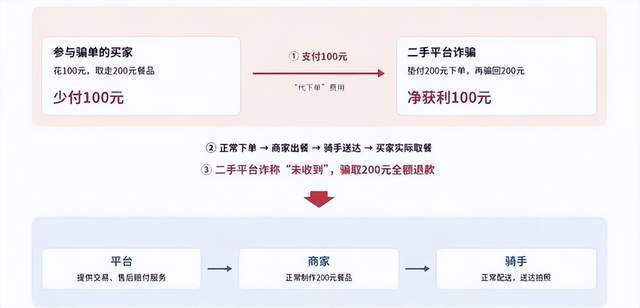
Schematic diagram of the fraud order process picture source / Xiao Tuan has something to say
In most cases, it is ultimately up to the food delivery platform to take the lead and bear the losses.
Similar incidents of malicious refunds and fraudulent claims have been common in the food delivery market in recent years. A takeout platform disclosed a case in May this year. After receiving a drink, Zhang put a pre-prepared flying insect carcass into the cup to take pictures, and then threatened the merchant with compensation on the grounds of food safety issues. He committed five consecutive crimes in a short period of time, making an illegal profit of more than 10,000 yuan, and was later criminally detained on suspicion of extortion. In July last year, a man placed an order three times on a food delivery platform, and then applied for a refund on the grounds of “not being delivered to the designated address” and “the product was lost”, thus making illegal profits. He was administratively detained by the police for 10 days on suspicion of fraud.
From individual behavior to gang crimes, to mature black industry, some people have turned normal takeout transactions into a tool to fraudulently obtain refunds. This kind of black product that makes profits by placing orders at low prices also appears in more consumption scenarios.
In the online ride-hailing industry, some people place orders for passengers through purchased accounts by posting “low-price taxi-hailing” advertisements. After the passenger completed the trip, he transferred the discounted fare to the ride-hailing agent, but the latter kept the fee as his own, abandoned his account, and no longer paid fares to the platform and the driver.
Similar routines have also appeared in the hotel industry. In a case handled by the Shanghai Putuo District Procuratorate, Luo discovered that some hotels’ breakfast write-off procedures were not strict, so he fabricated room numbers and names of guests and sold high-end hotel breakfast rights at low prices on second-hand platforms. Breakfast, which originally cost several hundred yuan, was sold at prices ranging from 10 yuan to 70 yuan. After investigation, Luo made a total of 143 illegal sales, involving 23 hotels, and was eventually prosecuted for fraud.
These cases are distributed in different scenarios, and the details of the crimes are not exactly the same, but the methods are highly consistent: first attract consumers on second-hand trading platforms with services that are significantly lower than normal prices, then use false account numbers, virtual numbers, forged information or platform after-sales rules to complete the transactions, and finally pass on the costs to the platform, merchants, drivers or riders.
02. In a low-price business, who bears the losses?
On the surface, this kind of illegal arbitrage is about a certain commodity, but in essence it is consuming the trust that society relies on to operate.
Going back to the “50% discount on ordering takeout” itself, in the end the platform paid for the whole thing. It seemed that the platform borne all the economic losses. But in addition to financial losses, performance disputes can incur other costs.
It takes time for the delivery rider to return to the site to look for meals and check the situation with the site and merchants.
The merchant has delivered the meal, but still has to respond to disputes about the order. Even if no compensation is ultimately required, the verification itself takes up energy from normal operations.
Consumers may not be the ones who really take advantage. When purchasing the “50% off ordering” service, buyers often need to provide unknown sellers with information such as address, phone number, dining preferences, etc. Some people don’t even know that after receiving the meal, the seller will apply for a refund as “meal not received”. Once personal information flows into the black industry chain, the subsequent risks are not limited to a takeaway order.

Chat records of the second-hand platform of the ordering group. Source / Fujian No. 1 Gangtuan
The longer-term impact may fall on all normal users.
If malicious refunds continue to increase, in order to control risks, the platform may increase the refund threshold, increase manual review, or tighten some convenient services. Consumers who really lose their meals will have higher rights protection costs; those who really need to place orders on their behalf may also be restricted.
Of course, just because the platform bears direct losses does not mean that the platform only has to wait passively for problems to occur. Fast refunds and contactless delivery are the product designs of the platform to improve transaction efficiency and user experience. While the platform enjoys the efficiency improvements brought by these mechanisms, it also needs to bear the corresponding risk control costs.
The difficulty is that by opening a second-hand trading platform, you can easily search for a large number of coupon transfers related to local life, takeout, and e-commerce, or low-priced goods for resale.
In addition, there are a large number of individual sellers on second-hand platforms, complex transaction types, different identities and sources of goods, making risk identification difficult. Even if some illegal sellers have their accounts disposed of, they may re-register their accounts and continue similar transactions.
This makes the management of food delivery platforms such as Meituan more difficult. Since the traffic and transactions of illegal products occur on different platforms, relying solely on the takeout platform to identify abnormal refunds cannot cover the entire illegal product chain. Second-hand trading platforms also need to strengthen the review of relevant risk information and establish more sophisticated identification and disposal mechanisms for abnormal behaviors such as frequent account changes and batch release of similar information.
Another reason that illegal products can exist for a long time and spread to various platforms cannot be ignored is that the main participants on the platform, such as consumers, riders, and merchants, have relatively simple information, and it is difficult to identify the complete illegal product chain on their own.
For example, in the Fuzhou Changle case, the criminal gang involved more than 2,500 orders scattered across 21 provinces and cities across the country. The total number seems to be a lot, but it may be just an accidental dispute if it falls on a single rider or a single merchant. Riders and merchants may not be able to discover the correlation between these orders in their busy daily operations and delivery.
The buyer may just think that he has bought a discount and is not aware of the refund operation behind it. The combination of these conditions explains why this type of business can appear repeatedly in different places.
It can be seen that the management of illegal products cannot completely rely on consumer identification or riders and merchants to prevent themselves. Platforms with more relevant information are indispensable for proactive management.
03. How does the platform maintain the balance between convenience and security when cracking down on illegal products?
The case of “ordering at 50% discount” was finally solved because of the joint action of multiple links.
Front-line riders discovered repeated abnormal refunds at the same address and linked the scattered orders; the food delivery platform conducted risk control research and judgment through orders, addresses, notes and after-sales records, and provided evidence to the police; the police then targeted gang members through cross-regional investigations and closed down the network uniformly.
During this period, Meituan’s immediate risk control identification and interception of relevant accounts and orders is a key step. Compared with individual riders and merchants, the platform can aggregate more transaction information and help law enforcement officers save a lot of investigation time and cost. After locking in problematic orders, Meituan also arranged dedicated personnel to ensure the smooth progress of investigation and research and judgment, and assisted the police in fixing the chain of evidence and locking in gang members.
According to Meituan, in response to malicious refunds, malicious claims and other behaviors, the platform has established a set of “intelligent identification-no liability exemption-complaint cover” protection mechanism. The system will first determine whether the dispute is caused by the rider based on behavioral characteristics such as ordering, delivery, and claiming compensation. Orders that are judged to be non-rider responsibility will automatically be exempted. For complex scenarios, riders can still submit evidence for manual review.
This mechanism can minimize the economic losses of riders and merchants in disputes. For fraud that has already occurred, the platform can also cooperate with law enforcement agencies to conduct follow-up investigations.
Public data shows that throughout 2025, Meituan cooperated with local public security agencies to investigate 30 cases of extortion and malicious claims, arresting more than 50 people. In the past year, it has used risk control technology to help catering businesses intercept and recover losses of 95 million yuan.

Meituan rider Xiao Chen Photo source / Fujian No. 1 Gangtuan
In recent years, food delivery platforms and law enforcement agencies have stepped up efforts to control gray and black products and safeguard the legitimate rights and interests of riders and merchants. However, in addition to continuously reducing the losses caused by malicious behaviors, the platform also faces a bigger problem: how to avoid accidentally injuring normal users?
Abnormal orders often have the appearance of normal transactions. An order that requires food to be placed at the elevator entrance may be because the user is really inconvenient to answer the phone; a high refund may also be a real delivery problem. If the platform simply tightens all after-sales channels, ordinary consumers will ultimately bear the price.
Placing an order on your behalf is not an original sin in itself. The elderly do not know how to use mobile phones, and their children order a meal for their parents; colleagues order meals together, and one person places the order. These are all normal needs. What really needs to be cracked down on are the gangs that use fake accounts, falsified facts and malicious refunds to make profits.
Therefore, the focus of governance should not just be to make refunds harder, but to make fraud harder.
In this process, the capabilities of the fulfillment platform are limited. It can identify abnormal refunds, but it may not understand all the communications between buyers and sellers who place orders on their behalf; the second-hand trading platform can see transaction information, but it may not know that a refund has been applied for for a delivered takeout. What different subjects see is only part of the transaction.
Therefore, a smoother clue collaboration mechanism needs to be established between different platforms. Black products are diverted on one platform, traded on another platform, and then monetized through malicious refunds. If each platform can only handle the part of the chain it sees, even if a gang is eliminated, similar patterns may still be quickly copied.
Consumers also need to re-understand services that are significantly lower than normal prices. 50% off takeout, 30% off taxi rides, and high-end hotel breakfasts worth tens of dollars may seem like discounts given by others, but they may actually come from stolen accounts, fictitious rights, or malicious refunds. When the price is so low that it does not comply with normal business logic, cheapness itself may be a risk reminder.
50% off takeout, who will pay in the end?
In the short term, the platform bears the loss of refunds, and riders and merchants have invested time and energy; in the long term, if this type of illegal products cannot be curbed, normal consumers may also suffer from stricter after-sales rules and higher transaction costs, and pay for the arbitrage of illegal products.
The convenience of society is based on trust, and the destructive power of black and gray products precisely destroys this trust. While cracking down on black industry for profit, we must also eradicate the soil that breeds illegal industry from the source. This is the direction that future platform governance needs to continue to work hard.
Related Reading
- Nvidia live updates: Nvidia stock falls as exuberance fades after Jensen Huang’s return as CEO2026-11-25
- Original: Huang Renxun “Xi Fei returns to the palace”, Nvidia surges by 6 trillion overnight2026-11-24
- iQiyi, countdown to delisting2026-11-24
- “Don’t ask, the gold bars are really sold out.”2026-11-24
- Nvidia live updates: Jensen Huang reinstated as CEO; Trump says he ‘convinced’ board2026-11-24