01. Shocking reversal, Huang Renxun’s “Return of the King”
In the past week, Nvidia, the global computing power hegemon, lost its soul and its stock price plunged into a deep hole due to panic selling. However, no one expected that in just 11 days, founder Huang Renxun would “return as the king.”
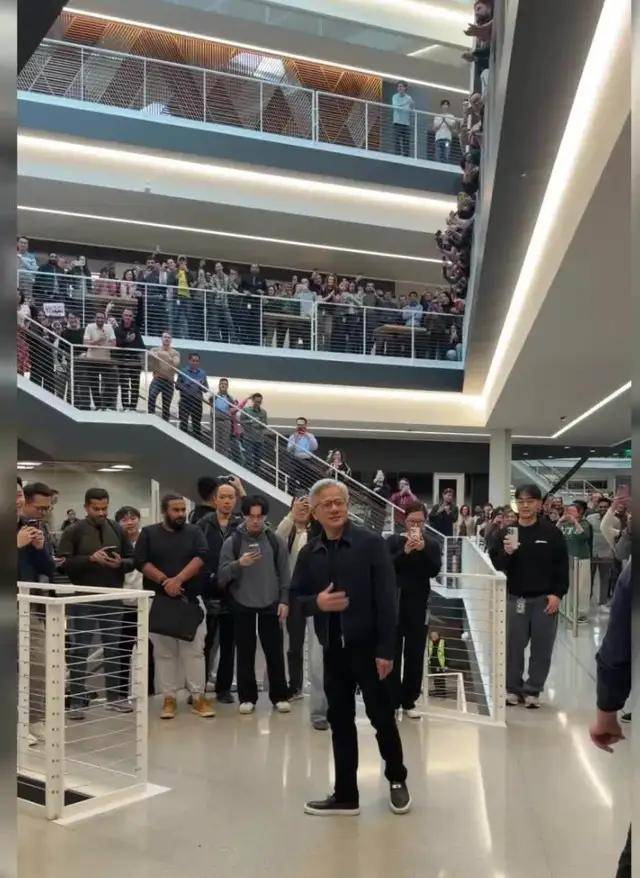
On the evening of November 23, Nvidia issued an announcement announcing that Huang Jensen was unanimously reinstated as president, CEO and director. The situation that originally had no room for maneuver underwent a shocking reversal. After the announcement of the news, it completely detonated the Internet, and many topic words rushed into hot searches.
Affected by this news, capital that had been suppressed for many days poured in instantly, and Nvidia’s stock price rose sharply. It finally closed at $165.05, a surge of 31.48%, recouping all the losses since November 13. NVIDIA’s market value surged by US$952.4 billion overnight, reaching US$3.98 trillion. NVIDIA’s stock price performance also completely ignited U.S. technology stocks and took Nasdaq flying. Some netizens lamented: “It’s absolutely amazing. Over and over again, those who are short and long are getting rich.”
What is even more incredible than the reversal in stock price is the almost 180-degree turn by Nvidia’s board of directors. Just 6 days ago, on November 17, the chairman of NVIDIA’s board of directors was still tough and decisive, saying he “does not intend to reinstate Huang Renxun.”
It only took 11 days from the initial announcement of his resignation that shocked Silicon Valley to his reinstatement. In the history of corporate governance of modern technology giants, it is rare to see such a violent self-overthrow: In these 11 days, what kind of wrestling happened inside and outside the poker table?
Turning the clock back to the beginning of the turmoil, as personal disputes triggered a crisis of public opinion, Huang publicly apologized and submitted his resignation. On November 12, the board of directors quickly approved his departure and quickly appointed a temporary successor.
At that time, the general judgment on Wall Street was that the founder of Nvidia for more than 30 years had reached the bleakest end of his career, but Huang Renxun obviously did not accept the script of being out.
November 17th became a subtle window for the first round of public confrontation between Huang Renxun and the board of directors. On the one hand, the board of directors issued a cold statement of “not considering reinstatement” and tried to completely close the door; on the other hand, Huang Renxun issued a very tentative personal statement on the same day.
In this statement, Huang Renxun kept his stance very low. He admitted his mistakes, promised to cooperate with all investigations, and even stated that his decision to leave or stay would be entirely left to the board of directors. He also mentioned that even though he has resigned, the company’s employees, major customers and investors are still contacting him continuously.
As the tug-of-war over Jen-Hsun Huang’s decision to stay has entered deep waters, U.S. technology stocks as a whole have suffered heavy losses. Trump has publicly expressed his support for Jen-Hsun Huang, directly pushing this internal corporate governance turmoil into the spotlight.
At first, signals from high-level officials in the U.S. government made the market feel that Huang’s return was hopeless. Just the previous week, U.S. Treasury Secretary Bessent severely criticized Nvidia in a public program, calling for the company to undergo a “substantial reorganization” and clearly suggesting that the next leader should come from “outside the company.”
However, as the turmoil in the computing power supply chain intensified and the government began to assess “national security risks,” Washington’s tone underwent a decisive reversal on the eve of his reinstatement.
On November 22, the day before the reinstatement announcement was issued, Bessant was once again asked about his position on “external coaching selection” in an exclusive interview with CBS. This time, the U.S. Treasury Secretary made a dramatic political turn: “I said they should look for someone from the outside, but he (Huang Jen-Hsun) is now outside.”
A sharp witty remark knocked down the last wall in front of Huang Renxun. However, Bessant also left a backup plan, emphasizing that the chain of responsibility has not yet been clarified. “It depends on whether the responsibility stops at the bottom, middle level, or goes all the way to the top.” He also expressed confidence in Nvidia’s internal committee to quickly provide robust investigation results.
The door that was originally closed by the board of directors quickly cracked open. On November 23, the reinstatement announcement was issued, and Nvidia rarely confirmed in official language that the decision was made after multiple rounds of in-depth discussions.
It can be said that these 11 days of extreme comeback only revealed half of the story.
02. There are many interests to consider behind the return of the helmsman.
During these 11 days of stalling, there were still huge crowds of people anxiously waiting for his return because of their own interests and fears.
The first to settle this account were NVIDIA employees at the Silicon Valley headquarters. November 18th became a day when anxiety within Nvidia was concentrated: the night before, Nvidia had just handed over a strong financial report, which would normally be enough to ignite the market. However, Nvidia, which lost its helmsman, closed down 2.89% that day, at $150.96.
On the same day, the first “No Huang Renxun” all-staff meeting was held, and as many as 700 employee questions were collected before the meeting. Among such questions, employee compensation tops the list, followed closely by management transparency.
To this end, the interim CEO had to come up with an emergency plan: start salary increases in advance and increase the amount of equity incentives. But for Nvidia employees, the temporary issuance of additional chips cannot calm their uneasiness. Two days later, on November 20, Nvidia’s stock price plunged a further 14% to $125.53.
A deeper sense of weightlessness comes from the break in daily work order. Darrell Dai, a robotics research engineer who chose to resign, specifically mentioned Nvidia’s iconic “Top 5 emails” in his public statement: In the past, regardless of rank, front-line engineers could regularly send the five most important things directly to Huang Jen-Hsun, eliminating the need for lengthy middle-level reporting and filtering.
After the incident, Darrell Day confessed that he “no longer felt heard.” For these people, after they are accustomed to a flat system where the No. 1 position directly makes decisions and runs at high speed, they cannot accept that their company has fallen into the management quagmire of a traditional large factory.
In contrast, Wall Street capital’s calculations are louder and their differences are more open. Liao Kaiyuan, a well-known individual major shareholder, gave the most decisive statement and directly announced that he would stop additional investment and deeply tied the retention of real money to Huang Renxun.
In the eyes of many retail investors, a considerable proportion of the high valuation given to Nvidia by the market is due to Huang Jen-Hsun’s founder’s premium. Once it loses this backbone, Nvidia may face the price of falling in valuation from an AI empire to an ordinary cyclical hardware manufacturer at any time.
In fact, in the 11 days since Huang Renxun left, Nvidia went through a curve with a huge stock price shock. On November 20, Nvidia fell 14%, and the Nasdaq itself also fell 5.3%.
Other institutions have a more prudent consideration. Institutional investor Ben Preston bluntly stated that Huang Renxun’s return may not automatically solve the business problems facing the company.
In addition to employees and shareholders, what really makes the “coach change” difficult is the incalculable replacement cost of the entire computing power industry ecosystem.
As the core node of the global AI infrastructure, the upstream and downstream industries and even the delicate policy communication interfaces established around export controls are highly dependent on Huang Renxun’s personal approval and credit endorsement. For them, if Nvidia hesitates strategically due to changing CEOs, the entire ecosystem may bear immeasurable costs of delay.
Under the desire and dependence of many parties, the board of directors finally chose to compromise. However, in order to hedge against the compliance costs of bringing back the founder, and in response to U.S. Treasury Secretary Bessent’s words to “find out where the responsibility lies,” Huang’s return was subject to a layer of strict institutional constraints.
According to the reinstatement announcement on November 23, the independent investigation into the previous controversy will continue to advance. Jones will remain as chairman to maintain independent checks and balances on the board of directors. The company has also established a new oversight committee focusing on national security and export control, and launched the recruitment of a chief compliance officer.
In the past, Huang Renxun has long been accustomed to sending emails directly to his desk, driving his trillion-dollar empire to run wildly with absolute authority. Now, he must return to the helm and prepare Nvidia to weather the next storm, under the watchful eyes of multiple compliance committees and pending investigations.
Related Reading
- Nvidia live updates: Nvidia stock falls as exuberance fades after Jensen Huang’s return as CEO2026-11-25
- iQiyi, countdown to delisting2026-11-24
- Original 50% off takeout, who will pay?2026-11-24
- “Don’t ask, the gold bars are really sold out.”2026-11-24
- Nvidia live updates: Jensen Huang reinstated as CEO; Trump says he ‘convinced’ board2026-11-24